Hewitt Award Nominee

“President Obama will negotiate with the Syrian butcher Assad and erase his red line, will capitulate to Vladimir Putin, and he will negotiate with the happy face of the killer regime in Iran, President Rouhani, but not with Republicans over issues all presidents have always negotiated over,” – Hugh Hewitt. (Award glossary here.)

It’s worth noting Hewitt’s constant lies. What president has ever “negotiated” repealing a duly enacted law because one faction in one House has decided that it will shut down the government and destroy the US and global economy if he doesn’t? When has such a thing ever happened before? What are the Republicans offering in return? Nothing but the maintenance of basic government functions. As Ponnuru has noted:

Many [House Republicans] want to force President Barack Obama to make major changes to his health-care law, and in return give him nothing but the debt-limit increase. There is no precedent for the satisfaction of such demands.

In contrast, Hewitt baldly states that all presidents have always done this. Hewitt is not a fool, just one of the most shame-free liars and propagandists in the public arena. And he intends to keep lying, to keep calling this the Democrats‘ shutdown, to keep repeating lies until they can gain some patina of truth among his followers.

Who’s Blamin’ Who?

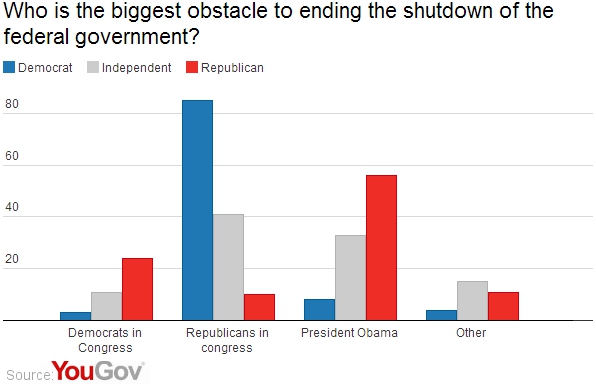
Shutdown Obstacle

YouGov’s latest:

The latest research from YouGov, conducted in the first two days of the shutdown, shows that half (50%) of Americans blame Republicans in Congress for the continuing shutdown. 11% blame Democrats in Congress while 29% blame President Obama for not ending the shutdown. This divides along partisan lines, with Democrats tending to blame Republicans and Republicans tending to blame the President or Democrats. Independents, however, are largely split, with 41% blaming Republicans in Congress and 33% blaming the President.

I’d find the narrow split among Independents unnerving, if I were the president. 33 percent blame the president for the shutdown and impasse? Given that he has already conceded sequester-level spending, and has cut the deficit in the last three years by the swiftest amount since the end of the Second World War, what else do they want him to do? If he were to abandon his signature domestic achievement after re-election, because of blackmail, we might as well give up on elections and representative government altogether. All round, this does not seem to me as a battle either side will “win” as such. Right now, as Harry Enten notes in a review of the polls, “no side is winning, one side is just losing by less”:

More Americans disapprove than approve of the job being done by all three actors in the dispute over the federal budget. President Obama comes out “ahead” in the ABC News/Washington Post poll with a -9pt approval rating. Both parties in Congress are much lower. Democrats in Congress manage to maintain a net approval of -22pt, while Republicans in Congress fall to a -37pt approval rating. These are all awful. …

A new CNN/ORC poll puts the net favorability rating of the Democratic party at -9pt: its lowest since CNN started asking the question in 2006. Republicans, too, are at their lowest level since 2006 as well, with -30pt favorability. A large portion of the difference between the parties’ favorability is that Tea Party supporters are less likely to hold a favorable view of Republicans than Tea Party opponents are of Democrats.

Meanwhile, Weigel highlights a Fox News poll with some bad numbers for Republicans. This one – compared with the last Fox News poll – stood out to me:

A tumble in the GOP’s favorable rating to 35–59, with 59 percent unfavorable marking the highest level in the history of the poll.

Of course that just might be the Tea Partiers frustrated that the GOP isn’t being radical enough in bringing the government and the economy into collapse.

Can You Get Axed For Loving A Kids Show? Ctd

A reader writes:

Excellent post that raises a really interesting issue – one on which I am torn. It really sucks that someone lost their job for such a trivial reason, but is the problem that employers can fire at will, or that we have created a labor market where losing a job with a shitty employer is so traumatic?

I am a total corporate guy who is a huge fan of universal healthcare because it could materially increase labor mobility and reduce the risk of leaving (or being asked to leave) a job.  I really think that the free market could be a much better mechanism to punish shitty employers than any regulation.  Want to fire people for their tastes in art and literature?  Fine, but good luck maintaining a workforce that will actually make you more profitable.  Employee, want to leave that draconian employer?  No big deal: you can find a new job and not worry about your health care.  Raise the cost of turnover and reduce the employee’s risk of job loss and employers will lose the incentive to fire capriciously and employees will be able to say “fuck you” and move on to greener pastures.

And hopefully make more “I quit!” videos like the awesome one above.

Who Knew Airline Safety Videos Could Be So Entertaining?

Based on yesterday’s MHB, which featured a parody of a safety video and then an update from a reader with a hilarious video from Delta, another writes:

My favorite airline safety video is this one from Air New Zealand [seen above]. It’s called The Bear Essentials of Safety.

Another reader:

I think Virgin America has one of the cutest and funniest in-flight safety videos – especially the part about how to operate the seat belts.

Another points to an “extremely cute” one from First Choice in the UK. And another:

This is my favorite cheeky airline video, from Mexico’s discount Volaris airlines.

Update from a reader:

The new Delta video you showed is cheeky, but a lot of us frequent fliers have a place in our heart for the so-called “Deltalina” video from a few years back. (The star even has her own Wikipedia entry.) While the video hasn’t been shown in a while, she has a cameo in the new one you posted yesterday, with the famous finger wag after the admonition to not smoke.

Post-Partum Extinction

Video of yesterday’s police chase in DC:

Marshall defends the use of lethal force:

Given what was known and her behavior, it makes perfect sense to me that the Capitol Police and whatever other federal authorities were in the mix were focusing on threat elimination as their primary goal rather than apprehension. Even the attempts to get her to surrender were rebuffed.

I wouldn’t second-guess the cops for reasons Ambers lays out, but I hope this incident prompts us again to appreciate the need for more serious mental health coverage. Post-partum depression is an extremely serious illness – in this case, apparently untreated. Its victims – especially children – are manifold. And killing the mentally ill is always a tragedy.

What A Functional Republican Party Might Offer

Ramesh admits that the GOP’s debt ceiling demands are unprecedented:

Look back at every previous piece of legislation that raised the debt limit while also making changes to other government policies, and almost always the debt limit was the occasion for a bipartisan deal rather than the achievement of only one party’s goals.

As part of a debt-limit deal, he encourages Republicans to “offer a temporary increase in spending from the levels of sequestration in order to delay the time when the Internal Revenue Service starts fining people for not buying insurance.” His other suggestion:

[A] deal should include policies that minimize the potential damage of a future debt-limit standoff. The most important one would be a law stipulating that even if the debt limit is breached in the future, the government will still be authorized to make debt-service payments in full, taking a default off the table. Republicans in the House have already passed a bill that would come close to doing this. Once this change is enacted, hitting the debt limit would mean having a partial government shutdown — which isn’t great, but not the disaster a default would be.

Losing Judaism, Staying Jewish

Marc Tracy parses a new study that suggests that, despite popular belief, Jewish life in America is not in decline:

[A]s Jews increasingly tolerate intermarriage and focus on other signifiers—pride, religious participation, and above all child-rearing—some good news appears. Ninety-four percent of U.S. Jews are proud to be Jewish, says Pew, and three-quarters feel a “strong sense of belonging to the Jewish people.” Seventy percent attended a Passover Seder, and more than half fasted during Yom Kippur. Fewer than 20 percent are not raising their children Jewish to at least some extent; 59 percent are raising them Jewish by religion, although, again, this number is insanely divergent depending on whether the marriage is all-Jewish (96 percent) or interfaith (20 percent).

“The most important finding is that contrary to the lachrymose narrative of a declining, disappearing, vanishing Jewish population, there are many more people who say that they are Jewish, claim Jewish identity, and the vast majority [who] say it is their religion,” Leonard Saxe, a Brandeis professor and prominent Jewish-American demographics expert who consulted on the Pew survey, told me Tuesday.

Jessica Grose takes a different interpretation of the study, stressing that actual religious observance has dropped significantly:

[A]s we get further and further away from virulent anti-Semitism (according to the Pew Survey, 15 percent of American Jews say they have been called offensive names or snubbed in a social setting because they are Jewish, and Jews think other groups, like gays and Muslims, face more discrimination than they do), perhaps it is not surprising that fewer Jews are religious. Other people do let us forget who we are. Plus we don’t have to believe to be Jewish: Judaism, unlike Christianity, is passed down through blood. It’s also difficult to convert to Judaism, and we welcome questioning. Not exactly a recipe for creating generations of faithful devotees.

Gabriel Roth doesn’t despair:

For my grandchildren, the fact that some of their ancestors were Jewish will have no more significance than the fact that others were Welsh. That will be a real loss. But we should be realistic about what’s being lost and what isn’t. Here are some of the things I cherish about Jewishness:

unsnobbish intellectualism, sympathy for the disadvantaged, psychoanalytic insight, rueful comedy, smoked fish. Those things have been thoroughly incorporated into American upper-middlebrow culture. Philip Roth and Bob Dylan and Woody Allen no longer read as “Jewish” artists but as emblematic Americans; their influence is as palpable in the work of young gentiles as young Jews.

The loss of Jewishness as a meaningful identity in America is the kind of loss that occurs when individuals are free to engage in the pursuit of happiness. It’s the loss of something that has great meaning to many people and an important place in history but that is, essentially, tribal.

To that point, Douglas Rushkoff suggests  that “if we want to promote Judaism and its practices, we might need to transcend our rather primitive misconception of Judaism as a race”:

It was Pharaoh who first called the Jews a “people”. The notion of a Jewish bloodline didn’t emerge until the Inquisition as a justification for executing even those Jews who had converted. And it was Hitler (repurposing a bit of Jung) who called the Jews a race.

As I look at history and the Torah, Judaism isn’t really a religion at all, but a path beyond religion. It was developed by the equivalent of recovering cult members, as a way beyond the idolatry and death worship of Ancient Egypt. Instead of “believing” things, a disparate amalgam of tribes (those mythic sons of Jacob), developed a living myth together – as well as a system of law that could be amended as civilization evolved. Everything from the Sabbath to the US Constitution came out of these insights and this continuous process of revision and renewal.

By applying the techniques of the census taker to the Jewish people (a practice actually forbidden in Talmud – we’re not allowed to count ourselves) the would-be protectors of Judaism are practicing a dangerous game with diminishing returns.
When Being An Amateur Is An Advantage

In our final video from Martha Shane and Lana Wilson, they recall how their perceived inexperience ended up being an asset in the filming of After Tiller:

The documentary, which features the four remaining doctors who still perform third-trimester abortions in the wake of George Tiller’s assassination, opens today in Los Angeles and Toronto. It will continue to play in New York until October 8 and then open in many more cities across the country. Trailer here. Martha and Lana’s previous Dish videos are here. Our “It’s So Personal” series, in which readers share their experiences with late-term abortion, is here. Another reader writes:

I worked on a response to your abortion dissent, but a followup reader said it so much better than I ever could:

Is abortion ever immoral? This pro-choice advocate says: Of course it is. But there are many immoral things that are not illegal, and imposing the blunt instrument of the law on a complex moral decision is not going to help people make better choices. The sooner pro-life activists take legal bans off the table, the sooner we can have productive talks about effective programs to help people make better moral choices about abortion and reproductive issues generally.

I have a story to go with that comment.

Many years ago I lived in a house with multiple roommates. We selected a seemingly charming, successful graduate student to fill a vacancy, but within months it was clear she was seriously disturbed.  Any number of things (e.g., polite requests to clean up weeks worth of dirty dishes or to allow someone else to watch TV) triggered abusive, screaming diatribes and implied threats of violence.  We were so freaked out we all decided to move until one brave soul convinced us to band together and boot her out.  She smashed holes in the walls the day she left. If it happened today, I’d worry that she’d return with a gun.

During the year this woman lived with us, she had two abortions.  She also told us she was sloppy with contraception and had had several abortions in the past. It’s easy to argue that these abortions were immoral, but should that translate into law?  Do we want to force a woman like this (who might be unwilling to give up a child) to bear unwanted children at risk for serious abuse?  I’m uncomfortable when the left discusses abortion in terms of rights and when the right discusses it in terms of morality. It’s so much more complicated than that.