The GOP Doesn’t Know It’s Losing

That’s the suspicion of First Read:

Despite polls showing that more Americans are blaming Republicans than Democrats for the shutdown, and despite establishment Republicans admitting they aren’t winning this fight, conservatives aren’t backing down. In fact, they feel they have survived the fallout from the first few days. Case in point is Sen. Rand Paul’s (R-KY) admission in that hot-mic moment that “We’re gonna win this, I think.” Is that the reality of this standoff? Or it is simply due to the conservative echo chamber? After all, one of the major differences between the last shutdown (in 1995-1996) and now is the rise of FOX News, Drudge, and Breitbart News. As the New York Times recently wrote, “a fervent group of conservatives — bloggers, pundits, activists and even members of Congress — is harnessing the power of the Internet, determined to tell the story of the current budget showdown on its terms.” It explains why conservatives aren’t as convinced as many others are that this will do significant damage to the party.

Larison connects shutdown spin to the larger GOP misinformation problem:

Some Republicans are making all of the same mistakes that they made when they ignored all of the evidence suggesting that the GOP was likely to lose in 2012. Most of the time, the echo chamber hurts conservatives and Republicans by making them oblivious to inconvenient facts and ideas, but in this case it is leading them to believe in an alternate political reality with its own set of rules.

In a follow-up, he tackles Kristol’s latest nonsense.

Democrats’ Message Discipline

It could use improvement, starting with the ever-insufferable Harry Reid:

Drum face-palms:

Democrats need to have better answers, and they need to explain just why the Republican CRs are such contemptuous exercises in trying to gull the American public. … [Reid] sounds as though he’s comparing some furloughed civilian workers in his home state with kids who have cancer. Fair or not, that’s going to sound bad.

Weigel describes the current GOP strategy as “take credit for trying to save cancer kids from heartless Democrats”:

Reid had made a mistake—a gaffe, if you will. He could have said something about how his Democrats had passed several continuing resolutions that would have funded the NIH, or that the sequestration cuts also tagged the NIH, or that the Republican budget recommendations also cut back NIH funding, or that there were probably plenty of poor kids with TV movie ailments in states where Republicans had opted out of the Medicaid expansion—well, whatever, instead he rejected the premise and insulted the reporter. He did not actually say “I don’t care about kids with cancer,” but his partial quote was enough to make the Drudge Report, Hannity, and the rest of the reliable wurlitzers of conservative opinion.

Snowballing Dysfunction

Gleckman worries about the consequences of any surrender to economic and fiscal blackmail:

Just take a look at what’s happened to the Senate in recent years. Once, filibusters were rare exceptions. Now, they are constant. Nearly every bill, no matter how trivial, requires 60 votes for passage in a body that historically required a mere majority.

Similarly, presidential nominations are now routinely blocked for reasons only occasionally having to do with the qualifications of the nominee. Lawmakers have learned that they can take a nominee hostage in order to send an ideological message or convince an administration to change a regulation.

As a result, behavior that was once rare has become as routine as the Senate’s daily prayer. … I fear the same is about to happen with government shutdowns. Once those who would use the shutdown as a useful legislative lever succeed, it will become a tool of choice. True, it couldn’t be used in every circumstance, but there would be enough opportunities to make it the next filibuster.

Which is why the fightback for constitutional governance and political moderation begins now.

Why They’ll Die On This Hill

The Democratic group headed up by Stan Greenberg and James Carville has just put out a report on their recent focus group discussions with Republican voters. It’s a sobering read (pdf) – and definitely helps explain the primal scream now threatening to take down the entire American system of elective government.

Here, for starters, is the word cloud for what these voters say when talking in like-minded focus groups about president Obama:
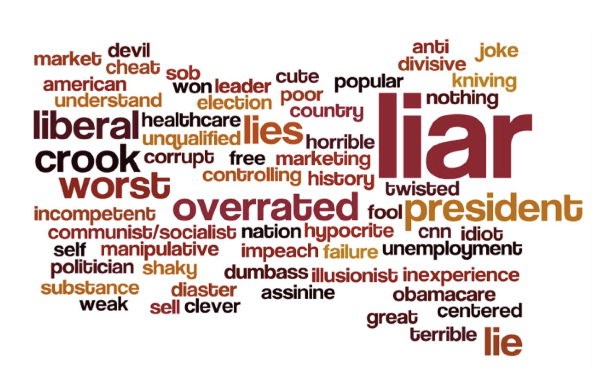
Screen Shot 2013-10-04 at 11.30.54 AM

The base Republican voters in these focus groups view themselves as besieged by minorities seeking free benefits, and see Obama as the Pied Piper of those hoping to abuse the system. They are not explicitly racist about the president or about the beneficiaries of the new goodies (though they had no such qualms during Bush’s Medicare D entitlement). But they believe they are losing an America that a Roanoke evangelical describes like this:

Everybody is above average. Everybody is happy. Everybody is white. Everybody is middle class, whether or not they really are. Everybody looks that way. Everybody goes to the same pool. Everybody goes – there’s one library, one post office. Very homogeneous.

This is the America they believe is being taken away from them. Some money quotes:

“The government’s giving in to a minority, to push an agenda, as far as getting the votes for the next time”. (Evangelical man, Roanoke)

“There’s so much of the electorate in those groups that Democrats are going to take every time because they’ve been on the rolls of the government their entire lives. They don’t know better.” (Tea Party man, Raleigh)

But this is the core conclusion of the study and why it helps us understand our current predicament – nothing represents their sense of loss and anger more powerfully than Obamacare:

When Evangelicals talk about what is wrong in the country, Obamacare is first on their list and they see it as the embodiment of what is wrong in both the economy and American politics. In fact, when asked what she talks about most, one woman in Colorado replied, “Obamacare, hands down, around our house.” In Roanoke, it was the first thing mentioned when asked “what’s the hot topic in your world?”

To participants in these groups, Obamacare “just looks like a wave’s coming, that we’re all going to get screwed very soon. ” (Evangelical woman, Colorado Springs)

“Obamacare’s just another intrusion on the Constitution … And I just – I’m appalled. I’m appalled by what’s going on in our country.”(Evangelical man, Roanoke)

“It’s putting us at the mercy of the government again.” (Tea Party woman, Roanoke)

“[Our rights] are slowly being taken away… like health care.” (Tea Party woman, Roanoke)

I’ve long argued that you have to see the bigger cultural and religious picture when analyzing what has happened to American conservatism these past two decades or so.

The bewildering economic and social and demographic changes have created a cultural and existential panic among those most heavily concentrated in those districts whose members are threatening to tear down the global economy as revenge for losing two presidential elections in a row. They feel they have already lost and have nothing to gain from any constructive engagement with a president they regard as pretty close to the anti-Christ of parasitic minorities. They feel isolated in a more multi-cultural country. They feel spied upon and condescended to. They have shut out any news sources apart from Fox. It does not occur to them, for example, that Obamacare might actually help them. And you get no actual specifics on policies they like or dislike. It is all abstractions based on impressions.

More to the point, the bulk of these Republicans no longer believe in the Republican party. They identify more strongly with the Tea Party or Evangelical groups or Fox News than the GOP. On social issues, the defining issue is homosexuality – not abortion. That intransigence will alienate them them even further from the future mainstream. Their next big issue: denying climate change. Right now, I see no way to integrate these groups and people into the broader body politic or conversation. Their alienation is so deep it is close to unbridgeable. And further defeats will make their isolation worse, not better, their anger more, not less, intense.

This is the deeper crisis we face – and without strong economic growth, it is hard to see how it can be ameliorated in the near future. Perhaps if moderate Republicans – a mere quarter of the whole – jumped ship to the Democrats, then the electoral losses would be so great as to demand some kind of reform. But the center is not holding. And I fear it will get even worse than this until it gets better.

Except it’s hard to imagine political dysfunction getting worse than risking the first ever default by the Treasury of the United States because a key minority feels “disrespected.”

Why The President Won’t Cave

Beutler spells it out:

The whole point of Obama’s refusal to negotiate is that what Republicans are actually demanding is to fundamentally alter the power balance between the legislative and executive branches of government. If Obama caves and offers concessions to Republicans in exchange for a debt limit increase, it will clearly weaken the presidency. By contrast, if Republicans “cave” and increase the debt limit cleanly, Congress will lose none of its fundamental power.

Moreover, senior administration officials are confident that if Obama establishes the precedent that the president should yield concessions to the opposition on a threat of default, eventually the opposition will demand something so impossible that a default will happen anyhow. Taking a hard line now is the only way to prevent that.

A more concise description of Obama’s thinking:

[I]t would be a complete abdication, in [Obama’s] mind, to leave the next president vulnerable to the nullification of his or her election.

Yes, that is indeed where we are: nullification again.

Obamacare Is Still Experiencing Technical Difficulties

Obamacare Technical Glitches

Ezra advises the administration to get its shit together:

[T]he Obama administration did itself — and the millions of people who wanted to explore signing up — a terrible disservice by building a Web site that, four days into launch, is still unusable for most Americans. They knew that the only way to quiet the law’s critics was to implement it effectively. And building a working e-commerce Web site is not an impossible task, even with the added challenges of getting various government data services to talk to each other. Instead, the Obama administration gave critics arguing that the law isn’t ready for primetime more ammunition for their case.

There are signs the site is improving. The early word from insurers is that basically no one was able to sign up during the first two days, though successful applications began to “trickle” in on day three. HHS says that added capacity has cut wait times by a third, though wait times aren’t the only problem, as I found when I got through the queue only to have the site crash on me five or six screens in. The Obama administration need to get the marketplace working, and fast.

It is not as if the issues were not foreseen. Yes, the task is huge, but so are the stakes. The American people seem more than willing to participate but the federal government as well as state governments have given them an almost perfect example of why Americans are leery of government.

There’s time yet to fix many of the problems. But I’m tired of the lame excuses. This has always been the top priority for this administration in domestic policy in its second term. And yet, even with a one-year delay for corporations, they blew it. Most people’s first interactions with Obamacare have been frustration at a computer screen that won’t work. Inexcusable. The team that ran a brilliant technological re-election effort could not construct a system that worked on time for their most important test of government effectiveness. And do you think any heads will roll? Me neither.

In some ways, Obama is lucky that the GOP decided to commit political suicide by shutting down the government this week. If only the Republicans had had the restraint to let Obamacare’s disastrous early roll-out play out alone.

Not this administration’s finest hour.

Earlier Dish on the subject here. Screenshot above from a Reddit thread on the healthcare exchanges’ coding errors.

The View From Your Shutdown

A reader writes:

My 80-year-old father-in-law is a Korean War vet and was 11 when we invaded Normandy. He has not been abroad since he returned from his tour in 1956. As part of his 80th birthday celebration, my wife asked that we find a way for me to take him to Europe to see all the WWII sights he’s been reading about since he was a young boy. For over a year now I’ve been planning and saving for this trip, and we leave one week from today.

But we might be forced to miss it because of GOP obstructionism. The American cemetery at Normandy and Patton’s grave at the US cemetery in Luxembourg, you see, are administered by the American Battlefield Monuments Commission, so they are essentially national parks overseas and closed due to lack of funding. Sixty-nine years of waiting to see one of our nations most sacred sights, and most likely his only opportunity, and this good and decent man may miss it because a congressional leader doesn’t have the will to stand up to his radical fringe.

Another reader:

I know this doesn’t qualify under the window rules, but I wanted to share it anyway regarding the IMG_1586government antics. I’m out here in San Francisco on long vacation. Today, I hiked from the wharf out to the ocean. At my starting point, I saw confused and pissed-off tourists, locked out of Alcatraz, waiting in line to get refunds. One lady from Leeds, here with family on vacation, said, “Even our government isn’t this messed up.”

I ended my hike four hours later at my favorite bar, Louis’s at Land’s End. Despite its stellar view of the Pacific, it was deserted. A waitress told me that everyone was scared off because technically Louis’s, which leases its little aerie from the U.S. Parks Service, was supposed to be closed. “But the owner said screw ’em and opened anyway.” So thanks so the House Republicans, I had my Anchor Steam beer – and this view – all to myself.

Another:

I might just be one of the only federal employees who is saving money from being furloughed.

I’m an attorney with a very very long commute, and I’m not getting paid for my year-long fellowship.  So I’m not concerned about how this impacts me personally.  I am concerned, however, about the work that is getting put on hold.  I spend my days enforcing and investigating violations of civil rights laws, primarily the Americans with Disabilities Act and Fair Housing Act.  I’ve had to put a number of settlement negotiations on pause as the victims of discrimination wait patiently on the sidelines. It’s a very small group of us in our office doing this work, and we’re all sitting at home.  And believe me, our district is in dire need of a vigorous enforcement of these laws.

Another:

I work for a company that does a significant amount of business with the federal government. Our client list includes the EPA, Department of Energy, Centers for Disease Control and Prevention, Housing and Urban Development, and the National Institutes for Health. These are the kind of agencies that many on the right would likely target as non-essential under any circumstance and that they are comfortable with shutting down now.

But here are some of the things that these agencies do, just from the perspective of our work with them: reduce pollution in our water system, lower energy usage in buildings in a cost-effective manner, prevent people – especially children and the aged – from being exposed to chemicals and other hazards that could jeopardize their health or kill them, and encourage builders to construct homes that are environmentally sound and energy efficient. Just to name a few things.

So, I laugh (sort of) when those who support the shutdown talk about how we can get by without most of this stuff. I guess they don’t breathe, drink water, live in homes, work in buildings or have any illnesses in their families. They’re pretty lucky, I guess.

I feel a general sense of low-level anxiety at our company. We’re keeping busy right now with internal tasks but how long that can last, I have no idea. I suspect the next step will be asking/encouraging people to use vacation time, if they can. Then, who knows?

It’s really nice that some of the Republican “leaders” decided to make sure the old vets could visit the World War II Memorial. Maybe they could do something a little more constructive that doesn’t also constitute a photo opp.

Another:

I’m an Aerospace Engineer who evaluates safety issues for the FAA. A couple of my coworkers and I have been excepted to keep up on the highest priority tasks, and evaluating new potential issues as they come in. But 90% of my coworkers (most of whom don’t work full time on operational safety) are furloughed. If this extends for much longer we’re going to have to bring back more people, because as lower priority issues sit for too long, they tend to bubble up the risk scale, and we don’t want to have to start grounding airplanes. Luckily, we have the flexibility to initiate call backs.

Three years ago, before becoming a civil servant, I would’ve shrugged off the folks who claim these absolute minimum staffing levels constitute the proper amount of government. I might have even conceded the principle. But having seen the sausage being made, it’s amazing how little these small-government fetishists know about what gets done day to day. Oftentimes, zilch.

One more:

I’ve been reading the various iterations of your blog since the Pleistocene era of the blogworld. I finally [tinypass_offer text=”subscribed”] today. I’ve been meaning to for a long time, but today I pulled the trigger. Your blog is the only place where I’ve seen all these stories of people actually affected by the shutdown brought on by the virulent clown-show that is the modern Republican Party. This is the bit from one of your readers that pulled me in: “While the Neo-Confederate toddlers stamp their feet and hold their breath, it is America that is turning blue.”

I’ve long since fallen under the spell of your writing. But today made it clear to me that I’ve also fallen under the spell of your readers’ writing as well. It is this extraordinary back and forth between writer and reader – which is not to be found anywhere else on the intertubez – which is ultimately irresistible to me.

And us as well. Read the whole series here, as well as unfiltered response from readers on our Facebook page. Our ever-growing archive of reader threads is here.

Last Repasts

Brent Cunningham details the tradition of providing custom-made meals to death row inmates just before execution:

In America, where the death rows—like the prisons generally—are largely filled with men from the lower rungs of the socio-economic ladder, last-meal requests are dominated by the country’s mass-market comfort foods: fries, soda, fried chicken, pie. Sprinkled in this mix is a lot of what social scientists call “status foods”—steak, lobster, shrimp—the kinds of foods that in popular culture conjure up the image of affluence.

Every once in a while, though, a request harkens back to what, in the Judeo-Christian West, is the original last meal—the Last Supper, when Jesus Christ, foreseeing his death on the cross, dined one final time with his disciples. Jonathan Wayne Nobles, who was executed in Texas in 1998 for stabbing to death two young women, requested the Eucharist sacrament. Nobles had converted to Catholicism while incarcerated, becoming a lay member of the clergy, and made what was by all accounts a sincere and extended show of remorse while strapped to the gurney. He sang “Silent Night” as the chemicals were released into his veins.

Previous Dish on last meals here and here.

Thoreau-ly Unattractive

We recently noted the sexual prowess of Walt Whitman, but what about his fellow 19th century writer, Henry David Thoreau? He wasn’t so lucky:

His close friend and fellow transcendentalist Ralph Waldo Emerson mentioned that Thoreau Henry_David_Thoreaulived alone and never married, but it’s the journal of author Nathaniel Hawthorne, a Concord, Massachusetts neighbor, that might explain why: “[Thoreau] is as ugly as sin, long-nosed, queer-mouthed….” Nathaniel’s son Julian is as kind in his own memoir, calling Thoreau a “short, dark, unbeautiful man.” Even nearly 20 years after Thoreau’s death, the Scottish writer Robert Louis Stevenson noted Thoreau’s “thin, penetrating, big-nosed face.” …

Despite his distaste for fashion, Thoreau did have some flair — if you could call it that. In the winter of 1855, Thoreau grew a neckbeard, which he claimed was for protection against “throat colds,” but also, he insisted, was quite popular with the ladies. Fellow author and Concord resident Louisa May Alcott reportedly pointed out the impossibility of this, mentioning to Emerson that Thoreau’s neckbeard “will most assuredly deflect amorous advances and preserve the man’s virtue in perpetuity.”

(Portrait of Thoreau in 1856, via Wikimedia Commons)