Pynchon’s Paranoid Style

Reviewing Thomas Pynchon’s new thriller Bleeding Edge, Justin St. Clair is unnerved by the novel’s attention to “obscure particulars.” He gets the feeling that the author “must actually be reading us, and, in a way, he is”:

The trick amounts to the literary equivalent of a “cold reading,” a paranoid narrative inducing the same by offering readers a multitude of “relatable” (if meaningless) details.  Primed for paranoia, we personally identify with the occasional particular, and the effect can be unsettling.  My own frisson of familiarity, for what it’s worth, was triggered by a pair of gratuitous Midwestern references:  Duck Creek Plaza in Bettendorf and the Hy-Vee commercial that [protagonist] Maxine’s kids can’t stop singing.  Neither have anything to do with anything, but they’re creepily specific, especially if one was the turnaround for your high school cross country team, and the other, well, you appeared in one of those blasted commercials as a high school bagboy.  Suddenly you’re wondering what the hell Pynchon was doing in the Quad Cities.

Noah Cruickshank praises the book for offering more than just Pynchon paranoia:

Like several Pynchon books, the heart of the conspiracy isn’t really uncovered, but that’s fitting in days like these. Maxi is a ballsy everywoman, buffeted about by forces she only slightly understands. And by placing the story before the NSA surveillance state became commonplace, Pynchon shows its genesis, which amounts to a bunch of very smart people making very stupid decisions. Bleeding Edge argues that everyone is culpable in these eventualities, but it also acknowledges that they may not have been preventable. That acknowledgement is an example of the empathy that runs through the novel (and is sometimes missing from Pynchon’s other work).

David Barrett is likewise caught off guard by the novel’s tenderness:

This relationship between the real world — which Pynchon dubs “meatspace” — and the internet is central to the novel. After September 11, more people find their way into [mysterious virtual world] DeepArcher. Maxine wonders if they’re in retreat from the real world. She picks up a “chill sense that some of the newer passengers [in DeepArcher] could be refugees from the event at the Trade Center”. Pynchon spends very few pages describing New York as the towers come down. He’s far more interested in how the atrocity distorts the public imagination, and over time DeepArcher begins to display the same levels of paranoia Pynchon sees everywhere offline. It’s in this context — amid the twin conspiracies of the internet and meatspace — that the novel considers what kind of future exists for boys like [songs] Ziggy and Otis in such a hostile world.

“There’s no innocence,” Maxine’s father Ernie says in the novel. “Anywhere. Never was.” Maybe so, but Pynchon’s preoccupation with family connections in Bleeding Edge shows that he wants there to be.

Recent Dish on the author and his new book here, here, and here.

Cool Ad Watch

This clever viral video had a lot of people fooled:

New Yorkers understand unconventional living situations, but this one is a little too crooked to be real. A documentary called Man in a Cube features a writer named “Dave” who claims to live inside the Astor Place Cube, an iconic New York City sculpture by artist Tony Rosenthal. … The video ends with a blatant plug for Whil, a self-proclaimed “brand about nothing.” The idea behind it is a 60-second technique during which one should meditate and power down from the chaos of the connected world.

Update from a reader:

There was a National Lampoon short story in the mid-1970s about a guy who lived in the Astor Place cube. If my memory serves me correctly (highly suspect for all the usual reasons), he had the gift of being able to poop a kind of super marijuana and supported himself by selling it around the neighborhood. “Hilarity” ensued.

The View From Your Shutdown

A reader writes:

I’m trying to bring my fiancee, who currently lives in Mongolia, to the United States on a K-1 visa. We were both ecstatic when my K-1 visa application was recently approved by U.S. Citizenship and Immigration Services. The next step is for the approved visa application to be forwarded to the National Visa Center, and from there to the U.S. Consulate in Ulaanbaatar, Mongolia. As I watched the news about the attempt to pass a CR, I thought that it was unfortunate, but wouldn’t affect me directly.

Then suddenly it occurred to me that visa processing was almost certainly considered a “non-essential” government service, so I looked it up, and sure enough, immigration services is one of the things that will be severely curtailed or completely halted by the government shutdown. Which means that my reunion with my fiancee, which had looked to be on track to happen by the end of the year, is now being postponed indefinitely until the shutdown is resolved.

Update from a reader:

I work for USCIS and I can assure you that this is not true. Immigration services within DHS and DOS are entirely fee based. Immigration paperwork is being processed as normal. The only delay will be the normal processing delay that accompanies any application or petition.

Update from the first reader:

It may be true that will USCIS will continue to operate as normal, but as I stated, my visa application has already been approved, which means that USCIS is no longer involved. The visa application has already been moved to the National Visa Center, and from there to the State Department. Per this document, guidance from State in anticipation of the 2011 shutdown indicated that State would severely curtail non-emergency visa-related activities.

I appreciate your effort to put a human face on this political farce.

One more update:

I am a Foreign Service Officer currently serving abroad.  In 2011, State Department guidance stated that visa services would be curtailed. This time around, we were given new guidance stating that all visa and citizenship services were fee based and would stay open (see Chapter 2, part C).  I hope that your reader can be reunited with his fiancee soon, and thankfully the shutdown should not slow down their reunion.

Another reader:

I work for the Indian Health Service on the Navajo reservation. My rural hospital is “essential” and we are still open for business. We are continuing to get paid, although we cannot take sick leave or vacation. It was heartbreaking to see one of our medical records employees coming back into work on Tuesday less than two weeks after having a baby. Like most of our staff, she is Navajo. The unemployment rate on the reservation nears 50%, so anyone with even a low wage job supports many extended family members. She could not afford to take unpaid leave.

As much as the shutdown impacts our staff, it hurts our patients more.

On October 1st, we got an email stating that we do not have funds to pay for medical care outside of our system. We do not employ cardiologists, oncologists, neurosurgeons, etc. All pending appointments that are not urgently life or limb threatening are cancelled until further notice.

Today, October 3, we got another email stating that our pharmacy does not have funds to buy medicines. We are only ordering medications that are “of a life saving and sustaining nature.” We already work hard to keep medication costs low. But now, for just one example, we are no longer able to stock medications to treat rheumatoid arthritis, a disease with particularly high rates in our population.

The United States government is bound by treaty to provide health care for Native Americans. The lack of a budget is gravely impacting our ability to honor that that obligation.

Another:

I am a furloughed government employee.  This government shutdown is so disheartening. I work in an office that deals with international issues and coordinates with the equivalent agencies in other countries.  We send delegates frequently to conferences to coordinate cooperative pilot programs, capacity building exercises for developing countries, and the negotiation of international agreements.  International meetings are on-going despite the shut-down, and the United States has lost its voice, investments, and subject matter experts for the time being.

It pains me that we have all be locked out of our offices and the missions we serve.  However, it’s merely the final step in a long line of insults: no cost of living increases for four years, endless budget uncertainty due to a revolving door of continuing resolutions, hiring freezes, cuts, and the still-continuing sequester.  My agency has not seen a Senate-confirmed leader in four years.  We have endured audits of 15 years worth of travel and conferences because of the GSA Law Vegas Scandal, though we had nothing to do with it. We are cautioned to not do anything that could be perceived as partisan in the wake of the IRS non-scandal, and have to make unnecessary, inconvenient, expensive accommodations to ensure that our office’s activities ensure money/attention flowing towards the states of the chairmen and ranking members of the congressional committees that oversee us.  We’re called leeches and ne’er-do-wells and told we “never created a single job.”

I hate the stereotypes that the Tea-Party has assigned government workers and greatly wish that Speaker Boehner and his party could come and meet us.  My office is so diverse: we have grandparents, thirty and forty-somethings, and childless millennials.  We have veterans from all five armed service branches, including those who saw active combat in Vietnam, Desert Storm, Kosovo, and the Iraq and Afghanistan wars.  We come from almost every state, and numerous colleges, universities, and career paths.

We don’t always agree on everything, but everyone works hard to pursue our office’s mission as a group, and navigate the sometimes draconian regulations that reflect an inherent distrust of us.  We all value public service, and there are several co-workers who cannot speak about 9/11 without getting emotional.  This is a very painful time emotionally as well as financially/logistically.  Some of my co-workers with decades of experience are actively looking for other work, which would be a huge loss to my agency’s institutional memory.  I can only imagine how many more across the entire government workforce are now doing the same.

I know I’m probably just a chump, but I believe it’s an honor to serve the People of the United States, and I got teary-eyed when I took my oath to “support and defend the Constitution…”  I wonder if the Republicans really believe they are upholding the Constitution as they strive to bring the U.S. to default to invalidate a legitimately passed and judicially-reviewed law?

Read the entire “View From Your Shutdown” series here.

The Magic Of Myst

Emily Yoshida explores the legacy of one of the first great computer games:

Twenty years ago, people talked about Myst the same way they talked about The Sopranos during its first season: as one of those rare works that irrevocably changed its medium. It certainly felt like nothing in gaming would or could be the same after it. If you remember the game, you remember that feeling of landing on Myst Island for the first time, staggeringly bereft of information in a way that felt like some kind of reverse epiphany, left with no option but to start exploring. This was a revolutionary feeling to have while staring at your PC screen.

And the word-of-mouth carried — people who had never gamed before in their lives bought new computers so they could play Myst. “It is the first artifact of CD-ROM technology that suggests that a new art form might very well be plausible, a kind of puzzle box inside a novel inside a painting, only with music,” came the impassioned, if grasping prophecy from Wired’s Jon Carroll. “Or something.” …

Myst required little more than your eyes, your ears, and a healthy sense of curiosity. And that’s the most important mark it made. Myst arrived before most home PCs had Internet connections; it was one of the first faraway worlds in which you could get lost from the comfort of your swivel chair. Without Myst there’s no Grand Theft Auto V or Assassin’s Creed — but I’d also argue that there’s no late-night bottomless Wikipedia rabbit hole. Maybe Myst didn’t change how we approached computer games, but rather how we approached computer lives.

Update from a reader:

I grew up with computer games in the ’80s and early nineties, and while Myst was revolutionary in its graphical content, it was not exactly revolutionary in the ways Emily Yoshida points out. She says “…left with no option but to start exploring.  This was a revolutionary feeling to have while staring at your PC screen.”

I’m not sure how you can talk about Myst and write that quote seriously without mentioning the Zork series.  Those amazing text based games were essentially a pre-cursor to Myst that created the exact same feeling, but with words instead of pictures.  You could also mention any of the party based RPGs of the time (Wizardry, Bard’s Tale, Might and Magic) with the same feeling. They clearly required a more “nerdy” bent to play a game with characters and statistics and you know, names.  However, they started you the same way.  The game threw you into an unknown situation with minimal back-story and you had to adventure your way through and figure it out.

So yeah, Myst was graphically revolutionary, and may have pulled more people in to computer gaming, but the basic concept was not that novel.

Previous Dish on Myst‘s influence here.

How Do We Reduce Gun Violence?

Gopnik recommends a recent book on the subject:

The book, just out from the Johns Hopkins University Press, is an anthology of studies, condensing and summarizing the actual state of our knowledge about the subject of gun violence in this country—what real, tested social science shows, not the “three million marauders have been stopped just by the sight of my revolver!” anecdotes. It also makes some simple recommendations.

In particular, there are four ideas agreed to by all the academic researchers involved in the project. First, fix the background-check system by doing small things such as giving the F.B.I. ten days, instead of three, to complete them; prohibiting “high-risk” individuals from getting their hands on guns (anyone with a restraining order filed against him for a threat of violence, for example); and accelerating federal legislation to keep the violent and mentally ill from having guns. Second, make the A.T.F. more effective through such simple measures as getting the agency a director. Third, encourage research on “personalized” guns and gun triggers. Fourth, ban assault weapons, carefully defined, and with them magazines that fire more than ten rounds. And finally—radical idea—fund research on what actually works to end gun violence.

The Best Of The Dish Today

You think I could resist that visual metaphor of the GOP and America right now? “House of Turds” indeed.

The day careened with the GOP-created crisis of the American polity. Boehner tried to change the subject; Obama kept up the pressure; a Republican congressman berated an unpaid Park Ranger for doing her job; and you told us your stories from the shutdown as it affected you.

I took some time to write a review of Breaking Bad’s political theory and the fatal flaw in Machiavelli’s worldview. Oh, and better airplane safety videos! Top post: The Nullification Party. Second? “We Must Not Negotiate With Economic Terrorists.

I also wanted to say a personal thanks to those of you who have subscribed this week. We knew you were out there and wanted this experiment in new media to succeed. And when real political fights loom, you come through for the site every time. We’re biased as well as, we hope, balanced. But we’re biased in fighting openly for what we believe in and not shying from the arena. And these next few months, I suspect, will be the truly critical ones for Obama’s legacy. We’re all in – and hope you are too.

This site has never been just about media; it’s been about America and the world and the chance to make things a little better. I make no apology for supporting this president broadly, while whacking his goofs and errors and misjudgments from time to time. I believe as firmly now as I did when I first saw him out there that this president matters, that his success is vital, and that the Dish can be a small but vibrant part of making it happen. So thank you for helping us. And if you haven’t yet, please [tinypass_offer text=”subscribe”]. It takes two minutes tops for just $19.99 a year or $1.99 a month. And you’re the only business model we’ve got.

See you in the morning.

The View From Your Shutdown

More readers share their stories:

Yup, I’m a federal employee who was furloughed.  And because of it, I can’t afford to keep paying my husband’s home health aid (he’s a 30-year paraplegic and 4-year stroke survivor).  Not only will I be home to tend him, but I won’t have the income to pay this good, hard-working young lady.  And because she has lost HER income, she will have to let go her child’s babysitter.

Update from a reader:

About the woman who “can’t afford to keep paying” her husband’s personal health aide.  It’s three days into the shutdown.  She will almost certainly be reimbursed.  Does she have no personal savings whatsoever?  If so, shame on her.  I find that those on the Democratic side often pay lip service to the idea of individual responsibility, but I wonder sometimes what they think it means.  A federal employee with full health benefits and a good federal savings plan really has no excuse for not having, at the very least, six months of living expenses saved up.  That is basic personal finance.  No doubt, some people are hurting from the sequester and the shutdown, but this knee-jerk helplessness is frankly annoying.

Update from another:

Excuse me? No excuse for not having six months of living expenses saved up? How about having a paraplegic spouse and all the costs that entails? Does this person realize how many people in this country are living paycheck to paycheck? Having six months of living expenses is a luxury to millions in this country.  To judge someone with a disabled spouse for struggling immediately from this shutdown, when the whole point of the shutdown is to stop a healthcare bill that will keep people from going bankrupt because of medical bills … just stunning.

Another reader:

I work at the National Science Foundation. As you can see from the photo, we shut down photo-29completely. So, I’ve been furloughed. I had hoped it’d be a day, perhaps two at most, but by the looks of it now, it might last into next week and beyond.
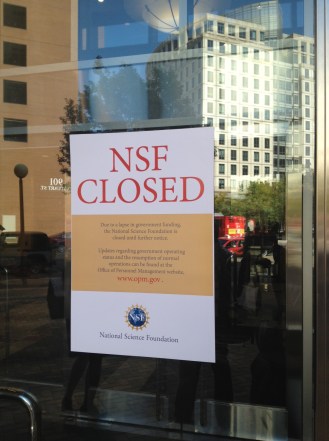
This is costing a fortune. Part of my work is planning and organizing very needed collaborative meetings between scientists. I have several coming up. If the shutdowncontinues another week, those will be postponed or canceled with the attending loss of monies that were sunk into flights, rentals, etc. In my event alone, dozens of scientists and educators will have to cancel flights and plans and NSF will have to eat the cost. Of course this doesn’t take into account the hundreds of man hours of preparation it took to get this meeting off the ground, which now will have been for naught.

And I’m not getting paid. I can handle a few days, but the further this goes on, the more likely it is this will turn into a hardship. I absolutely love my job. I believe it is a huge benefit to our nation and to people. I love it because I truly believe that. I go into every day of work with a purpose that benefits the nation and mankind, and I work with amazing people. What more could a man want?

And yet I am not even allowed to work with no pay during the shutdown. It’s actually against the law. I honestly wish I could.

Fiscal conservatives? Surely not.

Another:

I’m an attorney for nonprofits and small businesses.  Because of the shutdown, it’s impossible to get an Employer Identification Number (EIN), which in most cases is required in order to open a corporate bank account.  Without a bank account, my startup clients simply cannot begin operating.  (Before someone raises the idea, using a personal bank account can lead to personal liability – something we never recommend.) Talk about grinding business to a halt.  Any Republican who says the shutdown is just a “slimdown” clearly isn’t trying to start a business.

Another:

My 18-year-old daughter was supposed to start a year of community service in AmeriCorps on Oct. 7 in Denver, where one imagines they could use some young, barely paid idealists to help with the flood damage.  She was very excited to get started on this adventure, and deferred her college start date for a year in order to serve.  What message have we sent her and all those who work for lower pay and lower appreciation in public service?

While the Neo-Confederate toddlers stamp their feet and hold their breath, it is America that is turning blue.

Many more stories below:

First of all, I promise to [tinypass_offer text=”subscribe”].  I’ve just been too busy to pull out the credit card, but I will do so now after I send this note. Anyway, the view from my shutdown is this:

I am the Chair of the Board of a non-profit organization that does a great deal of work on a variety of science issues.  I would say that about a quarter of our effort is with federal partners.  We scheduled a small conference for this month about two years ago and the staff of the organization spent a considerable amount of time and money in putting it together.  It is looking more likely that we will cancel the event, since many of the participants cannot attend now.

In addition, we work with our federal partners on a number of science issues and all of this work is looking like it will be delayed  considerably and the staff of our organization is having to jump into other projects, only to likely jump back when the government becomes sane again.  Some of this work is rather time sensitive and will require starting experiments over.

As the chairman of the board of this organization, I am starting to strategize how we can better align our resources so we do not have to work with an increasingly erratic and anti-science federal government.  We also work with a number of state and local governments and they are very easy to work with and do not have these insane battles.  It is looking increasingly like state and local governments are the adults in the overall governance of our nation.

Another:

I’m a medical research scientist focused on developing therapy for ALS (aka Lou Gehrig’s disease). Half of my funding comes from private foundations such as the ALS Association; the other half from the National Institutes of Health. With the shutdown, we’ve been told that we are permitted to proceed using the funds already disbursed, but not to expect any further funding until the shutdown is over. We will be OK for a few weeks and then the programs will begin to rapidly degrade. The consequences of the shutdown will be amplified by the way NIH funding is a rolling system.

I also review grant applications to the NIH on ALS research. I’m not paid to do this; it’s a service many of us do out of scientific citizenship. About 1 in 11 of these grants get funded typically, but it will be awhile before any new grants are processed because the entire system is shut down. For every day this system is shut down, it will take 2-3 days to get through the backlog in addition to the new work.

Another:

I think that this is a very important thread because it brings to life the very real consequences created by a very small group of wack-jobs.  Next week I was planning to take my family on a vacation to see the Grand Canyon for the very first time.  We have been excitedly planning this trip for the past 8 months.  My daughters have been learning about the Grand Canyon and surrounding areas and we were excited to finally be able to see this amazing place with our own eyes.  I cancelled the trip this morning.

It’s unfortunate that we won’t be seeing the Canyon, but what’s more important is that a handful of restaurants, hotels, gas stations and gift shops will not be getting my money.  We had planned on around $2000 for the trip for hotels, food, gas gifts and sight seeing.  I know that this doesn’t sound like a lot but it adds up when hundreds if not thousands of others are being forced to do the very same thing.  The funniest part about this is that the congressman who represents Northern Arizona is one of the Republican wack-jobs responsible for this shutdown, so in a way I’m happy my money will not be supporting his district.

One more reader:

My best friend’s brother is a park ranger in Utah in charge of making sure no one enters a national park in Southern Utah, which is closed while the government is shutdown. Yesterday he spent the day being cursed at, cried to, and even spit at (seriously, people?) for having to turn visitors away at the gate. It’s unfortunate and not right, but it’s not the first time that people take out their anger and frustration on the messenger.

But similar reprehensible actions coming from a US Representative, in public, to a government worker? Unconscionable. Not much showcases the Beltway bubble more than seeing and hearing a congressman shaming a government worker for doing her job, whose current duties are a direct ramification of that very congressman’s neglect to do his own job. They’re so insulated within their echo chamber they’re completely divorced from reality. And these are the people threatening the entire world economy without even knowing their own demands.
Medicinal Music

Performing organ transplants on mice, Japanese researchers tested the effects of different musical genres and artists in improving the outcome of medical procedures. The choice of artist is no small thing:

[T]he mice placed in the silent or the single-frequency rooms suffered from acute graft rejection, as their immune systems rejected the foreign cells from the transplants. Those who had been listening to either Verdi or Mozart showed significantly improved survival outcomes, living an average of twenty days longer. The Enya listeners were not as fortunate: they did little better than the mice who had listened to nothing at all, living just four days longer, on average, than the mice exposed to noise or silence. The authors speculated that what might have been at play are the particular harmonies and musical features of a piece of music.

The human auditory cortex—the part of our brain devoted to hearing and listening—can differentiate between extremely specific frequencies of sound. In fact, single neurons can adjust to barely noticeable frequency shifts at a level that exceeds almost all other mammals (bats are the exception). Music with a four-four tempo, which corresponds closely to a normal heart rate, can help regulate heart rate, circulation, and breathing. Lyrical melodies and rhythms of about sixty to eighty beats a minute, which is common to much classical music and bird song, can stimulate relaxation and alpha brain waves, a type of pattern associated with wakeful relaxation. Yet music that departs from either of those tempos confers none of the benefits.

Previous Dish on the therapeutic uses of music  here and here.

How Many Have Enrolled In Obamacare?

Suderman wants to know:

The administration, which has been quick to tout its web traffic figures as evidence that the exchanges are in high demand, could end any uncertainty about enrollment in the federal exchanges by releasing enrollment figures for the federal exchanges. But they haven’t yet. Is that because the numbers so far are so low that they would undermine the administration’s argument that Obamacare is valuable because it is in high demand?

 Christopher Flavelle also requests enrollment numbers:

Sure, an exceedingly small number of applications — in the low thousands, say — would spark early criticism of the law’s long-term prospects. But Democrats never promised a surge of early applicants, so whether the number of people signed up so far is 10,000 or a million, the administration has grounds to claim a win. After all, the enrollment period lasts six months because it will take people time to adjust to a new benefit and a new system for getting that benefit.

Maybe it seems reasonable from the government’s perspective to avoid taking chances. The Obama administration, and in particular HHS, has been so thoroughly buffeted by criticism over this law that it’s adopted a mindset of sharing only the information that it must — and even then, delaying that information as long as possible. If that’s the explanation, it’s time for the agency to start emerging from its bunker mentality.

Update from a reader:

Are they kidding? This isn’t buying an iPhone that can be used that very day. This is purchasing insurance that will begin in THREE months, and if purchased today, will have to be paid for today. Who in their right minds will pay for something today that doesn’t start in three months?

Another:

The fact or speculation that few people have actually signed up for insurance immediately is not indicative of anything. Insurance is complicated and expensive and we should not expect newcomers to rush into any decisions immediately. At my workplace during open enrollment, we have several weeks to sort through all our options and many of us wait until the late day to decide which plan to choose. Those who are just itching to call the ACA a failure should be forced to wait at least a few weeks before anyone should pay any attention to them.