The Ameri-Canada Dream

J. Dana Stuster is amused by a new Diane Francis book, Merger of the Century: Why Canada and America Should Become One Country:

What would a united Ameri-Canada look like? In terms of acreage, it would be the largest country in world — surpassing Russia, even all of South America, in size. Its economy would be larger than the European Union’s. Since each country is the other’s largest trading partner, trade deficits would shrink. Canadian oversight at the Fed would bring stability to American banking. With all its energy needs met domestically, Ameri-Canada would be a lucrative petrostate, exporting oil to the developing world.

For all the benefits — energy self-sufficiency, secure borders, a cross-border maple syrup pipeline if we’re lucky — the merger would not be without consequences. Francis bets that the long-term economic incentives would outweigh the baggage Canada brings with it. But is that really the case? Would it be worth grappling with how to integrate U.S., Canadian, and Québécois laws, or trying to standardize health care across the two countries? Would Washington ever want to inherit First Nations land disputes, Quebec separatists, or Justin Bieber? And would Canadians want Washington, especially after such a case study in dysfunction this week?

This Extraordinary Pope, Ctd

A reader writes:

I’m a grateful subscriber, so I thought you might enjoy a copy (pdf) of the first Annual Report issued by the Vatican Bank (IOR) in its 126-year history. This is a direct result of Pope Francis’s call for oversight and transparency. In June 2013, Pope Francis appointed a Papal commission to conduct an “exhaustive report” into the IOR’s juridical standing and activities. The goal of this Commission is “to better harmonize the work of the IOR with the mission of the Church and Apostolic See.” Of note is how small and profitable the IOR actually is: “total assets are approximately EUR 5 billion, while fiscal year 2012 registered a profit of EUR 87 million. Of this, EUR 50 million was given back to the Church for operating purposes.”

One of my Wall Street wizard brothers is working with the Commission. He confirms that even Rome is infused with startled enthusiasm for this Pope. Many of us have been more homesick for the Church than we realized. So thanks for your ongoing coverage. I’m sure you take some heat for it, and not only from Hitch’s spirit.

Oddly, not so much heat. The spirit of this Pope is so obviously sincere and so disarmingly Christ-like I find myself a Catholic cheered on by many atheists right now. Just not the theocons. Or Hitch, I’ll bet you a bottle of Johnnie Walker Black.

Battle Of The Boomer Bands

Tyler McMahon reviews John McMillian’s dual rock biography:

Beatles vs. Stones captures an era that was confusing, tumultuous, often teetering on the edge of violence. At many concerts, there was more Altamont in the air than there was Woodstock. For pop stars, entering the public eye also meant wandering into an ideological vacuum. The backlash after the release of the Beatles’ “Revolution” (and later, the inverse reaction to the Stones’ “Street Fighting Man”) vividly shows the fault lines within the New Left. Oldham, Jagger, and the rest of the Rolling Stones consistently managed to win approval with more radicalized commentators. Their success was more about dexterity than values. As the author puts it: “Without ever devising or articulating a formula for instigating a cultural revolt, the Rolling Stones began to stumble upon one.” The Beatles, on the other hand, avoided controversy but provided a generational touchstone. One of the book’s most telling episodes recounts a Berkeley SDS gathering in which the students—unable to recall the lyrics to old labor standards—broke out into a blissful rendition of “Yellow Submarine.”

(Video: The Rolling Stones perform “Street Fighting Man” in 1969)

Why Hasn’t Big Business Stopped The Shutdown?

Josh Green examines the rift between the GOP and the U.S. Chamber of Commerce, a major GOP donor:

On Oct. 1, House Republicans ignored the Chamber’s pleas to keep the government running. The shutdown is costing the U.S. economy $300 million a day, according to IHS (IHS), a global market-research firm, and it’s only the latest sign suggesting that the old adage, “Republicans are the party of business,” no longer holds true. From the austerity imposed by sequestration to the refusal to reform immigration laws to the shutdown and now, as appears likely, another debt-ceiling showdown when U.S. borrowing authority expires on Oct. 17, the GOP’s actions have put a strain on one of its most valuable partners: the business community.

Drezner asks, “given the Chamber of Commerce’s tilt, why aren’t GOP representatives listening more closely?” Larison’s answer:

Because the Chamber of Commerce leans so heavily towards the GOP, Republican politicians may conclude that they can ignore some of its complaints without provoking the group to shift more of its support to the other party. Consistently and overwhelmingly favoring one party over another signals to party leaders that your group’s concerns can be dismissed more easily when the leaders have other priorities. The Chamber’s support for Republicans is being taken for granted because that support is so lopsided in the GOP’s favor, and as a result it sometimes has much less influence with what the party does in Congress than one would expect.

Street View Goes Off-Roading

Street view

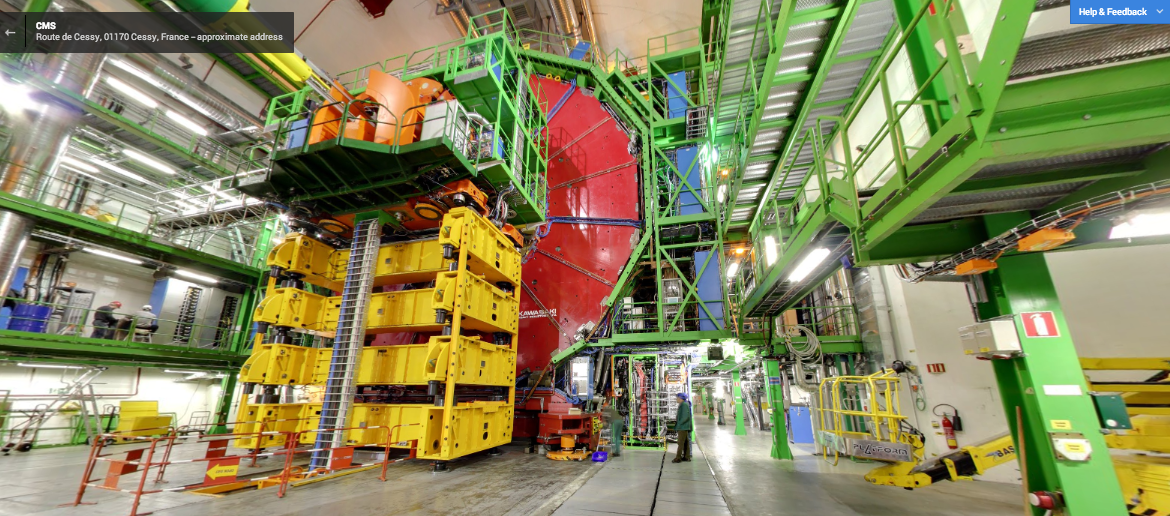
And into CERN, the international physics laboratory:

Putting together a Street View tour of one of the largest and most expensive science projects in history wasn’t a particularly easy task; the mammoth detectors and tunnels of the collider took two full weeks to photograph. “Every three meters, they took a six-sided panorama of the tunnel,” CERN photographer Max Brice told Symmetry Breaking. “Then we had to figure out the coordinates of every image. It came out to 6000 points for us to track.” This was in 2011; stitching everything together into the finished product took an additional two years.

Luke Westaway takes in the views:

The ATLAS particle detector experiment can be explored, as well as the tunnel that makes up the Large Hadron Collider, plus CERN’s ALICE, CMS, and LHCb experiments. Virtually traversing the dense labs is an atmospheric experience – cramped Half Life-esque tunnels and metal walkways abound, as well as ominous signs that warn of radiation and dangerous magnetic fields.

(Photo: The Compact Muon Solenoid (CMS), a general-purpose detector designed to investigate a wide range of physics. Via Google.)

Obamacare Is Still Experiencing Technical Difficulties, Ctd

A reader writes:

There are a couple of counterpoints to your post you should mention.

First, this is now the fourth day of 180 during which people will be able to enroll. No one will even get coverage until January 1 of next year. Yes, the technical difficulties exist, but a relentless focus on them makes it seem like health reform isn’t working.

Second — and probably more important — the federal exchange was never intended to be anywhere near as large as it is. The ACA was designed so that states would run the exchanges, and they were given massive flexibility to make that happen. The intent was that the federal exchange would be a back up for a few states that could not, or would not take advantage of their state prerogatives.

Instead, a full 34 states decided they hated the federal government so much that they opted to let the feds run a health care exchange inside their borders.

This was clearly one of the choices they had, but no one anticipated that the sheer hysteria of health care reform would drive so many states to act so deeply against their own state interest.

So the federal exchange went from being a backstop to being the primary new program the federal government was required to operate. And the technical challenges of operating an exchange in 34 states with 34 hugely varying markets, populations, and state laws that needed to be accommodated proved to be enormous.

That is a very large part of the landscape HHS has had to deal with. Yes, the problems are real. But they are not immediately affecting anyone’s coverage, and they arise out of a political perversity it would have been hard for any rational person to predict.

Has Netflix Fixed The Water Cooler?

Nolan Feeney suggests that the era of binge-viewing has revived casual conversations among coworkers:

“Binge viewing is more about staying current and getting caught up so you can have those water-cooler conversations, and less about stockpiling episodes,” [VP of Comcast Matt] Strauss says. “As they get more caught up, we’re finding viewers are more like to stay caught up.”

Comcast also found that pre-linear premieres—offering the first episode of a season online weeks ahead of its live airing—hasn’t seemed to cannibalize viewership or splinter interested audiences into pieces. Rather, for a majority of shows, the practice appears to be growing and developing audiences: After Comcast offered the first episode of A&E’s Bates Motel ahead of schedule, the regular premiere saw a 35-percent boost in viewers in Comcast markets as opposed to non-Comcast markets.

Lindsay Abrams studies how the Netflix factor has lured millennials back to watching episodes live on TV, rather than streaming online:

After inviting myself over to a friend’s cable-equipped apartment to watch “Breaking Bad’s” premiere, I started showing up, instead, to a bar in Park Slope. They also have cable, along with “Schraderbrau” on tap and, for the past several weeks, have been packed to capacity. That’s right — people have actually been standing through the entire hour, commercials and all.