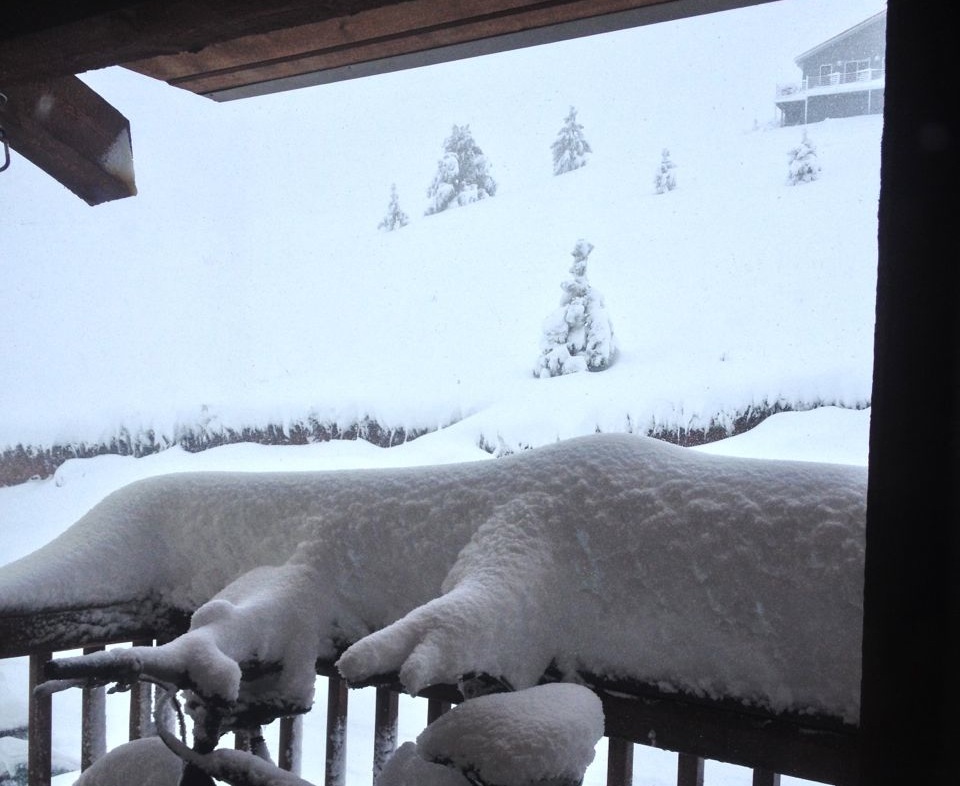
You have until noon on Tuesday to guess it. City and/or state first, then country. Please put the location in the subject heading, along with any description within the email. If no one guesses the exact location, proximity counts. Be sure to email entries tocontest@andrewsullivan.com. Winner gets a free The View From Your Window book or two free gift subscriptions to the Dish. Have at it.
Year: 2013
Animal Agents
Tom Vanderbilt explores Cold War-era CIA practices that relied on nonhuman operatives:
It is striking that even as the television program “Flipper” was making dolphins popular with American children, the creatures were becoming embroiled in the cold war arms race. As a partially declassified 1976 CIA document on naval dolphin training notes, the Soviets were “also assessing and replicating U.S. systems while possibly developing countermeasures to certain U.S. systems.” …
Even bugs—the kind with legs—were considered by the military establishment. “The Use of Arthropods as Personnel Detectors,” a 1972 report by the Army’s Limited Warfare Laboratory in Aberdeen, Maryland, summarizes research on the possibility of exploiting the “sensory capabilities of insects”—bedbugs, mosquitoes and ticks among them—“for the detection of people.” Scientists ruled out lice (“in a preliminary test they simply crawled about at random”) but saw “feasible” promise in the mosquito Anopheles quadrimaculatus, which “is normally at rest and will fly at the approach of a host,” and so might be used “to detect the approach of people during darkness.”
A Poem For Saturday
Dish poetry editor Alice Quinn writes:
The first poems I read and loved were in Volume Nine of a set of books called The Children’s Hour given to me by my mother when I was about five. I can summon up the opening lines of all of them – Longfellow’s “The Children’s Hour,” itself, naturally, “The Barefoot Boy” by John Greenleaf Whittier, Robert Browning’s “The Pied Piper of Hamelin,” Edward Lear’s “The Owl and the Pussy-Cat,” and “The Things I Miss,” attributed by me to Emily Bronte for most of my life but actually the work of Thomas Wentworth Higginson, most widely known now as an encourager and correspondent of Emily Dickinson.
Today and over the weekend, we’ll feature a few of these poems in tribute to my mother and to all parents who instill in their children a sustaining love of poetry because they love it themselves.
We begin with “The Barefoot Boy” by John Greenleaf Whittier (1807-1982):
Blessings on thee, little man,
Barefoot boy, with cheek of tan!
With thy turned-up pantaloons,
And thy merry whistled tunes;
With thy red lip, redder still
Kissed by strawberries on the hill;
With the sunshine on thy face,
Through thy torn brim’s jaunty grace;
From my heart I give thee joy,–
I was once a barefoot boy!
Prince thou art,–the grown-up man
Only is republican.
Let the million-dollared ride!
Barefoot, trudging at his side,
Thou hast more than he can buy
In the reach of ear and eye,–
Outward sunshine, inward joy:
Blessings on thee, barefoot boy!
(Photo by Zev, aka Fiddle Oak)

A Century Of Slumming It
Slum tourism has taken off in recent years, but as Sonia Tsuruoka shows, the practice dates back to the Victorian Era:
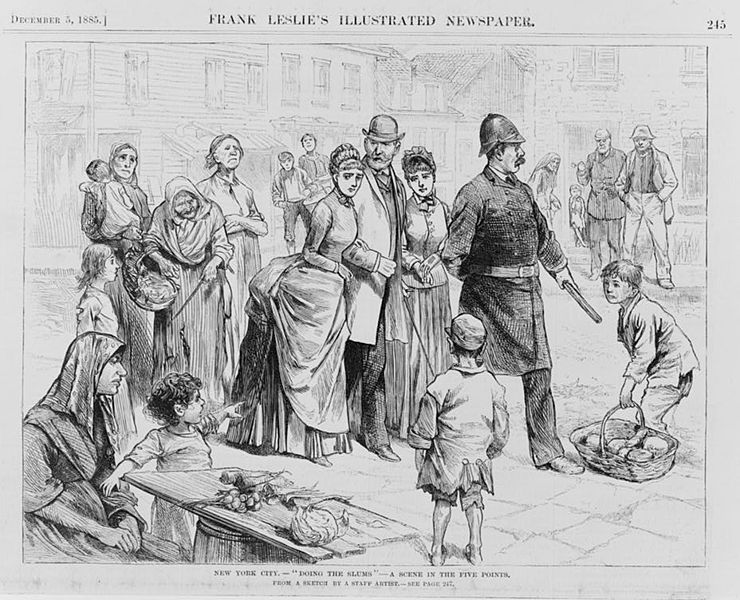
“How the other half lives” has been a topic of perverse fascination for the upper and middle-classes even prior to Jacob Riis’ groundbreaking photojournalistic study of Manhattan’s tenement- and sweatshop-ridden Lower East Side in 1890. Consider the loaded, etymological origins of the word slumming, and its earliest citation in the Oxford English Dictionary in 1884. Around this time hordes of blue-blooded Londoners – leaving their lavish abodes in Mayfair and Belgravia – were rumored to flood London’s squalid East End for everything from amusement to philanthropy. This “fashionable London Mania” found its way from Victorian-era England to the streets of New York City, as wealthy foreigners increasingly engaged in “slumming parties,” which typically entailed “a tour of the Bowery winding up with a visit to an opium joint or Harry Hill’s.” A recognizable tension between slumming as reform enterprise and twisted voyeurism emerged, blurring the boundaries between slum tourism as a form of entertainment for the privileged class and a spirited call to action for well-intentioned missionaries, social activists, politicians, journalists, and philanthropists.
(Image: 1885 engraving “New York City – ‘Doing the Slums’ – A Scene in Five Points”)
The View From Your Window
The Sound Of Crowdsourced Scholarship
English professor David Mikics links the rise of Wikipedia to a decline in student writing:
Wikipedia, which is against style on principle, crushes the individuality of student voice. For the kids in my class, this is what knowledge sounds like: balanced and bland, never indignant or provocative or committed—the voice of the crowd, the everyman. Student essays still occasionally contain remarks that sound jaunty, or freewheeling, or tragic, or ironic. But there are far fewer of these liberated moments than there were before Jimmy Wales gave us Wikipedia’s pasteurized version of scholarship.
But other academics are considering ways to improve the free encyclopedia. This year, the University of California, San Francisco will offer a class that gives credit to fourth-year medical students for editing Wikipedia articles. Dr. Amin Azzam, who will teach the course, explains:
When you look at [the quality of the articles], the fraction of high-quality information on Wikipedia in the medicine-related topics is significantly lower than other domains of Wikipedia. I think a large part of that is because we in the medicine community have not been embracing this model of democratized information. But when you realize that this is where all the world goes for information first, I think we’re missing an opportunity. Why don’t we contribute to improving the quality of information that the public has access to, and that the public goes to? So that’s why I became passionate about this model. I started realizing that this was a much bigger way to make a much bigger impact on public health.
The Classical Music Shutdown
As the New York City Opera heads toward financial ruin, Russell Platt takes stock of the industry’s troubles. Greg Sandow focuses on orchestras and their ever-older audiences:
[N]ow we see what a systemic crisis means. Because from the aging and shrinking of the audience follows every other problem that we’re having. Declining ticket sales. Declining funding. Performing arts centers (as the New York Times reported back at the start of the 1990s) booking fewer classical music events, because the audience for them was starting to fall. …
Maybe the current orchestra crisis shows us this danger starting to be real, meaning that it’s hitting now, and isn’t just something we project into the future. So many managements arguing with their musicians, over dividing a shrinking financial pie, the result (no matter how it plays out in each situation) of an overall drop in demand, and drop in funding (which of course is tied to the drop in demand), while expenses continue to rise.
Previous Dish on the struggling classical music industry here.
The “E” Stands For “Expensive”
Art Brodsky calculates how unfair e-book pricing is for libraries:
Take the example of J.K. Rowling’s pseudonymous book, Cuckoo’s Calling. For the physical book, libraries would pay $14.40 from book distributor Baker & Taylor — close to the consumer price of $15.49 from Barnes & Noble and of $15.19 from Amazon. But even though the ebook will cost consumers $6.50 on Amazon and Barnes & Noble, libraries would pay $78 (through library ebook distributors Overdrive and 3M) for the same thing.
Somehow the “e” in ebooks changes the pricing game, and drastically. How else does one explain libraries paying a $0.79 to $1.09 difference for a physical book to paying a difference of $71.50 just because it’s the electronic version? It’s not like being digital makes a difference for when and how they can lend it out.
The Best Of The Dish Today
First off, an email:
I’m having an immensely shitty day. My girlfriend and I aren’t speaking. I’m having trouble with
my heart, both Romantically and Physiologically, and even some really good news from work hasn’t been enough to lighten my spirits and cheer me up.
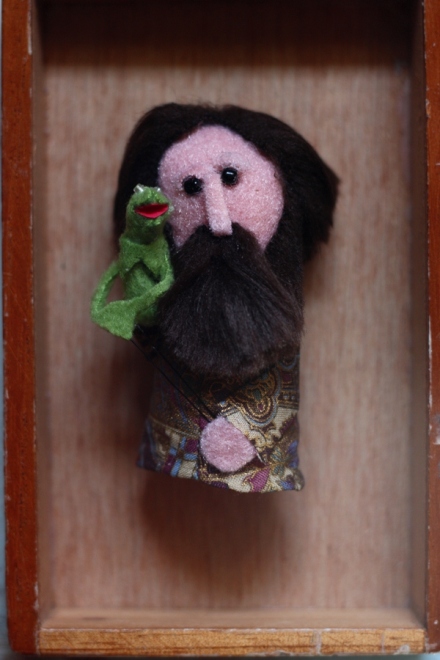
Then I saw this, and had this wonderful vision of you sitting at home putting these little fellas on your fingers and waggling them about joyfully while making them argue about Oakeshott and Niebuhr and how crap JFK was at foreign policy, all in your “I’m Having Imperial Obama Hysterics Voice” (which I’ve invented out of whole cloth; I’ve never actually heard you Freak Out, but I’m sure it’s adorable), and I just laughed and laughed and was instantly cheered. For about 90 seconds.
Seriously, Imma buy you all of these for Boxing Day. Or whatever you British people do in December.
They’re L’il Beards and the one above is of Jim Henson. From Thistledown Puppets. I’m a lucky blogger.
The day was dominated by the lingering showdown on the Hill, as the House GOP continued to threaten to keep the government shut down and to destroy the US and global economy unless their agenda is substituted for existing law. I took note of how deeply alienated the GOP base now is – and how immune to any reason. We noted the awful technical roll-out of many healthcare exchanges (and the reasons for it) and the worryingly narrow divide in favor of constitutional government in the polls. Plus: a beautiful window view from France and a gorgeous time-lapse window view from Minnesota.
The most popular post? Why They’ll Die On This Hill. Second? The Nullification Party.
See you in the morning.
Cool Ad Watch
A reader writes:
The clearest signal yet that the marijuana mainstream is here to stay: fast food marketing is turning to the growth market of stoner diners. The latest evidence is Jack in the Box’s rollout of their “Munchie Meal Menu,” marketed as the “cure to mellow even the meanest manifestation of the munchies.” Carmel Lobello describes the marketing tactic and explores other ways in which the fast food industry has begun to embrace this customer base.
More commercials in the “Munchie Meal” series here.