
West Hollywood, California, 5.15 pm
West Hollywood, California, 5.15 pm
Former Netanyahu aide Joel C. Rosenberg – surprise! – lambastes the president for dithering on intervention in Syria and thereby jeopardizing Israel’s war to remain the sole nuclear power in the Middle East:
If President Obama is so distrusted by the American people and her representatives in Congress that he cannot build solid support for limited military strikes against Syria’s chemical-weapons facilities, the Israelis are coming to the painful realization that there is no chance for the president to pull together support for preemptive military action against Iran’s nuclear facilities. Zero. Nada. Zilch. … That means one thing: The Israelis are on their own, and now they know it.
Enter AIPAC. Next week, that formidable group will storm the Hill for another war, even as Israelis themselves are content to allow the civil war to burn both sides in Syria out. It’s not in Israel’s interests that either Assad or the Jihadist rebels gain the upper hand. And yet they will happily ask the United States to risk its own potential enmeshment in a wider war – just to keep the conflict going. But AIPAC is fixated in forcing Obama to start yet another major war in the Middle East; and AIPAC never loses. They’ll threaten Democrats with de-funding and ostracism; they’ll win over Christianist Republicans with religious arguments about the need for Israel and America to stand together Muslim Jihadists. Goldblog takes things down a notch:
I believe it would be a mistake to assume that just because the president is hesitant on Syria he will be hesitant on Iran. Why? Because the president has defined Iran’s nuclear program as a core threat to U.S. national security. He has made it clear that only two challenges in the Middle East rise to the level of core American national interests: The mission to destroy al-Qaeda and the goal of stopping the Iranian nuclear program. He has stated repeatedly, over many years, that it is unacceptable for Iran to cross the nuclear threshold, and his administration has worked assiduously to sanction Iran in the most punishing of ways.
I hope Netanyahu listens to Jeffrey on this. And Rouhani does as well.
After a summer of big-budget flops, Catherine Rampell questions the blockbuster strategy of the big studios:
The summer was never actually as profitable as it seemed. The official season, which lasts about a third of the year (at least the way Hollywood divides the calendar), generates around 40 percent of annual ticket sales. Furthermore, box-office revenue may be higher in the summer precisely because that’s when studios have chosen to release their most popular movies. The expected box-office appeal of the film may be driving the release date, in other words, rather than the release date enhancing the box-office performance.
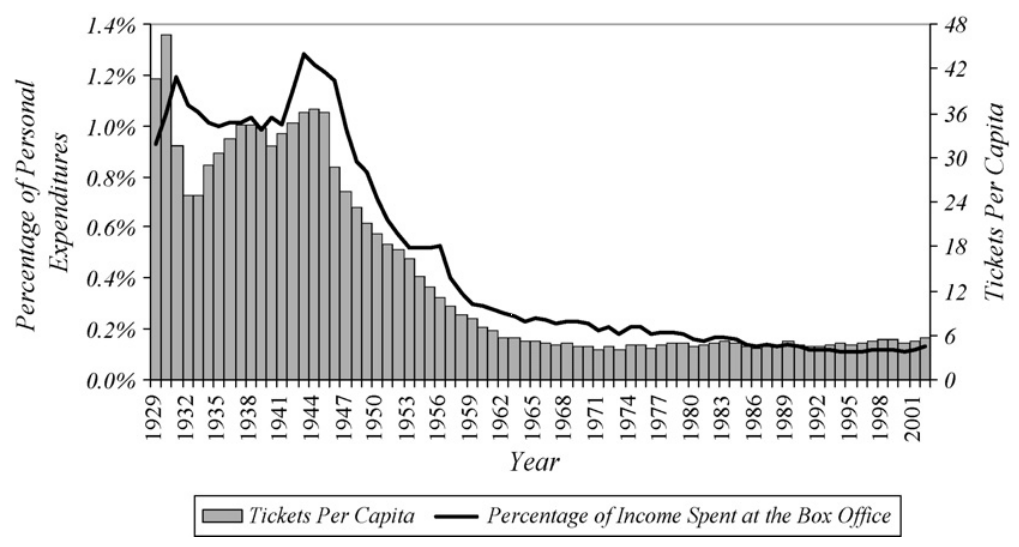
She follows up. Derek Thompson counters with the above chart:
The collapse of movie audiences, which far pre-dates Jaws and summer blockbusters, requires studios to heavily market their films since Americans’ default position on movies these days is not to see them. Studios have cannily created a summer of tent-pole features to focus audience attention on a handful of months when we’re taught to expect to go to the movies. Iron Man III would probably make a billion dollars if it were released on a Tuesday morning in March. But lesser films might benefit from debuting in a season when audiences are predisposed to going to the movies.
More Dish on this summer’s flops and the blockbuster business here, here and here.
In an excerpt from Tin House‘s Writer’s Notebook II, Bret Anthony Johnson advises against “writing what you know”:
[P]art of me dies inside when a student whose story has been critiqued responds to the workshop by saying, “You can’t object to the _________ scene. It really happened! I was there!” The writer is giving preference to the facts of an experience, the so-called literal truth, rather than fiction’s narrative and emotional integrity. Conceived this way, the writer’s story is relegated to an inferior and insurmountable station; it can neither compete with nor live without the ur-experience. Such a writer’s sole ambition is for the characters and events to represent other and superior—i.e., actual—characters and events. Meaning, the written story has never been what mattered most. Meaning, the reader is intended to care less about the characters and more about whoever inspired them, and the actions in a story serve to ensure that we track their provenance and regard that material as truer. Meaning, the story is engineered—and expected—to be about something. And aboutness is all but terminal in fiction.
Stories aren’t about things. Stories are things.
Stories aren’t about actions. Stories are, unto themselves, actions.
Copyranter calls it “the best insurance ad in recent years”:
Now, the [Geico] Cavemen were hilarious (especially “Therapy Session”), but this spot for John Lewis home insurance actually, you know, SELLS INSURANCE. Because frankly, this whole “let’s get ha-ha about insurance” ad movement (I’m looking at you, Allstate “Mayhem”) that Geico helped jumpstart is just getting so fucking tiresome.
Chris Mooney passes along a study:
According to a new psychology paper, our political passions can even undermine our very basic reasoning skills. More specifically, the study finds that people who are otherwise very good at math may totally flunk a problem that they would otherwise probably be able to solve, simply because giving the right answer goes against their political beliefs.
Drum chimes in:
How big a deal is this? In one sense, it’s even worse than it looks.
Aside from being able to tell that one number is bigger than another, this is literally about the easiest possible data analysis problem you can pose. If ideologues actively turn off their minds even for something this simple, there’s really no chance of changing their minds with anything even modestly more sophisticated. This is something that most of us pretty much knew already, but it’s a little chilling to see it so glaringly confirmed.
But in another sense, it really doesn’t matter at all. These days, even relatively simple public policy issues can only be properly analyzed using statistical techniques that are beyond the understanding of virtually all of us. So the fact that ideology destroys our personal ability to do math hardly matters. In practice, nearly all of us have to rely on the word of experts when it comes to this kind of stuff, and there’s never any shortage of experts to crunch the numbers and produce whatever results our respective tribes demand.

Syria once again dominated the day. Some key highlights: more evidence on the question of Assad’s motive for raising the stakes so high; more signs of American popular opposition to Washington’s plans; my advice on how Obama could yet save himself from the predicament he has largely created; your pushing back against my arguments and my responses to your points; and why this is – rightly – affected by the searing experience of Iraq and Afghanistan.
But we also took some time to view the evangelical movement that seeks to tolerate rather than demonize gays; I pondered Peter Beinart’s latest essay on the lack of real interaction between American Jews and Palestinians; and truly remarkable tweets from Hassan Rouhani and Iran’s foreign minister, wishing Jews a happy new year.
The most popular post of the day was “Saving Obama From Himself”. Next up: “Tweet of the Day”.
See you in the morning.
(Photo: A sculpture titled ‘Engel’ by Stephan Balkenhol is displayed in the grounds of Chatsworth House as part of the Sotheby’s Beyond Limit’s sculpture exhibition on September 5, 2013 in Chatsworth, England. World renowned artists such as Jaume Plensa, Marc Quinn, Manolo Valdes and Thomas Heatherwick feature in the show held in the grounds of stately Chatsworth House in the Peak District. The 20 works will be on view to the public from 9 September to 21 October. By Christopher Furlong/Getty Images.)
@TheEconomist to Obama on its new cover: “Fight this war, not the last one” [i.e. Iraq, I imagine] pic.twitter.com/uCQvLMLLVl
— Oren Kessler (@OrenKessler) September 5, 2013
Larison dismisses the argument that anti-interventionists are suffering from “Iraq Syndrome”:
[T]his is becoming a common way to describe the absolutely justifiable and sane reaction of the public and even many in Washington to the disaster of the Iraq war. Interventionists call this a syndrome because it is supposed to be seen as an affliction or something from which Americans need to recover, as if there were something unhealthy or harmful in becoming extremely wary of waging wars of choice in countries that we don’t understand very well for dubious and often unobtainable goals. On the contrary, the existence of this so-called “syndrome” is proof that the public is very sensibly recoiling from the repeated misjudgments and mistakes of their political leaders.
Most Americans are firmly against making yet another major foreign policy error, and what they keep hearing from Washington and from much of the media is that they are suffering from some kind of malady that needs to be cured with another war.
This truly is becoming a battle between the Washington war-machine and the people it is supposed to protect. And yes, Iraq is relevant. Of course it is relevant. And no, as Daniel argues, this is not a syndrome. It is not a syndrome to look twice before crossing the street, when you have been run over by a truck twice in the last decade. In any case, the parallels are so close as to be almost absurd. The president is trying to get support for a military campaign against a Baathist leader in a murderously divided Middle Eastern country in order to prevent the use of WMDs and to send a message to Iran. I mean: is there any more obvious analogy? Now I know the president has ruled out “boots on the ground”. But there are already boots on the ground, in a covert war the war-machine has already launched. And, as John Kerry was forced to concede, entering this conflict could quite easily require troops in the near or distant future if we are not to be seen as having empowered Assad rather than removed him.
And the same people and factions that backed that war are now backing this one: the full neocon chorus, AIPAC, the liberal internati0nalists, the Clintons, McCain, and on and on. Since no true accountability for that catastrophe was ever exacted, we are forced to endure the utterly discredited Bill Kristol and Paul Wolfowitz and Fouad Ajami make exactly the same arguments they made then. And yet this time, the man we elected not to repeat the Iraq disaster, the man who only holds the office he does because of his wise opposition to that war, is now apparently eager to risk a repeat of it.
Let’s be clear. The administration is losing this argument, and looks likely to lose the Congress. There are four times as many anti-war votes right now as pro-war ones in the House. The public remains opposed. Only neocons are backing the president forcefully, if he assents to their full-war agenda. The minute he doesn’t launch a full-scale war, they will abandon him. That’s already a horrible reminder that if the president decides to risk his entire second term on this quixotic act of neocon symbolism, he will be very alone very fast, with no country and no Congress behind him and not even the Brits offering some fig leaf of international support.
But in every crisis there is an opportunity.
Lose the vote, don’t go to war, but go to the UN repeatedly and insistently. Gather more and more evidence. Get Ambassador Power to pummel the Russians and Chinese with their grotesque refusal to do anything about this ghastly mass murder. Expose Putin for the brutal thug that he is. And focus on the huge challenges at home: a still-weak economy, a huge overhaul of healthcare, a golden opportunity for immigration reform. That’s why he was elected. And his domestic legacy is at a pivotal point.
I know opposing this president is painful for so many who want him to succeed. It’s painful – agonizing – for me. I understand his genuine and justified revulsion at this use of chemical arms and the wanton, hideous brutality of the Assad regime. I deeply respect his moral stand. He is right that the international community should not stand by. But America cannot be the sucker who is responsible for countering all evil in the world and then blamed for every success and failure. We must not become the sole actor against evil in the world, and not only because, at this point, after GTMO and Abu Ghraib and pre-emptive war, we have no standing to do so. We simply do not have the ability or the resources to do it. We’re as fiscally bankrupt as we are militarily incapable of fighting other people’s wars for them. And asking the military to do another impossible job in another Middle East hell-hole is grotesquely irresponsible.
We should make our case to the world and if we fail, as Obama clearly is, we should accept that and move this drama to a diplomatic stage. Yes, I know the horrors endure. I am not looking away. But if you cannot end someone else’s brutality without profoundly wounding yourself and empowering this vicious little creep at the same time, you should simply keep making your case – until Putin and Assad are close to indistinguishable, and moderate elements in Iran begin to gulp at the barbarism in plain sight.
That will take time; and patience, and resolve. But it’s a far wiser path forward than another unpredictable, horrible, bankrupting war.
Robert Charette thinks the much-discussed shortage of science, technology, engineering and math (STEM) graduates is a myth:
[N]early two-thirds of the STEM job openings in the United States, or about 180,000 jobs per year, will require bachelor’s degrees. Now, if you apply the Commerce Department’s definition of STEM to the NSF’s annual count of science and engineering bachelor’s degrees, that means about 252,000 STEM graduates emerged in 2009. So even if all the STEM openings were entry-level positions and even if only new STEM bachelor’s holders could compete for them, that still leaves 70,000 graduates unable to get a job in their chosen field.
Of course, the pool of U.S. STEM workers is much bigger than that:
It includes new STEM master’s and Ph.D. graduates (in 2009, around 80,000 and 25,000, respectively), STEM associate degree graduates (about 40,000), H-1B visa holders (more than 50,000), other immigrants and visa holders with STEM degrees, technical certificate holders, and non-STEM degree recipients looking to find STEM-related work. And then there’s the vast number of STEM degree holders who graduated in previous years or decades.
More evidence:
What’s perhaps most perplexing about the claim of a STEM worker shortage is that many studies have directly contradicted it, including reports from Duke University, the Rochester Institute of Technology, the Alfred P. Sloan Foundation, and the Rand Corp. A 2004 Rand study, for example, stated that there was no evidence “that such shortages have existed at least since 1990, nor that they are on the horizon.”
That report argued that the best indicator of a shortfall would be a widespread rise in salaries throughout the STEM community. But the price of labor has not risen, as you would expect it to do if STEM workers were scarce.
(Hat tip: Libby A. Nelson)

A man carries a wounded child after a reported air strike by Syrian government forces in the rebel-held northwestern Syrian province of Idlib on September 5, 2013. The Syrian Observatory for Human Rights watchdog said Syrian war planes bombed rebel held areas in Idlib, Aleppo, Hama and Lattakia. By Abu Amar Al-Taftanaz/AFP/Getty Images.
 The Dish