William Giraldi hails Herman Melville as “one of the best American examples of how every important writer is foremost an indefatigable reader of golden books”:
In the general rare books collection at Princeton University Library sits a stunning two-volume edition of John Milton that once belonged to Herman Melville. Melville’s tremendous debt to Milton — and to Homer, Virgil, the Bible, and Shakespeare — might be evident to anyone who has wrestled with the moral and intellectual complexity that lends Moby Dick its immortal heft, but to see Melville’s marginalia in his 1836 Poetical Works of John Milton is to understand just how intimately the author of the great American novel engaged with the author of the greatest poem in English. Checkmarks, underscores, annotations, and Xs reveal the passages in Paradise Lost and other poems that would have such a determining effect on Melville’s own work.
His broader argument about the connection between deep reading and great writing:
Would Cervantes and Shakespeare have made their masterworks if they hadn’t been devoted readers? Perhaps. But I hope it goes without saying that the rest of us aren’t Cervantes and Shakespeare. Try to imagine a teenager who never read an important book and yet produced a novel as permanent as Middlemarch. It cannot be done. Literature isn’t music or painting; there are no idiot savants in literature. Of course quality reading never assures success on your own pages. Judging from his latest insult to trees, Dan Brown has apparently tried to read Dante, and yet his sentences are still stacked like so many corpses. Still, quality reading is the only chance born writers have of succeeding in the creation of art.
As the US careens toward bombing Syria – without UN or NATO consent, congressional approval, or the interference of Russia – we pointed to strong evidence that intervening in civil wars does more harm than good, a reality that doesn’t conform to the wishes of Reuel Marc Gerecht, Roger Cohen, or the laughable “experts” at the Weekly Standard. Even if the US helps the sectarian rebels overcome Assad, the humanitarian conditions for Syrians could get worse. On a momentary high note, below is a recap of the above video, which “purports to show a father reuniting with his young son, who he thought had been killed [by the Syrian regime]”:
If you can hold it together through all seven minutes, you’re stronger than I am. But this video provides a welcome, if all too rare, moment of solace and joy in a war that has had precious little of either.
On the anniversary of MLK’s legendary speech, we assessed the condition of the mountaintop, recalled the obstacles King overcame, didn’t forget the legacy of Bayard Rustin, and devoted the FOTD to a black woman who reached the promised land and then some.
Reader contributions to the Dish have surged this week; lawyers defended the three-year model for law school against Obama’s critique, many others continued to discuss the curious habits of Chinese tourists, some pointed to more unsavory scenes from childhood classics, others offered historical context to “Support Our Troops”, and still others passed along more deconsecrated churches.
Meanwhile, Matt sounded off on the capitulation of that conservative Catholic on gay marriage. The view from your wildfire here. And this viewless dog still manages to find joy in playing fetch.
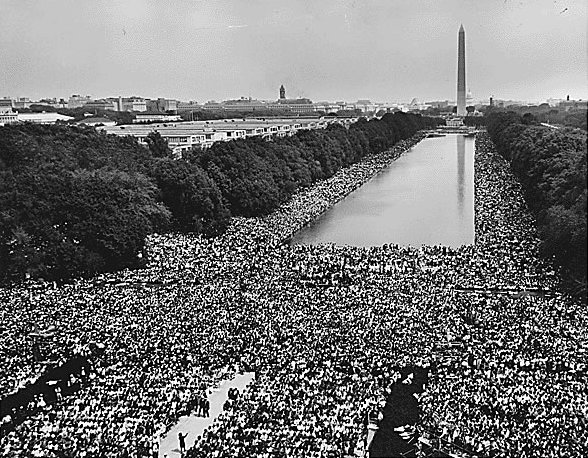
As America marks the 50th anniversary of the March On Washington for Jobs and Freedom, Jelani Cobb sees a country beset by contradictions:
There’s a bizarre dissonance that comes with watching the first black Attorney General give a speech to mark the fiftieth anniversary of the March on Washington and recognizing that the themes of his speech might have fit well with those given at the original march, in 1963. … That Eric Holder’s speech made explicit some implied truths – “But for the movement,” he said, “I would not be Attorney General and Barack Obama would not be President”—and nodded toward the humbling tenacity of unnamed thousands is not particularly surprising. That he went on to articulate a demand that the right to vote be protected for every citizen, and that the criminal-justice system be freed of bias, is alternately noteworthy and depressing.
Martin Luther King III agrees there’s far more to be done:
There are many in our nation who thought that the civil rights movement was done. They saw the election of Barack Obama as a moment ushering in a post-racial era in American history. But what happened? You’ve seen a backlash. Leaders of the Republican Party have demonized the president as an outsider, as if he doesn’t belong in the Oval Office. The Supreme Court has gutted the Voting Rights Act, which undermines the very work my father gave his life for. And Trayvon Martin has met the same fate as Emmett Till – not just in death, but by virtue of an unfair verdict that aimed to render his life less valuable. This is enough to show that the dream is not yet fulfilled and the mission is ongoing.
Bill Fletcher reminds everyone that it was a march for jobs as well as freedom:
The Americans, a high school history text by publishing giant Houghton Mifflin Harcourt, tells students that the march was called simply “to persuade Congress to pass the [1963 civil rights] bill.” In reality, the demand for jobs was not a throwaway line designed to get trade union support. Instead, it reflected the growing economic crisis affecting black workers. Indeed, while Dr. King was a major player, the March on Washington did not begin as a classic civil rights march and was not initiated by him. There is one constituency that can legitimately claim the legacy of the march – one that has been eclipsed in both history as well as in much of the lead up to the August 2013 commemorations: black labor.
Four out of the 10 demands march organizers listed were explicitly economic, and the announcement calling marchers to Washington cited “economic deprivation” as the impetus. Fifty years on, many of the same critical economic challenges the organizers targeted remain unmet. In fact, the African American unemployment rate is higher now than in 1960: roughly 13 percent in 2013 vs. 8 percent in 1963. Moreover, as Robert Fairlie and William Sundstrom laid out in the The American Economic Review, the employment gap between blacks and whites widened in the 1960s and has never closed. These data point to the fact that addressing racial inequality without a steady unwinding of economic injustice hardens and expands white supremacy.
At the same time, Brentin Mock warns that the Dream can’t survive without equal voting rights:
There’s no separating voting rights struggles from civil rights—the former is basically the source code for the latter. Which is why [John] Lewis and civil rights leaders knew back in 1963 that you couldn’t simply fold voting rights into a small section of the Civil Rights Act. It needed its own bill. Without the ability to vote, other civil rights gains would be suboptimal. … [T]he voting rights of African-Americans and people of color are in their most vulnerable position since the [Voting Rights Act of 1965] was passed. This is why the call for Congress to restore VRA and to pass a constitutional amendment that guarantees the right to vote was such a prominent feature of Saturday’s march.
Jamelle Bouie says America should remember the march as “militant and unpopular”:
The striking thing about the original March on Washington 50 years ago is how it wasn’t a moment of interracial unity—at least, not in the way it’s portrayed today. Rather, the 1963 March for Jobs and Freedom was militant, a demand for equal treatment under the law and direct investment in the long-neglected fields of black America. It wasn’t a popular agenda. That January, George Wallace was inaugurated governor of Alabama and declared: “Segregation now, segregation tomorrow, and segregation forever.” That June, Medgar Evers, field secretary for the NAACP, was assassinated in Mississippi while coming home from a meeting with lawyers. And that September, in retaliation for the march, four little girls would be killed after their church was bombed in Birmingham.
And Peniel E. Joseph thinks it’s worth taking a moment to celebrate what the march achieved:
In one week, during the run-up to two national celebrations of the 50th anniversary of the March on Washington (the second will occur on Wednesday when Obama makes a speech at the Lincoln Memorial, joined by former Presidents Jimmy Carter and Bill Clinton and members of the King family), we have witnessed two remarkable events: A black president in a nation founded on racial slavery promotes racial healing and economic equality. And an African-American attorney general vows to wage a robust struggle to defend and restore voting rights that were thought to have been won two generations ago.
Both of these instances attest to how far we have come as a nation since 1963 and the long road that lies ahead.
Laura Williams welcomes more attention for a lesser-known hero of the Civil Rights Movement:
He helped organize and participated in the first freedom ride, 1947’s “Journey of Reconciliation” (for which he and several other participants were jailed and put in a chain gang). In the 1950s, he advised, strategized, and raised money behind the scenes for the Montgomery Bus Boycott, helping to direct King’s rise to national prominence. He’s also credited with honing the King’s nonviolent strategy. Later, Rustin was the mastermind of the 1963 March on Washington for Jobs and Freedom (now simply known as the March on Washington), organizing it in just two months.
But Rustin was kept in the shadows by the homophobia of both his enemies (segregationist Strom Thurmond used Rustin’s sexuality to denigrate the movement) and his allies.
In November, Rustin will be posthumously honored with the Medal of Freedom. It comes after decades of marginalization, in no small part due to his homosexuality. In a profile worth reading in full, Steven Thrasher interviews Rustin’s longtime partner, Walter Naegle:
In his final years, by the time he was sharing his life with Naegle, Rustin was marrying the fight for racial civil rights with the emerging gay rights movement. He challenged the terrain of contemporary prejudice in a speech in which he said, “The new ‘niggers’ are gays.” Rustin, being so much older than Naegle, wanted to protect him legally for inheritance purposes. But “gay marriage” was almost unheard of, and any kind of legal status like domestic partnerships for legal couples was many years away. So Rustin, ever the creative problem solver when it came to outwitting discrimination, adopted Naegle as his son. …
In 1986, just a year before he died, Rustin gave a speech at the University of Pennsylvania in which he exhorted gay people to “recognize that we cannot fight for the rights of gays unless we are ready to fight for a new mood in the United States, unless we are ready to fight for a radicalization of this society.”
Your thread on churches transformed into alternative spaces reminds me of a beautiful building in my hometown, Colorado Springs (arguably the most religious city in America). It was the original home of Grace and St Stephen’s Episcopal Church, which quickly outgrew the space and sold the building. After a couple permutations, it became a nightclub called Syn, and then another called Eden (a particularly sleazy 18+ club, if my high school memories are to be believed). Sometime in the mid 2000s, an ultra-conservative faction of the very same Grace and St. Stephen’s, lead by this guy, broke with the Colorado Episcopal Diocese and formed a new church, St George’s Anglican. After briefly (and dramatically) occupying the newer Grace and St. Stephen’s building and a few other spaces, they bought the original building and reconsecrated it. Amazing how cyclical these things can be.
Another points to the post that started the thread:
Andrew may not have frequented it, since he lived in D.C. at the time, but before this former church in NYC was a gathering of shops, it was a nightclub – Limelight – where I saw things at all hours of the morning that I probably shouldn’t discuss on my work email.
Another sends the above screenshot:
No post about repurposed churches would be complete without a mention of the “Church of Skatan,” a skate shop in the old Second Baptist Church (“Founded Sept 1, 1910; Erected 1925; H. B. Thomas Pastor”) in the heart of downtown Santa Barbara.
Many more entries from readers:
The Netherlands has many deconsecrated churches which have been put to new uses, especially as venues for the arts. Here’s one in Maastricht converted into a bookstore.
Another:
The grand-daddy of deconsecrated churches has to be Mare Nostrum (Our Mother): In a chapel on the campus of the Polytechnic University of Catalonia (UPC), this is the Barcelona Supercomputer Centre, one of the 10 largest non-military supercomputers in the world. Google for pictures.
Another reader:
Chris posted about wanting to find a church that had been converted to a film house. We’ve had one in Houston since 1998. It is currently 14 Pews, which bills itself as a microcinema, and it was previously operated by the Aurora Picture Show.
Another movie theater:
I give you the Bijou Art Cinema in Eugene, Oregon. It is definitely my favorite theater in town. You should come check it out sometime!
Well I am currently visiting family out in Portland, so I just might. Another:
I’ve got a former church that is now an old fashioned movie theater: Wilton Town Hall Theatre, in Wilton, New Hampshire. Facebook page here. It has been at its present location for over 30 years, and trust me, this has it all: two movie theaters, one called the screening room, which is like your own private home theater that seats about 40; the second theater is about four times as large and still has the original choir balcony in back. For more than 20 years they had seating in “the upper balcony” (choir loft) for patrons of the theater. The cost of a ticket is five bucks anytime, and the concession stand has fresh-popped popcorn, drinks and candy, which are all priced very reasonably.
I’m please to add my find. This is a nifty thread.
Oprah Winfrey speaks at the Lincoln Memorial on August 28, 2013. President Obama and others spoke to commemorate the 50th anniversary of the march on Washington where Martin Luther King Jr. delivered his “I Have a Dream Speech”. By Brendan Smialowski/AFP/Getty Images.
In light of the fresh details exposing US assistance in Saddam’s chemical warfare, Juan Cole reposts an account of how we subsequently covered for Iraq at the UN. It comes off even worse with increased knowledge of our complicity:
[Secretary of State George] Shultz in the first instance wanted to protect Hussein from condemnation by a motion of “no decision,” and hoped to get U.S. allies aboard. If that ploy failed and Iraq were to be castigated, he ordered that the U.S. just abstain from the vote. Despite its treaty obligations in this regard, the U.S. was not even to so much as vote for a U.N. resolution on the subject!
Shultz also wanted to throw up smokescreens to take the edge off the Iranian motion, arguing that the U.N. Human Rights Commission was “an inappropriate forum” for consideration of chemical weapons, and stressing that loss of life owing to Iraq’s use of chemicals was “only a part” of the carnage that ensued from a deplorable war. A more lukewarm approach to chemical weapons use by a rogue regime (which referred to the weapons as an “insecticide” for enemy “insects”) could not be imagined.
I can relate to the readers gawked at by Chinese tourists and gawked at as tourists. When I was traveling in Xian, I was stared at and pulled aside for photos by domestic Chinese tourists quite frequently for being tall and white. However, the most disconcerting manifestation of Chinese curiosity was men peering around me at a urinal. Not in a sexual way, but they were obviously just curious if my genitalia was the same. Perhaps a diet of Western pornography had given them a false impression of what normal was in the US.
Another reader:
When traveling, one of my favorite ways to learn about a new culture is to visit a zoo on a weekend, where you can observe families. How they interact, and how they treat animals, can be revealing. In the developing world, these visits can be thoroughly depressing – a reminder of a time when American zoos kept animals in small cages with no enrichment. But even at such places, it can be heartening to see the joy on children’s faces when they see the animals.
Then there are the Chinese. A few years ago, I visited the zoo in Hong Kong. The facilities were quite modern and the park was extremely well kept. However, the design of the animal exhibits departed from the standard in other First World zoos. Instead of trying to find ways to bring the animals closer, great effort was taken to keep the animals away from people. Animal enclosures were kept several feet back from the public and the cages had an unusually tight mesh. When you watched the people, you knew why. It seemed like the favorite pastime of the Hong Kong Chinese visiting the zoo involved throwing rocks and jeering at the animals. It was appalling.
Another:
I just have to put in a few words on this topic, which I always find more amusing than vexing. I have three stories.
First, my husband and I traveled to Hong Kong in 1997. We took a flight from Hong Kong to Bangkok and there were many Chinese passengers. We boarded the plane by walking across the tarmac and climbing the stairs to the plane. As we exited the building, all the Chinese passengers just started pushing and shoving to get on the plane first. I found it baffling, because we had assigned seats, the plane wouldn’t take off until everyone had boarded, and this was when people still checked their luggage, so finding overhead compartment space was not an issue. But everyone (but us, and the other non-Chinese passengers) did it, and we were probably last on the plane.
Then as the plane got ready to land, the flight attendants instructed, as they always do, that the passengers stay seated with their seat belts fastened until the plane was at the gate and the captain had turned off the seat belt sign. They announced this in multiple languages, including, presumably, Chinese. The second the wheels hit the runway, the Chinese passengers all stood up and started opening the overhead bins, even though we were still traveling quite quickly down the runway. The flight attendants were shouting at the passengers to sit down, but they ignored them, and just crowded the doorway, and pushed and shoved their way off the plane.
Next story is not about Chinese tourists, but is along the same lines. I was going through infertility treatments, and had to have a blood test on New Year’s Day, which I believe also happened to be a Sunday. One of the few labs open in the city on that day was in Chinatown. I got on the elevator with a crowd of people, and when the door opened, I was shoved right off. I picked up the clipboard with the paperwork I had to fill out, and sat down in a chair to complete it. I had a book with me, as I always do, and put the book on the arm of the chair, and my pocketbook at my feet. I filled out the paperwork, and stood to hand it to the woman behind the reception desk, which could not have been more than two steps away. I left my bag on the floor in front of the chair, and my book on the arm of the chair, and expected to sit back down. When I turned back to the seat I had vacated for 5 seconds, there was someone sitting in it. I know that if you move your feet, you lose your seat, but in my regular blood lab, if you stood up from your seat for a moment, and left your things on the seat, it was understood that your seat is saved for you. Not there.
My last story is more recent. For some reason, the very narrow subway platform at my regular stop was very very crowded. There must have been some problem with the trains. I was walking with the crowd down the platform when I felt two hands flat on my back pushing me faster, which made me push the person in front of me. Considering how narrow the platform was, and how close I was to the edge, I found this particularly unpleasant. I didn’t want to fall on the tracks. I turned to see who was pushing me, and it was an older Chinese woman. I gave her a look, and she rolled her eyes and kept pushing. I think she thought she was helping.
I don’t think Chinese people are inherently rude. I think Chinese culture just defines rudeness differently than Western culture does.
Another:
A family member of mine traveled alone on a tour of China a few years back. On more than one occasion, she was in a group that included tourists from Hong Kong. Now, I know that some consider people from Hong Kong different than those from mainland Chinese, but bad manners must be something they have in common. At almost every tourist stop, the Hong Kong tourists would push themselves to the front of every group, jostling others out of their way so they could get a better view. One elderly woman hit my family member with her cane, hard, more than once. My family member turned around and, with a face full of rage, said, “Stop hitting me!” The woman’s response? Hit her again!
The tour guide stepped in and prevented this woman from winding up on the ground with a bloody nose. Her children and grandchildren did nothing to intervene. As the tour guide explained, Chinese people do not travel well, and they just think it’s normal to fight for everything.
Another observation from a guide:
When we were touring China, we noticed many tourists taking photos in public places where “No Photo” signs were posted. When we asked our guide about this, he said that here, these signs were more like “suggestions.” Then after a pause he said: “In China, traffic laws are also more like suggestions.”
Another reader adds to the previous post on the Chinese obsession with blond hair:
These things don’t just happen in Asia. Years ago my husband and I were visiting France with our two-year-old son. We were relaxing in the vast courtyard at the Palace of Versailles when an Asian woman came up to us, spoke something to me in a language I didn’t understand, and proceeded to pick up my young son and run away with him. Frantic, I chased after her. After wondering through crowds of people, I emerged to find my son being held in the center of a very large group portrait with Versailles in the background. I didn’t grab my camera before I bolted to go chasing after them, so I don’t have a picture to commemorate the event. Several of the Asian tourists took pictures, and somewhere on the other side of the world my son is a star, along with the Palace of Versailles, in someone’s photo album.
Years later while visiting the Great Wall of China, Chinese women twice stood next to me while their friends took their pictures. We were traveling with a family that had a very blond little boy. He had so many pictures taken of him on the trip, he took to crying whenever someone brought a camera near him.
Kevin Baron reports that the US won’t seek UN or NATO permission to bomb Syria. Larison comments:
In practice, the governments involved in this attack will be more or less the same ones that intervened in Libya, but there will be no illusion of international approval or alliance backing that the Libyan war received. If NATO had endorsed the action, it wouldn’t make it any more legal, but it would have created the superficial impression of a Western consensus in favor of it. As it is, the attack will most likely be backed by the U.S., Britain, and France, plus the activist Gulf monarchies that have been doing their part to worsen Syria’s conflict.
Millman argues that, if “we launch an attack on Syria, it will not be under any legal warrant whatsoever”:
[T]he entire public justification for an attack is the to punish Syria for a crime of war – that is to say, the justification is the need to uphold international law. In other words, an attack would be an open declaration that the United States arrogates to itself the right to determine what the law is, who has violated it, what punishment they deserve, and to take whatever action is necessary to see it carried out.
[W]hat strikes the U.S. and its allies launch against Syrian forces in the next few days will be contrary to international law. Now most Americans and even some American liberal internationalists probably don’t care about this, but it is a fairly significant flaw in the claim that the forthcoming missile strikes have something to do with enforcing international norms and creating a “rules-based order.” Indeed, it sinks the only argument for this particular attack.
Tony Capaccio recalls the intense state surveillance brought down on MLK for his activism, his radicalism, and his socialism:
Initially approved in October 1963 by then-Attorney General Robert Kennedy, the FBI’s wiretap and hidden-microphone campaign against King lasted until his assassination in April 1968. It was initially justified to probe King’s suspected, unproven links to the Communist Party, morphing into a crusade to “neutralize” and discredit the civil rights leader. … At a time when the nation is absorbing revelations of telephone and e-mail surveillance by the National Security Agency, the FBI’s spying on King — which had no court authorization or oversight — stands as an example of domestic security gone to excess.
David Corn observes that King’s famous “Dream” speech (above) sent J. Edgar Hoover into a new stage of panic:
For years, Hoover had been worried—or obsessed—by King, viewing him as a profound threat to national security. … The August 1963 march, which captured the imagination of many Americans, further unhinged Hoover and his senior aides.
The day after the speech, William Sullivan, a top Hoover aide, noted in a memo, “In the light of King’s powerful demagogic speech… We must mark him now, if we have not done so before, as the most dangerous Negro of the future in this Nation from the standpoint of communism, the Negro, and national security.” Six weeks later, pressured by Hoover, Bobby Kennedy authorized full electronic surveillance of King. FBI agents placed bugs in King’s hotel rooms; they tapped his phones; they bugged his private apartment in Atlanta.
Let’s not forget the anonymous letter the Bureau anonymously sent to King in November 1964, accompanied by audio tapes of his extramarital escapades. The letter implied that King should commit suicide:
King you are done.
The American public, the church organizations that have been helping — Protestant, Catholic and Jews will know you for what you are — an evil, abnormal beast. So will others who have backed you. You are done. The American public, the church organizations that have been helping — Protestant, Catholic and Jews will know you for what you are — an evil, abnormal beast. So will others who have backed you. You are done.
King, there is only one thing left for you to do. You know what it is. You have just 34 days in which to do it (this exact number has been selected for a specific reason, it has definite practical significance). You are done. There is but one way out for you. You better take it before your filthy, abnormal fraudulent self is bared to the nation.


 The Dish
