The Case Against The Personal Essay

Phoebe Maltz Bovy argues that “only fiction can be about the trivial without being trivial”:

The miracle of fiction is less about its execution than its promise: a story, not a delivery of life advice or an exhaustive documentation of reality. While personal essays fail as news because the subject matter isn’t newsworthy, they fail as storytelling because of how the texts are classified. A first-person protagonist and author may share a name and every event described may have happened as recorded, but if the document is labeled nonfiction, we respond to it differently.

Imagine Lucky Jim presented not as a novel but as a personal essay in The Chronicle of Higher Education. We’d be chastising the writer for his poor work ethic and for not being appropriately appreciative of his good fortune to even have a job. Or compare Jami Attenberg’s recent novel, The Middlesteins, about an obese matriarch, with the New York Times’s health-blog series “Fat Dad.” Take a wild guess at which of the two inspired the following response: “Thank you for this very important piece about the importance of family meals.”

No matter how rich the storytelling, the online personal-essay format, with its subtlety-free headlines and comments-welcome presentation, reduces these texts from nuanced portraits of human behavior to straightforward arguments about how to live.

America’s Semen Reserves

800px-Gefriersperma

Jesse Hirsch reports from the USDA’s strategic livestock-semen reserve in Colorado, which holds about 700,000 frozen samples from cattle, bison, goats, pigs, elk, and other animals:

Every straw has a story. There are 30,000 salmon milt samples, obtained from the Nez Perce tribe in Idaho. There’s rare sheep semen from Kazakhstan, near sheep’s center of domestication. There’s even a full backup of 20,000 exclusively bred cows on the Island of Jersey, progenitors for Jersey cattle all over the globe.

So where does it all come from? Universities, companies and private collectors often donate semen to the NAGP. Other samples are tracked down by Blackburn and his colleagues. One woman in Broken Bow, Nebraska, had a rare breed of cattle dating back to the 1940s. “We called this farmer, asking for semen from her bulls,” Blackburn says. “She picked up the phone and said, ‘I thought you’d never call.’”

The archive includes “rare and vintage” seed, but don’t accuse the USDA of snobbery: Hirsch reports that “everyday strains are just as important as the heirloom semen, if not more so.”

(Photo of frozen bovine sperm via Wikicommons)

Correcting Franzen

Jonathan Franzen’s recent interview with Colombian author Juan Gabriel Vásquez aggravates Chad W. Post’s anti-Franzen bias. He cites the following question as evidence:

Jonathan Franzen: I’m struck by how different in feel The Informers and The Sound of Things Falling are from the Latin American “boom” novels of a generation ago. I’m thinking of both their cosmopolitanism (European story elements in the first book, an American main character in the new one) and their situation in a modern urban Bogotá. To me it feels as if there’s been a kind of awakening in Latin American fiction, a clearing of the magical mists, and I’m wondering to what extent you see your work as a reaction to that of Márquez and his peers. Did you come to fiction writing with a conscious program?

“This is the kind of bullshit question that no one would ever ask an American author,” says Post, who rewrites the above passage:

I’m struck by how different in feel The Corrections and Freedom are from the American “modernist” novels of a generation ago.

I’m thinking of both their disinterest in language and representations of the inner workings of the human experience (the straightforward neo-realistic prose that dominates both of them) and the obsession with the suburbs. To me it feels as if there’s been a kind of awakening in American fiction, a clearing of the obfuscating mists, and I’m working to what extent you see your work as a reaction to that of Faulkner and his peers. Did you come to fiction writing with a conscious program?

Post’s point:

Implicit in Franzen’s question is the idea that there was—or is—a certain “type” of Latin American writing and that anything different than that is some sort of political statement or bold move, as if Latin American writers can’t write about Europe or America or anything modern and universal. Get back to the banana plantations and bring us some talking butterflies! Beyond being insulting to Latin American writers, it really makes the person asking the question—Franzen in this case—seem like an ignoramus. So all y’all Mexicans actually know about Europe? Holeey shit!

Meanwhile, Jason Diamond assembles “A Handy Guide To Why Jonathan Franzen Pisses You Off” here.

Animal Skyways

Canada’s most-travelled highway tears through the country’s oldest national park, imperiling both humans and wildlife. But park administrators came up with an inspired solution:

They look, for the most part, like typical pedestrian infrastructure: elliptical or boxy concrete culverts under the highway high enough for a human to pass through, or overpasses that would look entirely familiar to the vehicles passing below. All this highway engineering, though, is meant for the benefit of bears. And cougars, and wolves, and elk. …

[O]ver the years, critics and transportation planners, even some environmentalists have groused about the idea: Taxpayer money, building overpasses for bears? Is that really necessary? Would they even use the things? Researchers have been methodically studying the crossings since 1996 to answer this. And it turns out that, yes, animals deterred by fencing that now runs the full 70-kilometer [43.5-mile] length of the highway in the park actually cross the road an awful lot like a rational pedestrian would. It takes them a while, though, to adapt to the crossings after a new one is constructed: about four to five years for elk and deer, five to seven years for the large carnivores.

Under The Cloud Of The NSA Scandal

Derek Mead discovers that the Snowden leaks will cost American tech companies cooperating with NSA between $21.5 billion and $35 billion over the next three years:

The United States, serviced by giants like Google and Amazon, has until now spent more money on cloud computing than the rest of the world combined, but that gap has closed considerably, with Western European markets expected to grow heavily in the next few years. While Europe in particular has been open about trying to spur local cloud efforts, American firms still had a great opportunity to dive into a budding market. But with the US’s great cloud computing secret now out in the open—American servers can be tapped whenever, in secret, with secret court orders—those firms are going to have a much more difficult time competing with upstarts like Iceland, where strict privacy laws have fostered growth in cloud computing and hosting services.

That the US’s intrusions into data would have chilling effects on the data economy is no surprise. “It is often American providers that will miss out, because they are often the leaders in cloud services,” Neelie Kroes, European commissioner for digital affairs, told the Guardian in July. “If European cloud customers cannot trust the United States government, then maybe they won’t trust US cloud providers either.”

The Best Of The Dish Today

For our on-going social media coverage of the murderous day in Egypt as it unfolded, the key posts are from here (2.29 am), here (9.27 am), here (12.09 pm), and here (8.58 pm).  Read them in that order for the full story. My call for the US to cut off aid is here.

I weighed the costs and benefits of stop-and-frisk here; and defended myself from two readers’ criticism on the roots of rape here.

An internal Pentagon email that brought a lump to my throat here; and a devastating takedown of the Obama administration’s position on the NSA here.

The most popular post of the day was “Peering Into The Rotting Entrails Of The Intellectual Right.” Can you tell how much I enjoyed myself coming up with that headline? The second was my blogger mashnote to Glenn Greenwald.

My post on Maureen Dowd on Obama is now by far the most popular post of the last week. Oh, and Beard Of The Week!

See you in the morning.

(Video: The McLaughlin Report after the Congressional elections of 1994, featuring the legendary journalist, Jack Germond, who died today. Some tweet appreciations of the Fat Man In The Middle Seat here.)

Egypt Is Erupting Again, Ctd

What many are calling the iconic image of the past 24 hours:

EGYPT-POLITICS-UNREST

From the Getty description of the scene captured by Mohammed Abdel Moneim:

An Egyptian woman tries to stop a military bulldozer from hurting a wounded youth during clashes that broke out as Egyptian security forces moved in to disperse supporters of Egypt’s deposed president Mohamed Morsi in a huge protest camp near Rabaa al-Adawiya mosque in eastern Cairo on August 14, 2013. The fate of the young man is not certain, but at the time of taking these photos he was seriously injured having been shot by birdshot. For further information refer to this link.

For more, photojournalist Mosa’ab Elshamy has published a powerful gallery of images he took during today’s crackdown. Below are some additional tweets since our last update:

The Night Sky Is Still Alive

Phil Plait reports that, contrary to popular belief, most of the 6,000 stars visible from Earth are still burning strong:

Even the most luminous stars, which use up their core fuel far more quickly, can live for 1 million years or more. That means the odds of a star happening to die while its light is already on its way to Earth are very small; in terms of the star’s lifetime, a few thousand years is the blink of an eye. A star would have to be very, very near its own death for this to happen after a very, very long life.

I can think of very few exceptions, though Eta Carinae fits the bill. It’s on the edge of exploding; in the 1840s it underwent a massive paroxysm that was just short of a supernova event. It may not go off for another 50,000 years, but it might tonight. And at a distance of less than 10,000 light years, those are not terrible odds that, in a sense, it’s already gone and we just don’t know it yet. But that’s the exception, with the vast majority of stars still merrily fusing away, lighting up the galaxy.

What’s So Bad About Booker?

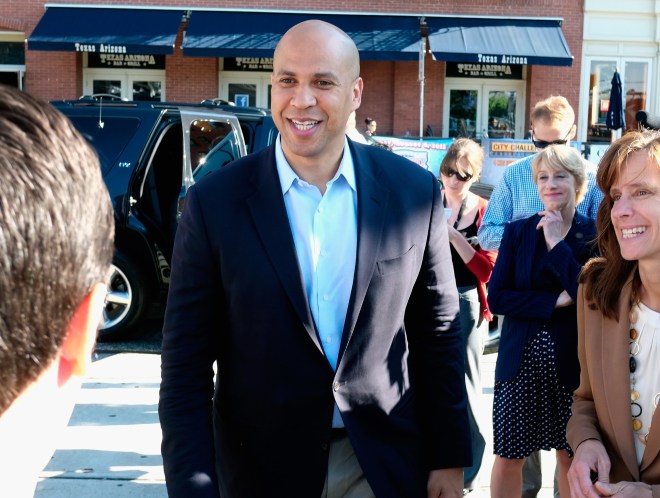
Corey Booker Thanks Constituents After Winning Primary

Most Americans haven’t heard of Cory Booker, who is almost certain to be New Jersey’s next Senator. Pareene provides an unflattering introduction:

In many ways, Booker is perfectly suited for the United States Senate. He won’t be expected to accomplish anything. He will have so many more opportunities to spend time with even more rich people with elite backgrounds and worldviews similar to his. He will have much more access to television studios and Sunday shows and cable news cameras. He will, in short, be the worst kind of senator. The kind that has no power and no real desire to exercise power on behalf of the people the senator ostensibly represents, but the kind that always expresses opinions on television about whatever national issues people on television care about that day.

Enten thinks that Booker will “probably be right in the middle of the Democratic caucus” and places him “slightly to the right of then junior Senator Barack Obama of Illinois“:

That said, it isn’t Booker’s style to stay quiet. He isn’t likely to put his nose to the grindstone and table pieces of legislation that please your tax accountant and nobody else. This is a man who thrives on the affection of fans on Twitterwho runs into buildings that are on fire, who likes to be heard.

So, if Booker isn’t going to make very liberal comments or pass very progressive legislation, then how will he make his presence felt? He’ll do what Obama promised to do when running for president: reach across the aisle.

Weigel is surprised that “that no Democrat ever scored a hit on the guy, who is loathed by some progressives in a way that’s only now being noticed”:

How often do Republicans toss out a conservative for a “gosh, guy, I want to cut deals” moderate? The only progressive argument for Booker, honestly, is that there have been only four African-Americans ever elected to the U.S. Senate, and from only three states, and that the long-term interests of a party that depends on huge minority turnout adding to white liberal turnout are served by promoting nonwhite stars.

Scott Lemieux doesn’t understand what all the fuss is about:

[I]f I’m going to be sold on the idea that he’s some kind of unique threat to the Democratic Party, I’d like someone to name one issue on which he’s to the right of the prohibitive frontrunner for the Democratic nomination in 2016.

(Photo: Newark Mayor Corey Booker greets people along with Hoboken Mayor Dawn Zimmer (R) at the Hoboken PATH station after winning the Democratic primary for U.S. Senate on August 14, 2013. Booker will face off in a special October election against former Bogota, NJ mayor Steve Lonegan to fill the empty Senate seat left formerly held by Frank Lautenberg, who died on June 3rd. By Michael Bocchieri/Getty Images)


Face Of The Day

Volunteers Raise Abandoned Seals, Return Them To The Wild

A young seal named ‘Helene’ watches out a basket at the Seehundstation Norddeich on August 14, 2013 near Norddeich, Germany. The Seehundstation Norddeich is a facility for raising young seals who were separated from their mothers due to storms, disease or human disturbance and who would otherwise have little chance of survival. Volunteers collect about 90 young seals a year from the North Sea German coast and care for the pups until they weigh about 25 kg before releasing them back into the wild. Sponsors pay for the costs of caring for the seals and get to name them. By David Hecker/Getty Images.