Needing A Nook To Be Free

Hugo Macdonald counters the view that small spaces are claustrophobic:

Time once was when rooms in houses were divided into small spaces – each with a prescribed function. It sounds ridiculous. You cooked in the kitchen, ate dinner in the dining room, lived in the living room and so on. The rise of open-plan living after the war was “modern” and progressive, thanks to the dictum of Le Corbusier. It was healthy to let air circulate. And partition walls went the way of the dodo – the enemy of the architect, the preserve of the uncultured. Open-plan living was aspirational. In the 1980s you were nobody if you couldn’t cook, entertain, run a bath and lie in bed all in the same room. A cavernous converted warehouse apartment with exposed brick was the stuff of dreams – endless, uninterrupted space to live and party in. …

We’re constantly reminded that more of us are living alone in singledom than ever before. Could it be that the lofty open-plan living we’re so accustomed to, where couples live in the same single space, is in fact stifling us to distraction and divorce? “Needing space” in a relationship is a little misleading – it should be reworded to “needing spaces”.
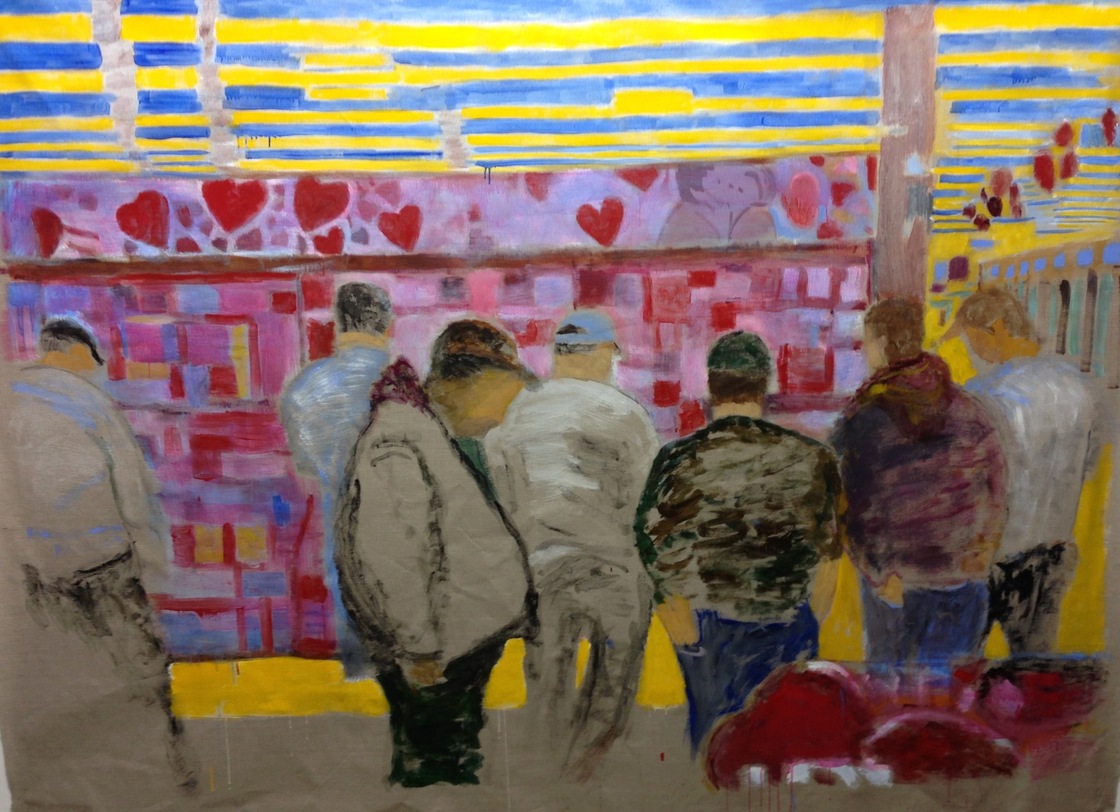

Low Prices, High Art

Maria Godoy admires the work of Brendan O’Connell, painter of Walmart tableaux:

Wal-Mart stores, he notes, are “probably one of the most trafficked interior spaces in the world.” In the tall, open, cathedral-like ceilings of Wal-Mart’s big-box stores, he sees parallels to church interiors of old. “There is something in us that aspires to some kind of transcendence,” he told me back in February. “And as we’ve culturally turned from religious things, we’ve turned our transcendence to acquisition and satisfying desires.”

He says it’s not his most expensive paintings that are selling:

Media reports have lingered over the fact that some of his largest paintings — those 8 feet by 9 feet or so — can fetch $40,000 or more. But O’Connell says it’s the small works in the $1,000-$1,200 range that have been selling. And the people doing the buying, he says, come from all over the country. “What I’m struck by is this relationship to brands,” he says, noting that buyers have called to inquire about specific paintings: ” ‘Do you still have the Corn Flakes? … I want the Maxwell House.’ Whatever brand it is that they have a personal relationship with. And that, to me, is fascinating.”

Susan Orleans’ recent profile of O’Connoll touched on the company’s reaction:

[O’Connell] had never had any official communication with Walmart beyond the local managers inviting him to leave. A dealer who was interested in his work had once approached the company about acquiring one of the paintings but was told that Walmart didn’t buy art. Then, by chance, the Globe article was forwarded to Suraya Bliss, a senior director of digital strategy at the company. Bliss says that she has always been interested in visual things, and collects art herself, and she liked what O’Connell was doing. Instead of interpreting the paintings as arch commentary, she thought he was speaking to the company’s mission. “I got in touch with him and said, ‘Let’s talk and get to know each other,'” Bliss told me. After their conversation, she was convinced that his work was ‘very pure and very genuine.’ She arranged for him to take pictures in stores whenever he wanted, and offered to let him photograph from a cherry picker in one of the New Jersey superstores.

O’Connell is also working on a project, Everyartist.me, which hopes to engage millions of  kids in art.

This Is Your Town On Drugs, Ctd

A reader writes:

I volunteer with the juvenile court in my county. As a result, I work with many parents who are unfortunate enough to have an opiate addiction. I also have a relative with an opiate addiction. My county is not quite as poor as Oxyana, but the demographics are much the same. As a result, we have a lot of opiate addiction here (SW Ohio) and I would say it is the number one drug problem by a large margin. Of the three articles you reference, Warren Jason Street comes the closest to depicting the reality of this problem. But, in my mind, the key quote in his article is not the one you excerpted. It is, rather:

First of all, there is a massive difference between recreational drugs and prescription drugs. In the case of Oceana, West Virginia, the difference couldn’t be more stark–doctors and pharmacies and pharmaceutical companies have profited handsomely at the expense of the citizens who were handed Oxycontin prescriptions to help them deal with “pain.” This is a case of for-profit exploitation, and a tragic one at that.

I attend continuing education conferences every year as part of my volunteer  work. Last year I participated in a seminar given by a drug treatment counselor in southern Ohio. After listening to him talk about opiate addiction and what contributes to it, it’s very clear to me that certain communities are most definitely targeted by “pain” clinic operators.

They set up the pill mills to reach a certain audience, predominately poor/working-class white folks. They staff them with doctors who are ethically challenged (at best!), hang out a shingle, and then proceed to carpet the area with prescription opiates. The drug stores turn their heads and fill the prescriptions.

It’s a massive problem in Florida as well. As a matter of fact, a trip down I-75 will expose you to large billboards advertising pain clinics. My point? These folks addicted to pain killers aren’t just weak-willed hedonists who can’t stop; they have been deliberately and evilly targeted – and only Warren Jason Street seems to understand this.

It’s not clear that any of the authors you cite realize that the manufacturers of Oxycontin were fined by the FDA for deceptive marketing practices. They claimed that Oxy wasn’t addictive and marketed it to doctors that way. It’s clear that Frum doesn’t understand diddly squat about this problem. But perhaps he only objects to street drug dealers, not corporate drug dealers?

There’s much much more evil to the opiate addiction problem. I would love to see some investigative journalism that was able to tie together the collusion of the large drug companies, the large drug store chains like CVS, and the pain clinic operators. I realize that I sound like a foaming at the mouth conspiracy theorist, but I think there’s a lot more to this story than even the documentary shows.

Artistic Communion

Ben Greenman reflects on his decision to use Amy Bennett’s painting “Salute to Water Bodies” for the cover of his new book:

Many of Amy’s paintings made sense to me as extensions of my novel—or maybe it was my novel that was an extension of her paintings — but one struck me as particularly appropriate. It was a vertical painting in which a house, seen from overhead, seemed stuck precariously to its foundation, as if it might slip away at any moment. This worked as a pun, and also as a thematic echo. She identified the perspective as literary and even a bit self-deceiving: “The bird’s eye view is one I keep coming back to. In fact, I think my next series will be mostly done from that perspective. To me it’s like an omniscient narrator. It gives all of the information with a somewhat detached coolness, as if it is undisputed fact.” A little later on, she made another observation about her own work that also seemed to directly address mine: “Often it is the relationship between characters, rather than individual characters, that I am interested in depicting. …

So what does it mean for a novel and a painting to share the same interests? They exist in different kinds of spaces. They are perceived (and possessed) differently by audiences. They are forced to jump through different kinds of hoops to attain critical notice. Can they truly be fraternal twins? I had been building a case, but I started to doubt my own motives. Maybe I was trying to anchor my work in another artist’s work to keep it from disappearing — from slipping away. And yet, in the end, my time with Amy’s work, which followed close upon the heels of my time with my own, had done exactly what I hoped for: it had returned me to some of the basic questions that I had set out to explore, and then shown me that it was not possible to spend too much time inside the inquiry without bumping into another explorer. It’s not fellowship, exactly, but a strong sense of being alone together, which seems like a good way of describing the creative impulse.

The World’s Average Income

Charles Kenny asks, “What is a reasonable ‘income floor’ above which we should hope all people worldwide live?”

At the moment, we define $1.25 [a day] as extreme poverty and $2 as poverty, plain and simple. According to MIT economists Abhijit Banerjee and Esther Duflo, among those living on $2 a day or less in urban areas of Tanzania, only 21 percent have a water tap in their house. In rural areas, it is less than 2 percent. The number with access to electricity is similarly dire. In rural areas, nearly one in 10 children die before their first birthday—most from easily preventable diseases. Two dollars is not nearly enough to ensure the basics of the good life.

The global median income is around $3 to $4 a day. Despite the fact that 50 percent of the population of the planet lives on less than that today, that’s still an insufficient floor. Why? In part because it’s less than the cost of a vente caramel frappuccino at Starbucks, and it seems wrong that most of the planet would subsist for a day on what many happily throw away on a caffeinated milkshake. More significantly, that level of expenditure still doesn’t guarantee people a quality of life we should all deserve.

He goes on to argue for between $10 and $15 a day.

The Daily Wrap

Today on the Dish, Andrew let loose on the continued degrading effects of Gitmo on America, wondered at the etch-a-sketch mentality of McCain and Butters on injecting America into Syria’s war, and took note of the absurd minutiae of the sectarian Mideast. He considered whether Obama has shackled his economic legacy to the fate of the sequester, meditated on the once and future form of blogging, and groaned at the ongoing effects of prohibition on medicinal shroom study. Later on he batted away the taboo on talking condoms and good sex and cringed at video of an airplane crash in Bagram.

In political coverage, we noted the enduring effects of the “yellow cake” snafu in debating Syria’s chemical weapons and Steve Coll warned of drone blowback as Rauch investigated our obsession with medical interventions. We sensed some vibrations in the market for pot lite, Phillip Smith connected PTSD with the healing effect of marijuana, and readers asked Josh Fox how he ended up in the anti-fracking movement. We realized the effect Nixon had on presidential privacy, uncovered psychological prints of natural prejudice and observed the evolutionary desire for basic equality. John Gray situated Marx in his proper place and time, Frum perked up at the drop in American homelessness, a Republican strategist spoke a vision of gloom and doom for the GOP and Dana Mackenzie perused formulas for justice.

In assorted coverage, Kevin Hartnett sized up the largest festival on Earth, William Germano proposed a looser, more bloggy academia, and DL Cade surveyed air crash art. We got to know the significance of oncoming datafication, spotlighted a grim commercial of botched suicide in the Creepy Ad Watch, and Tim Frenholz watched art imitate life in Sim City. Things got volcanic in the answers to this week’s VFYW contest, Daniel Kramb sampled fiction of our hot, crowded future and Laetittia Barbier tracked the grim history of wax museums. Finally, we cranked a Tom Waits/Cookie Monster mashup for the MHB, met the property owner of Bangladesh’s collapsed factory in the Face of the Day and looked out over Rome, Italy for the VFYW.

­–B.J.

This Is Your Town On Drugs

Sean Dunne’s documentary Oxyana depicts the rise of opiate addiction in the town of Oceana, West Virginia:

In a matter of 15 years, a normal community where people felt safe raising their kids has become a town where it is common for teenage girls to prostitute themselves for money. Oceana was a place where you didn’t feel the need to lock your doors. Now, it is tortured by violence. One of the most unforgettable people we meet in Oxyana is an Oxy dealer (and addict) who says bluntly, “It’s an epidemic around here.”

Frum sees the film as an argument against more lenient drug policies:

Many people can experiment with drugs, then quit without excessive trouble. Some people can use drugs for years and remain more or less functional. But more of us – most of us – can’t. I haven’t seen Oxyana yet myself. But I’m looking forward to seeing somebody speak up for those who need their ability to “say no” to be supported by the law, not undermined by it.

Warren Jason Street argues that Frum misses the point:

Opioids, and Oxycontin in particular, are dangerous, addictive substances. You cannot prescribe them to people and then just cut them off. The law is incapable of handing the social ramifications of legally putting people on an addictive substance that then requires them to break the law–and destroy their own lives–in order to keep getting that substance.

Separating Myth From Marx

Reviewing Jonathan Sperber’s Karl Marx: A Nineteenth-Century Life, John Gray puts the philosopher in context:

Sperber’s aim is to present Marx as he actually was—a nineteenth-century thinker engaged with the ideas and events of his time. If you see Marx in this way, many of the disputes that raged around his legacy in the past century will seem unprofitable, even irrelevant. Claiming that Marx was in some way “intellectually responsible” for twentieth-century communism will appear thoroughly misguided; but so will the defense of Marx as a radical democrat, since both views “project back onto the nineteenth century controversies of later times.”

Certainly Marx understood crucial features of capitalism; but they were “those of the capitalism that existed in the early decades of the nineteenth century,” rather than the very different capitalism that exists at the start of the twenty-first century. Again, while he looked ahead to a new kind of human society that would come into being after capitalism had collapsed, Marx had no settled conception of what such a society would be like. Turning to him for a vision of our future, for Sperber, is as misconceived as blaming him for our past.

The Spread Of “Datafication”

Kenneth Neil Cukier and Viktor Mayer-Schoenberger herald its benefits:

Once we datafy things, we can transform their purpose and turn the information into new forms of value. For example, IBM was granted a U.S. patent in 2012 for “securing premises using surface-based computing technology” — a technical way of describing a touch-sensitive floor covering, somewhat like a giant smartphone screen. Datafying the floor can open up all kinds of possibilities. The floor could be able to identify the objects on it, so that it might know to turn on lights in a room or open doors when a person entered. Moreover, it might identify individuals by their weight or by the way they stand and walk. It could tell if someone fell and did not get back up, an important feature for the elderly. Retailers could track the flow of customers through their stores. Once it becomes possible to turn activities of this kind into data that can be stored and analyzed, we can learn more about the world — things we could never know before because we could not measure them easily and cheaply.

Derek Mead passes along the above video:

As photographer Rick Smolan tells it, Big Data is now like the internet was in 1993: People are just learning what it’s about, and people are just figuring out what it is. But then you hear Google CEO Eric Schmidt say things like “There was 5 exabytes of information created between the dawn of civilization through 2003, but that much information is now created every 2 days, and the pace is increasing…People aren’t ready for the technology revolution that’s going to happen to them.” Then you realize that, like the early Web, we’re not sure where Big Data is headed yet.

Face Of The Day

BANGLADESH-BUILDING-DISASTER-TEXTILE

Bangladeshi property tycoon Sohel Rana, seen wearing police-issue body armour and helmet, is escorted for his appearance at the High Court in Dhaka on April 30, 2013. Bangladesh defended Tuesday its decision to snub foreign aid after the collapse of a garment factory complex where at least 388 people died as the UN revealed it had offered specialist help to find survivors. By STRDEL/AFP/Getty Images.