Hopefully these mascots’ crotches are as well protected as their heads:
Year: 2013
If You Give A Browser A Cookie …
Peter Swire worries about the escalating battle over online privacy:
[P]rivacy groups, government regulators, and others have argued that users should have a choice. If people don’t want to be tracked across multiple sites, then they should be able to indicate that choice through their browser settings: “Do Not Track.” Sounds simple enough.
But it’s not. The devil lies in the details of implementation, for there are many stakeholders besides individual users in the online data collection and advertising ecosystem. Without effective targeting and tracking, advertisers argue, ad revenue could plummet and lead to the shuttering of many popular websites that rely on third party ads as their primary source of revenue. Those who buy and sell behavioral advertising and retargeting point out that advertising revenue supports the diverse array of free content available on the internet. From this perspective, online data collection enables innovative business models, and supports the long tail of smaller websites that get revenue from targeted advertisements.
Crowdsourcing On Steroids, Ctd
Zach Braff is following the Veronica Mars model:
Alyssa worries about this trend:
My concern is that we’ll hit a point where studios and creators with even larger fanbases turn to those fans to get financing for films that could have been funded for conventional means solely as a way to boost their own profit margins.
I totally understand that people are excited to pony up for projects that they’re tremendously excited to see go from fantasies to reality. But I hope that as much as fan bases are advocates for creators and series that they’re invested in, that fans remember to advocate for themselves in this process too. Just because you’re willing to give someone a ton of money, or even a little money, to make their movie doesn’t mean that what you get in return is actually a fair trade. It’s terrific to win creative freedom for talented people, but if fans want to upset the corporate business model that drives the film industry, they should recognize that this is still a business, and someone is still making money off of their investments. And if fans goal is to buy that creative freedom for their favorite artists over and over again, it’ll be much more sustainable for them to do that if they’re getting some return on their crowdfunding investments.
Gabe Delahaye is most unpleased:
OH COOL STRAW MAN ARGUMENTS, ZACH BRAFF.
Jim Parsons is an Emmy winning star of the most successful show on television. I don’t think the “money people” would be upset that Zach Braff wanted him to play his “friend.” No one is making Zach Braff rewrite his movie to star Justin Bieber, and Comi-Con has been a prominent feature of multiple movies and TV shows, so please do not try and appeal to the “nerds” as if they are underserved in our culture. If anything, nerds need to take a step back because seriously enough with the nerds already. But, like, DO NOT LIE TO EVERYONE, ZACH BRAFF! And especially don’t lie to everyone UNDER THE GUISE OF BEING THE MOST HONEST. Whatever the complications and restrictions involved in signing financing deals by traditional methods may be, the worst case scenario would by some slight fine-tuning of your project to broaden its commercial appeal, not a wholesale Mad Magazine parody of what people in the 1980s thought Hollywood was about.
In an interview, Braff says that he “would love, more than anything, to have it be you get an equity stake”:
You have 10 bucks, you make your 10 bucks back with the percentage of profit, like a stock. But that’s not legal yet. I think it’s an exciting idea, that you can go, “Oh, I like x, y, and z, I want to buy a piece of that potential film project.” I think that that’s coming. But we’re not there yet legally.
So what do you do in the meantime? You offer them any and every incentive you can think of. But at the very least, if you pay 10 bucks, you’re joining what I like to think of as this club. You see how active I am on social media. I drive my family, friends, and girlfriend crazy. I get a lot of joy out of it. So turning that into an online behind-the-scenes filmmaking magazine, where there will be videos and content and people who are interested in the behind-the-scenes of the making of a movie will go on this ride alongside me — I think that’s cool for 10 bucks.
The Dish’s coverage of the Veronica Mars experiment here.
The Tweet Heard Round The Markets, Ctd
It turns out that the drop in the Dow caused by the fake AP tweet was probably not carried out by human traders, but rather robot ones, specifically high-frequency trading (HFT) algorithms, which parse and automatically act on key words contained in raw news feeds (in this case, “explosions” and “White House” in the same headline). Matthew Phillips explains more:
Though it’ll be months before we know exactly what happened, the consensus is that a handful of trading algorithms responded to the fake tweet by selling a broad range of stocks, bonds, and commodities. As message traffic spiked and prices started declining, HFT firms started backing out of the market, just as they did during the May 2010 Flash Crash [which was caused by a rogue algorithm]. As a result, liquidity dried up, as you can see here in this chart from Nanex. Since there were suddenly relatively few buy orders to match against all those sell orders flooding the market, the dip picked up speed. “When the amount of bids and offers thins out like that, it takes very little volume to move the market in a big way,” says Manoj Narang, chief executive officer and founder of Tradeworx, a Red Bank (N.J.)-based HFT firm.
Phillips goes on to detail how many firms employ aggregation firms to collect and analyze potentially important news for their trading models. But it now seems clear that some firms are also “mainlining Twitter’s ‘firehose’ feed directly into [their] trading algorithm, allowing the model to place trades instantly off the information it’s gleaning through some sort of text-analysis program.” That’s probably not a good idea:
As Narang points out, the vast amount of trading done by computers is statistical in nature, meaning algorithms look for historical patterns in the volumes of market data they sort through every day. The problem with tweets is two-fold. One, they’re super noisy, so gleaning a decent signal out of them takes a lot of analysis and is still pretty hairy. But also, even though some 400 million tweets get sent every day, there’s still not enough historical data out there. They’re still too new.
However, Steven Gandel reports that while the tweet-reading algorithms surely played their part in Tuesday’s flash-crash, it’s unlikely they actually started it:
The fake tweet went out 1:07 PM and 50 seconds. According to Eric Hunsader, who runs market research firm Nanex, the first high-frequency trading firms didn’t react to the fake tweet until 15 seconds after that. Most algorithms are written to respond to data within milliseconds. What’s more, most only respond to specific market-moving news events, like the monthly jobs number.
So Hunsader thinks humans made the first trades based on the fake tweet. Nonetheless, computer trading algorithms, trained to follow the market, likely piled into the selling once it got started. Hunsader says that computer trading systems may have incorporated the potentially bad news into their algorithms. When actual selling began to occur, those systems were primed and headed for the exits faster than usual.
Zooming out, Nick Baumann recently explored the rise and potential dangers of high frequency trading:
This rapid churn has reduced the average holding period of a stock: Half a century ago it was eight years; today it is around five days. Most experts agree that high-speed trading algorithms are now responsible for more than half of US trading. Computer programs send and cancel orders tirelessly in a never-ending campaign to deceive and outrace each other, or sometimes just to slow each other down. They might also flood the market with bogus trade orders to throw off competitors, or stealthily liquidate a large stock position in a manner that doesn’t provoke a price swing. It’s a world where investing—if that’s what you call buying and selling a company’s stock within a matter of seconds—often comes down to how fast you can purchase or offload it, not how much the company is actually worth.
As technology has ushered in a brave new world on Wall Street, the nation’s watchdogs remain behind the curve, unable to effectively monitor, much less regulate, today’s markets. As in 2008, when regulators only seemed to realize after the fact the threat posed by the toxic stew of securitization, the financial whiz kids are again one step—or leap—ahead.
Rock Band Nomenclature
Michael Erard wonders if all the best band names have been taken:
The main driver of the sense that band names are scarcer than they used to be is the central ritual of the naming process itself: typing a name candidate into Google and waiting breathlessly for 100 milliseconds for the verdict. Doing this is less to avoid legal liability than about securing one’s place in the wide world; given that you’re googling yourself and hoping not to find anything at all, it’s more than a little poignant. …
Musicians also point to the rise of Bandcamp, ReverbNation, SoundCloud, and the online music community for exhausting the stock of names.
“Every time we had a name idea we liked, it seemed like there were at least one or two groups with the same name,” Bruce Willen said. “Thanks to the internet any college kid who does home recordings on his or her laptop can start their “band” on Bandcamp or Myspace.” In a way, this makes sense. One can imagine that 20 years ago, any garage band could have any name it wanted—or no name at all. The only reason a band really needed a name was if they were going to gig or record or tour. Let’s say 10 percent of those bands ever left the garage. Today all those bands are on Bandcamp, and they can’t be on Bandcamp without a name. These sites, including Myspace, which has 14 million acts, have inflated the demand for band names.
Meanwhile, Jimmey Kimmel’s “Lie Witness News” went to Coachella this week and tested the limits of fake band names.
Why Is This Not A Weapon Of Mass Destruction? Ctd
John Cassidy imagines the public reaction if the Boston bombers had instead used assault rifles:
Well, for one thing, the brothers would probably have killed a lot more than three people at the marathon. AR-15s can fire up to forty-five rounds a minute, and at close range they can tear apart a human body. If the Tsarnaevs had started firing near the finish line, they might easily have killed dozens of spectators and runners before fleeing or being shot by the police.
The second thing that would have been different is the initial public reaction. Most Americans associate bomb attacks with terrorists. When they hear of mass shootings, they tend to think of sociopaths and unbalanced post-adolescents.
The reason he thinks this mental exercise is useful:
My point is about perceptions and reality, and how the former can shape the latter. The Tsarnaevs did have at least one gun—evidently a pistol, rather than the mini-arsenal originally reported—which they apparently used to kill an M.I.T. police officer, but that wasn’t what kept an entire city locked indoors: it was the fact that there were “terrorists,” who had carried out a bombing, on the loose. As I pointed out the other day, numerically speaking, terrorism, especially homegrown terrorism, is a minor threat to public safety and public health. It pales in comparison to gun violence.
Not An Actual Peggy Noonan Column
But see if you can tell the difference:
“What hurts me—not physically, but metaphorically, rhetorically, to (she taps her heart)—is the disdain some have for this man, a good, wonderful family man and someone who put down the bottle and picked up, —how do I say this?—God. His God. All of our God, even if you believe in another one. How can you not want to wrap you soul around that story? It’s something Democrats—how do I say this?—don’t have. Maybe their arms are too small, maybe—how do I say this?—they don’t see the soul in which to hug. All I know is they’re afraid—they seem to be afraid, I should say, uh–wow, this is hard, because I don’t really know— to show love. It’s a kinder, gentler love they’re lacking. And it makes me—how do I say this?—sad. And I grieve.”
The Creationist Curriculum
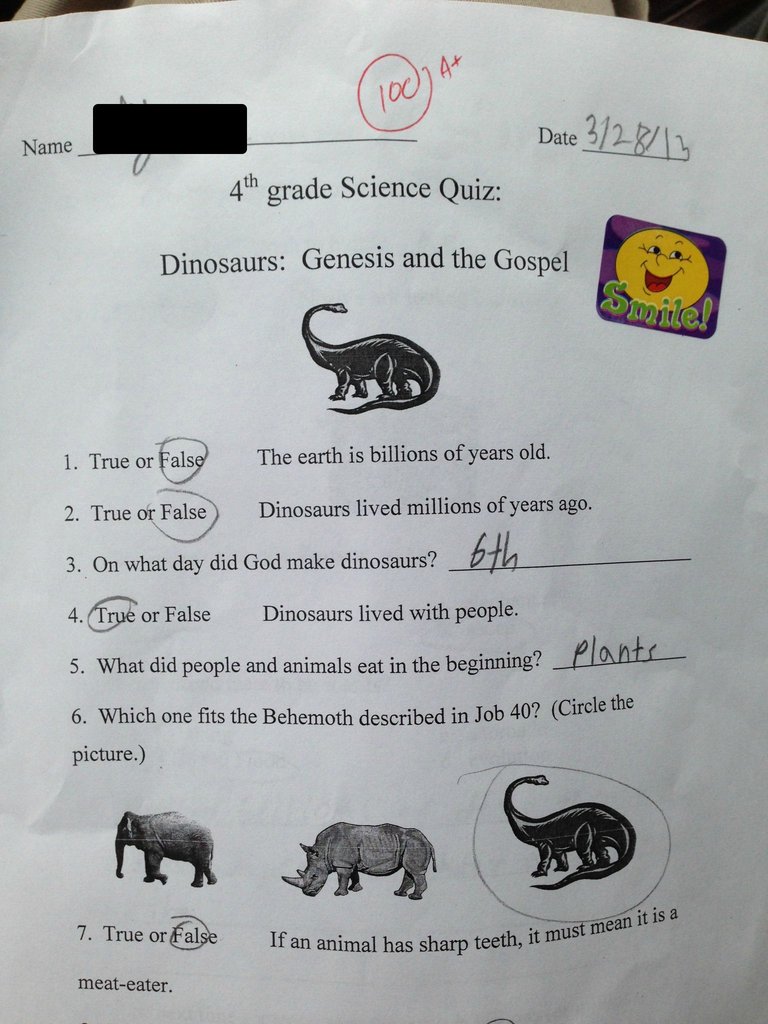
Joe My God passes along a test:
Above is the first page of a “science” test reportedly give to a fourth grade class at a Christian school in South Carolina. After receiving an email from a man claiming to be the father of the student, Snopes has rated the story as “probably true.”
Page two of the test after the jump:
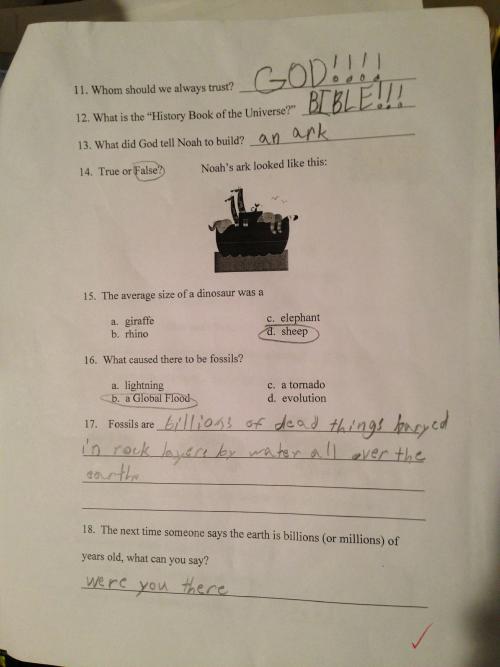
Inside Dangerous Minds
Robert Beckhusen investigates the psychological shifts underlying extremist behavior:
First, the would-be extremist “splits” the world into a rigid division between good and evil as a bulwark against feelings of — real or perceived — helplessness. Unfortunately, there are any number of ready-made ideologies which can serve to encourage this splitting. Next, the extremist constructs a double life that enables him to design, plan and carry out an attack in a “deadly calm state” characterized by single-minded determination.
Only a tiny few ever make it to this stage, but this “deadly calm” means it’s probably too late. “When you are on a mission with a gun or a bomb, you are not just creating another self, you are acting out a role like in a Rambo movie,” Griffin says. They appear outwardly normal to friends, associates and family members. But inside, the extremist believes himself to be preparing for a heroic mission that entails committing acts of violence that are anything but heroic.
The Weak Recovery Continues

Ryan Avent analyzes today’s GDP report, which came in under expectations:
Worringly, today’s figures reflect very little impact from the “sequester”—automatic spending cuts that only recently began to take effect and which may hack off a further 0.6 percentage points from GDP growth this year.
The main source of fiscal pain in the first three months of the year was instead a series of tax changes that took effect at the beginning of 2013 as part of the “fiscal cliff”. Marginal income tax rates rose on top earners at that time. Perhaps more important, a stimulative cut in the payroll tax was allowed to expire, delivering a direct blow to workers’ take-home pay. Despite this, personal consumption spending held up in the first quarter, growing at a 3.2% annual pace. That encouraging performance suggests that household deleveraging may have many families feeling more financially secure and ready to spend. That, in combination with continued contributions from residential construction, hints at the potential for healthy domestic demand growth, if only the government would relax the pace of deficit reduction.
Neil Irwin’s read on the situation:
The report should scratch any thought that our economy is heading into “escape velocity” and breaking into a higher, self-reinforcing trajectory of growth. That had appeared to be the case in the first couple of months of the year. But it just isn’t so. We’re muddling along at basically the same pace we’ve been at for nearly four straight years of this dismal recovery, with growth too slow to make up the lost economic ground from the 2008-2009 recession.
Bernstein looks at year-over-year real GDP:
[G]rowth by this measure is down a bit over the last six months, with the economy growing slightly below its trend growth rate of around 2%. If this underlying pace of growth persists, it will be very difficult to generate the jobs needed to “legitimately” bring down unemployment rate (meaning through job growth, not through people leaving the labor force).
Dylan Matthews provides the above chart.
 The Dish