Carl Sagan’s Highdeas

He wrote in 1969:

I do not consider myself a religious person in the usual sense, but there is a religious aspect to some highs. The heightened sensitivity in all areas gives me a feeling of communion with my surroundings, both animate and inanimate. Sometimes a kind of existential perception of the absurd comes over me and I see with awful certainty the hypocrisies and posturing of myself and my fellow men. And at other times, there is a different sense of the absurd, a playful and whimsical awareness. Both of these senses of the absurd can be communicated, and some of the most rewarding highs I’ve had have been in sharing talk and perceptions and humor.

Cannabis brings us an awareness that we spend a lifetime being trained to overlook and forget and put out of our minds. A sense of what the world is really like can be maddening; cannabis has brought me some feelings for what it is like to be crazy, and how we use that word ‘crazy’ to avoid thinking about things that are too painful for us. In the Soviet Union political dissidents are routinely placed in insane asylums. The same kind of thing, a little more subtle perhaps, occurs here: ‘did you hear what Lenny Bruce said yesterday? He must be crazy.’ When high on cannabis I discovered that there’s somebody inside in those people we call mad.

(Hat tip: The Longform Guide to Weed. Photo of Earth at twilight from NASA.)

The Allure Of War

Craig Hubert interviewed Sebastian Junger about his new documentary:

I wanted to create a platform where [Tim Hetherington]’s work can live and be seen and appreciated. I also wanted to continue what interested Tim, about young men in war and, it’s kind of politically incorrect to say this, why war is so compelling and even attractive to young men. That is true in this society, in many societies around the world. It’s not just a massive manipulation by the military industrial complex, it really is a very ancient thing. I wanted to understand that and Tim did as well.

From another interview:

“I think everyone who goes to war goes to war for very personal reasons,” [Junger] says.

“Sometimes it’s dressed up as patriotism and duty or, for journalists, it’s sometimes dressed up as ‘these stories must be told’ or horrible situations must be documented. All those things are true on paper, but I don’t think anyone risks their life for completely noble reasons. They do it because they have a powerful personal motivation. I think war is seen by many people as transformative – it will turn you into a man, it will turn you into a caring human being – whatever it is, there is a very strong personal component. It’s also a glamorous, romantic, admired job.

Jada Yuan tracks Junger’s own journey:

“When Tim got killed” has become Junger’s line in the sand; it’s the day he decided he was done with combat reporting for good. Junger was supposed to be with Hetherington in Libya but had to stay home. At first he couldn’t shake the idea that if he’d been there, he might have been able to stop the bleeding. Now he knows he probably would have had to watch his friend die. He’d never been taught how to fashion a camera-strap tourniquet, nor had Tim, nor have hardly any of the freelancers who make up the majority of the frontline reporting corps. Last year, Junger started a foundation called RISC (Reporters Instructed in Saving Colleagues) to provide free medical training for experienced freelance combat journalists. “It’s a way to minimize the number of Tims in the world,” he says.

A Guide To Mid-Century Dating

Maria Popova digs up a 1949 questionnaire from Esquire that provides not-so-timeless advice for dating and romance. A sampling of the tips offered to ladies:

Do you knit when you are having a cozy, fireside evening with a man?

For some reason, men hate to see a woman doing anything with her hands when talking to her. Undivided attention is best.

Do you either play bridge or dance really well?

If not, take steps to correct this at once. You’re better off if you do both well, but one talent is mandatory.

For the men:

Would you dine a girl expensively and not buy her flowers, or economize on the place and bring her at least a gardenia?

Most women would prefer having flowers and less to eat.

Facebook Regret

Emily McManus points to “one of the most entertaining academic papers ever written” (pdf):

Our research reveals several possible causes of why users make posts that they later regret: (1) they want to be perceived in favorable ways, (2) they do not think about their reason for posting or the consequences of their posts, (3) they misjudge the culture and norms within their social circles, (4) they are in a “hot” state of high emotion when posting, or under the influence of drugs or alcohol, (5) their postings are seen by an unintended audience, (6) they do not foresee how their posts could be perceived by people within their intended audience, and (7) they misunderstand or misuse the Facebook platform. Some reported incidents had serious repercussions, such as breaking up relationships or job losses.

One of many anecdotes cited:

Sometimes, people accidentally post sexual content. One survey2 respondent said, “I accidentally posted a video of my husband and I having sex . . . I didn’t mean to post it, I had accidentally clicked on the video of my daughter taking her first steps and on that video and they both uploaded together . . . I didn’t know I had posted it until the day after, when I logged on again, and saw all the comments from all of our friends and family, and my husbands coworkers (he’s in the army).”

A Poem For Saturday

bearpoem

“To Be Called a Bear” by Robert Graves:

Bears gash the forest trees
To mark the bounds
Of their own hunting grounds;
They follow the wild bees
Point by point home
For love of honeycomb;
They browse on blueberries.

Then should I stare
If I am called a bear,
And is it not the truth?
Unkept and surly with a sweet tooth
I tilt my muzzle toward the stary hub
Where Queen Callisto guards her cub,

But envy those that here
All winter breathing slow
Sleep warm under the snow,
That yawn awake when the skies clear,
And lank with longing grow
No more than one brief month a year.

(Used with the kind permission of The Robert Graves Copyright Trust. Photo by Flickr user Marshmallow)

Giving The Kid A Bottle

Max Fisher points to a study by UNICEF debunking some assumptions about which Europeans start drinking at a young age:

Despite the strong wine cultures in Italy, France and Spain – or maybe because of them, given the degree to which it cultivates drinking “to enjoy,” as I’ve heard many French say – children in those countries are among the least likely to get drunk.

Kids appear to be much more likely to get drunk in former Soviet states, particularly the Baltic states and Finland, the latter of which might be a surprise given that its kids otherwise score among the highest well-being in the Western world. That may be a partial legacy of Soviet bloc drinking culture, which have the highest alcohol consumption rates in the world and tend to be plagued by alcoholism.

The US ranks last in the surveyed countries.

Face Of The Day

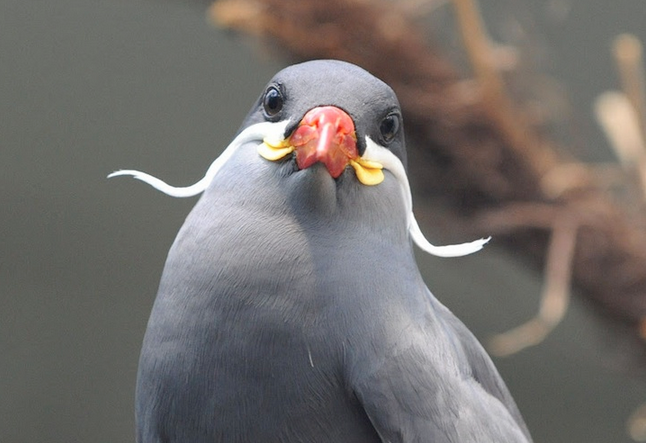
If Dalí were a bird, he’d be an Inca Tern:

Found along the rocky Pacific coastline, from northern Peru south to central Chile, the uniquely plumaged bird is easily recognizable for its dark grey body, its red-orange beak and feet and, of course, that curling white mustache. Sadly, its population has decreased at a rapid rate due to the loss of suitable nesting areas. They’re only an estimated 150,000 left, classifying them as near threatened.

(Photo by Maks Rozenbaum)

Bourgeois Babbling

William Deresiewicz points out that the distortion of the English language often starts with the elite:

There is a lesson here. Idiomatic mistakes, at least the ones that stick, are not produced by the hoi polloi. They happen when people try to sound educated—or to be precise, when educated people try to sound more educated than they actually are. A little learning is a dangerous thing. You hear a word like vagariesor misnomer, you think it sounds impressive, you think you know what it means, and you deploy it the next chance you get. And then somebody who has less cultural capital than you, and who looks to you as an authority, picks it up and uses it in turn.