Feeling Others’ Rage

In the wake of the Boston bombings, Greenwald asks Americans to empathize with individuals in countries regularly bombed by the US:

[W]hatever rage you’re feeling toward the perpetrator of this Boston attack, that’s the rage in sustained form that people across the world feel toward the US for killing innocent people in their countries. Whatever sadness you feel for yesterday’s victims, the same level of sadness is warranted for the innocent people whose lives are ended by American bombs. However profound a loss you recognize the parents and family members of these victims to have suffered, that’s the same loss experienced by victims of US violence. It’s natural that it won’t be felt as intensely when the victims are far away and mostly invisible, but applying these reactions to those acts of US aggression would go a long way toward better understanding what they are and the outcomes they generate.

I note only that today, more than 55 Iraqi civilians were killed by a wave of terrorism, a function of the botched invasion, occupation and sectarian disintegration the US set in motion. On the day of the Boston marathon, a new post-occupation record of 65 deaths was recorded.
Pot Polling Update

DC supports legalization:

A poll conducted by Public Policy Polling (PPP) and co-commissioned by the Marijuana Policy Project (MPP) and the Drug Policy Alliance (DPA) found that 63 percent of D.C. residents support taxing and regulating marijuana like alcohol, and that 75 percent of residents think the drug should be decriminalized.

In fact, no matter which liberalization scenario PPP presented–a $300 fine for cultivation with no jail time, a $100 fine for possession with no jail time, tax-and-regulate, unregulated legal possession for adults over 21, broadening the criteria for medical marijuana–a majority of respondents favored lessening or eliminating penalties for marijuana offenses.

The Media Frenzy In Boston

Told in four tweets:

The Safety Of Marathons

Lydia DePillis argues that marathons are impossible to secure completely. Alyssa thinks tight security “would fundamentally change the nature of marathoning for both participants and spectators”:

As Erin Gloria Ryan wrote for Jezebel, much of the value of these events is in the interaction between large numbers of runners and large numbers of viewers in close proximity to them. “The spectators — people who show up and cheer with noisemakers and high fives and encouraging cheers and magic-markered tagboard signs that read “YOU ALL ARE CRAZY! KEEP RUNNING!”— are the people who matter most to runners,” she explained. ” Without those people, a marathon would just be an exercise in self-abuse from a large group of crazies. But there is meaning in marathoning: the people who watch.”

Russell Saunders zooms out and observes “the ironic failure of terrorism”:

It shouldn’t be an act of courage to dine out in Tel Aviv. It’s shouldn’t be an act of courage to buy groceries in Baghdad. It shouldn’t be an act of courage to earn your paycheck in a skyscraper in Manhattan.

And then it becomes one.

Which is the ironic failure of terrorism. Because of course people will continue to dine out in Tel Aviv and go to market in Baghdad and step on the elevator in New York City. Where previously they did so without thinking, now they do so in a quietly defiant way. Because people will refuse to obey the dictates of the depraved and craven, and will go on living their lives. They will locate the courage within themselves. They will keep running marathons.

Bruce Schneier’s words of advice:

The damage from terrorism is primarily emotional. To the extent this terrorist attack succeeds has very little do with the attack itself. It’s all about our reaction. We must refuse to be terrorized. Imagine if the bombs were found and moved at the last second, and no one died, but everyone was just as scared. The terrorists would have succeeded anyway. If you are scared, they win. If you refuse to be scared, they lose, no matter how much carnage they commit.

A Path-Breaking Pulitzer

This year’s prize for National Reporting was awarded to an unlikely recipient:

InsideClimate News reporters Elizabeth McGowan, Lisa Song and David Hasemyer are the winners of this year’s Pulitzer Prize for national reporting. The trio took top honors in the category for their work on “The Dilbit Disaster: Inside the Biggest Oil Spill You’ve Never Heard Of,” a project that began with a seven-month investigation into the million-gallon spill of Canadian tar sands oil into the Kalamazoo River in 2010. It broadened into an examination of national pipeline safety issues, and how unprepared the nation is for the impending flood of imports of a more corrosive and more dangerous form of oil.

This reach-out to the new brood of lean, small reporting web outfits is really, really gratifying. Their total budget? $550,000. They have no office. Sound familiar? There are only three of them on the Pulitzer team. Dan Nguyen puts the award in further context:

At just 5 years old and with only 7 full-time reporters, InsideClimate News is likely the smallest news organization ever to win in the National Reporting category …

Here’s another size measurement: According to the AP, InsideClimate had about 200,000 page views last month. The winner of last year’s National Reporting Pulitzer, the Huffington Post, is also an online-only news site. But it reportedly racks up a a billion page views a month: i.e., 5,000 times the page views at InsideClimate.

Numbers may seem like a superficial metric, but there’s a reason why big papers dominate every Pulitzer category (except for maybe Public Service) – big investigations require big resources. InsideClimate’s investigation occupied 3 of their reporters for 7 months, a major commitment for a news organization still struggling to draw a daily readership. Even more impressive: InsideClimate is based in Brooklyn, but they invested time and money (i.e. a travel budget) for a story several states away.

Crowd-Sourcing Police Work

4Chan_Image

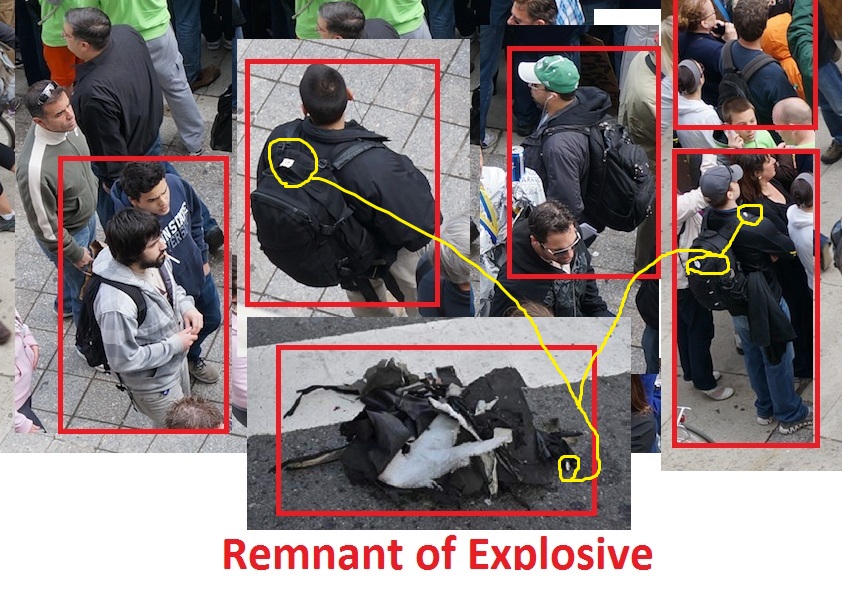
Reddit has a thread dedicated to finding the Boston marathon bomber(s). 4Chan is also on the case. Alexis begs them to stop:

Investigating these bombings is just not a job for “the crowd,” even if technology makes such collaboration possible. Even if we were to admit that Reddit was “more efficient” in processing the influx of media around the bombing, which would be a completely baseless speculation/stretch/defense, it still wouldn’t make sense to create a lawless space in which self-appointed citizens decide which other citizens have committed crimes. This would be at the top of any BuzzFeed list of the tried-and-true lessons of modern civilization. We have a legal system for a reason.

(Image from 4Chan’s round-up of Boston photographs)

Tweet Of The Day

There are conflicting reports and confusion all over cable news and Twitter this afternoon, so we will stay calm and blog on for now, until we spot something conclusive. Update: The FBI just issued a scathing statement:

Contrary to widespread reporting, there have been no arrests made in connection with the Boston Marathon attack. Over the past day and a half, there have been a number of press reports based on information from unofficial sources that has been inaccurate. Since these stories often have unintended consequences, we ask the media, particularly at this early stage of the investigation, to exercise caution and attempt to verify information through appropriate official channels before reporting.

Ellie Hall chronicles the clusterfuck.

“It Was All Just Supposed To Be Symbolic”

557949_10151600344921322_1462963247_n

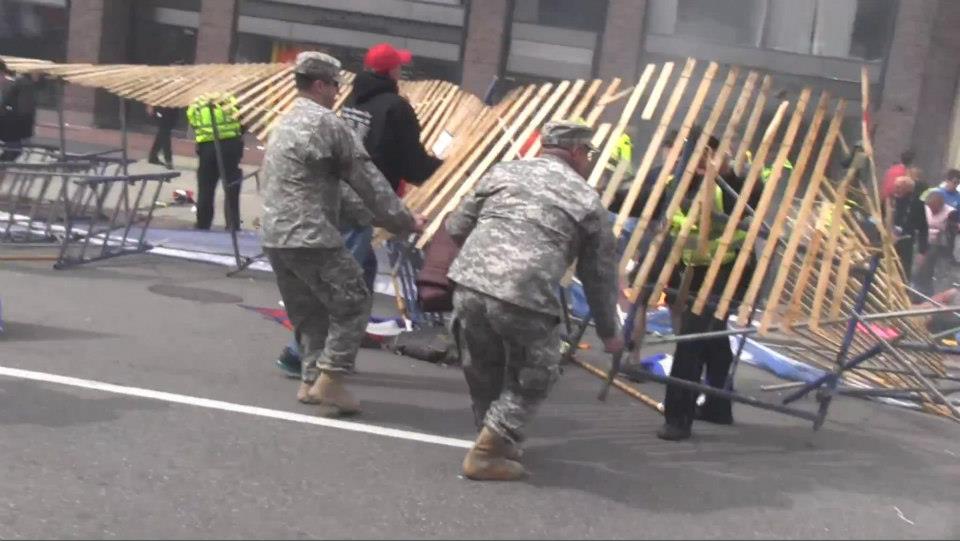
Some “Tough Ruck 2013” soldiers ran the Boston Marathon with “a military backpack weighing about 40 pounds. The rucks were filled with Camelbacks of water, extra uniforms, Gatorade, changes of socks—and first-aid and trauma kits.” They ran it in honor of their fallen comrades and those now committing suicide in record numbers under the weight of PTSD. The first-aid and trauma kits came in handy.

By the way, that dude in the cowboy hat who rescued the guy with the blasted-off lower leg? He’d lost one son in Iraq and another son to suicide because of his brother’s death. He was carrying pictures of both of them that day.

But suddenly he had a stranger’s life to save. So he did. Maybe we should start remembering him instead of fixating on whatever sick mind for whatever sick purpose planted those devices.