Chronicling The Carnage

The Boston Globe’s Big Picture has the most stirring images from yesterday. A reader responds to what was probably the most gruesome photo to surface:

Please, please, I hope to find that the man in the wheelchair with the bilateral leg trauma (and amputations) has survived. He will be in every prayer I have the ability to pray. If you hear of him, please let us know.

He appears to be alive and stable. A little background on the young man here. By the way, the guy in the cowboy hat seen helping in the photo is also featured in this stirring Youtube, in which he recalls the carnage while shaking uncontrollably. He also appears to be the same guy holding up the American flag in the middle of the bomb site. His name is Carlos Arredondo and his remarkable backstory is here.

The Daily Wrap

Explosions At 117th Boston Marathon

Today on the Dish, we rounded up coverage of the Boston Marathon bombing, from reax on Twitter to commentary and context in the blogosphere, while holding out further analysis until more information emerges. Patton Oswalt had the last word on the tragedy for today.

In other coverage, Andrew took apart Paul Wolfowitz’s retrospective of the Iraq War and pondered whether Pope Francis will drag the Church into the light of modern day. He also questioned our modern fixation on life-extending medicine despite the pain it can bring and wondered how soon news orgs will face the music of a new era. Elsewhere, Andrew responded to TNC’s thoughts on Rand Paul trip to Howard University, and shook his head at the ongoing merger of Christianity and Ayn Rand’s Objectivism in certain quarters of the GOP.

In more political news and views, Andrew Solomon expressed mixed feelings on North Dakota’s new law restricting abortion as we studied the frequency of cross-confessional marriage and cut subsidies for electric cars down to size. Readers filled in the media’s gaps on the horrific story of Kermit Gosnell as we gathered increasing commentary on the case. We met the rare souls who enjoy filling out tax forms while Heritage illustrated where your tax dollars ended up this past year. Finally, Marc Lynch rationalized the Muslim Brotherhood’s irrational track record while a reader took on Susan Jacoby’s reasons to leave religion.

In miscellanea, readers asked Rod Dreher about hometown blues, Willie Nelson spoke for the moment, in the moment, we found a reason for our ‘ums’ and ‘uhs,’ and remembered the first VFYW, in Los Angeles.  Michael Wolf awed with his photographs of Hong Kong high rises as we ate breakfast overlooking the Earth and listened closely to the sound of the universe being born. Later we put away our dreams for an invisibility cloak, shopped for germs and browsed some risqué botany. Lastly, we spent a moment in Rome for the VFYW and witnessed the shock following the Boston bombing in the Face of the Day.

–B.J.

(Photo: A man comforts a victim on the sidewalk at the scene of the first explosion near the finish line of the 117th Boston Marathon. By John Tlumacki/The Boston Globe via Getty Images)

Quote For The Day

“I don’t know what’s going to be revealed to be behind all of this mayhem. One human insect or a poisonous mass of broken sociopaths. But here’s what I DO know. If it’s one person or a HUNDRED people, that number is not even a fraction of a fraction of a fraction of a percent of the population on this planet. You watch the videos of the carnage and there are people running TOWARDS the destruction to help out. … This is a giant planet and we’re lucky to live on it but there are prices and penalties incurred for the daily miracle of existence. One of them is, every once in awhile, the wiring of a tiny sliver of the species gets snarled and they’re pointed towards darkness.

But the vast majority stands against that darkness and, like white blood cells attacking a virus, they dilute and weaken and eventually wash away the evil doers and, more importantly, the damage they wreak. This is beyond religion or creed or nation. We would not be here if humanity were inherently evil. We’d have eaten ourselves alive long ago,” – Patton Oswalt.

Converting To Atheism, Ctd

This embed is invalid


A minister criticizes Susan Jacoby for cherry-picking religious arguments:

Why is there polio? Why are there diseases?” If there is a good God why are there these things? The answer of the religious person is “God has a plan we don’t understand.”

That is not the religious answer.  That is a religious answer.  It happens to be a bad answer.  It is bad theology.  Atheism is a rational rejection of bad theology – and more power to them.  But there is also good theology out there – good religious answers which do justice both to our reason and to our spirits.

Why does God allow polio and disease and other bad things to happen to good people?  Because God is not an omnipotent manipulator of the world.  Because God works through the system, not over-powering it.  Because we have free will that allows us to create justice and love, and also evil.  God’s power is not coercive (“you must not do that horrible thing and I will stay your hand”) but patiently persuasive (“there’s a better way, make a better choice”).  God’s “plan” was not to create polio, or human beings, but to set the conditions and watch what we do, and to use that “still, small voice” to gently urge all creation toward divine ideals of deep rich experience, consciousness, love, marvelous beauty, and thoughtful theology.

As any teenage theologian can see, the idea of a simultaneously all-powerful and all-loving God is impossible based on the evidence of the tragedies that befall us everyday.  But there is better theology available.  The churches should be better teachers.  And atheists shouldn’t give up so soon.

Another reader views her youthful conversion to atheism as simply a step in her lifelong spiritual development:

During those early years it is not just typical but imperative for intellectual development to question all received wisdom. Everything that once made sense no longer does. Faith in God is a great example of that because it is taught to children when ultimately, to be authentic, it must be felt.

But the years after do something to us. We have hard times and unexpected joys and we begin to see nuance and complexity where everything had previously been so black and white. We’re humbled by this, by the sense that what we accepted may have been wrong, that we are and always will be a work in progress. For many people, that means discovering faith in a more mature and meaningful sense than what we were given as children.

I certainly followed that trajectory. As a teen and young adult, God just didn’t make sense to me. I couldn’t understand how anyone could believe that irrational nonsense. But at some point in middle age, as I negotiated the rough contours of my life, I began a kind of inner dialogue – sometimes accusatory and angry and sometimes grateful – with, I thought, myself. Eventually I realized I was engaging in a personal relationship with God. And once I understood that, fully grasped it, atheism just didn’t make sense to me anymore. Once again, everything that had made sense to me no longer did. I have a faith that I never thought I would have.

One reader takes issue with Jacoby’s tone:

My beef is actually with Susan Jacoby and the flippant way that she deals with the conversion of Paul. The problem with atheists has always been that they pride themselves on having discovered ‘the truth’ and hence also accord themselves the licence to belittle people of faith. In Susan’s words, ‘A voice appears out of the sky, you fall off your horse, you hit yourself on the head, and when you wake up you know Jesus is the lord.’ To deal with the conversion of Saul in such a disparaging way is why people of faith have no patience with the logic put forth by atheists. Saul didn’t fall down from his horse and hit his head and wake up a loony. I can take any text from any book and put forth the same derisiveness. All it requires is a little sarcasm and cynicism.

According to the Bible, you don’t need to worship stones and trees or have Gods with exotic names like Baal and Astaroth. When atheists are unwilling to entertain an opposing thought and are dogged about their determination to have converts, then it’s just another religion.

Another reader focuses on Saul’s conversion, and describes his similarly sudden conversion to atheism while visiting Mecca:

There I was in the middle of the teeming masses, observing an essentially pagan pilgrimage co-opted by Islam to gain the support of Mecca’s merchant class whose livelihoods had depended on it, a fact conveniently ignored/forgotten by most Muslims. And it hit me right there and then! None of this made any sense! NONE! Why are we going around this big black cube? Why do we have to pray five times a day? If God is all-knowing and all-powerful, surely he doesn’t need us to reaffirm our faith in him five times a day.

I left Mecca with the firm conviction that I was better off not worrying. I was already 40 years old, and I had a strong sense of right and wrong, and how to live the best life I could possibly live and how to be the best human being I could possibly be; a work in progress admittedly. I guess I had a Damascene conversion in Mecca!

Another points to Ricky Gervais (in the above video) as a similar “Damascene convert.”
As The Smoke Clears

Multiple People Injured After Explosions Near Finish Line at Boston Marathon

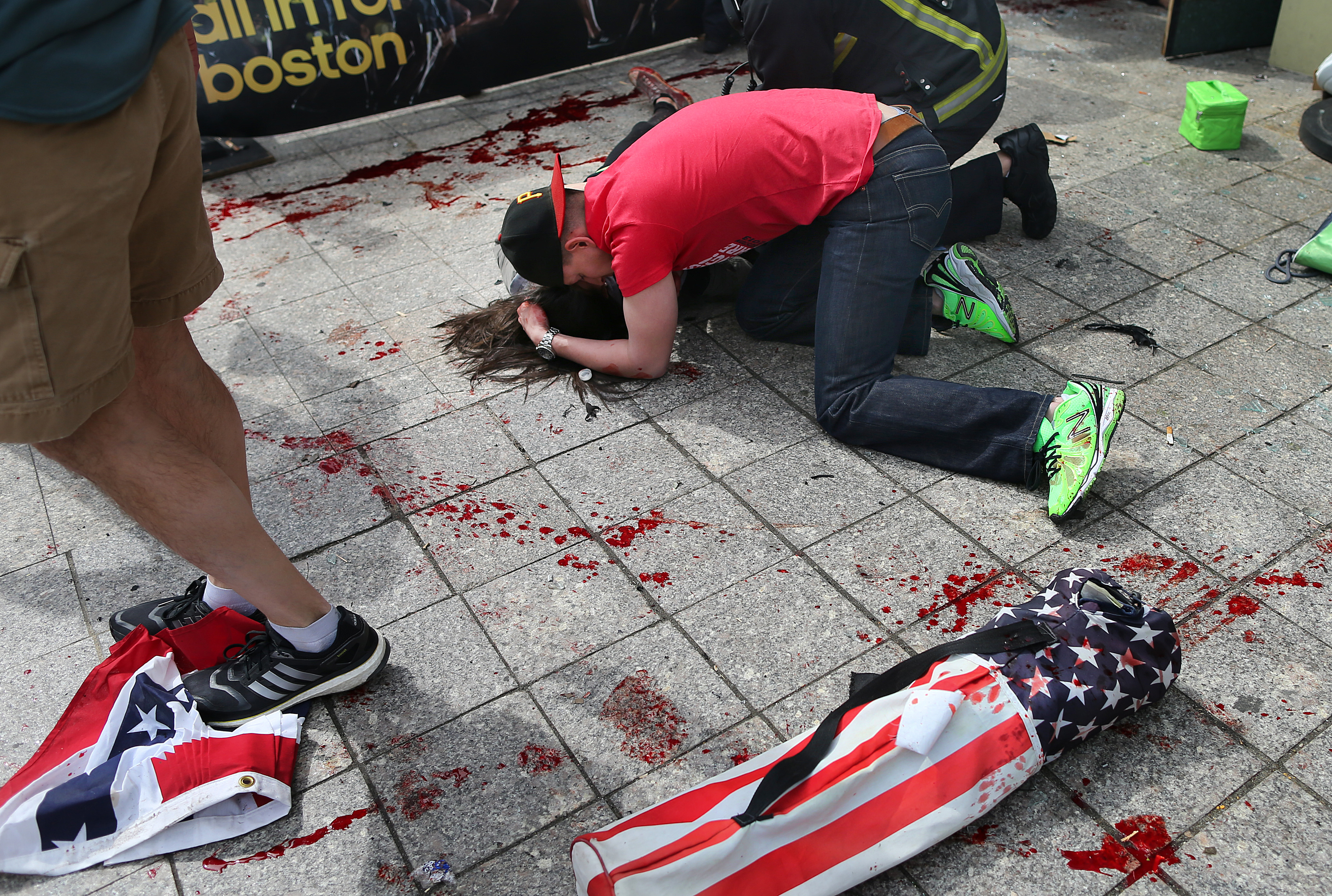
Charles Pierce reports from Boston:

Once I got to Copley Square, I sat down and talked to an EMT. He had been one of the first on the scene. The problem the EMTs had was that the bomb went off inside the security barricades. The barricades meant to protect the spectators briefly prevented the EMTs from reaching the injured. This was not the last of the day’s cruel ironies. The EMT told me that the first person he saw was a 5- or 6-year-old with blood on his face. He did not seem to be in any way injured. One of his parents lay on the ground next to him. The parent wasn’t moving.

Marc Herman points out that “today’s attack at the finish line appears to have coincided with the moment when, statistically, the largest number of runners — and presumably their friends and family — would be nearby.” Nicholas Thompson zooms out:

There’s something particularly devastating about an attack on a marathon. It’s an epic event in which men and women appear almost superhuman. The winning men run for hours at a pace even normal fit people can only hold in a sprint. But it’s also so ordinary. It’s not held in a stadium or on a track. It’s held in the same streets everyone drives on and walks down. An attack on a marathon is, in some ways, more devastating than an attack on a stadium; you’re hitting something special but also something very quotidian.

Ezra Klein focuses on the response to the tragedy:

If you are losing faith in human nature today, watch what happens in the aftermath of an attack on the Boston Marathon. The flood of donations crashed the Red Cross’s Web site. The organization tweeted that its blood supplies are already full. People are lining up outside of Tufts Medical Center to try and help. Runners are already vowing to be at marathons in the coming weeks and months. This won’t be the last time the squeakers run Boston. This won’t be the last time we gather at the finish line to marvel how much more we can take than anyone ever thought possible.

(Photo: Beacon Street near Kenmore Square remains empty for the use of emergency vehicles after two explosive devices detonated at the finish line of the 117th Boston Marathon on April 15, 2013 in Boston, Massachusetts. Two people are confirmed dead and at least 23 injured after two explosions went off near the finish line to the marathon. By Alex Trautwig/Getty Images)

Choosing A Special Needs Child

RUSSIA-SOCIETY-DISABILITY-CHILDREN

Andrew Solomon is troubled by North Dakota’s new abortion laws, which “criminalize selective abortion, which means that a woman cannot choose to terminate a pregnancy because she knows the fetus has a genetic abnormality, or to select for other characteristics, such as gender.” He is in favor of choice but also the choice to embrace the joy that children with special needs can bring:

I have written in my most recent book, “Far From the Tree,” about the rich experience many parents find in children with conditions against which people often select. I would never propose to anyone—even to myself—that such parents’ rapture constitutes an imperative to bring similar children into the world.

I do see a problem, however, in the speed with which women who have no prior exposure to the conditions in question are expected to make these decisions. Women often terminate a pregnancy without knowing what life would be like with and for an anomalous child. It is worth publicizing the satisfaction that the experience may entail, so that the pro-choice movement becomes the pro-informed-choice movement. Others have already pointed out that if we want people to keep these pregnancies, we might start by providing better services for people with disabilities; our neglect of decent care is a national disgrace, and is ignored in North Dakota’s new statutes.

We’re back to the seamless garment of Catholic teaching.

(Photo: Russian actress Evelina Bledans plays with her son Semyon, a child with Down syndrome, in their country house outside Moscow, on February 8, 2013. Evelina’s decision to keep her little son and recount his life in a blog named after him is often met with incomprehension in Russia, where the majority of children with Down syndrome are abandoned by their parents immediately after birth. By Kirill Kudravtsev/AFP/Getty Images.)

What The Marathon Means To Boston

Erik Malinowski explains the significance of the race:

If you’ve never run in, or even merely attended, the Boston Marathon, there are some unequivocal facts you should know. First, it’s an extremely open event, in the sense that the only thing separating you — well, you and a couple hundred thousand of your fellow spectators — from the planet’s most elite runners is usually nothing. Sometimes, it’s one of those easily moveable steel police barricades, sometimes it’s a piece of race tape, sometimes it’s the stern hand of a volunteer. But sometimes it’s nothing, and people are always running from one side of the course to the other. You have to time it like you’re running across the street in Rome. Runners come by out of nowhere and you don’t want to be the guy who accidentally tripped the lead runner when he was a mile or two from history.

Secondly, it’s more or less a mammoth, citywide party. The Red Sox play their annual Patriots’ Day game at 11:05 am, timed specifically so that three hours later, when the game ends, the crowd might file out to Kenmore Square and see a huge pack of participants run by on tired legs toward Copley Square and the finish line. A lot of people have a few drinks, which often leads to jokes about how easy it would be for any old spectator, to just tackle one of the lead runners at any time. But it never happened, because who would want to mess up the Boston Marathon? It was too much fun. You wouldn’t think standing there and watching people run — I mean, think about how that sounds — could be so much damn fun, but it always was.

Alyssa describes the marathon’s historical importance:

Boston is a city particularly defined by its sports teams and sporting events, and the Boston Marathon is one of the most important of them, even if it doesn’t inspire the same local fervor as the Red Sox or the Patriots, though it does attract 500,000 spectators each year. The Boston Marathon is the oldest continuously-run annual marathon in the world, and the second-oldest footrace, inspired in its first year, 1897, by the marathon at the 1896 Olympics.

Mixed-Faith Marriages

They are increasingly common:

American rates of inter-faith and inter-denominational marriage are rising, to the point where 45% of marriages in the past decade have involved either two religions or Christian doctrines that clash seriously (that rate includes unions spanning the evangelical and mainstream Protestant traditions—when all Protestants are lumped together, the mixed-marriage rate is 36%). Many are models of tolerance and creativity. Naomi Schaefer Riley, author of a new study of such marriages, records a wedding which featured two New Testament readings, the breaking of a glass (recalling the first-century destruction of the Temple in Jerusalem), the reading of a Jewish marriage contract, a transcendentalist poem and an Apache wedding prayer.

But there are some downsides to this development:

Inter-faith marriages are more likely to end in divorce. Half of marriages between evangelical Protestants and non-evangelicals fail, and prominent evangelical pastors warn of the “emotional anguish” of marriage to someone who does not share their strict interpretation of faith.

Who Did It – And Why?

Multiple People Injured After Explosions Near Finish Line at Boston Marathon

The short answer at this point is that we do not know and the Dish has learned not to speculate. We now have a graphic idea of what happened – but no context to make sense of it. Until the full context emerges, we’re not guessing.

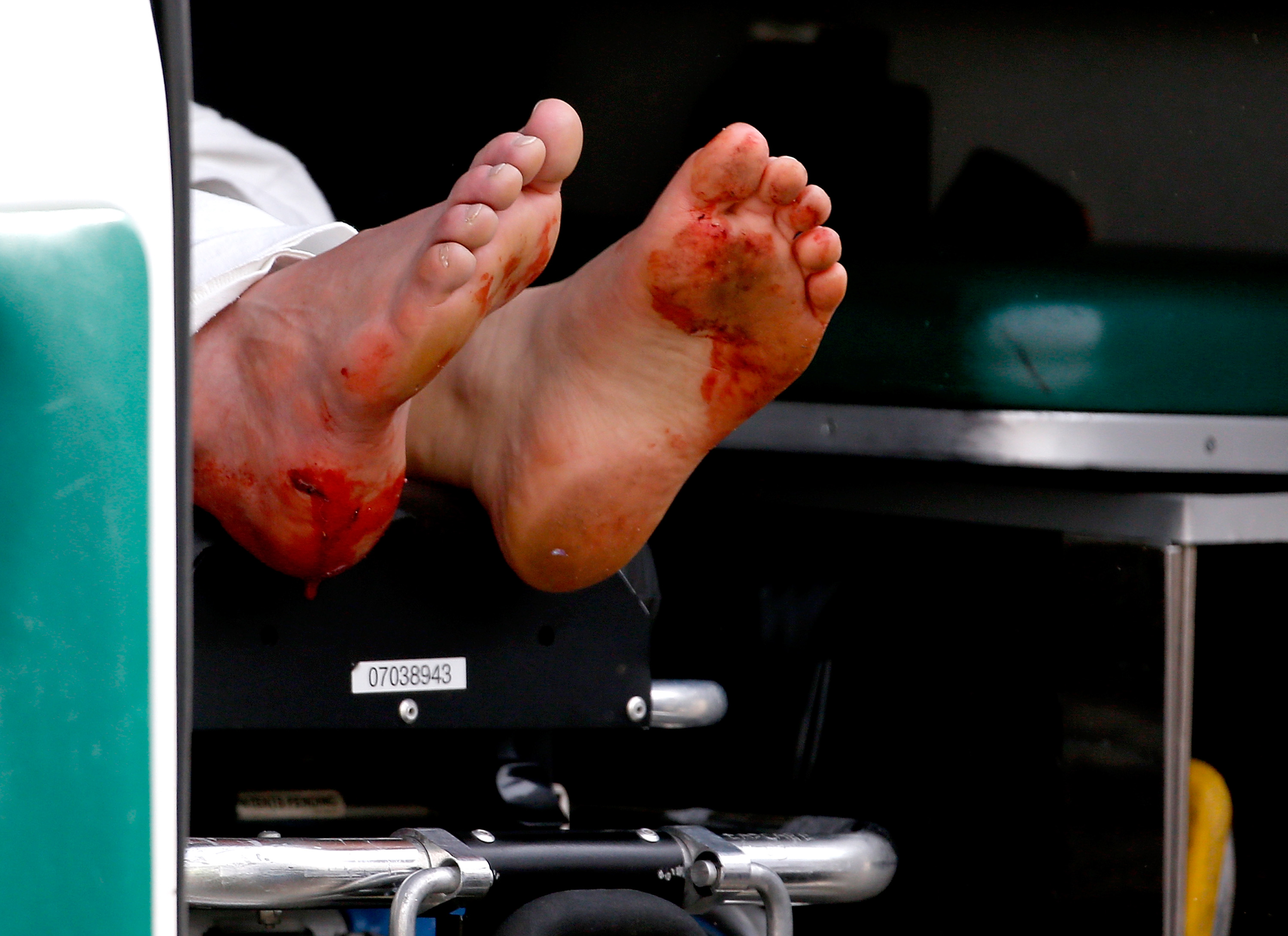
(Photo: Two blood stained feet of a man hangs outside an ambulance outside a medical tent located near the finish of the 117th Boston Marathon after two bombs exploded on the marathon route on April 15, 2013 in Boston, Massachusetts. By Jim Rogash/Getty Images)