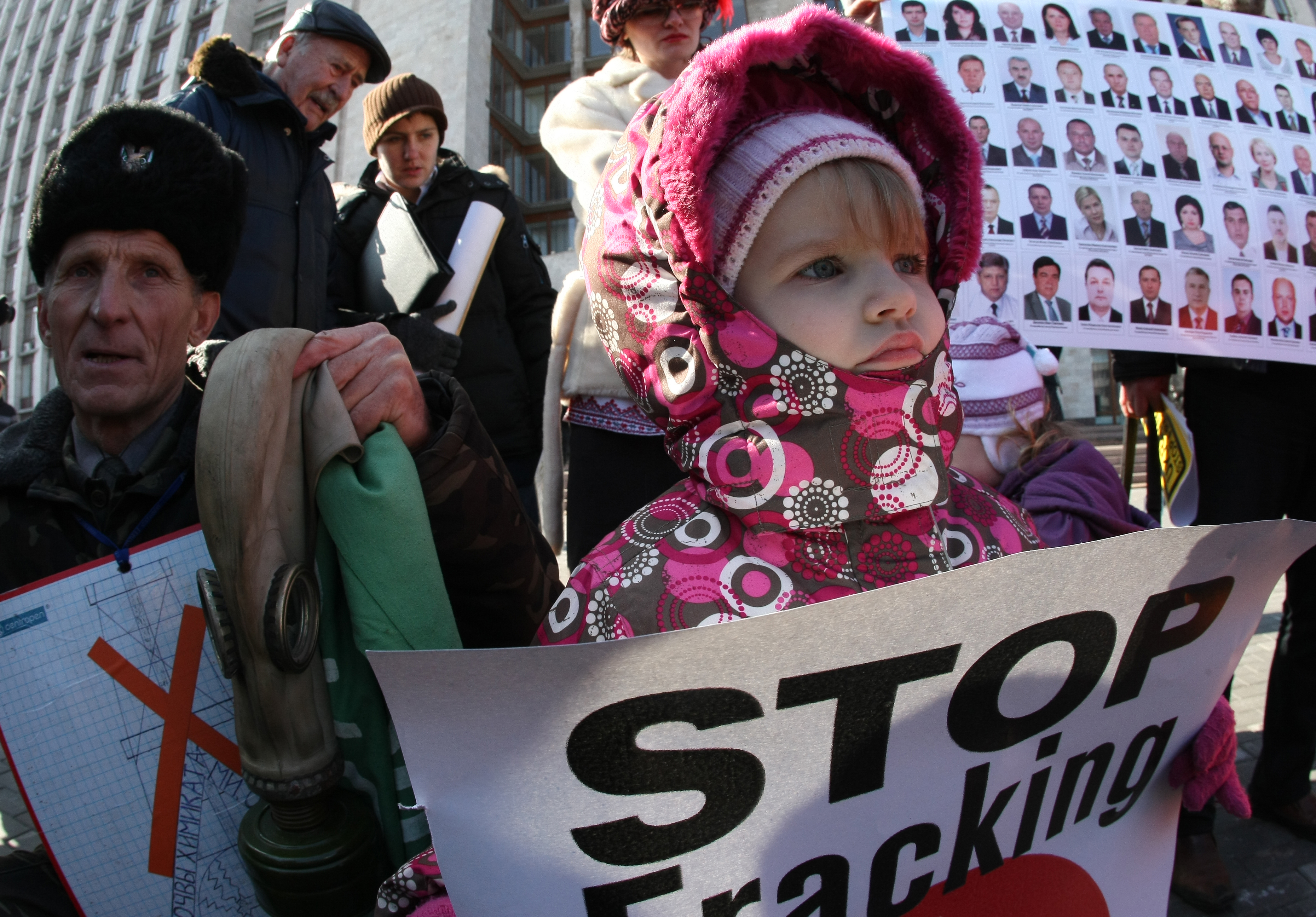
The Fracking Divide

By Doug Allen

UKRAINE ECOLOGY-GAS-PROTEST

Kevin Drum thinks the recent Citigroup report that sees natural gas as a major ally for renewable deployment will cause some tension among environmentalists:

If this analysis is correct, it’s going to provide some major heartburn for environmentalists. Fracking, for all its dangers, may turn out to be the least of our various fossil fuel evils.

Jason Mark focuses in on how this issue is dividing green advocates:

[S]ince the fracking boom began in earnest, a larger, anti-fracking grassroots has emerged. … Some homeowners had their wells contaminated with flammable methane. Places like Ohio and Arkansas that weren’t used to seismic activity started to experience earthquakes when underground wastewater injections stimulated geologic faults. Today, the movement against gas fracking has become a cause célèbre (Yoko Ono and Mark Ruffalo have an “Artists Against Fracking” group) and is one of the most invigorating issues among grassroots environmentalists. …

[Ted] Nordhaus and [Michael] Shellenberger [of the Breakthrough Institute] have a nearly opposite worry: that the intensity from [anti-fracking] partisans like [Sandra] Steingraber and [Maura] Stephens has forced some big green groups to retreat from gas. The World Resources Institute, a D.C.-based environmental research organization, is an example of that shift. As recently as early 2012, the organization was expressing qualified enthusiasm for gas as a “potential game changer” that “should be part of America’s low-carbon energy mix.” But when asked recently to comment on the gas controversy, Jennifer Morgan, director of the institute’s climate and energy program, chose her words carefully. “It’s an extremely fraught and tough discussion,” Morgan told me. “I think we recognize both the risks—and the risks are significant—and the potential opportunity.”

I’m pretty firmly in the Nordhaus/Shellenberger camp on this one. Among the resources that can provide the operational support needed for high levels of renewable penetration in our energy mix, I think natural gas strikes the best balance between cost and environmental impact. It would take major advances in energy storage or “clean coal” technologies to convince me otherwise.

This does not mean that we shouldn’t worry about the problems caused by natural gas extraction and transport. There is evidence [pdf] from the Marcellus Shale formation that natural gas wells were contaminating local groundwater resources, but the study’s authors were unable to determine whether the leakage was due to unplanned fractures or leaky well-casings. It seems to me that the latter is solvable through better industry standards and/or regulation, while the former is a more fundamental problem. Studies from Arkansas [pdf] and Wyoming are similarly inconclusive about the link between fracking and water contamination.

The other major uncertainty surrounding the environmental impact of natural gas is the effect of methane leakages, or “fugitive methane emissions” along the delivery chain. These leakages are especially problematic since methane is a much more “powerful” greenhouse gas, with 25 times [pdf] the heat-trapping ability over 100 years of CO2. Michael Obeiter and James Bradbury explain the implications:

At the point of combustion, natural gas is roughly half as carbon-intensive as coal. However, this comparison fails to account for upstream fugitive methane emissions. When used for electric power generation, natural gas is typically much more efficient than coal, but natural gas is not a more energy efficient fuel option for all uses—for example, in the case of vehicles. Also, if fugitive methane emissions exceed 3 percent of total gas production, natural gas’s climate advantage over coal disappears over a 20-year time horizon.

The critical question is: Given the current extent of U.S. natural gas production—and the fact that production is projected to expand by more than 50 percent in the coming decades—are we doing everything we can to ensure that emissions are as low as is technologically and economically feasible? The answer to that question today is clearly “no.”

Clearly, there is more information to be gathered about the environmental impact of extracting natural gas and using it for electricity generation, and I look forward to the conclusion of a currently running EPA study to fill in some of the gaps in our knowledge. Even before the conclusion of this study, however, I would like to see the EPA start looking into ways to eliminate leakages where it is “technologically and economically feasible,” whether below the surface or above. But until I see more convincing evidence indicating that fracking cannot be done safely and cleanly, I think natural gas will continue to be an important part of any long-term strategy to reduce emissions.

(Photo: Alexander Khudoteply/AFP/Getty Images)
“Collars for Dollars”

by Brendan James

Harry Levine explains the incentives in law enforcement that produce so many marijuana arrests:

Police work can be dangerous. Ordinary patrol and narcotics police like the marijuana arrests because they are relatively safe and easy. If an officer stops and searches 10 or 15 young people, one or two of them will likely have a bit of marijuana. All police have arrest quotas and often they can earn much-desired overtime pay by making a marijuana arrest toward the end of a shift. In New York City, arresting people for petty offenses for overtime pay is called “collars for dollars.” Every cop in the city knows that expression. From the officers’ point of view, people possessing marijuana are highly desirable arrestees. As one veteran lieutenant said, people whose only crime is marijuana possession are “clean,” meaning physically clean. Unlike junkies or winos, people arrested for marijuana don’t have HIV, hepatitis, or even body lice. They are unlikely to throw up on the officer or in the police car or van. Frequently they are on the way to a party or a date, and if they have smoked a little, they may be relaxed and amiable. Marijuana arrests are a quality of life issue – for the police.

By the by, here in NYC under Mayor Bloomberg, the police round up more pot smokers every year than the total number of arrests under Koch and Dinkins combined.

Ask Andrew Anything: What Made You Turn Against The Iraq War?

by Chris Bodenner
[vimeo http://www.vimeo.com/63292312 w=580&h=326]

The article about missing WMDs that Andrew refers to, “So Where Are They?”, is here. A key passage:

The third explanation is that our intelligence was radically wrong – or politically manipulated for effect. It certainly wouldn’t be the first time that U.S. and British intelligence got things wrong, although in many cases, such as North Korea or India, they have erred in the direction of complacency. Or it could be that the range of possibilities discovered by intelligence was presented by the politicians in the worst possible light so as to win public support. I’ve no doubt that was partly the case. That’s what politicians do. They make a case based on evidence. Others were free to make alternative cases, and they did. Currently, we simply don’t know what happened either in intelligence gathering or the political use of the data. But we should. After a decent period of time to gather all the possible evidence, there should indeed be a thorough inquiry into whether and how the case for Saddam’s imminent WMD threat was made.

But in some ways, these matters, while important, still don’t get to the heart of the matter. The fundamental case for getting rid of Saddam was not dependent on the existence of a certain amount of some chemical or other.

It was based on a political and military judgement. Once the threat from Islamist terror was self-evident, it would have been irresponsible for any political leader to ignore the possibility of a future attack with WMDs. It was and is the obvious next step for an operation like al Qaeda. Further, the war against terror, from the beginning, was always directed not simply at terrorist groups, but at the states that aided and abetted them. The key point is that Saddam’s Iraq was a clear and present danger in that context. What mattered was not whether at any particular moment Saddam had a certain specifiable quantity of botulinum toxin. What mattered was his capacity to produce such things, his ability to conceal them, and his links to terrorists who could deploy them. No one can doubt that he had had them at one point, was capable of producing them, and was linked to groups who would be only too happy to use them. That was and is the case for getting rid of him. It’s as powerful now as it was in January.

Finding Cash Cow

by Patrick Appel

Ellen announced Finding Nemo sequel Finding Dory on her show a couple days ago:

Christopher Orr is dispirited by the rash of Pixar sequels. He suspects Finding Dory was green-lighted because Nemo was “the third-highest grossing animated film—and the best-selling DVD overall—of all time.” A silver lining:

What I do know is this: If Pixar’s films seem to have been slipping back into the pack of excellent-but-not-transcendent animated features of late, it is in part because that pack has dramatically lifted its game. Kung Fu PandaHow to Train Your DragonDespicable MeTangledRise of the Guardians, and a dozen other recent offerings—animated filmmaking has rarely, if ever, produced such quality in such quantity. And it is very, very hard to imagine that this would have happened if Pixar hadn’t been around to show Hollywood that animated films could be such good films (and, not incidentally, such profitable ones).

How Alyssa thinks about sequels:

I can easily see a sequel to The Incredibles that focuses not on the grown-up Parrs, whose arc is largely resolved, but on their children, who are growing up superpowered in a world where the use of their abilities is technically illegal. For all that I’m charmed by the idea of Monsters University, I don’t see the necessity of an origin story for Mike and Sulley, just as I don’t feel particularly drawn to spend more time with Dory, the cheerful, forgetful fish voiced by Ellen Degeneres in Finding Nemo. For sequels to be artistically necessary, there needs to be some sort of narrative or character-driven urgency to them.

Iraq Wants Our Drones

by Brendan James

A couple Iraqi intelligence officers say their government asked the US for strikes against jihadis on the Syrian border. Obama declined. Micah Zenko, relieved, provides some background:

In March, the Wall Street Journal reported that the CIA had increased its covert training and support efforts to enhance Iraq’s Counterterrorism Service forces that are focused on AQI [al-Qaeda in Iraq] or [Syrian jihadist] al-Nusrah militants that threaten western Iraq. A senior Obama administration official stated: “This relationship is focused on supporting the Iraqis to deal with terrorist threats within their borders, and not about ramping up unilateral operations.” Training and advising another state’s security forces is a normal component of military to military cooperation, but conducting kinetic operations for them could quickly draw the United States into creating additional enemies out of what are domestic and regionally-focused terrorist groups.

The CIA already serves as the counterterrorism air force of Yemen, and, occasionally, Pakistan. It should not further expand this chore to Iraq.

Extending the drone campaign to Iraq to to combat Syrian insurgents sounds like a profoundly poor idea that, as Zenko points out, could very quickly spin out of control. Given Obama’s rejection of the Petraeus-Hillary plan to directly arm Syrian rebels and his interest in preserving his legacy on Iraq, it’s hard to imagine him touching that border as things stand.

But proof has been mounting for a while now that jihads in Iraq and Syria travel back and forth with ease, and have comingled to the point that State has labled them the same operation. The obvious snag is that we want Bashar’s regime to fold and Maliki’s to hold up. The jihadis, of course, don’t distinguish the two, and right now their success against Bashar contributes to instability in Iraq, and vice versa. It’s quite a nasty cycle, one we’ll have to break at some point soon.

How Graphic Should War Coverage Be? Ctd

by Chris Bodenner

Add your two cents to our survey:

This embed is invalid

A reader continues the thread:

When I was a journalism student, a visiting professor once told us a story. His editors had sent him to cover a state execution, where he sat with members of the victim’s family and various representatives of the state. He watched this man die and returned to his office with a grisly story full of graphic details. His editor told him there was no way the paper could print something so horrifying, to which the then-reporter asked, “Then why did you send me?”

Another:

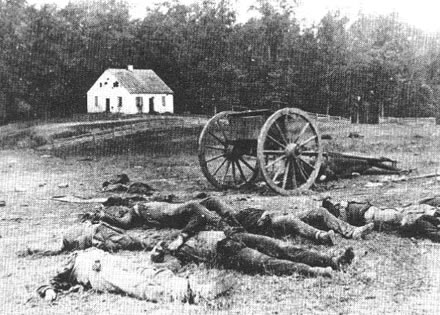
Going back even further than WWII, the intensely graphic photos that Matthew Brady and his team took on the matthew_brady_photobattlefields of the Civil War showed civilians, for the very first time, the true horror of war.  These photos are present at nearly every National Historic Battlefield and are an important reminder of what young men on both sides of the Civil War were willing to face for four years.  To my knowledge no one has protested to the NPS to take down the interpretive signs that show these pictures because they are too disturbing or violent.

It is easy to point to the people today who do not want to see modern-day war photos and say that they want to hide their heads in the sand – that they want to deny what is happening halfway around the world.  But there is also a key difference between battlefield photos now and then: Color.

Color photos of a dead soldier are much different than black and white photos.  How much more vivid and horrific would that photo of Kim Phuc been had it been published in color?  It is easy to overlook the blood, gore and trauma of a battlefield injury in black and white.  The mind knows it is there, but the emotions react more to the presence of the person in the photo, empathy and horror that this man or woman was gunned down in the prime of his life.

But color forces a person to see, first and above all else, the blood.  Red will draw the eye immediately.  No longer is the viewer looking at the person’s face and imagining being in that situation or sympathizing with the family left behind.  Rather, like watching a slasher movie, the viewer is simply looking at the grotesqueness of the injury, wherever that injury is.  I would argue that color in fact dehumanizes a battlefield photo so much that it DOES become obscene in a way.  It turns a very human tragedy into a Hollywood set piece.

That is not an excuse not to publish these kinds of photos.  But I do think we need to examine what we want to really show in these photos, what emotions we want to evoke, and whether or not the photos that show intense and graphic war violence in very living color will really accomplish what we’re setting out to do.

(Photo of Antietam by Matthew Brady)

The Risks Of Sharing

by Doug Allen

Richard Nieva sees the insurance industry as the biggest threat to the increasingly popular “sharing economy”:

Airbnb ran into issues when some hosts reported guests ransacking and stealing of their property. And Uber, the black car taxi service — the most successful of auto-related sharing companies — made headlines recently when the company’s contracted drivers staged a protest in San Francisco, partly over outrage that Uber doesn’t own a commercial insurance policy, meaning the drivers themselves are liable for any accidents they might get into.

As the sharing economy burrows its way into people’s everyday lives – or at least out from the realm of absurdity – there’s been a familiar refrain echoing throughout the blogosphere and traditional press: City hall has been getting in the way. Indeed, in many cases, government regulators have taken a hard line against the sharing economy companies. … But even with the long laundry list of attacks by city hall, the trickiest obstacle for sharing economy companies – particularly in the car-sharing space – is the arms length relationship they have with the insurance industry. Early adopters — call them the Napster generation — are happy to break the law within reason. Putting their savings at risk by lending an asset that insurance won’t cover (up to a certain point) may be another matter.

The Stigma Against Cheap Weddings, Ctd

by Patrick Appel

In response to this post, a reader writes:

I am one of 6 children and a member of an even larger Irish-Slovak Catholic extended family.  My wife and I are both college graduates with liberal arts degrees; getting by just fine, but by no means with the disposal income that would be required to throw a nice event for the number of people whom we consider ourselves to be really close to.  Once invites are extended beyond parents and siblings, the number of people we would “need” to invite would immediately jump into the hundreds.  We simply did not have the budget for this (and it was not a matter of choosing not to dip into savings; savings do not exist).  So, with some emotional and brief interpersonal turmoil, we only invited our immediate families and a close personal friend each to stay at 2 beach houses we rented for a weekend in Cannon Beach, Oregon.  Our guest list was 30 people.  We prepared the food ourselves, we bought the beer, wine, and liquor from costco, there was no photographer, or other hired help.  It was a family celebration, as it seems, is the whole idea behind a wedding ceremony, in the first place.

We were able to provide a level of setting/accommodation, food, beverage and activity that we could never have dreamed of if we had to extend invitations beyond the sphere that we did.  But, we were able to host an amazing event for the 30 most important people in our lives, that they all still talk about.  It was an amazing weekend for all involved.  In fact, though we would have liked to share that experience with many, many more people, I think that everyone– us included –enjoyed that experience much more than a rented party facility with standard catered fare, DJ/band, floral centerpieces, etc.  We recognized the importance and significance of making our commitment to each other in front of those who are most important in our lives, and wanted to provide them with an experience that they would always remember.  I think we definitely achieved our goal, and though the cost was definitely in the thousands of dollars, it was much less than half of what the “average” wedding costs today.

Both my wife and I have many friends from the East/West/Midwest young educated class that have chosen to celebrate their nuptials in similar fashion.  I think a nice intimate event shared with those you love most is a much more pleasant and ultimately meaningful celebration than the very expensive cookie cutter fiesta that leaves all involved feeling frazzled and stressed.  If I am going to spend $30k on something, I am going to get a lot more out of it than what I have witnessed siblings, cousins, and friends get out of their rather humdrum, but very expensive weddings.

Another reader:

Maybe I was lucky, but last year when my husband and I decided to abandon our plans for a blow out wedding, and instead opt for a small ceremony at my parents’ house over Christmas with family already in town, no one was quick to judge our financial situation. When we sent out invites, I told everyone “I found out I was going to have to pay $600 for table cloths. That’s not happening.” I don’t care how much money we have — that’s just ludicrous! Instead of the financial judgement, though, we got frequent calls asking “Are you pregnant???” from any family or friends over the age of 50. When we mentioned this to friends closer to our age, it was amazing — each of them said “That hadn’t even crossed my mind!” Either there’s a big generational divide in assumptions here or our friends were lying to our faces.

Anyway, our wedding was amazing and meaningful and perfect, and exceedingly cheap to boot! We even streamed it online for the family and friends we had to cut off the invite list to keep costs down. They were happy to watch, and happier to not have to attend or bring a gift. It was perfect all around! (And I’m still not pregnant, Uncle Jim.)

A final reader makes an important point:

“Average cost” does not necessarily mean “typical cost.”  This is especially true with something like a wedding, where the wealthy spend exorbitant sums and skew the statistic.  If four couples have $9,000 weddings and one couple has a $100,000 wedding, the average wedding cost is $27,000 — but let’s not interpret that to mean that that’s what most people should expect to pay.

A 2007 WSJ article provided better numbers:

For the three surveys, the median wedding cost is closer to $15,000. The median is the middle figure when you line up a set of numbers in order of size. It is a popular choice for social statistics because it is unperturbed by very small or very large numbers.

Debating Debates

by Doug Allen

Howard Kurtz responds to Stuart Stevens’ call for fewer debates in the primaries:

It’s not surprising that Stuart Stevens wants fewer presidential debates, since his candidate Mitt Romney got beat up in so many of them. But his suggestion, in his debut column for The Daily Beast, that the debates be wrenched away from the networks is way off the mark. Maybe he’s suffering from posttraumatic debate syndrome, but these televised extravaganzas actually give the country a good look at how the candidates perform under pressure. … A strong candidate knows how to hit major-league pitching.

Justin Green counters:

I’ll indulge the sports metaphor: having 18 debates before the first actual vote is like asking a pitcher to throw 300 pitches while warming up in the bullpen.

At a certain point, all you’re doing is wearing down your arm. And after, let’s say, four or five debates, a voter will have all the information he or she needs to make an informed choice. The Michele Bachmann screeds about stealth jihad, the Ron Paul demands for a gold standard and Newt’s rambling about Newt-things quickly reach the point of no longer being helpful to the democratic process. …

[W]as there a single moment from the primary debates that added something substantive to the presidential race? Did we really learn how any of the candidates handled themselves under pressure? Were conservative ideas vigorously debated, with differing viewpoints well-represented? Were conservative voters offered a variety of options that gave them a hand in shaping the future of the Republican Party? Did the debates strengthen the GOP? Did they strengthen the general election?

My answer on all counts: no.

The NRA’s Unlikely Role Model, Ctd

by Chris Bodenner

A reader writes:

This Winkler person trying to gin up the idea that the NRA got its ideas about strutting their gun culture in public from the Black Panthers … please. I was politically awake in California at that time.  There was a HUGE cultural backlash, from racist gun-culture-loving whites, against the “nerve” of those Black Panthers appropriating white conservative ideas – which were already long-cooked in the 1960s – of patriotic militias defending their rights against oppressive big governments. The idea that today’s West Coast NRA types who delight in congregating at their local Starbucks, armed up, to rile the local liberals, took this idea in any way from a now-obscure Black Panther model, instead of from their own generations of intense culture-worship of founding fathers with guns, backwoods pioneers with guns, cowboys with guns, American soldiers with guns, and John Wayne (and many others) playing at cowboys-and-soldiers with guns on the silver screen, is truly nonsensical.

Another is on the same page:

The NRA was singing the 2nd amendment tune long before there were Black Panthers.  I went to summer camp in the late 1950s, where we did archery and riflery, each under the banner of a national association, from which we earned kiddy honors, complete with sew-on patches and medals. So I became a junior member of the NRA, and read The American Rifleman, the NRA magazine.  It was full of the same bullshit still put forth: the only thing standing between the upstanding US citizen and government tyranny was the fact that some of the citizens were packing heat.

I proudly repeated this stuff to my father.  I figured he’d appreciate my attention to the Constitution, since he taught Constitutional Law.  He slapped it all down pretty quicky. “Read the amendment, and tell me what a militia is.  If gun control is really unconstitutional, they could get a ruling on that.  But the courts have always read the ‘right’ as related to militias.  It doesn’t work for them, so they just lobby against any laws they don’t like.  That ‘bulwark against tyranny’ line is just John Birch stuff.”

Well, the NRA finally found a Court that was willing to ignore the word “militia” and the concept of “well-regulated” – overturning 230 years of jurisprudence.  It’s a Court that claims to be traditionalist and modest in its reach.  Oh, sure: The Court said, “Let any unstable jerk be a militia, and let him regulate himself.” And the Court saw that it was good.  And the Court said “Let the corporations be people”.  And the Court saw that it was good.  This Court is detached from reality, lost in the swamps of theory, and radical.

The following passage is from the same email by the reader who said he prevented his rape in a hotel room by pulling out a gun:

By the way, your coverage of the ongoing gun debate has been nothing short of terrible and incredibly one-sided.  But I understand different people have different opinions.  And nothing being proposed so far would have impacted my ability to defend myself in that situation, so it’s a bit irrelevant to the gay rape issue.

But it’s worth pointing out.  The Frum quote you posted about the Black Panthers was particularly distressing. Reading his larger piece, he calls hunting an “increasingly marginal” activity, since only 6% of Americans have purchased a license, seemingly indicative of Mr. Frum’s long-term feeling that guns aren’t worthy of constitutional protection.  What then does that mean for Jews like himself, who are a nearly statistically irrelevant 2% of the population.  Or gays, who are likely closer to to 6% than the previously claimed 10%.  Are gays a marginal population?  Six percent of Americans is 20 million people, which doesn’t include all those over 65 or with their own land who generally don’t need a license to hunt. By way of comparison, 7% of Americans (25 million) played golf last year. Does David Frum think golf is an increasingly marginal activity??

Nothing in Winkler’s book should be a surprise to anyone who spent time examining the issue beyond merely reciting the talking points of the Bloomberg activism machine.  In fact, the reaction to the Black Panthers by the establishment (with the NRA’s support) passing onerous gun control laws designed from the outset for enforcement in a discriminatory fashion against blacks is the very reason the NRA’s membership erupted and split. All the Democrats these days pining for the NRA to return to the NRA of old, or Republicans to emulate Ronald Reagan (who oversaw the passage of those and other laws), are really asking for a return to the terrible days when it was considered acceptable to pass laws as long as the intent was only to impact those “other” people.  It’s reprehensible, and indicative of the deep distrust Americans have, for any attack on our rights.

Previous Dish on Winkler’s wonderful 2011 Atlantic piece here. Money quote:

The day of [the Black Panthers’] statehouse protest, lawmakers said the incident would speed enactment of Mulford’s gun-control proposal. Mulford himself pledged to make his bill even tougher, and he added a provision barring anyone but law enforcement from bringing a loaded firearm into the state capitol.

Republicans in California eagerly supported increased gun control. Governor Reagan told reporters that afternoon that he saw “no reason why on the street today a citizen should be carrying loaded weapons.” He called guns a “ridiculous way to solve problems that have to be solved among people of good will.” In a later press conference, Reagan said he didn’t “know of any sportsman who leaves his home with a gun to go out into the field to hunt or for target shooting who carries that gun loaded.” The Mulford Act, he said, “would work no hardship on the honest citizen.”

Yet another example of how Reagan is such a false idol for the contemporary GOP base.