Where There’s Smoke, You’re Fired, Ctd

by Chris Bodenner

A reader writes:

I am an ex-smoker (I quite a three-pack-a-day habit almost 40 years ago), so I have great sympathy for nicotine addicts.  I have worked for a major corporation that had a no-smokers policy (the boss had quit and thought it was a good idea; it was his company).  But I have no space for UPenn’s irrational policy with respect to smokers.

If health and its associated costs are the criteria for hiring, then are they hiring people with high BMIs, high LDL-low HDL, high blood pressure, diabetes, alcoholism or any other health issue?  Likely yes, because the ADA won’t let them discriminate.  Well, I believe there is enough evidence available now to include nicotine addiction under the illness rubric.  I won’t go into serotonin and dopamine reactions, but a quick Google search will yield a lot of information that you would expect PennMed to already possess. It would seem that just because they can discriminate against smokers (and not any of the other health issues), PennMed is discriminating.  That may be good for the bottom line.  It will not do anything for smokers.  And it stinks worse than cigarette haze.

Another also goes after “nanny-state paternalism”:

So are they going to stop hiring obese people as well?

You know, I get that there is an externality on the health care system now that we are all buying in, but they could just pass the premium increase on to the employees. ObamaCare specifically allows insurance companies to charge smokers more, and even though we pay ridiculously huge taxes on our smoking already, I’d be OK with paying double the Pigovian tax rate.  It’s not economically efficient, but it’s ok – a bit of tax-incentive nudging by the government in health policy isn’t the worst thing in the world.  We encourage home-ownership and retirement savings as well, and I think we should tax the hell out of pot too, so fine.

But this is just stupid.  It is not about health.  It is about image and heavy-handed, nanny-state paternalism which is different not just in degree but in kind from small price incentives or public health campaigns (even if these are incentives are larger than the economically “optimal” level).  Somehow it has become OK for people to find pleasure in excessive food or alcohol or risky sexual behavior (all of which induce the same kinds of public health externalities), but not in tobacco.

So here’s my deal: don’t hire smokers, but don’t hire overweight people, drinkers, or anyone who enjoys recreational sex either (or for that matter, anyone who risks their body in expensive ways playing soccer or mountain climbing or doing anything vaguely dangerous and fun).

Update from another:

It seems to me that readers complaining about “nanny-state paternalism” in private companies are trying to have their ideological cake and eat it too. Last I heard, no one was talking about making it illegal to hire smokers – and in fact I imagine that in the end, the nanny-state paternalism of the ADA will strike down no-smoker policies. But for libertarians, why does their right to smoke trump my right to run a company with just the “image” I want?

The GOP’s Green Base

by Doug Allen

Fox News may mock renewables:

But they do not speak for all Republicans. Brian Merchant points to a new survey from the Yale Project on Climate Change Communication, which focused on attitudes toward climate change among self-identified Republicans and Republican-leaning independents:

Republicans still love clean energy. I mean, overwhelmingly love the stuff by epic margins.

Some of the report’s findings:

A large majority of [Republican] respondents (77%) support using renewable energy in America much more or somewhat more than it is used today (51% and 26%, respectively). Among those who support expanded use of renewable energy, the most common preferred timing for taking such action is “immediately” (69%).

A slight majority of all respondents (52%) support using fossil fuels in American much less or somewhat less than it is used today (21% and 31%, respectively). Among those who support reduced use of fossil fuels, the most common preferred timing is “immediately” (52%). By a margin of almost 2 to 1 (64% vs. 35%), respondents say America should take action to reduce our fossil fuel use.

Your Marijuana Resort And Spa

by Brendan James

Matt Brown, one of two guys opening a kind of vineyard tour circuit of Colorado dispensaries, explains why he’s not worried about a visit from the feds:

Colorado has not seen enforcement action like you’ve seen in California, where they’re kicking in the doors of dispensaries. And that’s because Colorado has the most sophisticated medical marijuana regulatory system of anywhere in the world. At this point we have 400 pages of regulations and laws, so it’s very easy to tell if this person is following the rules, and that person’s selling 150 pounds out the back door. But we’re still being cautious. We’re not here to poke our fingers in anybody’s eye or annoy the federal government. We just want to help people and make the process of finding weed more normal.

Normal is what we have in Colorado right now. You buy your weed at a store, and it has hours. I was saying to my friend the other day, “Aw man, it’s 7:30, the weed store’s closed. Oh well, I guess I’ll wait until they open tomorrow morning at 9.” That’s normal. That’s what it should be.

The Daily Wrap

FRANCE-FEMEN-DEMO

Today on the Dish, readers asked Andrew where federalism begins and ends, Nick Beaudrot kicked off a discussion on blogging as a way of life and Matt Sitman looked at Pope Francis as a Jesuit. Suderman caught up with the hiccups in Obamacare, Weigel measured lack of interest in the sequester and Pareene wondered if we’ve seen the last of the Clinton hacks. We discussed the economic reasons of the “decline” of marriage, checked in on the demise of the Euro, and Adam Alter noticed a connection between a hurricane’s name and how much we give for relief.

We caught Americans running drugs on the Mexican border, kept considering the plight of the snitch, and welcomed terrorism back to the silver screen. We pondered the significance of teacher cheating, asked if we’re hardwired for language and toured a lonely, lonely shopping center. Elsewhere, we updated readers on the Dish experiment, unearthed the very first Face of the Day, and readers sounded off on the restaurant EZ pass. Kate Crawford differentiated data and truth, Calvin Trillin extolled the joys of the floating editor, while Zoe carried on the marriage-surname discussion (and announced some exciting news).

Later, Moynihan cringed at his Wikipedia entry, we eyeballed how many of our fellow citizens go for UFOs and trutherism, and readers shared their experience of sensual sneezes. We reckoned with the power of Wagner and revisited Ware’s broken leg as Evan Selinger opened a drawer of old thank you notes. Andy Greenwald said a good word for bulk watching Game of Thrones while Woodman defended the misuse “literally.”

Finally, we looked out on London for the VFYW, spotted tiny tourists beneath a big Face of the Day, took a somber look back at Fraggle Rock for the MHB.

­–B.J.

(Photo: A man kicks a topless activist of the Ukrainian feminist movement Femen as she raises her fist to protest against Islamists in front of the Great Mosque of Paris on April 3, 2013. By Fred Dufour/AFP/Getty Images)

Francis Emerges, Ctd

by Matthew Sitman

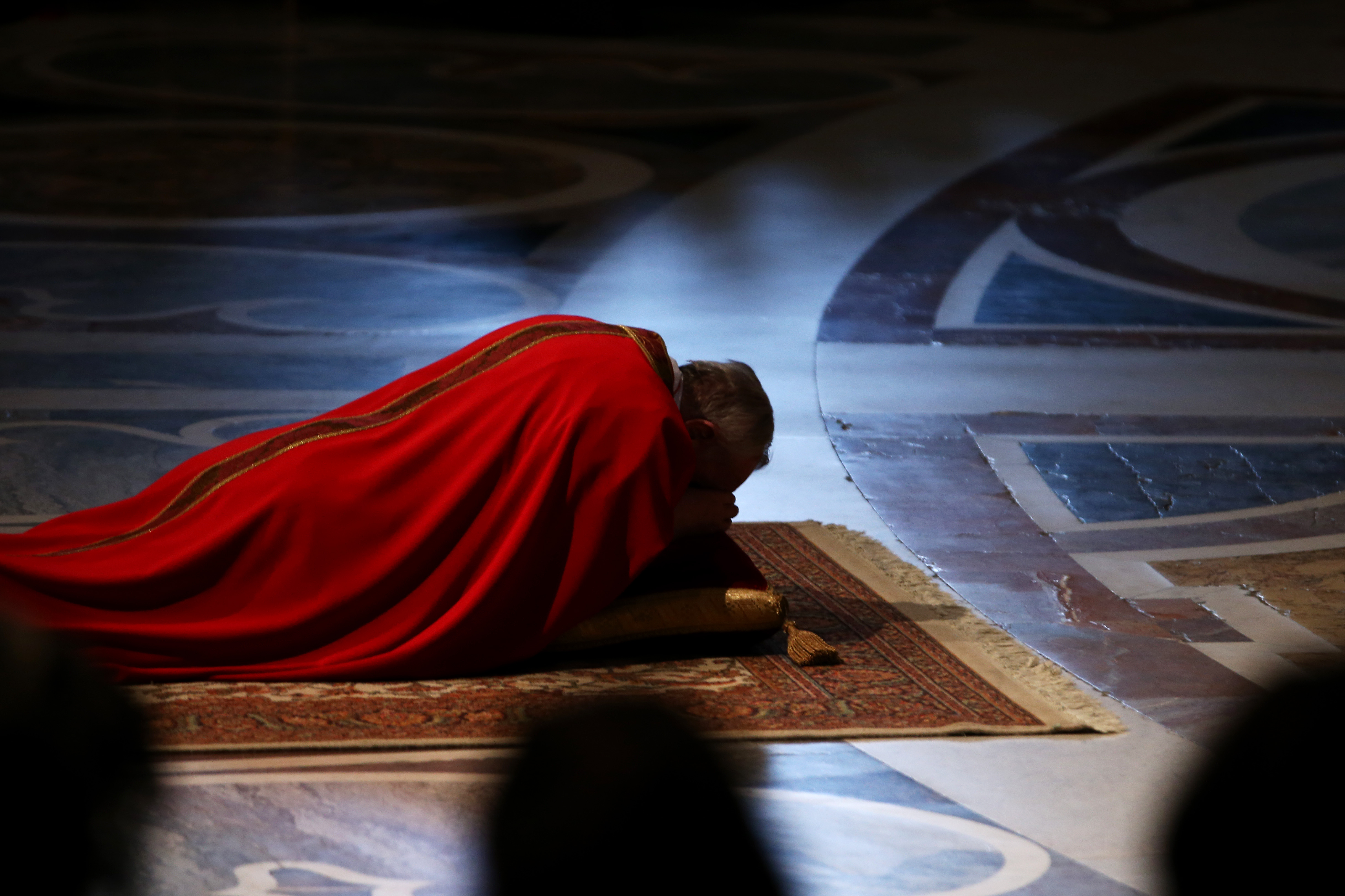
Pope Francis Attends Celebration Of The Lord's Passion in the Vatican Basilica

J. Michelle Molina finds the heart of Jesuit formation – St. Ignatius’s Spiritual Exercises – to be a revealing, but thus far largely neglected, way to understand Pope Francis:

No matter how we stake our political or religious claims, any effort to understand the man ought to include a sense of the Spiritual Exercises, a Jesuit meditative program of spiritual renewal that connects self-reform to transformative action in the world. These meditations offer a framework with which to interpret Francis’s actions because they have provided the key metaphors with which the Jesuit Bergoglio has sought not only to know himself, but also to engage the world.

One point of emphasis in the Exercises:

[The Jesuit] joins the twin goals of contemplation and action in a world understood in both geographical and existential terms. “Jesus knocks from within so that we will let him come out.” These words echo a very Jesuit notion that personal reform is linked, in the words Bergoglio drew upon to inspire the conclave, to an evangelizing church that is “called to come out of herself and to go to the peripheries, not only geographically, but also the existential peripheries: the mystery of sin, of pain, of injustice, of ignorance and indifference to religion, of intellectual currents, and of all misery.” He has eschewed certain liturgical vestments as, quite literally, trappings that would encumber his desire to walk in the world. And this sense of self in the world likely inspires Francis’s controversial symbolics, such as the washing of women prisoner’s feet.

I think this is very perceptive, especially because – as Molina intimates – it allows us to avoid imposing simplistic categories on Francis. Recently we featured a quote from Jody Bottum that made exactly this point, that our usual political labels don’t make much sense when applied to Francis, nor, at its best, historic Christianity more broadly. There’s no reason we should expect a man forged in spiritual practices developed in the 16th century to fit comfortably within any contemporary ideology scheme. And even more, the notion of contemplation joined to action in the world seems particularly fitting when considering Francis, as he appears to be intent on his deeds, from the simplicity of his lifestyle to the washing of a woman’s feet, conveying as much as his words. That style of leadership, that way of living, surely has its roots in the rich tradition of Ignatian spirituality.

There’s one other point worth making here. Molina notes this about Francis’s experiences with the Spiritual Exercises:

Bergoglio has made the full 30-day version of the Spiritual Exercises at least twice and has repeated the shorter, eight-day version every year since he entered the Society of Jesus in 1958.

A 30-day regimen of prayer, meditation, and introspection is an experience most of us probably have trouble fully imagining. One aspect of Ignatian spirituality, as Molina’s article makes clear, is knowing yourself. To overcome or transcend the self one must be acquainted with the darker corners of your soul. The humility and compassion Francis evinces, I suspect, comes at least in part from the rich inner life, the self-critical inward turn, that is a part of the Exercises. A deep awareness of your own faults and failures – a contrite heart – is the precondition for the extension of mercy and love to others. It isn’t surprising, then, that the Jesuit “activism” of Francis has skewed not toward ideological, political ambition, but humble service. Molina’s sketch of the new pope’s Ignatian formation goes as far toward explaining why this is so as any account I have read.

(Photo: Pope Francis prays on the floor as he presides over a Papal Mass with the Celebration of the Lord’s Passion inside St Peter’s Basilica on March 29, 2013 in Vatican City, Vatican. By Dan Kitwood/Getty Images)

Are Hand-Written Cards Obsolete?

by Zoe Pollock

Evan Selinger ponders the place of thank-you notes in today’s digitized world:

People like Nick Bilton over at The New York Times Bits blog argue that norms like thank-you messages can cost more in time and efficiency than they are worth. However, such etiquette norms aren’t just about efficiency: They’re actually about building thoughtful and pro-social character.

Take my six-year-old daughter. When she looked at her new iPod Touch (a Chrismukkah gift), she saw it as a divine labor-saving device. Unlike the onerous handwritten thank-you notes she had to do for her birthday, she envisioned instead sending quick thank-you texts to friends and family. Months later, she still doesn’t understand why her parents forbid the shortcut. And she won’t. Not anytime soon.

Why he’s sticking with the paper version:

At stake … is the idea that efficiency is the great equalizer. It turns every problem into a waste-reduction scenario, but its logic has a time and a place. Social relations are fundamentally hierarchical, and the primary way we acknowledge importance is through effort. Sending laconic thank-you texts to family treats them no differently than business associates.

Can’t We Get An EZ-Pass For Restaurants? Ctd

by Chris Bodenner

This embed is invalid


A reader writes:

I was going to save this topic for my own blog but this thread at the Dish has compelled me to write in. Other countries have already solved this “waiting for the cheque” problem years ago and they did it with a very low-tech solution.

In the past five months I’ve traveled to Australia once and the UK twice. One thing I noticed about some of the restaurants / pubs I visited was that they make you pay at the bar. Each food / drink purchase is a discrete transaction. You go to the bar where you give and pay for your order. You then take your drinks right away and if you ordered food they give you a marker and when it’s ready they bring your meal to your table. You repeat the process if you want more.

What I like about this approach is that it scales very well. The bar is optimized for taking orders and the customers transport their own drinks. One or two guys drop off the food and collect the empty glasses. Compare this with back home where servers in most restaurants and pubs will keep track of drink and food orders throughout the evening and give individual cheques when one or all of the patrons are ready to leave. The North American system only works well if it’s a small group where everyone is sitting in a fixed location for the whole evening and everyone has a car to get them home.

I’m the organizer of a social group that meets every Wednesday for a cinq-à-sept (five-to-seven), which is French Canadian for “happy hour” (note to all you Dishheads who think you’ve just improved your foreign language skills: be careful. In France it means something completely different.) On any given week between 30 and 60 people will show up. I’ve organized over a hundred of these evenings at a dozen different pubs / restaurants and I can say without hesitation that a system like they have in the UK / Australia would greatly improve our Pub Night events.

The North American system doesn’t just waste 20 minutes at the end of your evening; it’s the source of a bunch of other problems too. Orders for large groups take much longer and sometimes people forget to pay (intentionally or not). Sometimes customers don’t have enough money (this can’t happen if you have to pay before you order). It’s also hard on the servers who have to keep track of everything. And it breaks the rhythm of the evening if you want to move locations. You can’t just get up and leave; you have to wait for everyone to pay and this can take a long time depending on the size of the group.

Tabbedout looks promising but it only speeds things up if everyone in your party is using it which is unlikely to happen if you’re more than four people. What I would like to see is more restaurants adopt the UK / Australian model.

Another broadens the discussion:

When someone suggests that there’s an app for that, I wish the blog post or article would say how many people have smart phones, how many people have cell phones that aren’t smart phones, and how many people have land lines.

An app won’t help my father-in-law, who doesn’t have a cell phone. He eats out pretty regularly. An app won’t help my mother, because she only has a regular cell phone, not a smart phone. OK, they’re in their 80s. An app wouldn’t have helped one of my kids until recently, because of their phone contract. Thankfully, the contract expired. I’m in my early 60s. I would like to convert my cell phone to a smart phone, but if I do that, the monthly cost will have to come out of my restaurant budget. If I had to use an app to get efficient service, I couldn’t afford to eat out.

I spend too darn much on technology. There’s television, broadband and land line phone bundled into a big package with a big bill, plus a cell phone bill every month for just one person. Being a single person is expensive; I’m a widow, but I am a lot more sympathetic to the comments of single friends these days. I could get rid of the land line phone, but that would save almost nothing. I can’t do without the broadband because I work from home some of the time. I don’t watch much television and don’t get HBO, so I don’t feel I’m being extravagant even though I only spend a few hours a week in front of the set.

If I only had to pay for a phone, I’d have a smart phone. But I need other services, too. They cost money and they don’t seem to be included in consumer price indexes. When I was growing up, television was free and in our geographically difficult area, a good signal was hard to get. My husband grew up in a region with good signals and access to more than one metro area, and he heard a much wider selection of music on the radio and saw more television than I did as a kid – when I got a transistor radio in high school, there was only one station that really came in clearly. Now I have to pay to have things come in clearly, and I also have to pay to have Internet access. I’m dreading the day when a smart phone becomes a necessity, because then my monthly budget will be more expensive even though my income isn’t increasing.

Technology is making our lives very different, but it is a heck of a lot more expensive than writers from the national media acknowledge. Let’s take a sort of Suze Orman moment. Not saving for retirement? How much would you have in that retirement account if you relied on an antenna for television and never got cable? Kids need a college fund? How much could you have saved by not buying computers or paying for broadband? (Yeah, that brings up the issue of how the kids could get into college without access to computers and the Internet, so why aren’t those costs considered part of the market basket of essential expenses?) You know a senior citizen who needs more money for medications or a poor family that needs more cash for medical care? What would Suze say – “Ditch those cell phones and save, people”? Maybe the 47 percent have just had a hard time keeping up with the additional cost of supporting Microsoft, Apple, Verizon, among others, along with the cell phone and cable companies.

While I know it is possible to do without television, I think the time has come to agree that Internet access and basic cell phone service are, well, basic requirements. But a smart phone to pay a restaurant bill quickly is not a basic requirement. Find another way to serve all the credit card customers, not just the ones with pricey phone plans.

I wish I wasn’t turning into a curmudgeon, but money is a dimension often left out of discussions of technological solutions. Figure out the cost of the shiny new app and the equipment it runs on before recommending it to all of us.

Big Bias

by Doug Allen

Kate Crawford warns against believing “that massive data sets and predictive analytics always reflect objective truth”:

Data and data sets are not objective; they are creations of human design. We give numbers their voice, draw inferences from them, and define their meaning through our interpretations. Hidden biases in both the collection and analysis stages present considerable risks, and are as important to the big-data equation as the numbers themselves.

For example, consider the Twitter data generated by Hurricane Sandy, more than 20 million tweets between October 27 and November 1. … The greatest number of tweets about Sandy came from Manhattan. This makes sense given the city’s high level of smartphone ownership and Twitter use, but it creates the illusion that Manhattan was the hub of the disaster. Very few messages originated from more severely affected locations, such as Breezy Point, Coney Island and Rockaway. As extended power blackouts drained batteries and limited cellular access, even fewer tweets came from the worst hit areas. In fact, there was much more going on outside the privileged, urban experience of Sandy that Twitter data failed to convey, especially in aggregate. We can think of this as a “signal problem”: Data are assumed to accurately reflect the social world, but there are significant gaps, with little or no signal coming from particular communities.

I would only add that these problems are not unique to big data, though they are more likely to be ignored with a larger dataset. In any data analysis, it is important to think about not only the data that you have, but also the data that you don’t have.

Tin-Hats Among Us?

by Chas Danner

PPP recently took the conspiracy-temperature of 1,247 registered voters.  An unimpressed Joshua Keating sums up the poll’s more sensational results:

Among the survey’s big findings are that 51 percent of Americans believe JFK was killed by a conspiracy, 21 percent believe a UFO crashed at Roswell, 13 percent believe Barack Obama is the antichrist, 7 percent believe the moon landing was faked, and 4 percent believe “lizard people” control our societies by gaining political power.

He admits that while there are certainly some true believers out there who buy into theories like a global-warming hoax or Saddam Hussein being involved in the 9/11 attacks – he thinks the results are most likely skewed by the suggestible:

The day after April Fool’s Day is a good time to reflect on the fact that many of us are more suggestible than we’d like to admit. We’ve all had friends who have unquestioningly shared fake news stories on Facebook (There’s a whole blog devoted to them) or relatives who’ve forwarded us dubious conspiracy e-mails. The questions asked on the survey are detail-heavy and quite specific. For instance: “Do you believe Paul McCartney actually died in a car crash in 1966 and was secretly replaced by a lookalike so The Beatles could continue, or not?” We might hope that most people would say, no, of course not. If they had even heard of the theory, they would probably know that it was a running joke propagated by the Beatles themselves. But a significant number of people probably just heard all those facts and dates and though, “Huh, well I guess so.”