Small Government Theocons? Ctd

by Brendan James

A reader writes:

Concerning this post, I think you and Ed Kilgore are talking past each other.  Ed’s talking about the Religious Right; you’re talking about “young evangelicals.”  Not exactly the same thing—indeed, the young evangelicals you’re speaking of seem to be moving away from the Right, or at least modifying it to accommodate what is now clearly a cause as lost as keeping evangelicals from divorcing.

But if you focus on, say, the Tea Party, as Ed does, it’s apparent that the persistent efforts of some clueless pundits to characterize it as a “libertarian” movement miss the point.  It’s not the deficit these people are concerned with; after all, where were they in the oughts?  They’re concerned, as ever, with the federal government taking stuff away from deserving folk like themselves and giving it to undeserving folk like the poor, or the uninsured, or parasitic elites in academia, the bureaucracy, etc.

And for them this is a moral cause; that Obama is in the business of taking from the “right” people and giving to the “wrong” ones isn’t a policy disagreement, it’s proof of his moral perfidy.  That they are utterly clueless about the federal budget and the fact that they are major beneficiaries of federal redistribution policies makes it all the easier for them to strike this self-righteous pose; there’s no “libertarianism” for them if it touches “their” Medicare.  It really is the culture war by another means.

I understand this point, that libertarianism and Christianism are not a priori incompatible (even if it requires some slippery semantics) and so a rise in the former need not lead to perestroika. But the fact is that evangelicals are the core of the religious right, and if the next generation is becoming libertarian on social matters like marriage—we could talk about drugs as well—that’s a big problem for the old guard that organizes much of the base around cultural paranoia. If this generational shift continues, how small is the Christian Right’s tent going to shrink before they lack the clout Kilgore and the rest of us are worried about?

The UN’s Deadly Incompetence, Ctd

by Brendan James

A Zimbabwean cholera patient sits in his

Not long ago we posted on the UN’s cover-up of a cholera outbreak in Haiti, sparked by a peacekeeping mission in 2010. It turns out there was another outbreak on their watch, in Zimbabwe, which left 4,000 dead in 2008-09. A whistleblower in the UN tried to warn his superiors about the growing epidemic, but was fired by his chief officer, on behalf of that officer’s friends in Mugabe’s government. It was an election year, after all. Armin Rosen digs deeper:

The UN and [officer Agostinho] Zacarias’s chief responsibility should have been to Zimbawe’s embattled civilian population. Instead, both failed to live up to their obligations — even as they were conspiring against someone who had exceeded them. That campaign even seeped into the tribunal proceedings, as Zacarias and the UN made specious and unsupported claims in court that Tadonki had been accused of sexual harassment while based in Harare. It didn’t work, but the UN’s efforts are continuing even now: the UN has stated that it is appealing its own tribunal’s decision, and according to [lawyer Robert] Amsterdam, the World Body has taken the first procedural steps necessary to retry the case. At a March 6 press conference, a UN spokesperson refused to comment on the case — except to say that “judgments of the UN Dispute Tribunal are not final until they have been confirmed by the UN Appeals Tribunal,” and that “the Organization intends to file an appeal of this judgment.”

(Photo: A Zimbabwean cholera patient sits in his bed on February 27, 2009 at a hospital in Harare. By Desmond Kwande/AFP/Getty Images)

Sully Bait

by Chris Bodenner

Many readers are flagging this news – the formation of a PAC called the Bearded Entrepreneurs for the Advancement of a Responsible Democracy (BEARD). Money quote:

“It’s been 125 years since our last bearded President, Benjamin Harrison, was elected. We’re hoping that with our support, bearded individuals will shrug off over a century of political irrelevance and start running for office again.”

Update from a reader:

The news about the PAC has even more Sully Bait than I expected. If you go to Jonathan Sessions’ web site (he’s the founder of the PAC), and then go to his link about upgrading from IE, you’ll find his 404 page with a lovely picture of beagle puppies. What’s better than that?

Bearded beagle puppies?

How Powerful Is The Bully Pulpit?

by Patrick Appel

Jonathan Bernstein recently argued that Obama should talk more about fighting climate change. Digby is puzzled:

I had thought the bully pulpit is not only useless, but often counter-productive, so this is a surprise to me. Ezra Klein explained it to us all in this New Yorker piece from 2012, wherein he outlined all the political science numbers-crunching that proves public opinion is fairly irrelevant to public policy and presidential rhetoric even more so. Indeed, the thesis says that while the president coming out publicly for a particular policy may be able to harden his own troops’ resolve from time to time, he also hardens the opposition against him, so government basically can only be effective through the use of backroom deals and inside the beltway politicking

Bernstein’s response:

[A]s far as I understand it, the data we have on public opinion and the bully pulpit are mainly about short-term effects, and especially the (non-) effects of attempting to move Congress on specific legislation by changing public opinion. I don’t think we know much, if anything (and I hope someone will correct me if I’m wrong) about long-term effects, if any. I mean, we know that Ronald Reagan didn’t make US voters more conservative during his presidency…but I don’t think we know anything about what, if any, long-term effects he might have had either on specific issues or ideology in general — including effects concentrated within conservatives. Or, to put it the other way: we could have something here similar to campaign effects in which strong professional electioneering tends to cancel out; if one side saw the minimal effects results and decided to not campaign at all, we’re fairly certain that it would create a very large effect. If Democratic presidents preach liberal ideals it might not change any minds, but if they don’t, it might fail to “educate” a generation of Democratic activists.

It Takes A Village

by Patrick Appel

Mark Oppenheimer reflects on the aspects of parenting he outsources to others:

Parenting has made me painfully aware of all the skills I don’t have, all that I won’t be able to pass on to my children. Before the children arrived, the future was full of possibilities for the dad I would be: the one who would teach them to play guitar, to garden, to turn table legs with a lathe. All I had to do was learn how to play guitar, to garden, and to turn table legs with a lathe. Also to chant Torah, change the oil, and throw a football with a perfect spiral. And there was plenty of time for all of that.

But then the girls arrived, in short order, all three of them. I found skills I never knew I had, like holding an infant on my forearm, her head in my palm. I once changed a cloth diaper so deftly that my friend Derek was startled to realize it was cloth. “You did that just like a regular diaper!” he said. That was one of my proudest moments. I’ve been known to take all three girls—ages two, four, and six—to the supermarket together, pilfering only one banana and one plastic carton of blackberries to keep them in line. (Shamed by the empty carton and the empty peel, I paid up.) But for all the skills I never expected I’d have, there are more that I know I’ll never acquire.

The Bitcoin Bubble

by Patrick Appel

Bitcoin_Market_Cap

Felix Salmon worries about it:

If millions of people started using bitcoins on a regular basis, the soaring value of bitcoins would actually be disastrous. You’ve heard of hyperinflation: this would be hyperdeflation. Take a gold bar valued at $600,000. At $60 per bitcoin, the value of that bar is 10,000 BTC. But then assume that bitcoins rise in value to $600 apiece, and then to $6,000, and then to $60,000 — as would have to happen if the fixed number of bitcoins was being used to store hundreds of billions of dollars in value. Then the value of the gold bar would plunge, in bitcoin terms — to 1,000 BTC and then 100 BTC and finally just 10 BTC. The same thing would happen to all other goods and services in the world, including your own salary. Everything would be constantly going down in price, if you thought in bitcoin terms.

Inflation is bad, but deflation is worse. The reason is that in a deflationary environment, no one spends money — because whatever you want to buy is sure to become cheaper in a few days or weeks. People hoard their cash, and spend it only begrudgingly, on absolute necessities. And they certainly don’t spend it on hiring people — no matter how productive their employees might be, they’d still be better off just holding on to that money and not paying anybody anything.

The result is an economy which would simply grind to a halt, with massive unemployment and almost no economic activity.

The Gitmo Hunger Strike

by Zoe Pollock

Last weekend Amy Davidson crunched the numbers on it and found that “there are six times as many [Gitmo] prisoners on hunger strikes as there are those who have actual charges lodged against them.” Olga Khazan is pessimistic that the strike will accomplish anything:

Nearly 70 percent of hunger strikes occur in prison, and government entities are the target of the vast majority of them, according to research by Stephen J. Scanlan, an associate professor of sociology at Ohio University, who examined hunger strikes over the past century. Few (6 percent) of hunger strikers die. Rather, about three-quarters of these protests are called off voluntarily — usually because demands have been met, at least to some extent. What’s more, Scanlan found that nearly 76 percent of strikers get at least some of what they want. …

However, hunger strikes are most effective when the protesters’ predicament presents an obvious solution, something Guantanamo doesn’t necessarily have. President Obama pledged years ago to close the facility, but now that the detainees are banned from the U.S. and can’t be sent back to their home countries out of fears that they’ll join back up with terrorist groups, they’re effectively living in a geographic and legal limbo.

Reality Check

by Patrick Appel

Marijuana_Majority

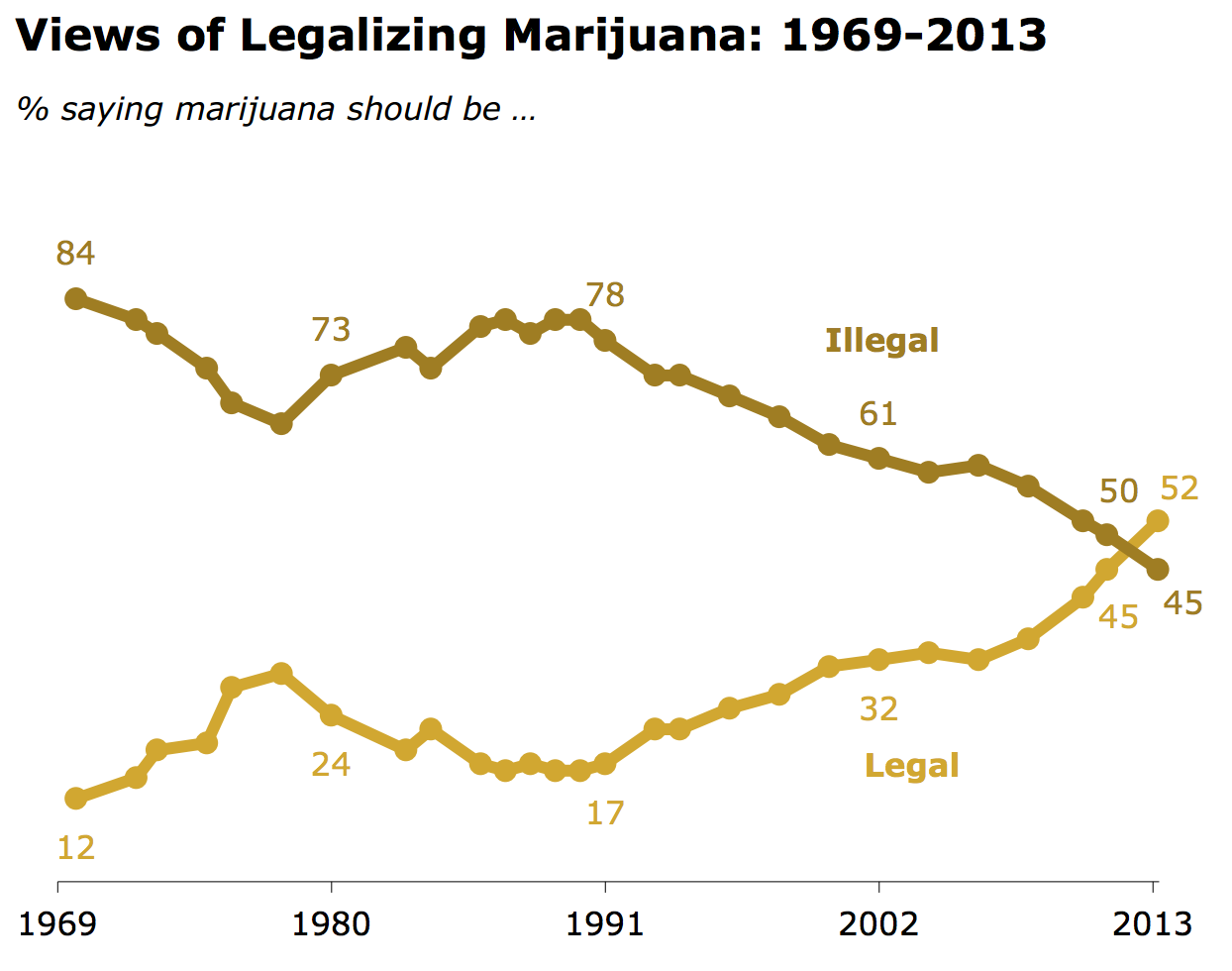
Pew’s latest finds increasing support for marijuana legalization:

There are partisan differences over legalizing marijuana use and whether smoking marijuana is morally wrong. But Republicans and Democrats have similar views on enforcing marijuana laws: 57% of Republicans and 59% of Democrats say that the federal government should not enforce federal marijuana laws in states that permit its use. Substantial majorities of both Republicans (67%) and Democrats (71%) also say federal enforcement of marijuana laws is not worth the cost.

Immigration Reform Is More Popular Than The GOP

by Patrick Appel

After reviewing public opinion on immigration reform, Harry Enten finds that “overwhelmingly majority of Americans now believe that people who came to this country illegally should not be forced to leave it.” He thinks that opposing reform could hurt Republicans:

The real problem for the Republican party is that its brand is currently in the can. With favorable numbers in the low 30s, the GOP is seen as out-of-step with Americans on many issues.

That’s why you’re seeing Democrats jumping out to a large lead on the House ballot for 2014. The latest Quinnipiac poll puts Democrats up by 8pt, more than enough for them to take back the House. Voters are, at this point, not willing to vote for the party that opposes what they believe in. What Republicans don’t need, then, is another issue – that is, immigration – that contributes to notion that they’re out-of-touch with the way most Americans feel.

Opposing immigration reform would be yet another instance of GOP “obstructionism”, which is what most people see as the Republicans’ biggest fault.