Why Take His Name? Ctd

by Zoe Pollock

As I’m getting married in two months (!), I’ve been super into this Dish thread. I’ll be taking my fiance’s name for a variety of reasons. I think Zoe Di Novi’s got a nice ring to it. I always dreamed of getting a new last name when I was a kid, and I’ve got two brothers so the house of Pollock will likely live on. But I’m Jewish and my fiance is Italian American/ Canadian, so it’ll be odd to have a name that doesn’t match my heritage at all (Eastern European/ British).

Italians and Jews have enough in common (friends admit my swarthy, neurotic fiance “could pass”), but I understand readers who worry about the disconnect. I’d like to think that’s an important part of the American experience: With each successive generation we become harder and harder to pin down.

My own mother’s British parents disowned her when she married my Jewish father. Today, the only grief I get for marrying my Italian is of the Jewish guilt variety, insisting we should have the ceremony under some sort of makeshift chuppah. This is progress, no?

(Video: that other classic Jewish/Italian pairing, from Goodfellas)

Proofreading Your Life

by Brendan James

Moynihan braves a glance at his Wikipedia page and confronts some conspicuous errors:

I won’t bore you by cataloguing all the mistakes in my entry (I found about a dozen), but the results weren’t terribly impressive. I’m unsure how long it remained on the page, but according to Wikipedia’s edit log, my biography once claimed that I had a “vagina” and—pardon the language—“love the cock.” The only people who can refute the first point are, I hope, biased in my favor and wouldn’t be trusted by Wikipedia as “reliable sources.” The second point, also difficult to disprove, seems irrelevant to the job of polemicist.

But the damages can go beyond anatomical inaccuracy:

Wikipedia is often the first stop for inquiring minds and so one must vigilantly monitor one’s own entry. Just ask Taner Akçam, a Turkish historian domiciled in the United States, who in 2007 was briefly detained (PDF) by Canadian immigration officers on suspicion of being a terrorist. When he protested that he was an academic, the diligent border agents showed him a printout of his Wikipedia page, which had been defaced by his political enemies. Upon returning to the United States, Akçam was stopped by agents of the Department of Homeland Security who also inquired about his Wiki-reported terrorist connections.

The Stigma Against Cheap Weddings

by Patrick Appel

Millman blames the decline of marriage, especially among the lower classes, on economic factors:

The deep causes of the decline of the marriage norm are the rise of the equality of women and the yawning wage gap between the working classes and the profession and upper-middle classes. Marriage has become aspirational rather than normative because men are less-desireable than they used to be, both because women need them less and because men can offer less than they used to.

There is another, overlooked reason that low-income individuals are less likely to get married these days: they can’t afford to. Weddings are a form of conspicuous consumption. Couples, and their parents, are judged on everything from their attire, to the venue, to the flowers. As Zoe noted recently, the average wedding now costs around $27,000. Committed low-income couples could simply go get married at a courthouse, but settling for a low-cost wedding violates cultural expectations and announces the sorry state of your finances to immediate friends and family. It’s little surprise that many lower-income couples opt for no wedding rather than a dirt-cheap one.

Marriage has many intrinsic benefits, but the increasing cost of a wedding partially explains why, statistically speaking, married couples are better off than non-married couples. Being the type of person who has $27,000 to spare, or has parents who can foot the bill, undoubtedly increases the likelihood of success in all facets of life. If you compared households with $27,000 cars to those without any car, I imagine you’d find that owning a such a car likewise correlates with greater economic potential, physical health, and various other desirable traits.

The Dish Model, Ctd

by Chris Bodenner

German Funnies

Josh Luger at Business Insider interviewed Andrew over the Dish experiment:

BI: How do you wrap your ahead around the meter concept?

AS: Back in the day I would go to Harvard Square bookstore. When I was there in 1984, having left England, there was no way for me to know what was going on back home except in the British papers. I would go there and flip through the newspapers. At some point the dude had every right to say “Either buy the magazine or put it down.” That’s basically what the meter is.

That’s a good analogy but a tad exaggerated for the Dish, since about 80% of our content – the stuff above the read-ons – will always be free for everyone; we’ll never make you put down the Dish. But yeah, if you’ve enjoyed our work over the years for free and haven’t yet chipped in 2 bucks a month, we hope the meter will nudge you into doing so. As one reader puts it:

I have been reading your blog for several years (since it was at the Atlantic). However, I hadn’t subscribed until you offered the $1.99/month model. Why? Hard to say, really. Part of it is that I am a perpetually broke student. But mostly, I think it feels like a lower commitment threshold. Sure, $20 to enjoy a year’s worth of a blog I have enjoyed for six or seven years is not much of a stretch. But the bite-size $2/month just seems more manageable, particularly for the iTunes generation. Even though I’m paying more in the long run (and glad to do it), each small payment is so negligible that it feels like nothing – unlike $20, which feels like handing over a crisp $20 bill out of my dwindling wallet. I wouldn’t be surprised if you get more young readers signing up on the monthly plan. We’re much more accustomed to buying our media in single servings rather than handing over a lump sum up front, as in the dying magazine subscription model.

Anyway, thank you for your writing, Andrew. You have been a role model for me for what it means to grapple with being both gay and Catholic. Keep fighting the good fight!

More feedback from readers on the new pricing option here. Subscribe [tinypass_offer text=”here”] if you haven’t already. And thanks to everyone for their support and feedback, positive and critical. Another reader:

As a cognitive therapist, I’m always interested in people’s belief systems – and the actions they take to maintain them.

Along those lines, I imagine that many of your readers have an underlying belief that says, “Content offered online should be free,” or even, “Paying for content online is wrong. It’s a slippery slope. If we start paying for content, we restrict the flow of information.” Or something along those lines. If they make an exception for you by subscribing, they’ve weakened that belief system. And the mind resists weakening its self-protective beliefs.

In your “pitch,” you might want to invite a discussion about the underlying belief  system at work here. Should all online content indeed be free? If so, what else should be free? Coffee at coffee shops? Dinners out? Video games? Therapy sessions? Car repairs? Or just online content? And if so, why?

I myself waited a few weeks to subscribe, just to see how my mind would react to the process. I ended up realizing that I am an enormous consumer of your material and would probably value it at somewhere around $300/year. Compared to that value, a $20 price is a no-brainer.

You might ask your readers: What value (specific, numerical) would you place on one year of content from the Dish? If you value it at more than $20, how does that square with your belief system? At the least, it could be an interesting discussion.

Luger actually asked Andrew a similar question:

BIHow much would you pay for The Dish? How much do you think its worth? I ask because it’s very conceivable that, at some point, you may need to raise subscription prices on existing subscribers to hit your desired revenue goal.

AS: [Laughs] I pay $50 to Talking Points Memo so that will tell you something… I think its worth it. I’d happily pay $50 a year and I can prove that I did.  And I asked readers to do so.

I am too falsely modest to say how much I’d pay for The Dish and way too close to even understand the concept. It’s very hard for me to see The Dish as some option for me to read. I, generally speaking, hate everything I write and say its all crap. But, every now and then I go on vacation and I look at it and read it. And I go “that’s not bad, is it?” If I was a general reader and wanted to find out about the world, it’s pretty comprehensive and kind of fun.

Update from a reader:

Reading the discussions about how and why people pay how much for The Dish brings to mind a theory of mine about the value of technology, and how much people are willing to pay for it. I call this John Halbert’s Three Laws of Technology Economics:

First Law: People will pay trivial amounts for convenience, and be conscious of small differences. They will pay $1 for a newspaper, but not $2, for example.

Second Law: People will pay out of cash flow for enhancements to their existing abilities or equipment. They will pay $100 for more memory for their computer, or $50 for a software upgrade. This amount is roughly equivalent to what they carry in their wallet on a daily basis.

Third Law: People will make substantial financial commitments for the ability to do something that they could not otherwise do. In other words, they will go into debt for power. Buying a car, or going into debt for an education, are examples.

This theory is particularly useful when there is a differential between cost and value. For example, a plane ticket is Second Law cost (no one goes into debt to buy a plane ticket), but Third Law value: you can go somewhere faster than you otherwise could. The Internet is a two-law differential: First Law cost ($30/month for Internet access), but Third Law value: you can do many things on the Internet you could not otherwise do.

The Dish straddles the line between First and Second Law cost and value. For some people, $20 is a trivial amount, and they wouldn’t particularly care if it was $20 or $50. For some people, it’s also Second Law value: it’s not just convenience (First Law); it’s an enhancement to their existing abilities or equipment. There is a lot of information/discussion on The Dish that would be difficult to find anywhere else. If I absolutely had to, I’m sure I could find a good discussion of prosecutors vs. public defenders, but I doubt it would be as succinct as your recent discussion. So for some people, reading The Dish is a great timesaver. If you’re a high-powered lawyer who charges $800/hour, saving a couple of minutes a day adds up very quickly.

But for other people, it’s strictly First Law cost and value. Paying $20 all at once may represent the difference between going out on a Friday and staying home. It’s also something many people read occasionally, but that they don’t really need. They can read Talking Points Memo, Daily Kos, or any number of newspaper sites. So those people are reading it for convenience, and they are conscious of small differences.

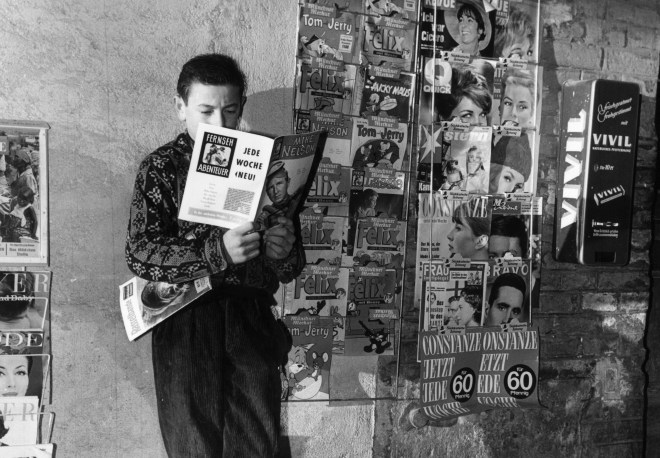
(Photo: A German boy leans against the wall next to a magazine stand to read a comic book, circa 1955. By Evans/Three Lions/Getty Images)

Chart Of The Day

by Doug Allen

sequester

Dave Weigel traces the public’s interest in “sequestration” (in blue) and “the sequester” (in red):

[Y]ou’ll see that interest started to rise at the end of February, that the buzziest news stories were about congressional action, and that search volume exploded on March 1 — the Friday the cuts went into effect. By Monday, search volume had fallen by 63 percent. And it’s never recovered, even as the cuts get implemented and local news outlets diligently file stories on their impact.

Obamacare’s Rollout Hits A Snag

by Patrick Appel

It was recently announced that a key aspect of the ACA, as it applies to small businesses, will be delayed for a year in most states. Suderman explains:

[E]xchanges in the majority of states won’t be offering health plan choice to small business owners. For all practical purposes, then, the law’s exchanges will offer nothing to small business owners and employees. As health policy professor (and ObamaCare supporter) Timothy Jost noted in Health Affairs when the delay was first proposed, the choice option was the “primary benefit” offered by the law’s small business exchange system. Without that option, he wrote, it’s “unclear what advantage” those exchanges would actually offer to small employers over currently available insurance options. The Chamber of Commerce seems to agree. As USA Today notes, it issued a statement saying that because of the delay, small business insurance purchased in the health exchange, “will be of little or no value to employers, or by extension, their employees.”

Joe Klein blames the administration:

This is a really bad sign. There will be those who argue that it’s not the Administration’s fault. It’s the fault of the 33 states that have refused to set up their own exchanges. Nonsense. Where was the contingency planning? There certainly are models, after all—the federal government’s own health benefits plan (FEHBP) operates markets that exist in all 50 states. So does Medicare Advantage. But now, the Obama Administration has announced that it won’t have the exchanges ready in time, that small businesses will be offered one choice for the time being—for a year, at least. No doubt, small business owners will be skeptical of the Obama Administration’s belief in the efficacy of the market system to produce lower prices through competition. That was supposed to be the point of this plan.

Casey Mulligan looks at other ways Obamacare could impact businesses.

Ask Andrew Anything: What Fundamental Rights Should Be Subject To Voting?

by Chris Bodenner

A reader responds to yesterday’s video:

Andrew, the video in which you expressed near-speechless amazement at the recent acceleration of the US toward embracing LGBT rights truly struck a chord with me. We’re roughly the same age (I was born in 1960), but I grew up in southwest Virginia, the heart of the Bible belt, a part of the world where being gay was considered the worst fate one could imagine, the most shameful, wretched possibility – worse than being a criminal, worse than anything. My family wasn’t particularly religious, but the messages they gave me from the time I was a child (and they certainly sensed my gayness early on) clearly steered me toward a life of respectability and “normalcy.” I entered a state of deeply ingrained denial, believing and hoping so strongly that there was simply no way possible that I could be a homosexual, that it simply wasn’t an option.

I eventually married a woman, and truly loved her, though in a limited way that ultimately led to frustration and bewilderment for both of us. We remained married for 12 years, until my wife suggested that I go back into therapy. After much difficult, emotional work with a supportive therapist, I was finally able to admit the truth of being gay, first to myself and then to my wife. Our marriage was over as soon as I disclosed my sexuality (and my lies and infidelities). Sadly, we remain distant and have little contact with each other.

So I came out at the age of 43, fearing that it was too late to ever find love with another man, and unsure that a sustained, loving relationship between two men was even possible.

However, I not only met a wonderful man, with whom I’ve shared my life for 8 years now (not married yet, but we’re talking about it), I also finally became politically active, attending protests of “ex-gay” conferences, and lobbying the state legislatures for trans rights. I was astounded and tremendously impressed by the young activists I met, wowed by their absolute conviction (yet so casually expressed) in their right to be fully recognized and their deserving complete civil equality. (I was living in New York during the ’80s, at the height of the Plague and during the rise of ACT UP, but I was severely closeted and scared to death of gay sex.)

While I’m amazed at the changes we see how happening all around us – the court cases that are going all the way to the Supreme Court, one state after another ratifying civil marriage rights for gay couples – I also cant help but worry that a backlash will come. I share your sense of hope, and I’m incredibly encouraged by the confidence and strength of will that I see displayed by the next generation of young LGBT people. But I still remember being slammed into lockers and being called a faggot in junior high (even though I was trying desperately not to appear effeminate … somehow people just knew). I know there are very large, heavily financed organizations composed of people that feel severely threatened by the advances we’ve seen: the FRC, NOM, Focus on the Family, etc. I celebrate right along with you, Andrew, and share your gratitude for how much has changed. But I’m still nervous, and still fearful, I suppose, of the bullies and the smoothly delivered condemnations after all these years. It’s hard to believe that the victories we’ve seen will really “stick” and become fully embedded into our culture, for good.

But most of the time, I do know hope. Because I was reborn when I came out, late though it was, and I learned that even a balding, middle-aged man, who once lied to himself so thoroughly that he had a hard time distinguishing truth from reality, was finally able to accept the truth about himself, and was able to find love. I share your awe in the dazzling, surreal world in which we now find ourselves, a world that was once only imagined but that appears to be coming into being. A world in which who we love really makes very little difference to the world at large, but a tremendous difference to each individual who has the courage to be themselves.

Thanks always, Andrew, for your honesty, and for making the case for marriage from early, early on.

Bloggers Aren’t Normal

by Doug Allen

After Nick Beaudrot gave up Twitter for Lent, he found that he didn’t feel like using it again “until [he found] a way to separate the wheat from the chaff.” Ezra Klein agreed, Yglesias differed, and Kevin Drum positioned it as a problem for “the verbal, well-educated, politically conscious social group that most bloggers belong to.” Jonathan Bernstein zooms out:

[T]he truth is that Klein and Yglesias and Drum and, for a few years now, myself, aren’t part of that group. We’re in a different category: people who have to follow the news for professional reasons. … [T]he less-interesting upshot of all this is that it’s not clear why most people should be particularly interested in how Klein and Yglesias and Drum use twitter, because their — our — needs are really different. But the more important lesson that really can’t be repeated often enough is that reporters, columnists, bloggers: we’re not normal. Even worse: of the not normal — the people who pay a lot of attention to politics — we’re not even normal in that group. …

Twitter, with its self-selected feeds, is particularly good at making you forget about [this]. It’s very easy to think that “everybody” is talking about something, when really it’s a handful of reporters and political operatives. Or that something is old news, when in fact only some 10% or fewer of those out in the electorate have even heard about it.

When Teachers Cheat

by Patrick Appel

Dana Goldstein analyzes the Atlanta public school cheating scandal:

The extent of the top-down malfeasance under Beverly Hall may be unprecedented, but as I report in this Slate piece, there is reason to believe that policies tying adult incentives to children’s test scores have resulted in a nationwide uptick in cheating. An investigation by the Atlanta Journal Constitution found 196 school districts across the country with suspicious test score gains similar to the ones demonstrated in Atlanta, which statisticians said had only a one in 1 billion likelihood of being legitimate. A 2011 study by USA Today of test scores from just six states found 1,610 instances in which gains were as likely to be authentic as you are likely to buy a winning Powerball ticket. Absent independent, local investigations of suspected wrongdoing—which are rarely conducted—we simply cannot know the full extent of the cheating, which makes it difficult to assess whether the United States ought to continue down the road of tying teacher and administrator pay and job security to kids’ standardized test scores.

Chait yawns:

Incentivizing any field increases the impetus to cheat. Suppose journalism worked the way teaching traditionally had. You get hired at a newspaper, and your advancement and pay are dictated almost entirely by your years on the job, with almost no chance of either becoming a star or of getting fired for incompetence. Then imagine journalists changed that and instituted the current system, where you can get really successful if your bosses like you or be fired if they don’t. You could look around and see scandal after scandal — phone hackingJayson BlairNBC’s exploding truckJanet CookeStephen Glass! — that could plausibly be attributed to this frightening new world in which journalists had an incentive to cheat in order to get ahead.

Edward Glaeser proposes a solution:

Teacher cheating isn’t an excuse to give up on standardized tests. It is a reason to administer them properly. Just imagine if college admissions tests were given by individual teachers rather than by the College Board. Teachers would have a huge incentive to help their favored students; the College Board, therefore, administers tests at well-monitored sites. If the U.S. is going to use standardized tests to evaluate teachers or schools, it should pay the extra price of using an external agency, such as the College Board.

The Return Of Big-Screen Terrorism

by Patrick Appel

Jay Newton-Small notes that several new films depict the destruction of DC:

Destroying the White House or other trappings of the presidency – most notably Air Force One – is not a new subject matter. But [Olympus Has Fallen, G.I. Joe: Retaliation, and White House Down] are notable in that they are the first blockbusters since the Sept. 11, 2001 terrorist attacks to violently attack Washington landmarks. In the intervening years after the attacks, Washington was destroyed on the silver screen, but by natural causes: an ice age in The Day After Tomorrow (which tactfully avoided showing the actual destruction of any landmarks) and tectonic shifting in the movie 2012.

She thinks the “the release of movies that would’ve been unimaginable a decade ago marks a healing milestone on the collective American psyche post 9/11.”