A Pro-Life And Pro-Animal Alliance?

Charles Camosy, author of For Love of Animals: Christian Ethics, Consistent Action, sees overlap between the pro-life movement and animal welfare activists:

Charles also spoke with K-Lo about this connection:

[O]ne thing which frustrates me to no end is that merely holding my position is often identified with activism and extremism. “Oh, you’re one of those people who blow up clinics and yell at women,” I’m told. Of course, over half of the U.S. identifies as pro-life, so this caricature is unfair and irresponsible. It is nevertheless used to good effect by some pro-choicers to marginalize the views of their opponents in the public square. But something similar happens to those of us who are concerned about the welfare of non-human animals. We are caricatured as “animal-rights activists,” and this conjures up similar images of extremism. But there are many millions of vegetarians in the United States, and many millions more who will only eat meat from animals who were treated well. So, one of several things that pro-lifers and those who are concerned for animals have in common is that our opponents, rather than engage our arguments, will often simply try to paint us as extremists who shouldn’t be taken seriously.

He elaborates on his position:

Animal-rights thinkers like [Peter] Singer sniff hypocrisy from pro-lifers who defend the dignity of prenatal and neonatal children, but then ignore the dignity of animals who seem to be more sophisticated than even the smartest newborn baby. Elephants mourn their dead, dolphins recognize themselves in a mirror, and chimps can teach their children sign language. Pigs can play video games, and even chickens can beat humans at tic-tac-toe. Now, I absolutely insist that all human beings — including those who are prenatal, neonatal, disabled, or injured — are worth more than even the most sophisticated non-human animal. But I can also see how an animal-rights secularist could be confused by self-described pro-lifers who are adamant about nonviolence with respect to human beings, but then ignore and even directly benefit from the horrific violence inflicted on animals.

Camosy’s previous videos can be found here. Our full Ask Anything archive is here.

How The Saudis See The World

F. Gregory Gause explains what the Saudis have against America’s agreement with Iran:

This was not simply a geopolitical setback for Riyadh. The Saudi leadership believes that increased Iranian power will lead to political mobilization by Shia inside the Sunni-ruled Gulf states. The Saudis and their allies in the Gulf remain certain that Iran meddles directly in their domestic affairs, but they are also convinced that Iran’s heightened regional role will inevitably inspire Shia discontent, which makes Iran’s ascendance an indirect threat to the stability of the Gulf monarchies.

It was through this lens that the Saudis viewed the sustained and peaceful demonstrations in 2011 against the Sunni monarchy in Shia-majority Bahrain, even though there was no objective evidence of an Iranian role in the protests. The Arab Spring also brought down Riyadh’s most important Arab ally, Hosni Mubarak’s regime in Egypt. But there was one bright spot for the Saudis amid the regional upheaval. The uprising against Assad in Syria, Iran’s closest ally in the Arab world, represented the best chance in a decade for Riyadh to roll back Iranian power.

For the Saudis, therefore, Obama’s refusal to take action against Assad was seen as another example of Washington’s inability to appreciate both the dangers and the opportunities of the Arab Spring.

Reliving The Iraq War, Ctd

Readers are starting to get more specific with their feedback on the e-book (available to subscribers here):

I’ve finished reading through I Was Wrong. First of all, thanks for giving us subscribers this long-form content. It’s greatly appreciated. The entire collection is worth reading, but I think that andrew-sullivan-i-was-wrong-covermuch can be summarized and learned from your very first post written during 9/11, in particular, “When our shock recedes, our rage must be steady and resolute and unforgiving.”
If there is one lesson I think that is vital to learn, it’s that rage is never a good response to an attack. Rage feels righteous and it moves us to do things that we would never otherwise consider. Perhaps the most chilling and ironically prophetic sentence in that first post was that “[t]he response must be disproportionate to the crimes.” It certainly was, and now we can see the cost of disproportionate revenge. We can see that anger and a desire for revenge can lead us to lashing out blindly and, worse, stupidly at those we fear and hate, turning us into awful parodies of that very hatred. It’s no wonder that the Bush administration was able to sell us on going to war against Saddam. We needed someone to punch. Bush and Cheney just gave us a target to plant our fists in.

What worries me is that I don’t know that we’ve really learned our lesson. In the aftermath of the Boston bombing, I saw and heard much of that same righteous anger looking for a target. I worry that if and when another truly large attack occurs, we’ll be perfectly content to follow the next call to war without pausing to consider whether it’s even the right war.

Another:

I read your e-book last night. It was riveting. I read most if not all these posts at the time and the book took me back to that time in a visceral way. The history came alive for me. It also gave me a glimpse into another person’s psyche in a new and vivid way. It’s like seeing pieces of glass laid down every day, then all the sudden stepping back and discovering a broad mosaic. I don’t know that I’ve ever experienced history in such a vivid way.

If you read the e-book and want to discuss particular parts of that history, our in-tray is open. Another reader:

The entire first part of I Was Wrong is post after post of invective against “appeasers” and “decadent liberals” – your words, not mine – for offering even the slightest objections to rushing headlong into Iraq. Then, in the heat of the 2002 midterms (while, let’s not forget, the entire GOP party apparatus dealt the “Vote Democratic and 9/11 will happen again” card from the bottom of the deck), you accused the Democrats of not even participating in debate over the war – while at the same time criticizing anyone who entered the debate on the side opposing yours.

Everyone against the war, according to Sullivan-circa-2003, was an America-hater, a French person, or an editor of the New York Times. And even the members of the military who express doubts about the workability of an invasion are just cowardly “doves.” Oh, and Colin Powell’s bullshit-ridden presentation to the UN Security Council got you excited. All this after you admitted (and this is a very Christian sentiment) that you were hoping for war. Seriously? I’m at March of 2003, and if I read the phrase “Fifth-Columnist” – which you of all people would know is a code-word for “traitor” – my iPad is in serious jeopardy of being thrown out the window.

It gets better. Another:

I read I Was Wrong in one sitting and listened to your conversation with Mikey Piro shortly afterward. I have to be honest, there were points when I was astonished at what I was reading.

There were even points when I questioned whether I should re-subscribe. What lead me to that questioning was not, as one of your readers said, the fact that you were wrong. I do not look towards you to be an oracle. Mainly I was almost scared by what I read. Your talk of exterminating the enemy, your desire to go to war with the entire Middle East to root out and destroy terrorism in all corners of the globe, your denunciation of the anti-war crowd without appreciation … this was not the Andrew I felt I had gotten to know over the past couple years.

Where was Oakeshott? Where was Saint Francis? Where were the tempered, multi-faceted reflections on the world that linked specific events to broader intellectual themes? Where were the analyses that drew upon a variety of sources and influences? Instead, there was simply a Manichean view of the world filtered through deep anger and hurt. This was frightening to me. I felt that one of my mentors (yes, despite the fact that we have never met, although I saw you riding your bike in Ptown once and had a mini-freakout, your writing has had a mentoring effect on me) had been sullied, that I had been betrayed.

Having been in elementary school when you were writing about Iraq, I thought I had no understanding or contact with the early Dish. My initial reaction to I Was Wrong only confirmed this thought. But then I realized, as Abu Ghraib and torture began to weigh more heavily on your writing and view of the war itself, that I have been deeply in contact with the early Dish. How? Because I got the overwhelming feeling that the Dish since the war is a reaction to the Dish before the war.

Even more than that, the Dish since Iraq is atonement. It is attempting to atone for the person who wrote the infamous “fifth column” paragraph and many others that were equally vehement. The diverse riches of the Dish today are an atonement for the single-mindedness of your writing on Iraq. Is it the sole driving force? Maybe not. But I think that every time you post theological writing, or post reader responses, or cultivate a dynamic and often wrenching reader thread, and definitely when you write about conservatism, there is an element of atonement.

I feel like you don’t feel as if your apologies are enough, that writing I Was Wrong is enough. The only way to truly atone for what happened is to make sure it never happens again and your way of ensuring that is through creating a tapestry of essays, criticism, responses, and discourse that, when taken as a whole, demonstrate that the only way forward is a reflective and informed skepticism. It shows the readers of this blog that the vagaries of life can only be endured through a disposition towards the world that appreciates its nuance, confusing contradictions, subtlety, and complex interiority. Leveling critiques will not do. Single-mindedness will not do. A lack of familiarity with the arguments against your position will not do. That is the only way that the stain of Iraq can be faced.

Thank you for teaching me this and much more.

I cannot undo the ugly, but the open Dish model, and what I now do every day, is my attempt at atonement.

Update from a reader:

I haven’t read the ebook yet – may do so over the holiday.  Not sure I can take it a second time. But reading the readers’ reactions you’re posting, I’m fascinated by the people who feel angered or shocked by the Andrew.9-11 version of the Dish. I am now a subscriber and have been a daily reader (well, maybe hourly) since the run up to the Iraq War. What brought me to the Dish was a search for a conservative, pro-war voice that would be a reasonable, educated counter-balance to my own views and all the anti-war stuff I was reading at the time. I couldn’t make any sense out of what we were doing (even from a cold, hard, Machiavellian perspective – it seemed insane to me), and I was hopeful that you would at least provide some perspective into that worldview.  I came for the perspective, but stayed for the evolution.

But, as I’ve seen you grapple with all of this, and other issues (I think I’ve even noticed a bit of softening in your white-hot hatred of the Clintons, but thankfully no movement on Sarah Palin), I have to say that I miss having someone as smart and articulate as you are to turn to for the opposing view.  I’m sure some of this is the influence you have had on some of my viewpoints (I have a much broader view of the Catholic Church because of you, for instance), but it has been amazing to watch and read and be a part of all of this.  Thanks for sharing yourself so transparently.  Glad to pay for the privilege.

20% Of Obama’s Pardons Have Gone To Turkeys

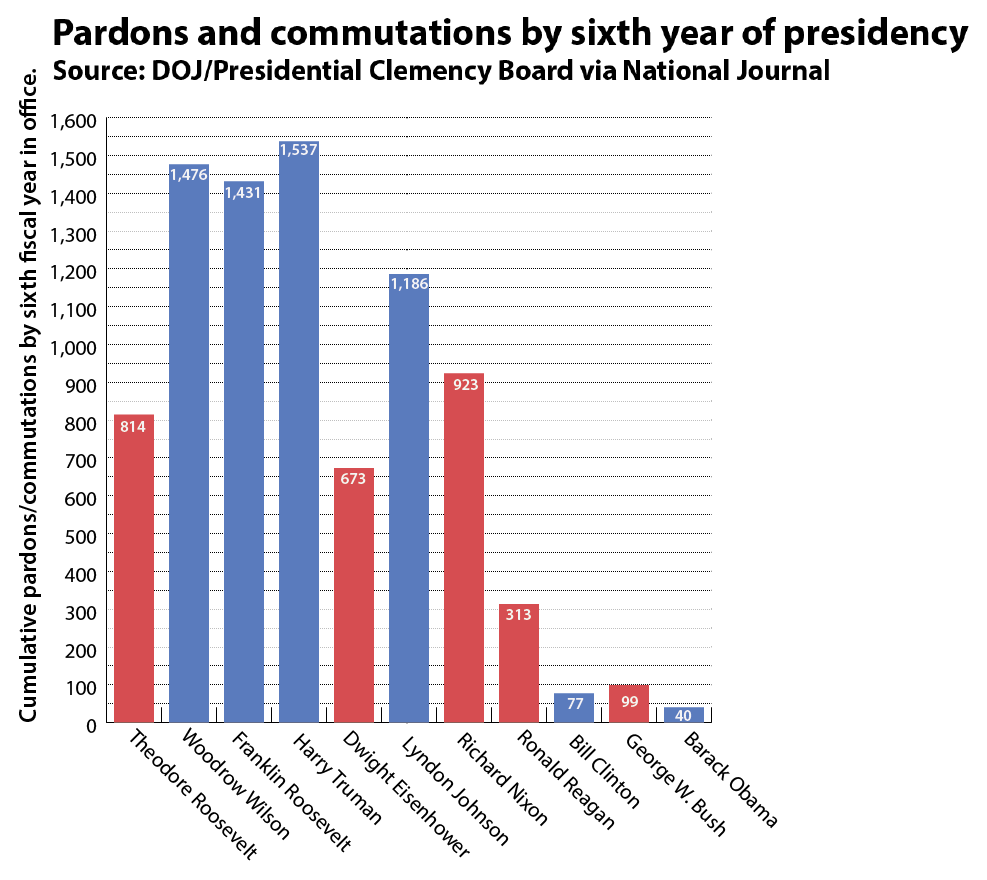
presidential-pardons

Plumer hates the turkey pardon:

Obama will have “pardoned” 10 turkeys in all (turkeys that, as best we can tell, haven’t actually committed any crimes). By contrast, he will have only pardoned or commuted the sentences of 40 actual living human beings. The latter is a record low for modern-day presidents. At the same point in his presidency, Ronald Reagan had pardoned 313 people. Harry Truman had pardoned 1,537 people

Emma Roller thinks that the “statistics of presidential pardon ratios as of last year—that is, the ratio of pardons granted to the number of human pardon applicants—speak for themselves”

Ronald Reagan: 1 in 8

George H.W. Bush: 1 in 19

Bill Clinton: 1 in 16

George W. Bush: 1 in 55

Barack Obama: 1 in 290

Does A Company Have Religious Rights?

SCOTUS is going to have to answer that question:

The Supreme Court will hear two challenges to the requirement that all employers provide birth control coverage to their workers. One comes from craft store chain Hobby Lobby and the other from Conestoga Wood Specialties, a custom cabinet-making company in Pennsylvania.

The owners of both companies have argued that the requirement to provide employers with contraceptive coverage is a violation of their religious liberty. And, in Hobby Lobby’s case, the 10th Circuit Court of Appeals agreed: The craft store won a preliminary injunction against the health law requirement this past summer. The Department of Justice then appealed that ruling to the Supreme Court, leading to today’s granting of cert for the case.

Dahlia Lithwick examines the case:

The court will need to address several questions here, beginning with whether a for-profit corporation can be a “person” capable of exercising religion freedom. Citizens United taught us that corporations count as people when it comes to campaign speech. Does this weird concept of personhood extend to their religious rights? The 10th Circuit said yes. The 3rd Circuit said no. More questions: Does the birth-control coverage benefit substantially burden a company’s exercise of its religious rights, if it has them? Is the contraception mandate nevertheless justified by compelling government interests because it is a vitally important element of affording women equality in health care?

Schwartzman and Tebbe find no precedents:

Never has the Supreme Court suggested that profit-seeking companies may exercise religious freedom rights. In contrast, many Supreme Court cases before Citizens United had indicated if not outright insisted that corporations do enjoy speech rights. These corporate religious freedom cases are truly without precedent, yet they are coming to be viewed by the media and the courts as though they are part of a natural legal progression.

Jeffrey Rosen worries the case could have major consequences:

The case has huge significance because, if the broad version of the constitutional challenge is accepted, any for-profit corporations whose owners claim that they are organizing their businesses to further religious principles could claim exemption from a host of federal regulations. As Judge Illana Rovner pointed out in her dissent from the Seventh Circuit case granting a religious exemption to the health care mandate to for-profit corporations, a ruling along these lines “has the potential to reach far beyond contraception and to invite employers to seek exemptions from any number of federally-mandated employee benefits to which an employer might object on religious grounds.” For example, Judge Rovner noted, an employer who is a Methodist and objects to stem cell research might refuse to cover an employee’s participation in a clinical trial of stem cell research for Lou Gehrig’s disease; an employer who is a Christian scientist might insist that the ACA’s mandate of coverage for traditional medical care is a violation of his religious beliefs; and an employer who is a Southern Baptist and objects to gay marriage and surrogacy might refuse family leave to gay employees that would otherwise be required under federal law.

Finally, Sargent sizes up the politics of the case:

Bloomberg poll last March found that more than six in 10 Americans, and nearly 70 percent of women, rejected the GOP’s rationale for opposing the contraception mandate, seeing it as a matter of women’s health, and not religious liberty, with more than three quarters saying the topic shouldn’t even be part of the debate — suggesting that the middle of the country soundly rejects the GOP’s framing of the issue. And so, Dems will use this news to try to shift the argument over Obamacare on to cultural and health care turf that has already proven favorable to them.

How Do You Say …

This embed is invalid


Katherine Wells captions the above video:

Former Harvard professor Bert Vaux asked tens of thousands of people across the U.S. these questions and released the results as the 2003 Harvard Dialect Survey. The data are fascinating; they reveal patterns of migration, unexpected linguistic kinships between regions, and the awesome variety of words we say and how we say them.

The study has wormed its way into popular consciousness and periodically morphs into a meme (just search “accent tag” on YouTube). Last summer, North Carolina State University graduate student Joshua Katz turned Vaux’s geographical data into a set of stunning heat maps that went viral.

For the video above, we called people across the country to ask them a few of Vaux’s questions, then layered the answers with maps based on Katz’s. You’ll hear what Philadelphians call a group of people, the many ways of pronouncing “pecan,” and what Southerners mean when they say “the devil is beating his wife.”

Kottke chimes in:

It’s one thing to read the difference between the pronounciations of “route”, it’s another thing entirely to hear them. I haven’t lived in the Midwest since 2000 and I have since transitioned from “pop” to “soda”, “waiting in line” to “waiting on line”, and am working on switching to “sneakers” from “tennis shoes” (or even “tennies”). But I was surprised to learn that I still pronounce “bag” differently than everyone else!

The Pity Of War, Ctd

A reader just finished listening to my conversation with two-time Iraq vet Mikey Piro (available here for subscribers):

Oh man, the way he described his friends being killed, and how it’s clearly still affecting him emotionally, was pretty startling. It sorta revealed how much I previously viewed soldiers as almost mechanical. I never conceived of them expressing that kind of emotion. I honestly pirowondered whether you were experiencing technical difficulties or what else could be causing the silence. Then I realized he was crying. I definitely cried once myself.
That detail about the Abrams tank’s soft underbelly and how the bomb would’ve ripped through that and – hopefully, he adds – killed his buddy instantly also stuck with me. That’s a tragically-apt metaphor for the war. And the entire narrative arc of the interview nicely captures our country’s experience since that fateful September morning. The sheer rage and eagerness for payback. The panic when we realized we may have gone too far. And the resignation and bitter disappointment at the Bush administration, warring Iraqi factions, and even at humanity itself once the sectarian war is unleashed.

And nice tie in with your experiences during the AIDS crisis. That frustration when people around you don’t understand – indeed, are incapable of understanding – what you’re going through is something that I think will broadly resonate with many people. I had a similar situation, albeit at a less intense level, with respect to my underemployment during the Great Recession. I was deathly afraid of letting my friends – most of whom were getting along fine – know how underemployed and desperate I was. And it was on my mind constantly, leading me to act in objectively inexplicable ways towards others. I have greater stability in my life now. But I wonder whether I’ll always be a little more guarded.

Anyway, great interview. You continue to make me a happy subscriber! Happy Thanksgiving!

All readers can listen to two clips of the conversation here.  If you want to hear the whole thing and haven’t subscribed yet, click here for full access to Deep Dish and daily Dish. Read more about Mikey here. He’s a hero of mine and still doing all he can to help his brothers grappling with the psychic aftermath of intense, prolonged, brutal trauma.

The End Of DIY DNA Testing? Ctd

Gary Marchant covers the FDA’s crackdown on genetics company 23andMe:

[T]he FDA was not required to take this heavy-handed and drastic action. We know this because many of the exact same genetic tests are already being provided to consumers through their physicians, without any FDA approval. There are approximately 3,000 genetic tests now commercially available through your doctor, of which only a handful have received FDA approval. So it is apparently now unlawful for 23andMe to sell you a genetic test but OK for your physician to order the exact same test, at a much higher cost to the consumer. This is an unjustified and unwarranted double standard.

There are important reasons why at-home genetic testing may be preferable to consumers.

To many, their genetic information is very private, and they prefer to get the results privately at home rather than through their physician, who will likely put the information in the patient’s medical record. It is much cheaper to get tested through 23andMe, which is currently offering its entire battery of genetic tests for only $99. It would cost many hundreds if not thousands of dollars to get the same tests through one’s physician, and health insurance does not cover the cost of most genetic tests presently. As a practical matter, most physicians are unlikely to order the complete set of genetic tests offered by 23andMe, so those who are interested and curious to get as much genetic information as possible will be blocked from doing so if they must go through their doctor.

Drum admits that he’s “sort of agnostic about the issue of whether personal genome services should fall into the category of highly regulated diagnostic tests”:

[W]hile your genome may be medical information, interpreting your genome and explaining whether it puts you at risk for different diseases is very close to medical advice. And not just general medical advice, of the kind that Dr. Oz purveys on television. It’s specific, personal medical advice, of the kind that only licensed physicians are allowed to provide.

That’s the argument, anyway. If 23andMe is going to perform a lab test and then send you a personal letter suggesting that you, personally, are or aren’t at high risk for some disease, it’s acting an awful lot like a doctor.

Reihan joins the conversation:

One gets the impression that the FDA is now seeking to protect us from hypochondria, in which case it will have to do more than regulate harmless saliva testing kits. Perhaps the FDA should redefine internet-enabled devices as medical devices, as these devices are used to access WebMD and Yahoo Answers, where all kinds of information is shared about medical conditions, not all of which is relevant or reliable.

Nick Gillespie thinks the FDA’s rules are outdated:

Peter Huber of the Manhattan Institute, a conservative think tank, has an important new book out called The Cure in the Code: How 20th Century Law is Undermining 21st Century Medicine.. Huber writes that whatever sense current drug-approval procedures once might have had, their day is done. Not only does the incredible amount of time and money – 12 years and $350 million at a minimum – slow down innovation, it’s based on the clearly wrong idea that all humans are the same and will respond the same way to the same drugs.

Given what we already know about small but hugely important variations in individual body chemistry, the FDA’s whole mental map needs to be redrawn. “The search for one-dimensional, very simple correlations – one drug, one clinical effect in all patients – is horrendously obsolete,” Huber told me in a recent interview.

From Brushstrokes To Books

Reviewing The Letters of Paul Cézanne, Colm Toibin highlights the many writers who took inspiration from the French painter’s innovative style:

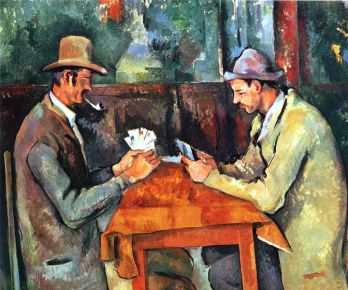
Cézanne was a voracious reader, familiar with the contemporary French novelists as with classical literature. While his life inspired Zola, the work itself began to intrigue novelists and poets. The dish_cezannebrush strokes with the look of textured sentences, and Cézanne’s ability to paint a section of the canvas in great rich detail and then leave other sections undernourished or even blank, would interest writers such as DH Lawrence (“Sometimes,” Lawrence wrote, “Cézanne builds up a landscape out of omissions”) and Hemingway.

In a deleted passage in Hemingway’s story Big Two-Hearted River, he wrote: “He wanted to write like Cézanne painted. Cézanne started with all the tricks. Then he broke the whole thing down and built the real thing. It was hell to do … He … wanted to write about country so that it would be there like Cézanne had done it in painting … He felt almost holy about it.” Some of the most beautiful and perceptive writing about Cézanne’s work was by the poet Rilke.

“The artist,” Cézanne said, “must avoid thinking like a writer.” By this I understand him to mean that the painter must avoid narrative in a picture, or taking sides, however briefly, for one tone against another, or offering moral truth or even ironies, or allowing mere feelings to interfere with a picture, including a portrait. It is perhaps for this reason that writers, who much of the time believe also that writers must avoid thinking like writers, have been so interested in Cézanne, and why his work and the legend of his life, as dramatised in these letters, have endured.

(Image of The Card Players by Cézanne, 1892, via Wikimedia Commons)