
Newport Coast, California, 10.02 am
Newport Coast, California, 10.02 am
Not by Israeli forces, the UN now reports, contra previous stories from the WaPo and the BBC last November. The child was a victim of a Hamas counter-attack. Will they correct? We’ll keep you posted.

Readers are responding to this post in droves. Below are all their best arguments against legal polygamy (with pro arguments coming shortly):
Your readers debate the polygamy objection to gay marriage, but they both miss the actual answer that has been provided by the courts a long time ago – and it makes perfect sense. Bans on polygamy are constitutional because the discrimination is purely numerical and thus applies equally across racial and gender lines, etc. The law says you can only have one spouse, and that law applies to blacks, whites, men, women and, yes, ultimately heterosexuals and homosexuals. It is the same reason it is constitutional to legislate an age when you can marry, an age before you can vote, or the maximum speed that you can drive on a highway.
All laws discriminate in some sense. But purely numerical discriminations do not discriminate based on a person’s inherent nature and, thus, are (usually) constitutional. Its also why it is possible (if not necessarily advisable) to criminalize polygamy. Society is free to decide that polygamy is an accepted marital arrangement. Indeed, we already accept serial polygamy (e.g., Newt Gingrich). But constitutional considerations would be implicated if society tried to legislate that only whites or only heterosexuals could be polygamous. At bottom, the polygamy question is a red herring to the gay marriage debate.
Another:
In addition to the excellent response from another reader which you posted, I have to add this: In societies that previously recognized polygamy, it was almost exclusively polygyny and not polyandry; a man could have more than one wife, but no wife could have more than one husband. I’m going to assume that we’re doing away with that scenario on the basis of gender equality alone, but a quick look at the details of what polygamous marriage would look like makes it clear why polygyny (provided legal gender inequality) is actually manageable but generalized polygamy isn’t in most cases.
Let’s do away with genders and just talk about three people, A, B, and C. Person A wants to have a polygamous relationship with B and C. In the US, the primary legal result of marriage is the formation of a single legal household entity that encompasses two people. So, if A and B become one household, and C marries A, are B and C now married too? If not, you have a legal mess on your hands that should be obvious. And it gets worse if C wants to marry D as well, but A and B do not.
There is an argument to be made for “group marriage,” where an arbitrary number of people enter into a marriage contract with each other. Let’s also provide that any individual can voluntarily “divorce” him or herself from that married household. I could see a legal basis for this, although my question would be: does this even resemble anything that we would call “marriage” anymore? Is there any way in which the complex group dynamics inherent in human nature don’t split this “marriage” into factions? And for that matter, what really is needed here that isn’t provided by, say, incorporation?
Perhaps there’s an argument to be made for arbitrary “adoptive families” that aren’t families at all. For a less explosive example, let’s imagine two unrelated people who come to cohabitate as siblings and not romantically or amorously. In the same way that four co-“married” polyamorous individuals might want hospital visitation rights and inheritance rules, these two people might want some protections without being married. I can see an argument for that, but I can’t see calling it marriage.
Another way to look at it:
The reason for a two-person marriage works much better than three-person marriage is not due to government policy. It is entirely social. Pardon me going all geeky here but this is how I think:
Three-unit systems where all equal to each other are inherently more unstable than just two-unit systems. Imagine that the probability of two people having a great interpersonal relationship is x. In a two-unit system, probability of stability is x. But in a three unit system it has to be x to the power of 3, since three relationships have to be great. Note that x is less than 1. So x^3 is much much less than x. A stable society can not function with such a high divorce rate.
In ancient societies and in some places even now, polyandry and polygamous marriages are traditional. They work because of special social circumstances and in lot of cases one or more of the persons in the marriage has more weight than the rest and they stay cohesive only because of those special circumstances. Once everybody wants equal weight, things will collapse.
Another points to a variety of complicated scenarios:
What happens if Wife #1 wants a divorce but Wife #2 objects? When the husband dies, are the two women still married to one another? Does the estate get disbursed or do they have to keep on sharing it? The assumption is that if it’s one man and two women, if one of the women dies the remaining man and woman are still married. What do you do in community property states? What happens in the community property state when Wife #2 dies during the middle of the divorce of Wife #1. Does the husband get to keep everything or does the about-to-be-divorced wife get half instead of one-third? If they were divvying up things three ways before she died and she does it three hours before the final decree does the surviving wife have a half interest in the third? What about if she dies three hours after? The husband dies before both wives. Do the kids of Wife #1 get a say in the end-of-life decisions being made about Wife #2?
Another runs through a similar series of situations and concludes:
We do not have the laws in place to support plural marriage. I don’t know for sure, but I suspect that most of the countries that do allow plural marriage allow only one form of plural marriage: a single man and multiple wives. Our constitution will certainly not allow that restriction if we decide to go down that road. We would have to build those laws, and I don’t think we have anyone wise enough to craft laws to cover a fraction of the situations that would develop. People who want some sort of a plural marriage will have to resort to lawyers and contracts to formalize their relationships on a case-by-case basis. I realize that is what people used to say about same sex marriage. The difference between the two situations is that we already have a body of law to govern the marriage of two people.
One more for now:
Please continue to make a clear distinction between gay marriage and polygamy. The best argument for gay marriage is that it harms no one and is good for gay people and their children. No one has managed to come up with even a shred of evidence that gay marriage is harmful to anyone, and not for want of trying. Polygamy, on the other hand, is demonstrably bad for women and children, in ways that go far beyond creating a surplus of unmarried men. An excellent resource on this topic is A Cruel Arithmetic: Inside the Case Against Polygamy, by Craig Jones.
(Photo: the full family of one Joseph F Smith, c 1900, a known polygamist. This picture depicts members of his family, including his sons and daughters, as well as their spouses and children. Via Wiki.)
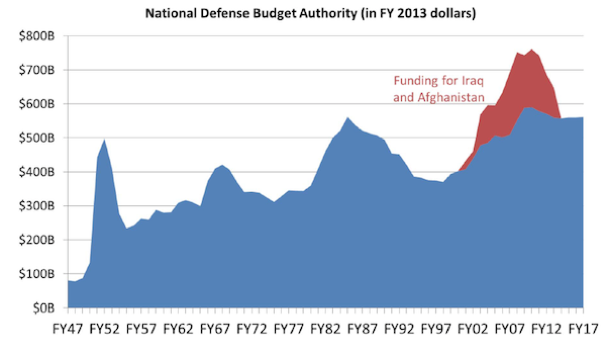
There’s a truly hopeful piece in the NYT today that’s a further argument for the sequester. The military is slowly beginning to think through where and how to cut – in ways that can only help lower the debt and make massive land invasions of foreign countries much less feasible.
Inside the Pentagon, even some senior officers are saying that the reductions, if done smartly, could easily exceed those mandated by sequestration, as the cuts are called, and leave room for the areas where the administration believes more money will be required. These include building drones, developing offensive and defensive cyberweapons and focusing on Special Operations forces.
Given the way procurement and bases are spread across the states to prevent rational cutting and pruning – as would happen in any private sector company – I’m not sure the Democrats and non-neocon Republicans should ever end the defense sequester. How else are we going to cut defense spending given our corrupt, horse-trading, not-my-military-base Congress? And look at the chart above. Are we really spending more now than we did during Vietnam or the height of the Reagan defense buildup? Yes, we are.
Even as a percentage of GDP? Yes, we are:
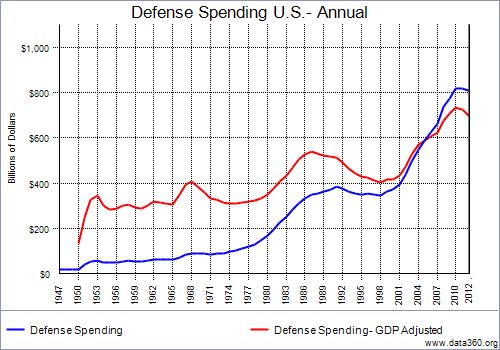
I know we have a base-closing commission – but we all know its limits and manipulation (especially after the beginning of “House of Cards”). As the institution fights over “slices of a $530 billion budgetary pie that many experts think should be shrunk by one-fifth over the rest of this decade,” Thomas P.M. Barnett’s bet is on the army:
At roughly 560,000 men and women, the Army is bigger than it has been since 1994, when it was still crashing from its Reagan-era Cold War heights of 780,000. Later in the 1990s, the Army bottomed out at 480,000, and there’s no reason it can’t go back to that level, given that none of the fabulously high-tech wars being dreamed up by Pentagon planners calls for multiyear occupations of distant California-size countries.
A reader rebuts Filipovic:
How is my father’s surname more my identity than my husband’s surname? Both, if you want to get all feminist about it, highlight the fact that females are “owned” by the males to whom they are born or wed, right? I am more than a name and I’ve had a lot of them. My birth parents saddled me with an atrocious moniker that only teenagers could have come up with and a surname that is now deemed a state secret. My parents stuck me with a vanilla Catholic saint name. My late husband offered me a new surname and my second husband gave me another. Don’t even get me started on nicknames.
And still, none of these arbitrary arrangements of letters are me. If I tried, and I have now and again, I don’t think I could put a name to me that sums me up. My names are like a history – snapshots of me at different points of my development and always a step behind as I evolve.
Another:
Jill Filipovic’s case for women keeping their surname strikes me a bit romantic. Yes, our name is our identity, but what if you do not want to be associated with the identity? I had three fathers growing up (a non-exsistent birth father and two abusive step-fathers) and so changing my surname to my husband’s was my first choice at creating my own identity separate from the childhood I wanted so desperately to leave behind. I loved shedding the identity of my youth (abused) for my new identity (happy adult, wife and mother).
Many more readers are sounding off on our Facebook page.

Gregory Ferenstein insists that we should all be walking while we work:
After piloting a walking desk – a standing desk attached to a treadmill – for a month, I’m convinced they should become the default workstation. Immediately, my daily calorie burn jumped 30.7 percent, and I lost 3 pounds and a percent of body fat in a week. I also experienced less joint pain throughout the day. …
The first day I couldn’t walk more than an hour at a time before I felt like I was losing concentration. It also takes some getting used to walking like a Tyrannosaurus rex (arms tucked-in and elbows bent at the keyboard). At first, I would work for an hour walking, and then sit for 30 minutes. The first day I walked about four hours. Now I only rest once a day. It also took a bit to develop the musculature in my upper back to support raised arms for hours on end. This is no longer a problem.
Update from a reader:
That chart is totally misleading. By starting at 2400 calories it makes it appear like the walking desk helps you burn 300% more calories than sitting, but it actually you’d burn 33% more calories. Not that the walking desk is a terrible idea or anything.
In his new book, To Save Everything, Click Here: The Folly of Technological Solutionism, Evgeny Morozov explains how certain kinds of technology could help us become more moral beings. For instance, he’s intrigued by “a caterpillar-shaped extension cord which, if you leave devices in standby mode, it will start twitching as if the caterpillar was in pain”:
To me, it’s a nice way of alerting you, as someone who is a user of electricity, that there are many more issues involved that designers have tried to hide from you. They would rather you not think of devices in standby mode and would rather make that extension cord as invisible as possible.
And it’s this very paradigm that has brought us to a point where we think about energy – and even think that cloud computing – as being provided by some invisible infrastructure we no longer have to care about. I’m not sure how far we will be able to go with that paradigm in the future. If we will be replacing that paradigm, then I think that making technologies into these triggers for deliberation and reflection is not a bad place to start.
In a recent WSJ piece, Morozov provided other examples of ethical tech:
An Internet-jacked kettle that alerts us when the national power grid is overloaded (a prototype has been developed by U.K. engineer Chris Adams) doesn’t prevent us from boiling yet another cup of tea, but it does add an extra ethical dimension to that choice. Likewise, a grocery cart that can scan the bar codes of products we put into it, informing us of their nutritional benefits and country of origin, enhances—rather than impoverishes—our autonomy (a prototype has been developed by a group of designers at the Open University, also in the U.K.)
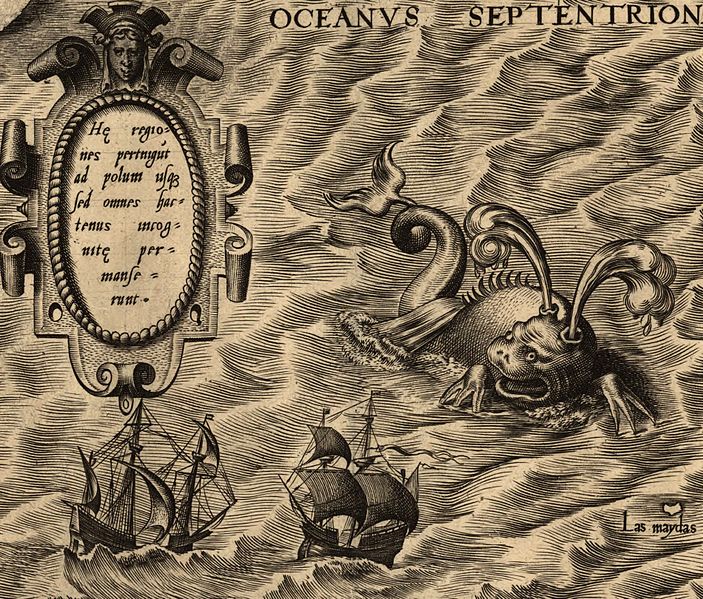
Frank Jacobs debunks the myth that “mapmakers of yore, frustrated by the world beyond their ken, marked the blank spaces on their maps with the legend Here be monsters”:
It’s a pleasing hypothesis. For to label a cartographic vacuum with the stuff of nightmares solves two problems at once. It explains why the fringes of contemporary knowledge didn’t match the outer limits of the entire world – monsters were keeping us out! And, by being equal parts fantastic and horrific, those monsters symbolise our fascination with the known unknowns just out of our reach. What keeps us out is also what draws us in.
Unfortunately, the theory suffers from an all too common trifecta: it’s neat, plausible and wrong. No map dating from the Age of Discovery (or before) is emblazoned with the slogan Here be monsters, nor with its variant: Here be dragons. At least not in English, or any other vernacular language. But there is one (if only just one) example in Latin: h[i]c sunt dracones, placed over the eastern shore of what is barely recognisable as Asia, on the so-called Lenox Globe.
(Above: Detail of the map Americae 1562 (the Americas) by Diego Gutiérrez and Hieronymus Cock (engraver) via LoC and Wikimedia)
Tim De Chant fears the likelihood that “sometime in 2016, for the first time in over 50 years, the U.S. won’t have a polar orbiting weather satellite”:
Currently, the U.S. has 24 Earth-observing satellites in orbit. Their missions are widely varied, covering more than just weather. There are satellites that monitor tropical rainfall (key in our understanding and prediction of hurricanes), keep an eye on land-use change (important for urban development and habitat conservation), and observe the ice sheets that cover Greenland and Antarctica (an indicator of sea level rise). …
In 2007, the National Research Council issued a report on the overall status of the U.S. Earth observation system. What they found wasn’t promising.
“The extraordinary U.S. foundation of global observations is at great risk,” they wrote. Today, more than five years later, the situation hasn’t improved. Of the 15 satellite missions reviewed for that report, “I believe two of those are actually on track,” says Dennis Lettenmaier, a hydrogeologist at the University of Washington and member of the NRC committee. Budget shortfalls have jeopardized nearly every program. “Notionally, at least, there was enough money to do all those things, so it wasn’t supposed to be about there not being enough money,” he says. That changed when the economy soured. When NASA started running short on funds, it went looking for programs to cut. Satellites that were many years away from launch got the ax. “NASA basically just dropped them all,” Lettenmaier says.

This weekend on the Dish, we provided our usual eclectic coverage of religious, books, and cultural coverage. In matter of faith, doubt, and philosophy, Conor Williams pondered the miracles that come from love, J.L. Wall examined an exception to the decline of the religious novel, and Kerry Howley imagined a conversation between Schopenhauer and Joel Osteen. Christian Wiman ruminated on the parables of Jesus, Jerry Saltz praised Piero della Francesca’s artistic vision, and Stefany Anne Golberg visited the Shaker Heritage Society in New York. Alan Jacobs remembered Walker Percy’s Lost in the Cosmos, readers debated arguments against polygamy, Robert Zarestksy argued that Isaiah Berlin thought like a fox, and Kiley Hamlin asked why we judge each other.
In literary coverage, W.H. Auden critiqued the gluttony of reading, Amit Majmudar found that contemporary fiction fears sentimentality, and John Fram described writing a bad book for money. John Jeremiah Sullivan movingly recalled his father’s love, Jason Resnikoff traced the evolution of the word “indescribable,” and Carmel Lobello provided a Scrabble player’s dream. Claire Barliant highlighted a library of unborrowed books, Cynthia L. Haven explored how Polish-born poet Czesław Miłosz’s became a Californian, and Mark Levine mused on what former Poet Laureate Philip Levine was like in the seminar room. Mark Oppenheimer gave tips on freelancing in the digital age, Julian Baggini held that encyclopedias always were relics, and Simon Akam mourned the distinctly American transformation of a butchered pun. Read Saturday’s poem here and Sunday’s here.
In assorted news and views, Maggie Koerth-Baker compared gun violence to climate change, Marc Tracy showed where Moneyball is bankrupt, and Chip Scanlan emphasized the power of silence for journalists conducting interviews. There proved to be an app for STD diagnosis, Conner Habib critiqued Alain de Botton’s views on sex, and Rose Surnow detailed the market for paying for cuddling. Marina Galperina gazed at webcam performers who pose like they’re in a classic work of art, Niall Connolly delved into the history and enduring popularity of “voguing,” Tom Junod looked back at Dazed and Confused, and Megan Garber cast a light on moon towers.
MHBs here and here, FOTDs here and here, VFYWs here and here, and the latest window contest here.
– M.S.
(Image: Detail of Piero della Francesca’s “Virgin and Child Enthroned with Four Angels”)


