
Busting The Daily Caller

This is a pretty definitive exposure of a total fabrication in the Daily Caller. But along with its sister propaganda sheet, Breitbart, what defines this new form of hackery is not that it makes shit up, but that even when it is busted, it keeps up the Baghdad Bob routine. Its imperviousness to truth even when it is presented with it. The detachment from reality – the strongest feature of today’s degenerate Republicanism – is embedded in its own fabricated media. That’s partly why they were living in never-never-land even on election day last November. Another piece detailing the Caller being a party to a con, concludes, after ABC News destroyed the lies:

The ABC News story isn’t a game changer; it’s a game ender.

Not if you live in what’s left of Tucker Carlson’s brain.

Quote For The Day

“Chávez is very close to the climactic moment when he will announce that he is a poached egg and that he requires a very large piece of buttered toast so that he can lie down and take a soothing nap,” – Hitch, eerily republished today in Slate.

It’s a hilarious piece. He doesn’t mean to take down Sean Penn – but what are you gonna do?

Congress Evolves On Marriage

DOMAs

We recently marveled at the dramatic shift in public opinion in California over the past few decades. Ian Thompson notes a similar shift in Congress:

On Friday, 212 members of Congress, 172 representatives and 40 senators, filed an historic brief in support of Edie Windsor’s challenge to the discriminatory and unconstitutional so-called Defense of Marriage Act’s (DOMA) exclusion of married same-sex couples from marriage-based federal responsibilities and rights. This amicus brief stands in dramatic contrast to the overwhelming support for DOMA when it was passed by Congress in 1996. DOMA passed the House with 342 votes (with 67 members voting no) and the Senate with 85 votes (14 members voted no). Obviously much has changed in the years since DOMA was signed into law by President Clinton, most notably the fact that gay people could not marry anywhere in the country (or world) in 1996 and today can do so in nine states as well as the District of Columbia.

And how did marriage equality affect civil marriage and divorce in the last decade as it became reality in several states and was on the front-burner of public discussion? Between 2000 and 2009, divorce rates dropped nationally from 4.1 percent to 3.4 percent. The lowest divorce rate? 2.2 percent – in the state that first legislated marriage equality, Massachusetts. This argument is essentially over as an empirical and civil matter.

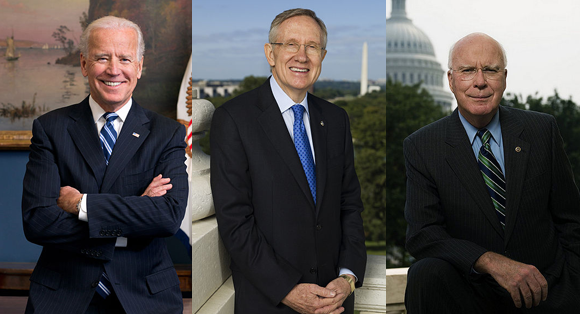
(Above: President of the Senate Joe Biden, Senate Majority Leader Harry Reid, and Senate Judiciary Chairman Pat Leahy all voted in favor of DOMA in 1996. The latter just two signed the aforementioned amicus brief while Biden is now an outspoken supporter of marriage equality. Portraits taken from their respective Wiki pages.)

Illustrating Inequality

The above video on wealth inequality in America, despite being a few months old, has suddenly racked up millions of new views this week. Daniel Luzer attempts to understand the public’s poor estimation of the existing wealth distribution:

Part of the reason Americans don’t understand class might be because true inequity is so excessive that we might well characterize it as unfathomable. That’s because one cannot show in any reasonable format, whether in print or on the web, both the wide distribution of people who have virtually no money, and the amount of money possessed by a very, very small portion of rich people.

Steven Mazie questions the video’s conclusion that “all we need to do is wake up and realize that the reality in this country is not at all what we think it is”:

If the 2.2 million+ viewers of the video were to expand, Gangnam style, to all 311 million Americans and everyone finally saw with clear eyes just how vast wealth inequality truly is in their country, things would change, right? Maybe, but I seriously doubt it. Even leaving aside Republican resistance to measures that could dent the wealth gap, many Americans would likely remain opposed to measures that would be necessary to seriously address the problem.

What Iraq Can Teach Us

UNs

Millman hopes we won’t repeat our mistakes:

From the end of the Gulf War through to the very eve of the Iraq War, there was almost no serious discussion about our goals for relations with Iraq. The assumption was that there could be no goals with the existing regime, and our goal, even before 1998, was for the Saddam Hussein regime to fall. What our other goals might be were not even in the frame until that was achieved. As a consequence, war looked not so much like a “choice” as an “option” – the only one certain to achieve our primary goal – and all other “options” were evaluated in terms of the trade-off between lower cost and lower-likelihood of success.

That’s why it’s so vital that the conversation about Iran be reframed. Our goal should be normal, peaceful relations with Iran – whatever its regime.

Our new discussion thread on the Iraq War is here.

(Left photo: U.S. Secretary of State Colin Powell holds a vial representing the small amount of Anthrax that closed the U.S. Senate last year during his address to the UN Security Council February 5, 2003 in New York City. Powell was making a presentation attempting to convince the world that Iraq is deliberately hiding weapons of mass destruction. By Mario Tama/Getty Images.  Right photo: Benjamin Netanyahu, Prime Minister of Israel, while attending the United Nations General Assembly on September 27, 2012, points to a red line he drew on a graphic of a bomb meant to represent Iran’s nuclear program. By Mario Tama/Getty Images)

ADHD’s Other Deficit

A recent paper looks at how the disorder correlates with future earnings:

The employment reduction is between 10 and 14 percentage points, the earnings reduction is approximately 33%, and the increase in social assistance is 15 points, figures that are larger than many estimates of the Black people/White people earnings gap and the gender earnings gap.

Austin Frakt analyzes:

Needless to say, these are huge effects. It makes me wonder whether, to the extent it is over-diagnosed, ADHD is serving as a proxy for characteristics predictive of poor labor market outcomes. That is, Johnny is looking like he’s not succeeding in school (itself suggesting reduced earnings and employment potential), but maybe an ADHD diagnosis and the associated meds will help him. But maybe they actually don’t help much. Alternatively, maybe there is a self-fulfilling stigma to the diagnosis. Of course the straight-forward interpretation that ADHD is legitimately bad for your future is perfectly fine.

Venezuela After Chávez

Venezuelans In Caracas Area React To Death Of Hugo Chavez

Succumbing to cancer after several months of treatment, President Hugo Chávez died yesterday, ending his 14-year rule and leaving a radically transformed Venezuela with uncertain days ahead [NYT]. For now, Vice President Nicolas Maduro will assume power for 30 days until a new election is held. Looking over the past few decades, Venezuelan blogger Francisco Toro argues that his country paid a huge price for El Comandante’s legacy:

[D]ebasement of the public sphere set the stage for the million insanities that came to pass for public policy making in the Chávez era: the gasoline given away almost for free by a government that loves to excoriate others’ environmental records, the ruinous subsidy to importers and to Venezuelan tourists abroad implicit in the exchange control system; the unblushing blacklisting of millions of dissidents; the manically self-destructive insistence of piling on tens of billions in unsustainable foreign debt at a time of historically very high oil prices; the nonchalant use of imprisonment without trial to cow dissidents and intimidate opponents; the secret spending of a hundred billion dollar slushfund beyond any form of scrutiny; the incessant repression of independent trade unionists; the botched nationalization and virtual destruction of industry after industry, from steel — to electricity — to cement — to the agro-food sector – the list goes on and on.

Oscar Guardiola-Rivera is far more positive about Chávez:

The facts speak for themselves: the percentage of households in poverty fell from 55% in 1995 to 26.4% in 2009. When Chávez was sworn into office unemployment was 15%, in June 2009 it was 7.8%. Compare that to current unemployment figures in Europe. In that period Chávez won 56% of the vote in 1998, 60% in 2000, survived a coup d’état in 2002, got over 7m votes in 2006 and secured 54.4% of the vote last October. He was a rare thing, almost incomprehensible to those in the US and Europe who continue to see the world through the Manichean prism of the cold war: an avowed Marxist who was also an avowed democrat.

Now that he’s gone, the question is whether “chavismo” – a muscular and internationalist push for socialism in Latin America – will outlive Chávez. Jon Lee Anderson sets the scene:

What is left, instead, after Chávez? A gaping hole for the millions of Venezuelans and other Latin Americans, mostly poor, who viewed him as a hero and a patron, someone who “cared” for them in a way that no political leader in Latin America in recent memory ever had. For them, now, there will be a despair and an anxiety that there really will be no one else like him to come along, not with as big a heart and as radical a spirit, for the foreseeable future. And they are probably right. But it’s also Chávism that has not yet delivered.

Daniel Lansberg-Rodriguez suspects that Venezuelan “chavismo” will die with the man:

Come what may, domestically the party may yet be able to trudge along in slow decline for a period — perhaps eventually splitting into several independent parties that sporadically cooperate (much like the Venezuelan opposition does now). Yet without Chávez, the international side of the revolution — on which he has staked much of his legacy — cannot last.

Recently the former minister of Trade and Industry, Moisés Naím, predicted a crisis to follow Chávez’s death:

Crushing headaches will soon be inevitable across the country, including within the private sector but especially among the poor. President Chávez has bequeathed the nation an economic crisis of historic proportions. The crisis includes a fiscal deficit approaching 20 percent of the economy (in the cliff-panicking United States it is 7 percent), a black market where a U.S. dollar costs four times more than the government-determined exchange rate, one of the world’s highest inflation rates, a swollen number of public sector jobs, debt 10 times larger than it was in 2003, a fragile banking system and the free fall of the state-controlled oil industry, the country’s main source of revenue.

David Blair warns of the consequences for Venezuela’s oil economy especially, which constitutes 96% of export earnings:

Chavez toughened the terms for foreign energy companies, causing many to leave. The result was that oil production fell from 3.1 million barrels per day in 2001 to 2.7 million in 2011, representing a cumulative loss of tens of billions of dollars. While betting Venezuela’s future on oil, Chavez also placed his country on a path of steadily declining output. Mr Maduro must try to reverse this disastrous combination; otherwise the social programmes that were Chavez’s great achievement will eventually become unaffordable. And there lies the rub: reviving production would mean accepting the expertise of the foreign oil companies that Chavez so fiercely denounced.

Simon Tilsdall hopes fresh leadership in Venezuela will give Obama a chance for a broader rapprochement in Latin America:

Whether the opportunity is grasped depends partly on Maduro, a Chávez loyalist but a reputed pragmatist with close ties to Raúl Castro in Cuba. Yet it depends even more on Obama, whose first term, after a promising start, ended up perpetuating Washington’s historical neglect of Latin America. He now has a chance to do better. The political climate seems propitious. Economic and cultural ties are also strengthening dramatically. Trade between the US and Latin America grew by 82% between 1998 and 2009. In 2011 alone, exports and imports rose by a massive 20% in both directions.

(Photo: People react to the death of Hugo Chaves outside the military hospital on March 05, 2013 in Caracas, Venezuela. By Gregorio Marrero/LatinContent/Getty Images)
Don’t Blame The Boob Tube

Mark Oppenheimer contemplates his family’s TV habits:

In truth, I suspect that both my parents’ generation and my own have worried far too much about television. Or, rather, we’ve given it too much credit. TV probably can’t destroy a good family culture, just as it never realized its promise of teaching children all sorts of things their parents and teachers couldn’t. It’s neither a prison nor a window to the world. It’s just a box—or, nowadays, a flat, matte screen. Like other inanimate objects, it is what we make of it. (TVs don’t kill families, families kill families.) Thinking back to my own childhood, I had a couple of friends who seemed to waste away whole years just watching re-runs of 1960s sitcoms; today, I know fellow fathers who, abetted by smartphone apps, manage to ignore their children for entire football seasons.

Rummaging For A Living, Ctd

A reader writes:

This is such a fascinating topic that I highly recommend the 2010 documentary Scrappers [trailer above]. These guys and gals with their trucks piled high are ubiquitous in Chicago, roving the alleyway. They too seem very much like the hardworking folks Jon Alpert found in NYC. It especially highlights how the global economic slowdown’s effect on the price of basic commodities is felt at such an immediate and local level.

Another:

As a Southern transplant to upstate New York, I was never used to recycling. (We could recycle in the city where I was raised of course, but it wasn’t encouraged – financially or socially – like it is here.) My habits changed immensely after moving north, and I am better off for it. But as a relatively well-off family with busy lifestyles, including jobs, children and pets, we never seem to get around to depositing our own bottles.

One night, after my husband had removed the recycling to the curb, we heard a noise out front of our house.

We live “in the country”, on a dead-end road, so this was odd. My husband took the dog to investigate and found an embarrassed man and his family digging through our recycling. They apologized and drove off.

We talked a lot about what had transpired that evening and how lucky we were to not worry about that 5 cents per bottle, but how – if we had to provide for our family – we wouldn’t hesitate to do what that man was doing in the cold of winter, with his family by his side. My husband was mortified for any feeling of condescension he might have felt at first blush. It was an enlightening experience for the both of us, particularly as relatively young and recent ascenders out of the working-class families in which we had been raised.

From then on, we’ve separated our bottles in a box for that family, setting it by the rest of the recycling, so he doesn’t have to feel the indignity of digging through empty baby food jars and yogurt containers for 5 cents/bottle. Some moments can really open your eyes to your own privilege.

A reader from the city:

I learned about returning bottles from drinking in South America. And then in college, I started organizing with my friends to make sure we gathered up our beer bottles and brought them back on the next beer run. In NYC, however, when I started trying to do this, the stores would refuse to accept them unless they had sold basically the precise bottles.

They are actually correct on the legal obligation;  they don’t have to accept them. The rule is: “Dealers must refund the deposit on all containers of the same type (brand, size, shape, color, and composition) they sell for off-premises consumption, regardless of where the container was originally purchased”. But the stores I have dealt with treat brand as specific to the label (i.e. if the store didn’t stock the precise beer I was returning, they would refuse the bottles, even if they sold beers from the same manufacturer/brewery). So … although 5 cents a bottle is ridiculously small to incentivize me to bring them back to the store, I might do it myself just out of sense of responsibility, if I could without figuring out where I bought every beer.

And from way up North:

Here in Ontario we buy wine and spirits at government-run Liquor Stores and buy beers at the Beer Store, which is owned by the big breweries. When we put in a deposit on wine and spirits containers, it was decided to make the Beer Store the return place, since they had been doing returns since Moses was a baby. Since I hardly drink beer, that means a special trip to the Beer Store to get a nickel for my wine bottle. Frankly, it ain’t worth it. Nor is it worth it for a huge number of wine drinkers. I put the bottles in my recycling bin, which theoretically means that they get recycled anyway, and the deposit is forfeited to the Beer/Liquor Store consortium.

Enter the Redemptorists (apologies to the Catholic religious order of that name) who walk the neighbourhoods the day before recycling pick-up, dive into the blue boxes, and carry the containers to the beer store for a nickel a jar. At first I was offended by strangers coming onto the front porch to rummage through the bin. When I realized that they were not taking from me – I had no intention of taking the bottles to the Beer Store – but were taking from the Booze Monopoly Power, I thought it was a very swell way to transfer some wealth to the down-and-outers.