Our Internal Clocks

In an article on sleeplessness, Kolbert reviews the work of Till Roenneberg, author of Internal Time: Chronotypes, Social Jet Lag, and Why You’re So Tired. Roenneberg separates the the population into early birds, who he dubs “larks,” and night owls, who he simply refers to as “owls”:

Toddlers tend to be larks, which is why they drive their parents crazy by getting up at sunrise. Teen-agers are owls, which is why high schools are filled with students who look (and act) like zombies. Roenneberg advocates scheduling high-school classes to begin later in the day, and he cites studies showing that schools that delay the start of first period see performance, motivation, and attendance all increase. (A school district in Minnesota that switched to a later schedule found that the average S.A.T. scores for the top ten per cent of the class rose by more than two hundred points, a result that the head of the College Board called “truly flabbergasting.”) But, Roenneberg notes, teachers and school administrators generally resist the change, preferring to believe that the problem is insoluble.

The Twitter Lens

That’s one summary of a recent study from Pew that compared Twitter reactions to public surveys when measuring opinion on the same political events. Alex Fitzpatrick, noting widespread efforts to use Twitter as “an accurate reflection of public opinion,” is more detailed with the findings:

According to Pew, in some instances — Barack Obama’s reelection, the first presidential debate and a federal court ruling on California’s same-sex marriage ban — the reaction on Twitter was “more pro-Democratic or liberal than the balance of public opinion.” However, other events — Obama’s second inaugural speech, John Kerry’s nomination as Secretary of State and Obama’s 2012 State of the Union address — elicited a more conservative response on Twitter than they did in opinion polls.

Pew also pointed to the general negativity of political tweets, which perhaps suggests people are more likely to tweet about something about which they disapprove rather than vice-versa. That would affect Twitter sentiment data vis-a-vis public polling data, as Twitter data is comprised of opinions from people who weren’t directly prompted to share an opinion whereas public opinion polls rely on respondents’ answers to a series of questions.

Covering Up Climate Change, Ctd

In the wake of the decision in January to reassign reporters on the “Environment” desk, the NYT is now ending the Green blog as well. Andrew Revkin of the NYT’s Dot Earth blog is disappointed:

The news side of The Times has nine sports blogs; nine spanning fashion, lifestyles, health, dining and the like; four business blogs; four technology blogs (five if you include automobiles as a technology); and a potpourri of other great efforts… I would like to have thought there was space for the environment in that mix, even though these issues are still often seen by journalists weaned on politics as a sidenote (remember Candy Crowley‘s post-debate comment about “all you climate change people”?).

Curtis Brainard calls it “terrible news”:

The Green blog was a crucial platform for stories that didn’t fit into the print edition’s already shrunken news hole—which is a lot on the energy and environment beat—and it was a place where reporters could add valuable to context and information to pieces that did make the paper. An addendum to the discontinuation announcement encouraged readers, “Please watch for environmental policy news on the Caucus blog and energy technology news on the Bits blog,” but without the Green blog, there’s no way that these topics are going to get as much attention as they once did.

The Daily Wrap

[youtube http://www.youtube.com/watch?feature=player_embedded&v=_cpUnUUQF3o]

Today on the Dish, Andrew meditated on the origins of modern conservative thought, saw spectres of the past in Israel’s segregated bus lines, and questioned the recent announcement of a baby “cured” of HIV. In home news, he wrapped up the first 30 days of the new Dish model.

In political coverage, Ta-Nehisi regretted his perceived powerlessness in the march to the Iraq war, while Dreher’s emotions swayed him in favor of it. Peter Person ascribed the slowdown in healthcare costs to the ACA, Adam Gopnik probed the limits of the market, and Jeb jumped back from his published stance on immigration. Seth Masket deliberated over politician perceptions, the GOP gave little ground in their latest budget, while Ponnuru made room in the party for Chris Christie. Scarborough pwned Krugman and the Daily Caller channeled Family Guy in its Ashley Judd coverage. Abroad, the Tories tussled with a perception problem and Syria schools felt the effects of the extended conflict.

In assorted coverage, Seattle weighed a tax on bikes, the cost of flying fell without our noticing, and Vince Beiser pushed back against the idea of “peak oil”. Readers continued the thread on doctor salaries while surgeons honed their skills on their smartphones, Lori Rotenberk went to DIY University, and Judith Glaser tried to wean us off of arguing. Dylan Bergeson dug through archaeological findings in the West Bank, chimpanzees savored their first taste of freedom, and luck loomed large in Hong Kong. Ruth Clark praised Jell-O’s ability to preserve and Evgeny Morozov protested Big Data-influenced punk.

Meanwhile, journalists sold their services to Malaysia, Marie Chaix found inspiration in pain, Madhavankutty Pillai chronicled the troubles of bringing great novels to the big screen, and Twain posed topless. We resorted to the tiebreaker for our Kagoshima VFYW contest and awoke to a Cancun sunrise in the VFYW, Spidey’s romance got the BLR treatment in the MHB, and Misao Okawa celebrated the big 1-1-5 in the FOTD.

D.A.

The Writer’s Wound

Marie Chaix, a French novelist whose discovery of her father’s collaboration with pro-German fascists spurred her first book, The Laurels of Lake Constance, conveys her understanding of what moves a writer:

I think writing, or art, it comes from an injury. Something happened in your life and it opened a wound. Several times, I tried to write about what was around me. My father being on the wrong side, for one thing. I felt like I was on the wrong side, too. I think I have this guilt that’s not gone, even if I know it’s not my fault. I was a child. I was born in 1942, in the middle of wartime. What could I know? But when I was a seventeen-year-old girl, I felt exactly the same as I felt when I was ten or twenty. I will always be the daughter of a collaborator. I can’t escape that. The pain is in there, somewhere. It’s hidden. Even if I don’t see it in my everyday life…

Writers are very strange people and they need to suffer, I think. It sounds very selfish. I could write about different things, but I think what’s fascinating is that all these events are very simple, right? I don’t know if it’s true about my father, but—separations, love, and no more love. It’s so ordinary, and so all stories have it.

Face Of The Day

World's Oldest Woman Turns 115

Misao Okawa, who is recognised by Guinness World Records as the world’s oldest woman, receives a birthday cake during her 115th birthday celebration at Kurenai Nursing Home on March 5, 2013 in Osaka, Japan. Okawa was born in Tenma, Osaka on March 5, 1898. A descendent of Kimono merchants, she married in 1919 and had three children, of which a daughter and a son are still alive, and four grandchildren and six great-grandchildren. By Buddhika Weerasinghe/Getty Images.

The Deficit Hawks Dig In

Ezra previews the GOP’s budget:

[T]he Republican budget will reflect the newer, even harder-line House GOP. Their last budget didn’t balance until almost 2040. But in order to secure conservative votes to delay the debt ceiling for three months, House Speaker John Boehner and Budget Committee Chairman Paul Ryan promised that the next budget would balance within 10 years. They’re helped in that effort by the “fiscal cliff” deal, which added more than $600 billion in tax revenues to the bottom line. But that’s not nearly enough to get them to balance by 2024. And so they’re going to need to propose much deeper cuts than in their previous budgets. Ryan is reportedly considering breaking the GOP’s promise to keep Medicare unchanged for everyone over age 55.

Jonathan Cohn adds:

With this new budget, Ryan doesn’t appear to be offering new concessions. On the contrary, it looks like he’s making new demands. And plenty of Republicans seem to think this is the right thing to do. That’s perfectly within their rights: They believe it’s best for the country. But it’s a reminder that Republicans aren’t sincerely interested in compromise for its own sake—or in taking more moderate positions on the issues. Yes, the voters delivered a pretty devastating verdict about this agenda just a few months ago. But if the number two guy on the ticket doesn’t seem to care, why should the rest of them?

Map Of The Day

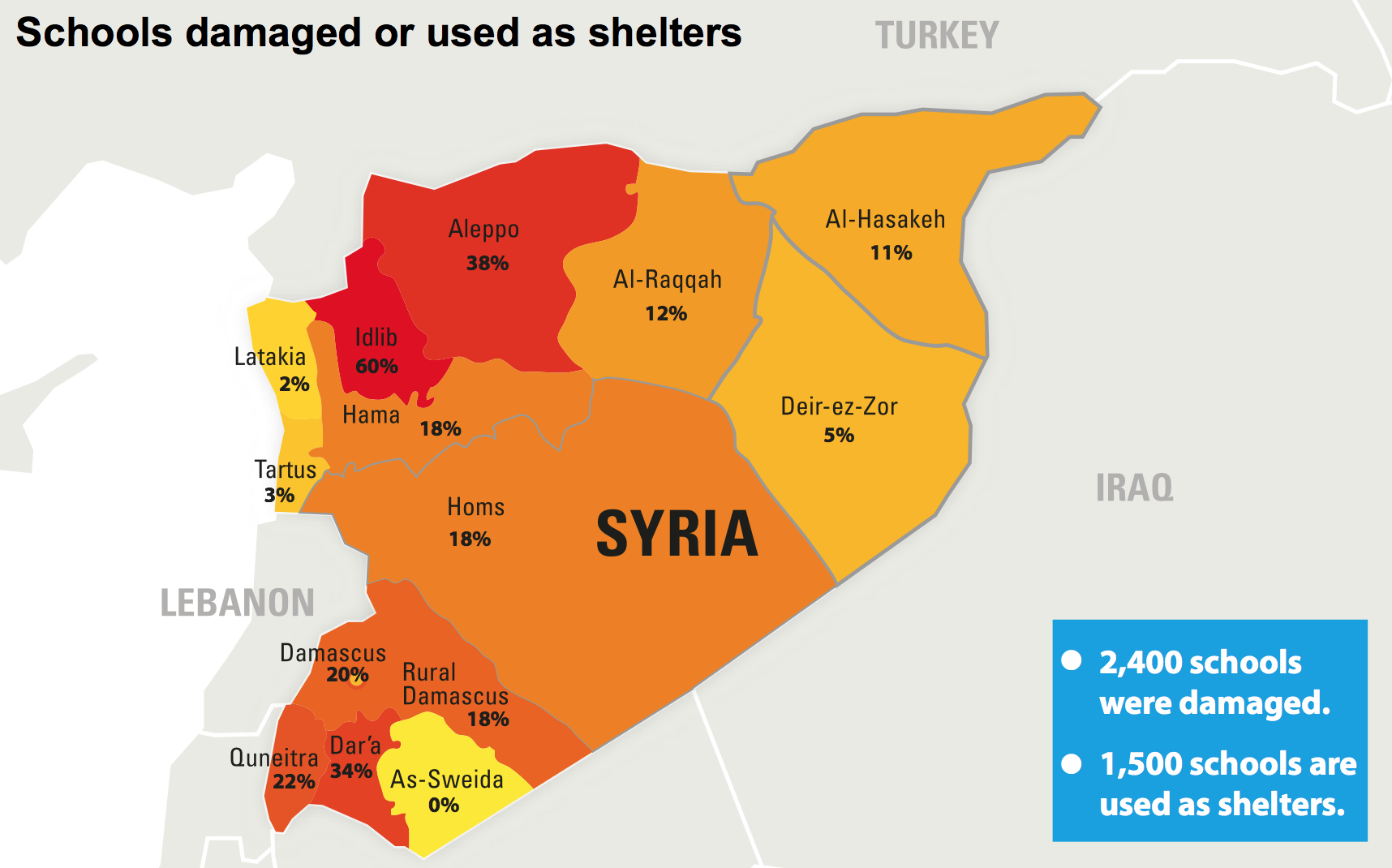
A recent UNICEF report (pdf) finds that Syrian schools are in dismal shape:

Syria Schools

Some key details from the report:

[A]ttendance rates have plummeted — down to 6% in some areas. UNICEF blames insecurity, lack of teachers and resources, and damaged buildings, along with the pressure to drop out and earn an income or get married early.

Peak After Peak

Vince Beiser paints an ugly picture for fossil fuel fighters such as McKibben:

The widely circulated fears of a few years ago that we were approaching “peak oil” have turned out to be completely wrong. From the Arctic to Africa, nanoengineered materials, underwater robots, side-scanning 3-D sonar, specially engineered lubricants, and myriad other advances are opening up titanic new supplies of fossil fuels, many of them in unexpected places—Brazil, Australia, and, perhaps most significantly, North America. “Contrary to what most people believe,” declares a recent study from the Harvard Kennedy School, “oil supply capacity is growing worldwide at such an unprecedented level that it might outpace consumption.” …

[T]he problem has never been exactly about supply; it’s always been about our ability to profitably tap that supply.

We human beings have consumed, over our entire history, about a trillion barrels of oil. The U.S. Geological Survey estimates there is still seven to eight times that much left in the ground. The oil that’s left is just more difficult, and therefore more expensive, to get to. But that sets the invisible hand of the market into motion. Every time known reserves start looking tight, the price goes up, which incentivizes investment in research and development, which yields more sophisticated technologies, which unearth new supplies—often in places we’d scarcely even thought to look before.

Frum points to the next emerging market:

Mexican oil production has been declining over the past decade, mostly because of under-investment and mismanagement by the state oil monopoly, Pemex. … In October, Pemex announced discovery of a big new field in the Gulf of Mexico. Newly elected Mexican President Enrique Pena Nieto is urging his country to amend its constitution to allow foreign investment in Mexican oil fields. Experts assess that opening the Mexican oil industry to global investment will revive Mexican oil production and boost Mexico’s economic growth by potentially 2 points a year. Nieto’s PRI party — the very party that nationalized Mexican oil 80 years ago — is expected to vote this weekend to approve the new policy.

Fighting Mold With Jell-O

Tom-in-front-of-gelatin-molds-from-our-Glistening-and-Jiggly-Contest-1024x883

Hunter Oatman-Stanford interviewed Ruth Clark about her website The Mid-Century Menu, where she recreates recipes from the 1950s. A cool discovery:

We’ve done a lot of different Jell-O stuff and noticed that freshness is basically extended when you encase things in Jell-O. We’ve done cakes covered with gelatin that the cake would still be moist after a week and a half. We made sandwiches with gelatin, so open-faced sandwiches and then you’re supposed to pour flavored gelatin over the top, which was supposed to be like mayo. I thought it was going to be disastrous. [Husband] Tom wolfed them down. He’s like, “These are really good and the bread isn’t soggy.” I’m like, “Are you kidding me?” It was like two days later, and they were still edible.

I don’t know if being frugal and using up leftovers was part of the Jell-O trend, putting them in gelatin and then trying to force them down that way. But that’s my theory.

(Photo of Ruth Clark’s husband about to dig into the herb-glazed open-faced sandwiches and other gelatin contest delights.)