The Platinum Coin Option, Ctd

Drum recently argued that it would be illegal to mint a trillion dollar platinum coin in order to avoid the debt ceiling. Lizardbreath at Unfogged, who is a lawyer in New York, counters:

I don’t think a court would stop it, and I’m sure that a court that did stop it would be acting unusually and for politically motivated reasons. Courts are expected to do what legislatures say, not what they mean: “legislative intent” can only be considered where there’s an ambiguity in the law. Even if what the legislature said is obviously not what they meant, courts are still expected to follow the letter of the statute. And the platinum coin statute isn’t ambiguous (unless there’s something in the wording I’m missing): the treasury can mint platinum coins, and they’re real money.

Regardless, Felix Salmon sees the platinum coin option is reckless:

[I]t would effectively mark the demise of the three-branch system of government, by allowing the executive branch to simply steamroller the rights and privileges of the legislative branch. Yes, the legislature is behaving like a bunch of utter morons if they think that driving the US government into default is a good idea. But it’s their right to behave like a bunch of utter morons. If the executive branch failed to respect that right, it would effectively be defying the exact same authority by which the president himself governs. The result would be a governance crisis which would make the last debt-ceiling fiasco look positively benign in comparison.

McArdle foresees other consequences:

I think–and I assume the White House does as well–that there's a substantial risk that this sort of nominally-legal-but-obviously-tendentious reading of the law would trigger a selloff in US bonds. Minting a $1 trillion coin neatly end-runs GOP obstructionists, but only by proving that the president himself has little respect for the institutional restraints on his office. So while the pundit in me is eager to see how this would play out, the US citizen in me is afraid of the effect that this would have on my country. I assume that our president shares these sort of concerns.

Cowen believes that exploiting the platinum coin loophole would be counterproductive: 

[L]et’s say that — somehow — the whole thing miraculously worked out well from start to finish. The testier Republicans would in fact get exactly what they want. They would receive isolation from any negative consequences from brinksmanship, and a new narrative about how President Obama is a fascist incarnate.

Tomasky thinks the proposal doesn't pass the laugh test: 

Can you imagine a president giving a prime-time, Oval Office address and saying, what we're gonna do, people, is mint a coin worth $1 trillion. That just doesn't pass any laugh test I can conceive of. I'd bet Obama would drop 12 points in the polls within five days of making such an announcement.

But Josh Barro isn't so quick to dismiss the idea:

[W]e need to compare the platinum coin option against others on the table. For example, we could hit the debt ceiling and the government could start leaving about 40 percent of its bills unpaid. The president could accede to Republican demands for near-term spending cuts (of an as-yet-unspecified nature) in addition to the amounts from the Budget Control Act sequesters, which would cause another recession. Or he could assert authority under the 14th Amendment to continue issuing debt, notwithstanding the debt ceiling, which would lead to court battles and probably impeachment. (The 14th Amendment play sounds less "silly" than the platinum coin, but it's actually on much shakier legal ground.) Minting the platinum coin would be less economically damaging than any of the above options, which is why Obama should announce he will pursue it if the debt ceiling is not raised.

A Game Of Chicken On Spending Cuts

John Boehner claims that Republicans aren't afraid of the sequestration, which includes major defense cuts. Chait wonders whether the Speaker will lose his nerve:

Boehner is asserting that Republicans don’t actually care that much about cutting defense — that replacing the sequester is something Democrats want. Just because Boehner says this doesn’t make it true. He may be holding his defense hawks in line publicly, but the question is whether he can keep them in line as the negotiations proceed and the prospect of implementing the cuts grows more real.

I'd be fine with the sequester precisely because of its focus on defense. But it needs to be adjusted to be less crude – and the relevant government agencies need more flexibility in timing and arranging the cuts. What strikes me is that Boehner may be realizing that he does not have the popular support for cutting Medicare as he wants and that the sequester may be the only politically feasible way of doing it. Especially if Obama proposes major tax reform to come up with revenues to slow the cuts in Medicare.

Meep meep.

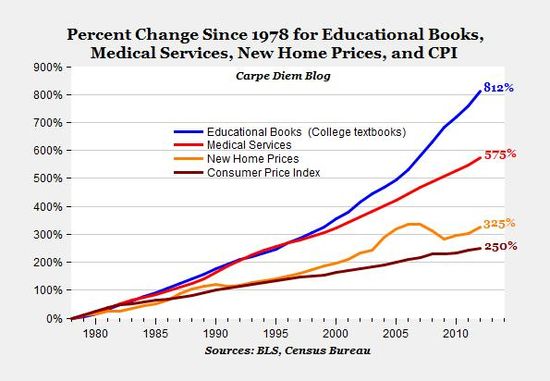
The Great College Book Rip-Off

Textbooks

Mark Perry created the above chart:

The 812% increase in the price of college textbooks since 1978 makes the run-up in house prices and housing bubble (and subsequent crash) in the 2000s seem rather inconsequential, and  the nine-fold increase in textbook prices also dwarfs the increase in the cost of medical services over the last three decades. 

Jordan Weissmann puts the cost in perspective:

According to the National Association of College Stores, the average college student reports paying about $655 for textbooks and supplies annually, down a bit from $702 four years ago. The NACS credits that fall to its efforts to promote used books along with programs that let students rent rather than buy their texts. But to put that $655 in perspective, consider this: after aid, the average college student spends about $2,900 on their annual tuition, according to the College Board. We're not talking about just another drop in the bucket here.

Hathos Alert

Khamenei-air-freshener2

Max Fisher highlights an air freshener being sold in Iran:

The Post’s Tehran correspondent, Jason Rezaian, sends on the above photo of the Khamenei air freshener, which is apple-scented, if you’re wondering. It’s just the thing to add some revolutionary aroma to your late-model Samand. The item was procured by a friend, Jason says, at the Tajrish bazaar in northern Tehran. It cost 10,000 Iranian rials, or about 81 cents. And no, sadly, he is not taking orders. But I’ve asked him to let me know if he comes across a cherry-scented Khomeini or "new car" Rafsanjani.

Update from an Iranian reader:

The cult of personality they are trying to build around Khamenei is reaching North Korean levels. Too bad for them the majority in Iran cant give a flying fuck about the monster. Back in the '80s, Khomeinei was a charismatic leader and had a real following, yet he wouldn't even allow his pic to be posted on the national currency – he didn't need it. He was popular among the more religious and traditional sectors of the society without any such propaganda. Khamanei is not, and that's why his gang tries so hard to turn him to a saint, to recreate that aura around the Ayatollah.

The Collective Brain

In examining Stephen Hawking's network of assistants, technicians and machines, Hélène Mialet notices the collective nature of his genius:

Traditionally, assistants execute what the head directs or has thought of beforehand. But Hawking’s assistants – human and machine – complete his thoughts through their work; they classify, attribute meaning, translate, perform. Hawking’s example thus helps us rethink the dichotomy between humans and machines.

It also helps us rethink the dichotomy between those who are in charge, and those who execute. While far less embodied, just think about Obama’s brain trust on the night of the election: Were they not part of Obama’s brain? They helped make his success happen; they were as, if not more, invested in the outcomes; and they looked just as exhausted as Obama’s mind probably felt.

Someone who is powerful is a collective, and the more collective s/he becomes, the more singular they seem.

Thanks for being out there, Dishheads.

Why Online Advertising Need Not Die (And Could Just Get Better)

While explaining why, as of February 1st, the Dish won't be taking advertising, I wrote how "distracting and intrusive" online ads can be and "how online ads have created incentives for pageviews over quality content." Mike Masnick pushes back:

[I]t's absolutely true that an awful lot of advertising sucks in exactly the manner described above. But that doesn't mean it needs to be that way. There's a growing recognition in the industry that intrusive and annoying advertising is not the way to go for exactly the reasons that Sullivan explains above. But as we've discussed, when you do advertising right, it's simply good content itself that people want. That's why a month from now, the most popular thing on Superbowl Sunday won't be the football game, but the commercials. There are times that peopleseek out advertising and are happy to see it. And compelling ad/sponsorship campaigns need to be about that. 

Now, it's reasonable to admit that many marketers haven't full grasped this concept, and dragging them, kicking and screaming, into this new era is not something that Sullivan and his team wants to take on. And that's a reasonable argument (and, as someone who's spent way too much time trying to convince marketers of this thing, only to see them default back to silly, pointless, misleading ad metrics, I can completely respect such a decision). But, it seems wrong to slam "all advertising" into a single bucket, just because some (or even a lot of) advertising is done really poorly. 

Agreed. And we have emphatically not ruled out advertizing for ever. It's just that, right now, it's more trouble for a site like ours than it's worth. But if the industry begins to smarten up and find a way to bring creative advertizing that does not impede but enriches the reader experience, we have no philosophical objections to it. Just not yet. In the same vein, Derek Thompson assesses Buzzfeed's business model:

It's probable that the Dish can live a year on subs alone. It's plausible that the Dish can live for two years on subs alone, or three, or 30. But practically everything else — the vast majority of journalism, from the New York Times to the pop culture blogs that specialize in bikini shots — cannot survive on the good will and generosity of their readership, and there is no expectation that they will. Advertising is what makes news and entertainment — first in 19th-century newspapers, then on early 20th-century radio, then on late-20th-century television, and now on early-21st-century Web and mobile — affordable at a mass scale. The news needs successful advertising to breathe.

That's why BuzzFeed's story matters. It's commonly understood that Web advertising stinks, quarantined as it is in miserable banners and squares around article pages. BuzzFeed's approach is different: It designs ads for companies that aim to be as funny and sharable as their other stories. Jonah Peretti, the CEO of BuzzFeed, told the Guardian's Heidi Moore that he attributed nearly all the company's revenues to this sort of "social" advertising. "We work with brands to help them speak the language of the web," Peretti said. "I think there's an opportunity to create a golden age of advertising, like another Mad Men age of advertising, where people are really creative and take it seriously."

The Highs And Lows Of 2012

First, a low of sorts:

But more to the point, Christopher Burt reviews the extreme temperatures recorded last year:

The Weather Underground climate extremes database follows 298 significant city sites in the U.S. which represent all climate divisions and major population centers. More importantly, they all have long periods of record (POR’s) dating back to the 19th century in most cases. This past summer some 22 of these 298 sites beat or tied their all-time absolute maximum temperature on record. This was the most since the infamous summer of 1936. No site recorded their coldest such.

Evan Lehmann notes that 2012 was "one of the most expensive weather damage years on record." And the effects were not evenly distributed:

Nearly all the world's economic damage from storms, drought, fire and earthquakes was centered in the United States as it experienced the highest temperatures ever recorded, according to Munich Re, a global reinsurance company. More than 90 percent of insured losses worldwide occurred in the United States, well above the 30-year average of 65 percent.

Despite these extreme conditions, Douglas Fischer reports that news coverage of climate change was down in 2012, "with worldwide coverage continuing its three-year slide."

Assad Digs In

On Saturday, in his first public speech in months, the Syrian dictator rejected any political compromise with the opposition. The world is not amused:

The West, including the U.S. and Britain, denounced Assad’s speech, which came amid stepped-up international efforts for a peaceful settlement to the Syrian conflict. On Monday, Turkish Prime Minister Recep Tayyip Erdogan also criticized the Syrian leader’s initiative. He accused Assad of "state terrorism" and called on him to relinquish power.

Dan Murphy argues the speech is proof that both the regime and the rebels now view the conflict as a "zero sum struggle":

To be sure, anyone going into a negotiation would want to do so from a position of strength. It's possible that Assad is striking a maximalist, defiant tone in public while entertaining compromises behind the scenes. But there were no indications of even a moderation of tone towards his opponents, routinely described as "terrorists" or agents of foreign powers, which would usually be taken as a signal that some sort of overture was being made.

And the deeply troubling news about chemical weapons does not reassure either. I have few doubts that Assad would use them. The crime family running Syria lost any semblance of humanity decades ago. Richard Spencer hears an echo of Gaddafi in Assad's speech:

Even the slogans were the same as the slain Libyan dictator: "God, Syria, Bashar, enough". Reminiscent too was the rambling delivery, leaping incoherently back and forth between vague peace proposals and unremitting imprecations against the opposition: "al-Qaeda", "armed criminals", "foreign terrorists" were also prominent in Col Muammar Gaddafi's vocabulary.

Al-Jazeera rounds up reactions from the Syrian opposition and Western statesmen.