The End Of Mexico’s Great Migration?

This embed is invalid


Gary Becker ponders the drop-off in illegal immigration from Mexico:

Once the American economy resumes its long-term growth path with full employment (it has not been on this path for the past 4 years), the economic pull from the US should return to where it had been before the economic crisis. However, the push from Mexico has been decreasing and should continue its downward path for the foreseeable future. One important cause is the sharp decline in Mexican birth rates during the past couple of decades.

Not long ago Mexico was a country with high birth rates that produced many young adults who had trouble finding jobs. Now, the Mexican total fertility rate (TFR)- the number of children born to a typical woman over her lifetime- has plummeted to about 2.25. This rate is only a little above the population replacement rate of 2.1. Unlike in the past, the number of young people in Mexico will no longer be growing rapidly over time, so that the numbers looking for work in the Mexican labor market will be on the decline.

The push from Mexico has also diminished because its economy has been growing at a good clip during the past 9 years. Excluding the large drop in 2009, the growth rate in real GDP has been over 4% per year. Mexico’s growth rate after 2009 considerably exceeds the American rate of under 2%, which is remarkable since about 80% of all Mexican exports go to the depressed American economy. One consequence is that the gap between earnings in Mexico and the United States is narrowing. This clearly reduces the demand to immigrate to America, especially under the difficult circumstances illegal immigrants face.

Cannabis Lite, Ctd

A reader counters a previous one:

“Unlike alcohol, where the proof is written on the bottle and assured by regulators, you can only gauge THC levels through trial-and-error or your dealer’s sales patter.” That’s another artifact of prohibition.  I work for an edibles company here in Colorado, we’ve developed a method of adding very precise amounts of active THC in food that’s already been prepared. Our big sellers are bags of 25 candies that each have just ten milligrams of THC in them.  An equivalent to e-cigarettes have also become popular among patients, which you can use to take very tiny puffs of vapor until you feel medicated enough and even the potency of the extract you vaporize can be controlled to some degree.  Both my company (as well as all edibles manufacturers) and companies filling cartridges for vapor pens are byproducts of a thriving and regulated cannabis industry; neither is practical for the black market and neither can be done at home.  Another byproduct of an industry is that there are a couple labs where I think anybody can take a sample of something to be tested for cannabinoid content.

Your reader is also incorrect in his supposition about the potency of black market pot.

It’s actually quite hard, and quite expensive to produce marijuana with much about 16% THC; 12% or 13% would be more likely for street weed, you might get as much as 8% in Mexican brickweed.  It’s impossible to go above that in an outdoor grow, and indoors getting a plant to its full potential potency requires growing them inches from thousand watt floodlights but not letting them get above 75 degrees with the lights on.  Not only does the expense produce diminishing returns but the air conditioning is incredibly conspicuous.

Further, the strains that can produce high potency tend to have much lower per-plant yields and black market growers grow for yield above all else.  Breeding really has increased potential potency but high-end growing/breeding like that and black market growing are two very different worlds that don’t actually intersect much.  The only major overall increase in the potency of black market marijuana happened when sinsemilla – growing only unpollinated female plants so they spend their energy creating THC-laden resin rather than seeds – became the standard, and that happened in the ’70s. Everything about increased potency on the street since then has been pure propaganda.

Update from a reader:

I thought the reader was not actually contradicting either of the points in the previous post (lack of dosage information and increased potency of weed since the 1970s are artifacts of prohibition), but he too casually dismisses as “propaganda” the notion that black market pot has increased in purity.

It’s common knowledge that cannabis quality and availability has increased steadily since the 1970s. The reader confuses the THC content of the plant with the purity of the product. In 1993, a New Yorker buying weed in Washington Square Park was likely to get a few grams of junk, seeds, and stems mixed in with his baggie. Today, black market product in the city is sold by reputable delivery services who compete to provide quality and variety. Whether this is a result of increased crop yields or increased THC content in the cannabis plant is immaterial: you will get a much larger dose of THC from a gram of 2013 delivery weed than from the same gram purchased on the street 20 years ago. A similar – and much more dangerous – phenomenon has occurred with harder drugs like heroin, where overdoses can lead to death.

The View From Your Window Contest: Winner #146

Screen Shot 2013-03-23 at 4.11.37 AM

As all of you contest fanatics noticed, we didn’t post the results yesterday at the normally scheduled time, due to the nonstop coverage of the SCOTUS hearings. But wait no longer:

I thought this one was going to be easy – just match up the design on the police cars and voila! After plumbing the endless world of local patrol car detailing, I still got nothin’. Champion, who manufactured the window through which the photo was taken, apparently distibutes only within the US, east of the Mississippi. Based on the landscape, my heart cries mid-Atlantic states. It’s a sizable river, so let’s say it’s the Susquehanna. It’s a small town, so let’s say, at random, Nescopek, PA.

Another reader:

I know I am probably thousands of miles off, but this looks like Atchison, Kansas, birthplace of Amelia Earhart. Atchison sits on the banks of the Missouri River.  The police cars look familiar, the last remnants of shoveled snow from a recent snow storm remain and, well, it just looks like the place I am desperately trying to recall from memory.  I figured why not guess?

Another:

First time I can at least muster even a half-assed guess. As an Omahan, I think it looks like a shot from somewhere along the Nebraska side of the Missouri River.  Looks like a beautiful gloaming on the Loess Hills of Western Iowa.  Unfortunately, a quick Google Earth trip up the Muddy Mo revealed no such location.  On the bright side, following that great river from satellite photos is fascinating. The Flood of 2011 is evident and, despite its destruction, eerily beautiful.  A hybrid view that includes state lines seems to indicate that some land may have changed hands too! (Though, I suppose these maps are only somewhat accurate.)  At any rate, reading VFYW guesses on Tuesdays is something I always look forward to. I am happy to experience a VFYW from the Saturday end of things for once!

Another:

I think it is a view from the top level of the Livermore Falls, Maine town hall. Either the main lobby or one of offices behind the service counter. I’ve done some business there. The Androscoggin river is in the background.

Another:

Oh the hours I’ve spent Google-map-riverboating down every river in North America. Started up-river from Pittsburgh, headed all the way down the Ohio, then switched over to the Hudson, and then went over to the upper Mississippi … you get the idea. I sure hope someone was able to see the lettering on one of the two cop cars. And they say March Madness wastes valuable work time!

My guess: Second floor room of the No-Tell Motel, facing south, overlooking the Oil City Police Department impound lot, next to the mighty Allegheny River. Wrong, but I have to submit SOMEthing after all those hours!

Another:

This looks like Southeastern Ohio to me and given recent news, I would guess Steubenville. I would look for the exact location, perhaps the Juvenile Court Building, but I have to get my teams ready for the collegiate National Debate Tournament next week. It is sort of like March Madness, but for the cool kids.

Another gets on the right track:

First-timer here. Would do more research but I’m leaving tomorrow on a trip. That is absolutely a picture of the east side of the Hudson, probably somewhere in Westchester County. I’m going to guess it’s Tarrytown, and that the building near the water tower might be part of the abandoned GM plant there. If you were to stand near the police car, you would probably see train tracks – the Hudson Line of Metro-North – running along the river. The amount of snow also maps with what’s been going on in the area lately. It’s the remnants of the snowstorm we had on March 19.

Another:

I’m pretty sure the window is on the western side of the Hudson River. So I will go with Highland Falls, NY, outside of West Point.

Another nearly gets it:

This strongly resembles the Palisades, as seen from the NY side, just north of NYC. The police car’s logo is identical to the ones in my village, across the river. I will take a guess and say it’s Yonkers, since that is where the Palisades are highest – though it could also be Dobbs Ferry or Hastings on Hudson.

Another nails it:

As someone who lived in NYC for 12 years, I instantly recognized the Hudson River and the Jersey cliffs beyond, so I just scrolled up the Hudson until I saw the unmistakable slanted roofs of the factory sitting right on the shore of Hastings-on-Hudson. And while it is fun trying to investigate a VFYW photo clue by clue, scouring Google Maps for hours, I have to admit a certain thrill when you look at a photo (here, of a place I haven’t even visited) and just feel in your gut you know where it is:
Screen Shot 2013-03-23 at 9.17.15 AM

Makes me miss New York.

Another:

I know exactly where this is.  The town on the east bank of the Hudson where this must be from is Hastings-On-Hudson. Every time I go hiking upstate, I take the Metro-North Hudson Line from Grand Central. In the last year noticed the remnants of a rock slide on the New Jersey side of the Pallisades, which is described in this article.

Another points to a local news report of the slide on YouTube. Another sends the photo seen to the right. Another writes:

vfyw 23-mar-2013 picture 2Sometimes you get lucky. On Monday, I took a very scenic train trip along the east bank of the Hudson River from Rhinecliff, NY into New York City. I was looking out the window when I saw the most distinctive feature of this VFYW: the recent scar of a rock slide along the Hudson Palisades. After recognizing that, the rest was easy.

By the way, I would like to share just one fact that my mother told me about the Hudson Palisades: It’s a fjord. How cool is that?

More than 150 readers correctly answered Hastings-on-Hudson, but only three of them have gotten difficult views in the past without yet winning. The most accurate entry of those three is the following:

hastings_on_hudson1I’ve spent hours on previous windows without making any progress, and so it was with great satisfaction that I recognized this week’s view the moment I saw it!  I live in California these days, but I grew up in New York, and it’s hard to forget the Palisades.  That light-colored streak in the cliff marks the site of a major rockfall in May of 2012.  The fall liberated roughly 10,000 tons of rock from the cliff, the largest such event in at least the last 25 years.

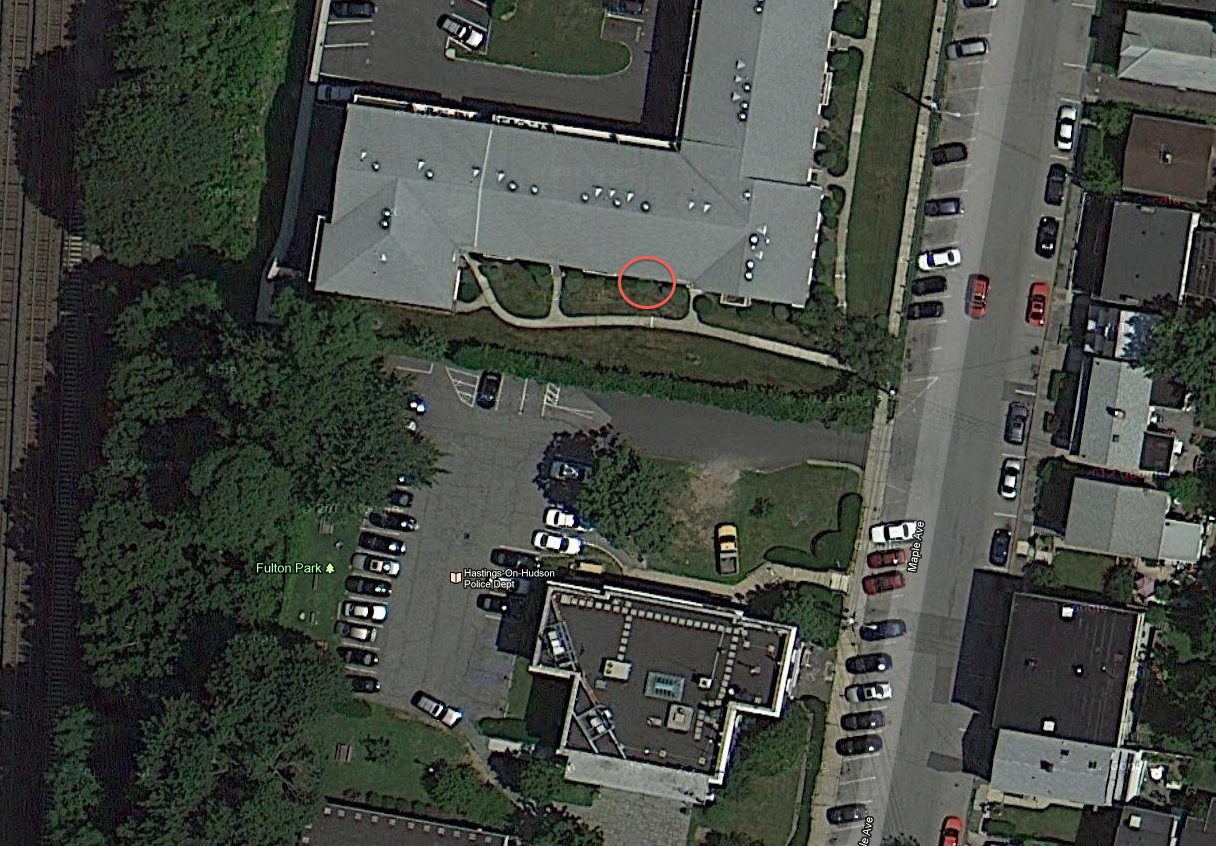
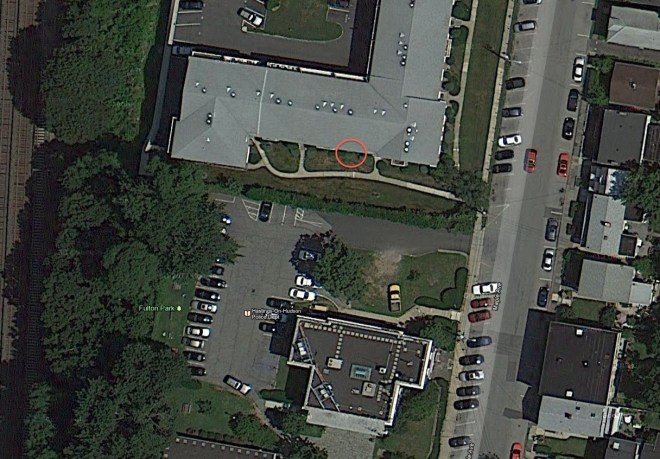
On to the actual window.  The photograph was taken from the third floor (also the top floor) of the River Edge Apartments, looking south west across the Hudson River.  I’ve attached an aerial view of the apartment complex and circled the correct window in red, but it’s partially obscured by the overhang of the roof and some tree hastings_on_hudson2branches.  Sorry, best I could do.  I’ve also attached a street level view of the south-facing side of the building, but the correct window is again largely obscured, this time by the fire escape.  The correct window is visible looking through the bars of the fire escape.  I’ve done my best to circle it in red.

This marks my sixth correct entry in seven weeks.  I’m sure you’ll have many correct entries from New Yorkers (and beyond) this week, but hopefully I’m moving up in the tie-breaker rankings!

And into the winner’s circle. From the submitter, for the record:

3rd floor of the building.  I’m a Hastings resident.  By the way, the Hastings farmer’s market moves back outside to the parking lot shown in my photo on April 13!

(Archive)

Time-Shifting Television

Tom Vanderbilt analyzes the state of contemporary TV. One highlight:

Today, it’s not rare for a huge portion of a show’s audience to watch it well after it originally aired. CBS, for example, recently released data showing that the viewership for its Sherlock Holmes reboot, Elementary, skyrocketed when seven days were tracked—its rating among the valuable 18- to 49-year-old demographic shot up 64 percent. (And there’s no reason to stop at seven days. Millions of hours of TV get watched beyond the one-week cutoff. Science fiction shows, it turns out, are particularly likely to be watched more than a week after they air.)

A recent study found that “29% of weekly TV viewing is recorded content.” Alyssa comments:

That 29 percent seems like a number that’s likely to grow, rather than to shrink, particularly as long as networks are scheduling shows with unpredictable gaps in between episodes.

Does This Photo Make You Faint?

Bleeding_finger

Then you’re definitely a blood phobic. As a former one himself, John Sanford was curious about the physical response associated with the fear:

Observing blood seep from a wound, flow into a syringe or spatter on the ground, blood phobics initially will respond like other phobics — that is, their heart rate and blood pressure will increase. But then something else will happen: Their heart rate and blood pressure will suddenly drop, causing dizziness, sweatiness, tunnel vision, nausea, fainting or some combination of these symptoms. … why would the sight of blood, or for that matter the sight of being stuck by a hypodermic needle, trigger a physiological response that is so different — practically diametric — to that of other phobias? This is the mystery.

Rachel Nuwer examines some possible reasons:

Some say that fainting at the sight of blood may be the human equivalent of playing opossum—pretending to be dead so that a dangerous predator will lose interest. Others think that the physiological reaction some experience at the sight of blood may be an evolutionary adaptation. If a caveman got stabbed in the foot while out on a hunting trip, Sanford explains, he may have a better chance of surviving if his blood pressure drops, helping him to avoid bleeding to death. … So besides being useful for dramatic effect in the movies, it seems blood phobia—perhaps like the appendix or wisdom teeth—is an evolutionary throwback that has largely outlived its usefulness.

(Photo from Wikimedia Commons)

Another Hacker Hounded By The Feds, Ctd

A reader writes:

The analogy made by your software developer reader is misleading. The vulnerability is not like forgetting to lock your door, allowing someone to rummage around in your house. It’s like having a household policy that anyone who calls you on the phone, and asks for a specific family member’s email address, can have it. You don’t publicize the number, but millions of people have the number in their phones. So Auernheimer’s friend called the number millions of times, guessing at family names, and gave Auernheimer the resulting emails, which he then publicized. If you use a database to look up the emails when someone calls, is the caller illegally “accessing” (much less “hacking”) your database? Should someone who publicized those emails go to jail for several years?

Another:

Your reader misses the point about the nature of the data. This was not AT&T’s data; it was the data of their customers. Companies have an extra responsibility when it comes to data of their customers. They should be held liable for loosing that data, just as your insurance company will not pay out when you leave your door unlocked. Experience also shows that companies like AT&T would have done shit if Auernheimer had politely pointed out the security leak. Naming and shaming is the only way that works. He provided a public service – for free – and got jailed for it. Meanwhile, AT&T has not been held accountable for its lack of care of its customer’s data. Is that right?

Another:

Your reader’s analogy to “locking your house” is ridiculous, as most analogies between digital and physical spheres are.

AT&T didn’t forget to lock the door; they publicly posted the emails in a way that anyone could access them, and that anyone with computer know-how could copy them all.  There were no passwords or other security that would prevent someone unauthorized from accessing the email addresses.  Nothing was hacked.  Weev accessed ill-designed public websites in a way that AT&T didn’t like.  Think the opening scenes from The Social Network, only Zuckerberg is going to jail for several years and we never get Facebook.

The ability of the government to turn anything that a website owner doesn’t like into a felony is a problem with the computer crime laws, not a fun feature.  Beyond whether what Weev did in this case was right, the government shouldn’t be able to turn accessing public information or any misuse of a website into a crime, as it just opens up a whole can of worms criminalizing ordinary conduct.  Giving a site a fake email address?  Jumping on another computer so you don’t have to worry about your “read more” limit?  All potential felonies under an expansive view of the CFAA.  If this is a crime, it’s an example of why we need to reform the CFAA, and so far the government has moved in the opposite direction.

For more on the case and the technical/legal details look at this post by Orin Kerr, a computer crime expert representing him on appeal pro bono.  There are lots of other serious issues with the government’s theories, including a fun way of interpreting the law to make every CFAA violation a felony, despite Congress explicitly including a distinction between misdemeanor and felony violations.

The Dish: Now Just $1.99 A Month!

dustygate

[Re-posted from yesterday]

Well, you [tinypass_offer text=”asked for it”]. In fact so many asked for it, so quickly, we feel bad it took us this long to get there. But today, we can announce a new way to subscribe to the Dish, which will, we hope, accommodate those of you (a considerable number) who are going through tough economic times and could use a lower barrier to entry and the option of canceling in the future if your budget tightens again. Here’s how one reader put it:

I’m not sure if your clan has considered it, but setting up monthly subscriptions would be a great option for those of us happy to pay more than $20/year but who just don’t have the all-at-once cash. I’d happily sign up for $5/month which would work out to three times the subscription rate.

That’s a super-generous offer. $1.99-a-month seems a more reasonable sum – an app-like fee that simply gives you more options for payment. Like the $19.99-a-year option, we’re also leaving it up to you if you’d like to pay more – even if that’s only $2 or as much as $5. The point of course is to make this available to as many people at as many Screen shot 2013-03-25 at 1.34.34 PMprice points as you want and need, above a minimum baseline. You can buy your new full access $1.99-a month subscription [tinypass_offer text=”here”].

As for our progress, we are purring along. Our gross income is now $653,000 toward a goal of $900,000 by next January 1. That’s 72 percent of our goal in almost three months – but almost all the likeliest subscribers have joined already. It gets tougher from here on out. That $900,000, by the way, is simply the sum of our fixed costs (servers, legal costs, health insurance, salaries for staff, video equipment, photo agencies etc.) and an attempt to pay the three co-owners of the company, Chris, Patrick and me, something close to what we were paid in the past. Alas, it can’t pay for much more than that: our desire to start commissioning the kind of long-form journalism that is disappearing from many magazines, and acquiring a long-form editor to craft the essays, reports and arguments we want to run. But we really do want to reinvent the whole concept of a magazine – starting from a blog outwards – and by the most honest and simple way possible: purely reader support.

It may not be possible; but we didn’t think what we’ve done already would be possible not so long ago. You made it possible – and a large number of media outlets are watching this experiment closely to see if they can follow us. We hope they can, and we can begin to rebuild a model for serious, calm journalism in an era of page-view mania, sponsored content, noisy comments sections and cheap SEO gimmicks.

Think of it: $1.99 a month for a noise-free, carefully edited, always lively, provocative daily read. It isn’t much – but it could help set a model to recapitalize and re-stabilize an entire industry. You can help build this new model by getting an annual or monthly subscription [tinypass_offer text=”here”]. Please help us. It could also at some point help a hell of a load of others.

The Daily Wrap

US-JUSTICE-GAY-MARRIAGE

Today on the Dish, Andrew examined the differences between his appearance on Charlie Rose and the WSJ’s editorial, hoped that the benefits of marriage would soon be equal opportunity, parsed the arguments, and celebrated the early signs of a moderate outcome. Elsewhere, Douthat described a world without the Iraq war and Boris took a beating from the British press.

As the Supreme Court heard arguments in Perry v. Brown, past SCOTUS decisions bucked popular opinion, Cass Sunstein explained the benefits of a narrow ruling, and Greenwald heralded the defeat of defeatism. Josh Barro made the fiscal case for marriage equality as Frum completed his turnaround, McArdle connected marriage equality and “traditional morality,” and Allahpundit looked ahead to marriage equality’s role in the 2016 primaries. Nate Silver found hope in marriage equality’s steady polling advances, as Republicans divided along demographic lines and Christie picked the wrong side of a Jersey wedge issue. We took Twitter’s temperature on the hearing, compared Perry to Roe as readers chimed in, and applauded straight allies. Scalia and Olson exchanged questions, we reviewed “standing,” Lyle Denniston played out the possibilities in a deadlock, and Dale Carpenter read the tea leaves, as even the lawyers had trouble making predictions. After all this time, MLK Jr.’s and Hannah Arendt’s words continued to ring true, and the struggle for marriage equality was nothing new.

In assorted news and views, a reader pointed out Weez’s wrongdoing, Freddie deBoer poo-pooed the Pebble watch, smartphones proved a popular target for thieves, and robots took over the valet stand. Carl Zimmer defended “basic research,” money mattered in March Madness, and we envied the “sleepless elite” while distracting ourselves to get rid of earworms.

Meanwhile, we pondered prenuptial agreements, Elizabeth Samet questioned the belief that soldiers make the best politicians, Brits narced on their neighbors, and TNC dove into the deep end to learn french. A butterfly perched precariously in the FOTD, we stopped by Senegal in the VFYW, and peeked in on panda playtime in the MHB.

D.A.

(Photo: Jewel Samad/AFP/Getty.)

The GOP’s Looming Gay Crisis, Ctd

The CNN poll tells you all you need to know about the public’s view of the core argument tomorrow – that the feds have no right to choose which state-sanctioned civil marriages it recognizes:

In total, 56 percent of respondents supported federal legal recognition of same-sex marriage while 43 percent opposed it.

The breakdown among party affiliation and generation is stark. Admong those 18-34-years-old, 77 percent support federal recognition. Among those over 65-years-old, just 39 percent support it. Those in-between 34 and 65 hover around the 50 percent mark.

Along party lines, 75 percent of Democrats, 56 percent of independents and 28 percent of Republicans support recognition.

The GOP is increasingly isolated, with Independents closer to the Dems on this, and the next generation overwhelmingly for it. Meanwhile the fundamentalist base cannot change their minds – since their minds are made up by the Bible, not current reality. And the court’s seeming reluctance to end this debate will only prolong the agony. I think of this wedge boomerang as Karl Rove’s parting gift to the Republican coalition he played such a central part in destroying.

“Standing”

The best legal summary for the argument that the opponents of Proposition 8 have no standing in federal court to reverse the state court’s ruling is here – Walter Dellinger’s (pdf). A reader chimes in:

As a proud, native Californian, I’ve thought a lot about the standing question (nerdy as that is). And I think your inclination on standing misses the key point: Politics.

You say, “But if a state’s elected leadership refuses to intervene to defend a popular initiative, doesn’t that make a mockery of the entire system?”

No, it doesn’t. The elected leadership are all political actors, and make political calculations, pretty much for a living. The decisions not to defend Prop. 8 were not made casually, and each one was made knowing that that politician would be subject to future elections.

I can’t see how that’s not an incredibly important fact. “The entire system” includes the proponents and the voters, and the politicians who represent all of the people. If the politicians make a decision that is widely rejected, they run a risk of not being reelected, a risk that gets higher as the rejection of their position increases.

Our governor and attorney general, and others, made their decisions not to defend Prop. 8, and if they are wrong about that, they have put their own jobs on the line. That, too, is the system. I think they made, not only the right decision based on the principle of equal protection, but as a matter of their own political survival. But no matter what, they are accountable.

So if the court rules that this particular set of citizens doesn’t have standing to defend Prop. 8 (in federal court only, remember — they had full standing to challenge it in our state courts, and did so), it’s not as if they are without remedy. Yes, it would involve extra effort to get those damn politicians out of office, but that is the same remedy we all have, all the time. And, in California, in addition to the initiative, we also have the recall, specifically to get rid of politicians prior to the next election, if that’s what we want. We got rid of a governor that way not so long ago.