“It’s Not An Ad, It’s Thought-Leadership”

Shafer tackles sponsored content:

When Web publishers deliberately blur the visual and textual divide that separates editorial from advertising, as The Atlantic did, they force readers to judge whether a page is news/opinion or a commercial advertisement. But they’re not confused; it’s the publisher and the advertiser who are confused. The publishers and advertisers have polluted their own tradition by erasing the traditional line. Suddenly, it’s completely reasonable for readers to blame controversial news stories directly on advertisers and blame controversial advertisements directly on reporters and editors, because publishers and advertisers have essentially merged operations. Such calamities injure both publisher and advertiser, even already controversial advertisers like Scientology …

I’m not an absolutist. I’ve never feared advertising that advertises itself as advertising. I’m prepared to accept that an advertiser could produce content worthy of my time, though I’ve yet to witness that miracle. I don’t even fear “thought leadership,” as long as the wallet financing the composition and promulgation of the thoughts can be identified, as was the case when Herb Schmertz, Mobil Oil’s vice-president for public affairs, routinely published his company’s “low-key advocacy ads” on the New York Times op-ed page beginning in the early 1970s. Just make sure I can see the line.

As a great wag once said, a newspaper is nothing but an advertisement with a news story printed on the back. That arrangement has worked well for American publishers, readers and advertisers for two centuries. But can it work if you have to guess which side contains the ad?

Three cheers for Shafer writing that stuff for Reuters. It’s amazing how little public debate this media-corporate whoring has generated … in the press. Writers at the Atlantic have been formally warned not to talk to anyone from the press. And you can see why: the “sponsor-content” press doesn’t want to expose its sordid desperation. Which itself lends credibility to the idea that the Fourth Estate – if it cannot easily be distinguished from corporate and government power – is fast disappearing.

This is not about media narcissism. It’s about a critical independent pillar of our democracy, a truly independent press, a pillar that is being demolished even by magazines with as distinguished a past as the Atlantic.

The Dish’s sponsored content thread can be read in full here.

Holy Father, Holy Mothers, Ctd

As all old men in frocks deliberate about which one of them will become Pope, one obvious thing is missing: half of humanity. That half was not missing in the Synoptic Gospels, John’s or the less reliable Gnostic ones. A former priest, now scholar and anam cara – friend of the soul – John O’Donohue, in an interview worth reading in full, here touches on the Church’s problem with women:

Before I criticize it, let me say what I love about the Catholic Church. I think the seven sacraments are the most beautiful liturgical rituals. The Christian mystical tradition is populated by such giants as Meister Eckhart, John of the Cross, Hildegard von Bingen, and Julian of Norwich. The dogmas of the Catholic Church are sophisticated, poetic, speculative doctrines; they invite imagination, not  dogmatism. I love Magdalen_with_the_Smoking_Flame_c1640_Georges_de_La_Tourthe Church’s teaching on the communion of saints. I love the theology of the Trinity, which is not often preached because it is such a complex thing, yet it remains one of the most exciting discoveries of the nature of the divine.

On the other side, I do not trust the Catholic Church with Eros. I never did, even when I was a priest. The Church does have a pathological fear of the feminine. It would sooner allow priests to marry than it would allow women to become priests. This awful mistrust of the feminine goes all the way back to Genesis, where Eve is blamed for offering the apple to Adam. And the doctrine that a woman, after giving birth to a child — the most beautiful thing a human being can do — has to go to the Church to be cleansed: this is a demonization of women that I cannot understand.

All extremes create a mirror of themselves. So when you have the demonization of the feminine, you also have the crea­tion of the ideal feminine type: Mary as the perfect woman, on whom no stain of mortality — or complexity — was allowed to fall. None of the awkward, subtle, different, or dark faces of the feminine were allowed near her image. I think it’s a shame, and it has consequences. I think the Church is in danger of losing women. As I’ve said for the last twenty years: if tomorrow all the women in the Catholic Church decided to walk, the Church wouldn’t last three months.

Catholic Judith O’Reilly’s desperate thoughts on the same question can be read here.

(Painting: Mary Magdalen, Magdalen with the Smoking Flame, Georges de La Tour, 1640.)

The Climate Game-Changer

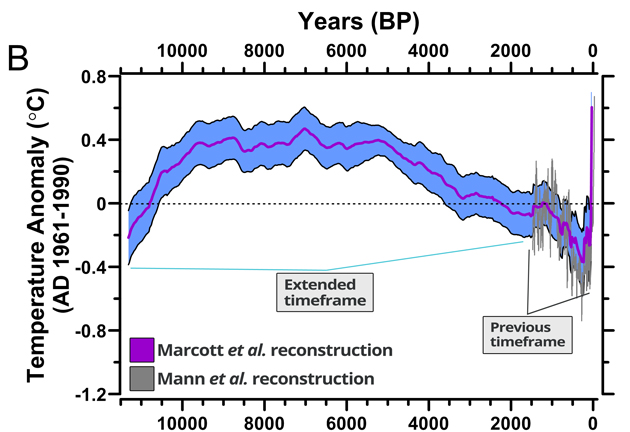
This graph seems to me to reconcile aspects of legitimate skepticism with a devastating reality. Here’s the earth’s temperatures going back 11,000 years – far further than the 2,000 years previously viewed in popular culture as the “hockey stick”. You can see that stick at the far right of the following graph:

marcott-B-MJ

So, yes, the earth has been warmer than it now is while humans inhabited it. Yes, climate has shifted over the millennia, depending on a variety of non-human factors which could also be affecting us now. Yes, in the last half a millennium, we hit what was described as a mini-ice-age, bringing temperatures down to record lows for ten millennia. In 1683, for example, the river Thames was frozen completely for two months. Here’s a painting of the river in 1677, as the Little Ice Age, as we now call it, set in:

The_Frozen_Thames_1677

I can remember a cover-story in the New Republic predicting a new ice age in the 1980s – based on the long-term chilling of the planet. So you can see why those urging against hysteria have some historical climate variety to argue that change has always been here and that humans have lived on the planet for 2000 years and adapted to similar temperature variations before. So chill out, and keep drilling.

The problem with that reassuring scenario, as Tim McDonnell points out, is that we have never before experienced this sudden rate of heating before ever – certainly not since humans developed agriculture. It’s getting close to a vertical line now, which suggests to me that the likelihood of feedback loops actually intensifying the heat has also gone up.To put it mildly, I can see no external reason why the earth’s temperature would have suddenly gone haywire in the last 500 years, without factoring in carbon, capitalism and the industrial revolution. For a while, that carbon actually warmed us up out of a millennial-long cooling. But now, it’s out of control. And if you begin to imagine the impact of every Chinese or Indian reaching the same level of prosperity as Western Europe, using the same carbon sources of energy, we are clearly putting the planet through a stress test never before imposed by its inhabitants.

To be perfectly frank, this graph shows our civilization to be unsustainable unless we dramatically alter its source of energy. Maybe we can adapt – in ways our ancestors did. But they were able to do so over much, much longer periods of time, and were not actually creating the situation.

We have become gods. And we are destroying what we inherited as a species. I do not have an answer, and suspect only a technological breakthrough in energy resources will make a difference real enough to stop this looming catastrophe. But that this isn’t the priority of every government on Earth right now (apart from Russia and Canada) is beyond me. And a carbon tax – the simplest clearest inhibitor of turning our planet into an oven – would be a start.

But What If Three People Love Each Other? Ctd

800px-Joseph_F._Smith_family

Readers are responding to this post in droves. Below are all their best arguments against legal polygamy (with pro arguments coming shortly):

Your readers debate the polygamy objection to gay marriage, but they both miss the actual answer that has been provided by the courts a long time ago – and it makes perfect sense.  Bans on polygamy are constitutional because the discrimination is purely numerical and thus applies equally across racial and gender lines, etc.  The law says you can only have one spouse, and that law applies to blacks, whites, men, women and, yes, ultimately heterosexuals and homosexuals.  It is the same reason it is constitutional to legislate an age when you can marry, an age before you can vote, or the maximum speed that you can drive on a highway.

All laws discriminate in some sense.  But purely numerical discriminations do not discriminate based on a person’s inherent nature and, thus, are (usually) constitutional.  Its also why it is possible (if not necessarily advisable) to criminalize polygamy. Society is free to decide that polygamy is an accepted marital arrangement.  Indeed, we already accept serial polygamy (e.g., Newt Gingrich).  But constitutional considerations would be implicated if society tried to legislate that only whites or only heterosexuals could be polygamous.  At bottom, the polygamy question is a red herring to the gay marriage debate.

Another:

In addition to the excellent response from another reader which you posted, I have to add this: In societies that previously recognized polygamy, it was almost exclusively polygyny and not polyandry; a man could have more than one wife, but no wife could have more than one husband. I’m going to assume that we’re doing away with that scenario on the basis of gender equality alone, but a quick look at the details of what polygamous marriage would look like makes it clear why polygyny (provided legal gender inequality) is actually manageable but generalized polygamy isn’t in most cases.

Let’s do away with genders and just talk about three people, A, B, and C.  Person A wants to have a polygamous relationship with B and C.  In the US, the primary legal result of marriage is the formation of a single legal household entity that encompasses two people.  So, if A and B become one household, and C marries A, are B and C now married too?  If not, you have a legal mess on your hands that should be obvious.  And it gets worse if C wants to marry D as well, but A and B do not.

There is an argument to be made for “group marriage,” where an arbitrary number of people enter into a marriage contract with each other. Let’s also provide that any individual can voluntarily “divorce” him or herself from that married household.  I could see a legal basis for this, although my question would be: does this even resemble anything that we would call “marriage” anymore?  Is there any way in which the complex group dynamics inherent in human nature don’t split this “marriage” into factions?  And for that matter, what really is needed here that isn’t provided by, say, incorporation?

Perhaps there’s an argument to be made for arbitrary “adoptive families” that aren’t families at all.  For a less explosive example, let’s imagine two unrelated people who come to cohabitate as siblings and not romantically or amorously.  In the same way that four co-“married” polyamorous individuals might want hospital visitation rights and inheritance rules, these two people might want some protections without being married.  I can see an argument for that, but I can’t see calling it marriage.

Another way to look at it:

The reason for a two-person marriage works much better than three-person marriage is not due to government policy. It is entirely social. Pardon me going all geeky here but this is how I think:

Three-unit systems where all equal to each other are inherently more unstable than just two-unit systems. Imagine that the probability of two people having a great interpersonal relationship is x. In a two-unit system, probability of stability is x. But in a three unit system it has to be x to the power of 3, since three relationships have to be great. Note that x is less than 1. So x^3 is much much less than x. A stable society can not function with such a high divorce rate.

In ancient societies and in some places even now, polyandry and polygamous marriages are traditional. They work because of special social circumstances and in lot of cases one or more of the persons in the marriage has more weight than the rest and they stay cohesive only because of those special circumstances. Once everybody wants equal weight, things will collapse.

Another points to a variety of complicated scenarios:

What happens if Wife #1 wants a divorce but Wife #2 objects? When the husband dies, are the two women still married to one another? Does the estate get disbursed or do they have to keep on sharing it? The assumption is that if it’s one man and two women, if one of the women dies the remaining man and woman are still married. What do you do in community property states? What happens in the community property state when Wife #2 dies during the middle of the divorce of Wife #1. Does the husband get to keep everything or does the about-to-be-divorced wife get half instead of one-third? If they were divvying up things three ways before she died and she does it three hours before the final decree does the surviving wife have a half interest in the third? What about if she dies three hours after? The husband dies before both wives. Do the kids of Wife #1 get a say in the end-of-life decisions being made about Wife #2?

Another runs through a similar series of situations and concludes:

We do not have the laws in place to support plural marriage. I don’t know for sure, but I suspect that most of the countries that do allow plural marriage allow only one form of plural marriage: a single man and multiple wives. Our constitution will certainly not allow that restriction if we decide to go down that road. We would have to build those laws, and I don’t think we have anyone wise enough to craft laws to cover a fraction of the situations that would develop. People who want some sort of a plural marriage will have to resort to lawyers and contracts to formalize their relationships on a case-by-case basis. I realize that is what people used to say about same sex marriage. The difference between the two situations is that we already have a body of law to govern the marriage of two people.

One more for now:

Please continue to make a clear distinction between gay marriage and polygamy.  The best argument for gay marriage is that it harms no one and is good for gay people and their children.  No one has managed to come up with even a shred of evidence that gay marriage is harmful to anyone, and not for want of trying.  Polygamy, on the other hand, is demonstrably bad for women and children, in ways that go far beyond creating a surplus of unmarried men.  An excellent resource on this topic is A Cruel Arithmetic: Inside the Case Against Polygamyby Craig Jones.

(Photo: the full family of one Joseph F Smith, c 1900, a known polygamist. This picture depicts members of his family, including his sons and daughters, as well as their spouses and children. Via Wiki.)

In Praise Of The Defense Sequester

csbachartmon

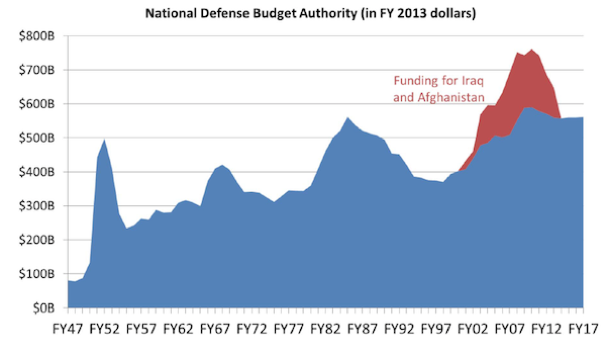
There’s a truly hopeful piece in the NYT today that’s a further argument for the sequester. The military is slowly beginning to think through where and how to cut – in ways that can only help lower the debt and make massive land invasions of foreign countries much less feasible.

Inside the Pentagon, even some senior officers are saying that the reductions, if done smartly, could easily exceed those mandated by sequestration, as the cuts are called, and leave room for the areas where the administration believes more money will be required. These include building drones, developing offensive and defensive cyberweapons and focusing on Special Operations forces.

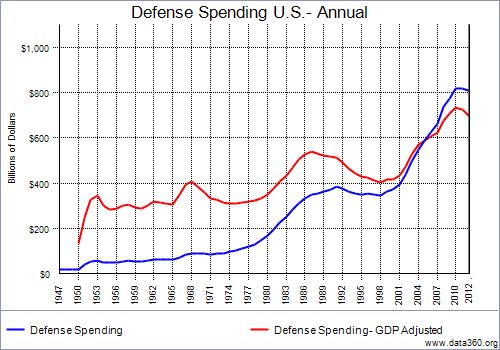
Given the way procurement and bases are spread across the states to prevent rational cutting and pruning – as would happen in any private sector company – I’m not sure the Democrats and non-neocon Republicans should ever end the defense sequester. How else are we going to cut defense spending given our corrupt, horse-trading, not-my-military-base Congress? And look at the chart above. Are we really spending more now than we did during Vietnam or the height of the Reagan defense buildup? Yes, we are.

Even as a percentage of GDP? Yes, we are:

dsg539_500_350

I know we have a base-closing commission – but we all know its limits and manipulation (especially after the beginning of “House of Cards”). As the institution fights over “slices of a $530 billion budgetary pie that many experts think should be shrunk by one-fifth over the rest of this decade,” Thomas P.M. Barnett’s bet is on the army:

At roughly 560,000 men and women, the Army is bigger than it has been since 1994, when it was still crashing from its Reagan-era Cold War heights of 780,000. Later in the 1990s, the Army bottomed out at 480,000, and there’s no reason it can’t go back to that level, given that none of the fabulously high-tech wars being dreamed up by Pentagon planners calls for multiyear occupations of distant California-size countries.

(Charts via Ezra and data360)

Why Take His Name? Ctd

A reader rebuts Filipovic:

How is my father’s surname more my identity than my husband’s surname? Both, if you want to get all feminist about it, highlight the fact that females are “owned” by the males to whom they are born or wed, right? I am more than a name and I’ve had a lot of them. My birth parents saddled me with an atrocious moniker that only teenagers could have come up with and a surname that is now deemed a state secret. My parents stuck me with a vanilla Catholic saint name. My late husband offered me a new surname and my second husband gave me another. Don’t even get me started on nicknames.

And still, none of these arbitrary arrangements of letters are me. If I tried, and I have now and again, I don’t think I could put a name to me that sums me up. My names are like a history – snapshots of me at different points of my development and always a step behind as I evolve.

Another:

Jill Filipovic’s case for women keeping their surname strikes me a bit romantic.  Yes, our name is our identity, but what if you do not want to be associated with the identity?  I had three fathers growing up (a non-exsistent birth father and two abusive step-fathers) and so changing my surname to my husband’s was my first choice at creating my own identity separate from the childhood I wanted so desperately to leave behind. I loved shedding the identity of my youth (abused) for my new identity (happy adult, wife and mother).

Many more readers are sounding off on our Facebook page.

A Stand-Up Job

Gregory Ferenstein insists that we should all be walking while we work:

After piloting a walking desk – a standing desk attached to a treadmill – for a month, I’m convinced they should become the default workstation. Immediately, my daily calorie burn jumped 30.7 percent, and I lost 3 pounds and a percent of body fat in a week. I also experienced less joint pain throughout the day. …

The first day I couldn’t walk more than an hour at a time before I felt like I was losing concentration. It also takes some getting used to walking like a Tyrannosaurus rex (arms tucked-in and elbows bent at the keyboard). At first, I would work for an hour walking, and then sit for 30 minutes. The first day I walked about four hours. Now I only rest once a day. It also took a bit to develop the musculature in my upper back to support raised arms for hours on end. This is no longer a problem.

Update from a reader:

That chart is totally misleading.  By starting at 2400 calories it makes it appear like the walking desk helps you burn 300% more calories than sitting, but it actually you’d burn 33% more calories.  Not that the walking desk is a terrible idea or anything.

The Machinery Of Morality

In his new book, To Save Everything, Click Here: The Folly of Technological SolutionismEvgeny Morozov explains how certain kinds of technology could help us become more moral beings. For instance, he’s intrigued by “a caterpillar-shaped extension cord which, if you leave devices in standby mode, it will start twitching as if the caterpillar was in pain”:

To me, it’s a nice way of alerting you, as someone who is a user of electricity, that there are many more issues involved that designers have tried to hide from you. They would rather you not think of devices in standby mode and would rather make that extension cord as invisible as possible.

And it’s this very paradigm that has brought us to a point where we think about energy – and even think that cloud computing – as being provided by some invisible infrastructure we no longer have to care about. I’m not sure how far we will be able to go with that paradigm in the future. If we will be replacing that paradigm, then I think that making technologies into these triggers for deliberation and reflection is not a bad place to start.

In a recent WSJ piece, Morozov provided other examples of ethical tech:

An Internet-jacked kettle that alerts us when the national power grid is overloaded (a prototype has been developed by U.K. engineer Chris Adams) doesn’t prevent us from boiling yet another cup of tea, but it does add an extra ethical dimension to that choice. Likewise, a grocery cart that can scan the bar codes of products we put into it, informing us of their nutritional benefits and country of origin, enhances—rather than impoverishes—our autonomy (a prototype has been developed by a group of designers at the Open University, also in the U.K.)