by Chris Bodenner
A reader writes:
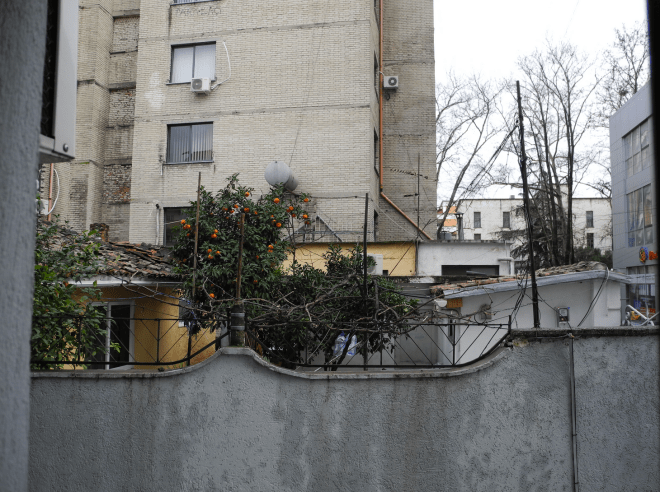
The leafless trees and an evergreen in the background made me think of a northern climate, but since my guesses are rarely even in the correct hemisphere, I’m going to go out on a limb: The orange tree, yellow house, and white-washed garden walls point to Athens, Greece. The red-tile roofs visible in the photo make me think its in the Old Town area of Athens below the Acropolis.
Another reader:
This is my first time guessing a VFYW. I am not using any investigative tools for this guess; I just have a hunch. The orange tree reminds me of the kind I used to see and pick oranges from walking through Damascus, but the roof shingles on the yellow building and lack of satellite dishes tells me this can’t be an Arab country. However, it does have a Mediterranean feel, just emerging out of winter. Letters on the building could be Greek? It’s be in the news lately. But let’s go with Cyprus. To be more specific: Limassol, Cyprus.
Another:
The first step was to identify the logo in the lower-right corner. It’s ProCredit, and a quick search online reveals that they only operate in Latin America, Africa, and Eastern Europe. You’d think after cross-referencing the specific countries where they operate with orange-producing countries you could cross off Eastern Europe and Africa, but that’s not quite true. Since ProCredit’s website doesn’t offer an easy way to display all of their locations in any given country, I’m going to stop here and just guess Guadalajara, Mexico, since Mexico is the #1 orange producing country among countries where ProCredit operates.
Another:
Through a combination of Wikipedia and luck, I identified that building on the right as a ProCredit bank within a ten minutes. But it’s 60 degrees and sunny in New York today, so I’m not going to spend much of it indoors trudging through Google Maps. Time for educated guessing:
Given the week’s news, I suspected Cyprus, but ProCredit lists no branches there. The oranges made me think Mediterranean, where it has branches in Albania and many of the former Yugoslav Republic countries. Then again, Cyprus involves Russia, and Georgia is in the Russian sphere, grows wonderful citrus, and has ProCredit banks. So now I’m leaning Georgia. But hang on — the people who live where the picture was taken are clearly concerned with heavy rain: The drainpipes and gutters are prominent and well-tended. So, a tropical country? I’ll say Nicaragua, because Dish-heads seem to travel off the beaten path, although ProCredit also operates in El Salvador, Mexico, Honduras, and Colombia and I think it could just as easily be one of those.
Now I’m going out for some sun.
Another:
I’m going to go with Italy, and I’m going to go with a post-WWII neighborhood of Florence since the orange tree was a symbol of the Medici.
Another:
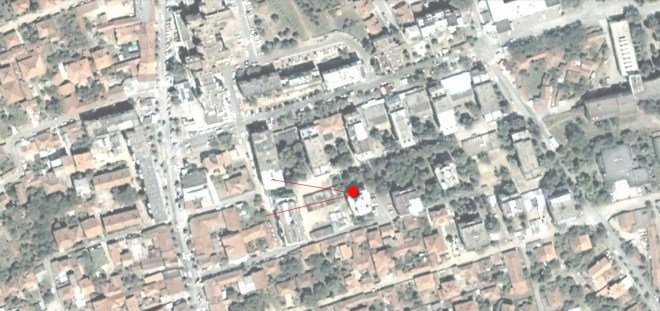
The picture this week was pretty difficult to due to the lack of coverage in Serbia of Google Street View, but thankfully the photo has a clear view of a Pro Credit Bank branch, and apparently they are pretty common throughout Serbia. The photo also offers other clues such as the “aesthetics be damned, we are putting a Mitsubishi a/c unit in this place, and are going to plop the brilliant white condenser outside the window”, a common practice throughout the city of Vranja, where the citizens, like the rest of the country, prefer to grow apricots on any available area of their back yard to help block out these eyesores.
I doubt I have much of a chance this week, as I am sure somebody’s ex-girlfriend’s cousin happens to be banker’s associate for Pro Credit Bank in Vranja, and has already sent them exact coordinates of the location to send in to The Dish and claim the prize. Nevertheless, if I win, I promise to send in my subscription.
Don’t let a loss stop you! Another reader:
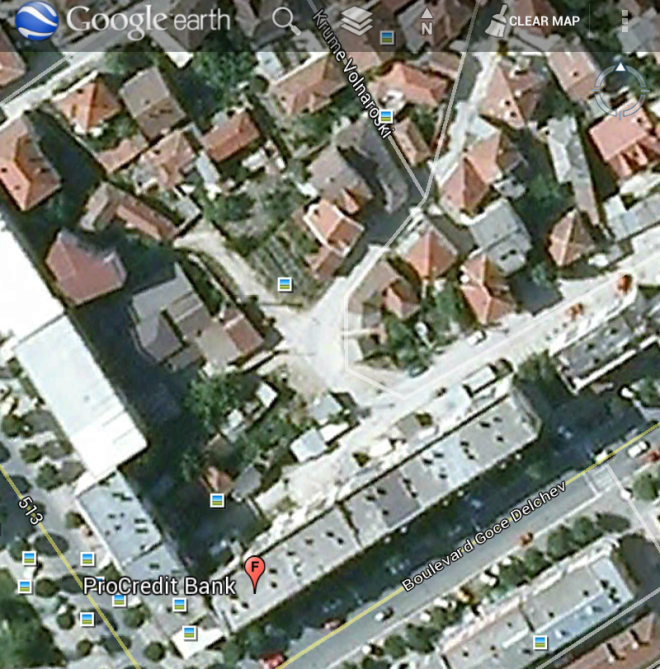
Well, I started in Serbia and ended up in Macedonia. I was able to identify ProCredit Bank on the corner and I figured orange trees grow far enough south in Macedonia that it just might be the place. That’s as far as I can get without some decent software so this is where I have to stop. Prilep, Macedonia:
Another Eastern European country:
I recognized ProCredit bank instantly from my time spent in Moldova doing development work. Problem is, it’s a huge bank, and branches could be anywhere in the developing world. The combination of the fir tree in the back and the unique roof shingles narrow this location down to Eastern Europe (no major Asian countries have ProCredit banks, and those shingles are only found in a handful of countries outside of Asia). It looks like Romanian graffiti on the top of the white brick building, so we could be in Romania or Moldova (Moldovan is essentially Romanian). I’ll limit my Google Maps search to what I know: Moldova.
It doesn’t look like any of the major branches in Moldova (many of which are located in more urban housing than this). From the satellite, I’m guessing it’s possibly this branch: Ştefan cel Mare şi Sfânt 33, Soroca, Moldova.
Yet another:
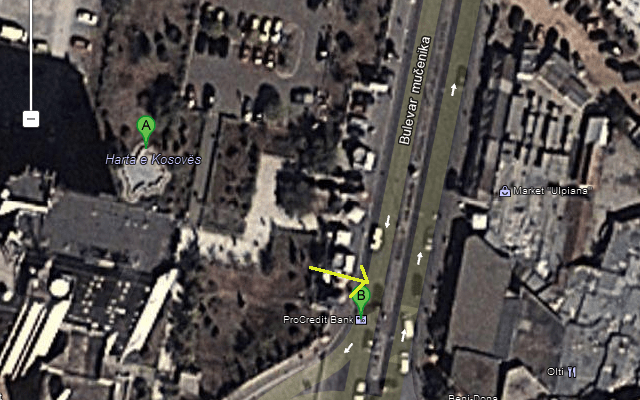
You sent me on my first ever VFYW witch hunt, searching for ProCredit banks in Kosovo. I could probably spend several more hours trying to pinpoint the locations, but I’m not sure I have the time or the energy (although it is kind of fun to see all the streets named after American politicians, like Eliot L. Engel St in Peja!).
Why my sudden VFYW participation?
A couple years ago, you had a picture of Cartagena, Colombia. I swore it looked familiar as I was planning a trip there for my friend’s wedding. Of course I thought my hunch would have been thousands of miles off. (During my trip, I actually took a picture of the window it was taken from). Then, a few months later, you had an entry from Mozambique. This failure to go with my gut cut much deeper. Not only was my friend the one who had submitted the picture, but I was the one who had advised him to submit something while he was working overseas. After not entering my guesses those two times, I vowed to pursue any future leads.
Now, here I am with no confidence whatsoever in my guess fully aware that some other Dishhead will have pinpointed the exact home from which the picture was taken. It kind of looks like it could have been taken from Haxhi Zeka, in Prizren Kosovo, but I really have no idea.
More coincidences from our contest here and here. Another Kosovo guesser:
Another gets the right country:
I noticed the graffiti on the apartment wall that says “Para Laci”. This appears to be a reference perhaps to the European football team from Laç, Albania. Laç is near an ancient church that is a destination of pilgrimage dedicated to St. Anthony of Padua. There is a dearth of photos and map details of the town. I can’t say for sure the photo is not from somewhere else such as Tirana, but I am going with Laç.
Another gets closer:
Going on the Laçi graffiti, I’m guessing it’s in Albania. There are two ProCredit Bank locations that Google Maps finds there, and one is next to the Hotel Lisus in Lezhe. So perhaps it’s a first or second story hotel window facing north.
Another nails the right city:
What a frustrating contest this week! The more of these I do, I notice how we VFYWers have assembled a collective toolbox, and in this regard narrowing down to the country was mostly an 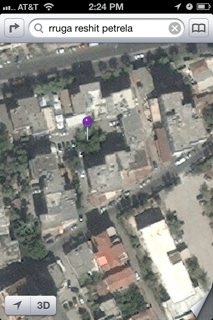 act of standing on the shoulders of giants. Those window units point me to eastern Europe and the geographically limiting orange tree pushes me south. I figured out the commercial bank sign and went to its website to learn the scope of its worldwide footprint. Grafitti confirms the usage of the Latin alphabet. Google “Para Laci”, and the wisdow of crowds points you to … Albania, via links about fooball clubs and rappers, amongst others. Less than an hour to confirm the country, and with the requisite shot of luck we have the city of Tirana, Albania inside another thirty minutes.
From there the toolbox disintegrates. We look at every storefront photo of a ProCredit Bank, but none quite fit right. Albania’s capital has not yet succumbed to the intrusiveness of Street View. Aerial shots are as inscrutable as I wish my own home were. But we’ve found that tallish brick building in a photo, we know we have. But it’s across the street from a different ProCredit branch. We think perhaps there’s another branch, or possibly an abandoned one across the street, but we can’t get behind the brick building to confirm. After nailing the neighborhood in 1.5 hours, we spend 3 more trying to find the window.
Then despair – a mile down the road, another similar brick building, adjacent to another ProCredit branch. It all crumbles. I still believe in Tirana, but I have no confidence in my specifics.
Another Tirana guesser:
A lot of the aerial views of Albanian towns show red-tiled roofs like the one in the photo. And when you go on ProCredit’s Albanian website – whose webmaster is probably wondering why they’ve been getting so many hits this past weekend – you see a lovely picture of this smiling man in a blue shirt:

This is exactly the same image that you see hanging in the window of the ProCredit bank in the VFYW.
A group effort:
So here’s how my weekend went: I had all these plans to catch up on homework for my master’s program. Then the weekly VFYW contest started on Saturday, and my entire afternoon and night were completely shot. Here’s what I did: my girlfriend, a mutual friend, and I all scoured the photo for any evidence. I was the first to realize that the bank was a ProCredit Bank (I googled “ProC” and saw what came up in the AutoComplete box). Then we went to the bank’s web site and started eliminating countries. My girlfriend noticed that the guy on the advertisement on the window of the bank was the same guy that appeared on ProCredit Albania’s web site, so we had a country match.
Since that time, we spent hours and hours on Google Maps and Street View (turns out, satellite imagery of Albania is not quite what it is in, say, New York). We especially focused on Lac, since graffiti on the building on upper left says “para laçi.” Anyway, the point to all this is: we still don’t know which branch it is. Damn ProCredit and its all-too-convenient branches.
So I’m guessing Tirana. Because it seems like the kind of place that might have both a ProCredit Bank branch AND a backyard orange tree. So there.
Another nails the right building:
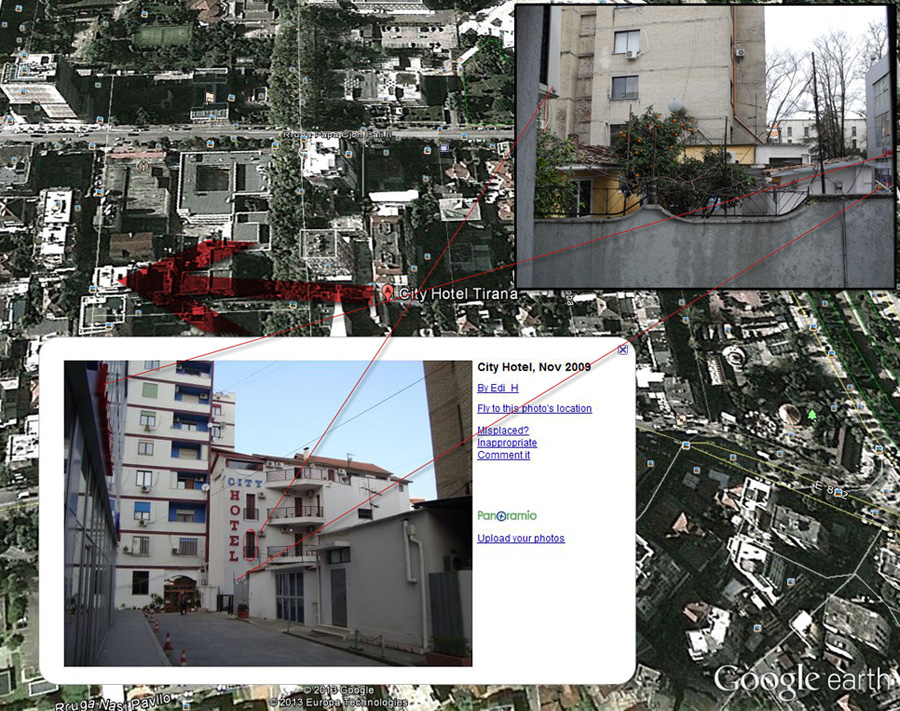
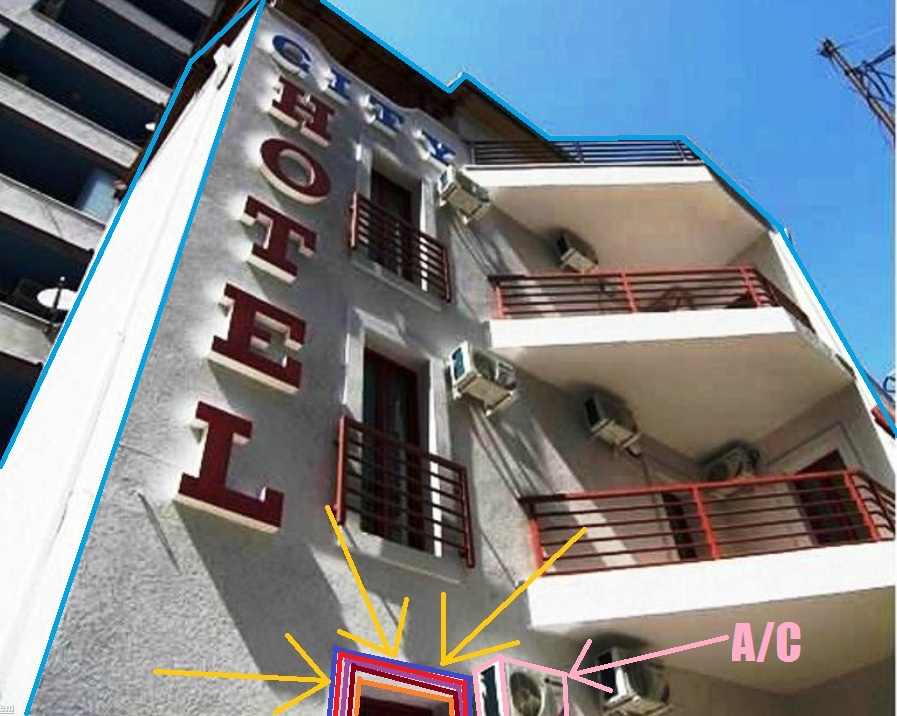
This week’s “View From Your Window” is located in Tirana, Albania. Of this I am 100% positive. I am also about 99.5% sure that this picture has been taken from the City Hotel Tirana on Rruga Ismail Qemali. If I had to be more specific, I’d say it was taken from the second floor window next to the “E L” in “hotel” on the southern side of the building, facing the alley.
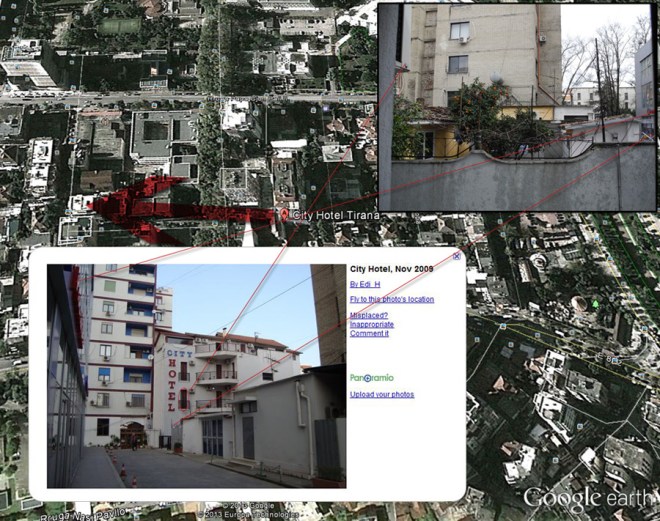
In the event of multiple correct guesses (as is likely; I’m guessing 50-60 correct hotel-level guesses), this is my fifth correct guess. Previous correct guesses include Queenstown, New Zealand; Sausalito, California; Anchorage, Alaska and Kagoshima, Japan.
The number of correct hotel guessers was actually ten (all of whom will now be on the “Correct Guessers” list, which will give them an edge in future contests). But only one of them has guessed more prior views than the above reader without yet winning. That reader’s entry:
That persimmon tree initially had me thinking Asia. But the sign for ProCredit Bank – a surprisingly large network of microloan and retail banking establishments through Eastern Europe, Latin America, and Africa – quickly redirected me toward SE Europe.
Let this be said: While there may be more Rodeway Inns and local police stations in North America than ProCredit branches in the Balkans, there are still plenty of the latter. What’s more, they’re represented pretty spottily in Google Maps. Most of Serbia’s and Kosovo’s show up in map view, for instance, but you won’t find any in, say, Bosnia-Herzegovina that way.
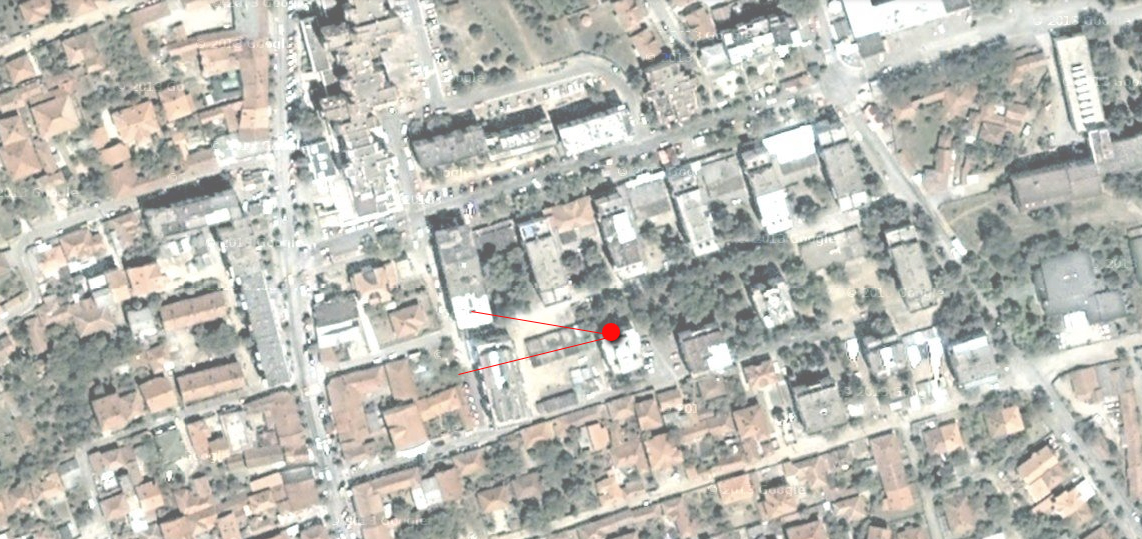
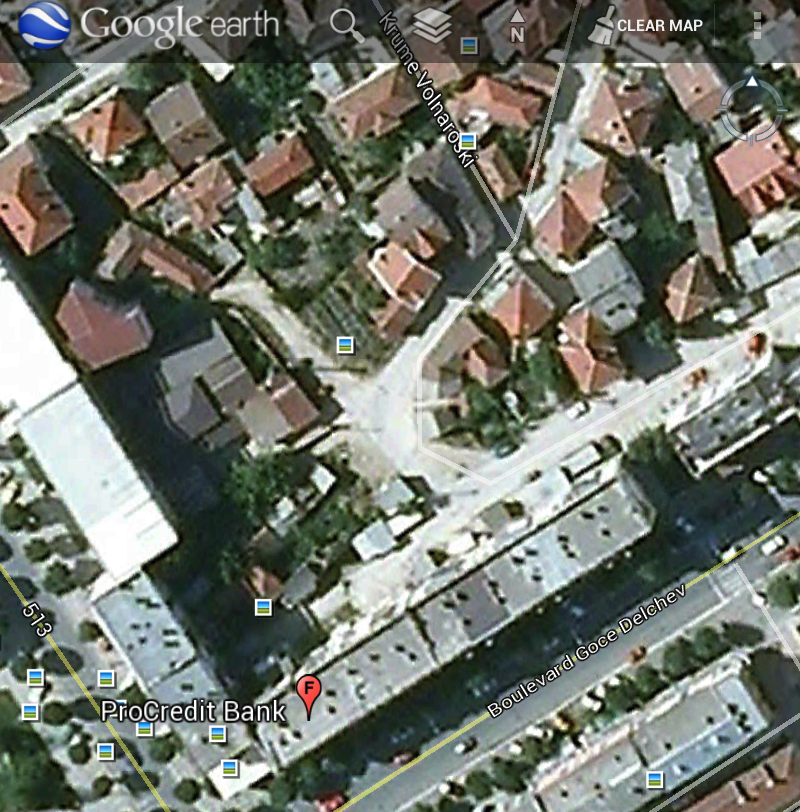
I had a good feeling about Albania (Wikipedia singles the country out as a regional leader in persimmon cultivation, for whatever that’s worth), but even on ProCredit’s Albanian website, a lot of the branches had no photos available. Google apparently has no Albanian Street View database, and its grasp of exact addresses there is a little shaky. Thank goodness some kind folks took photos in the vicinity of one of the several Tirana branches, this one on Ismail Qemali St.:

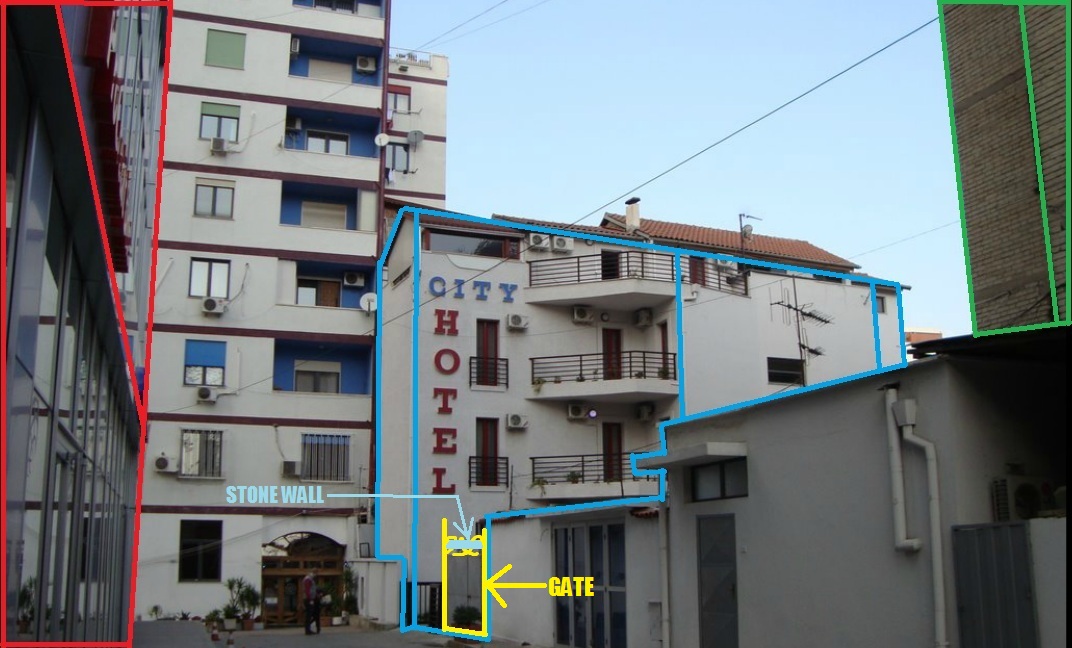
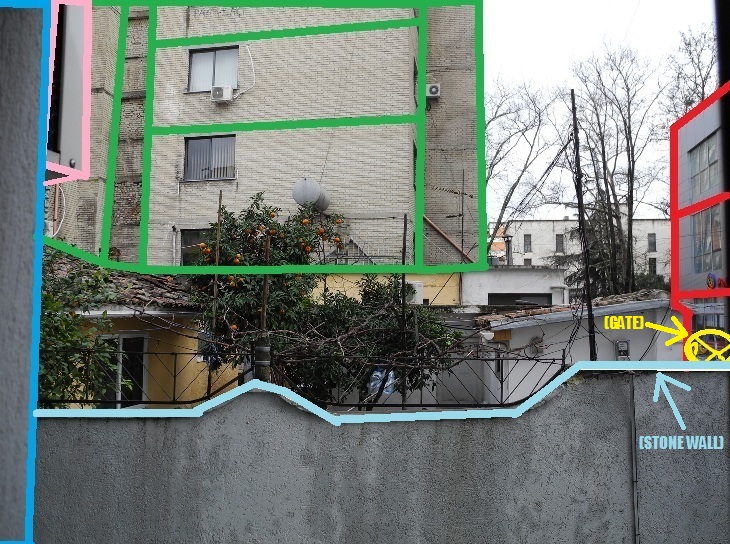
The colored outlines correspond to the same on the original VFYW and the Google map view:
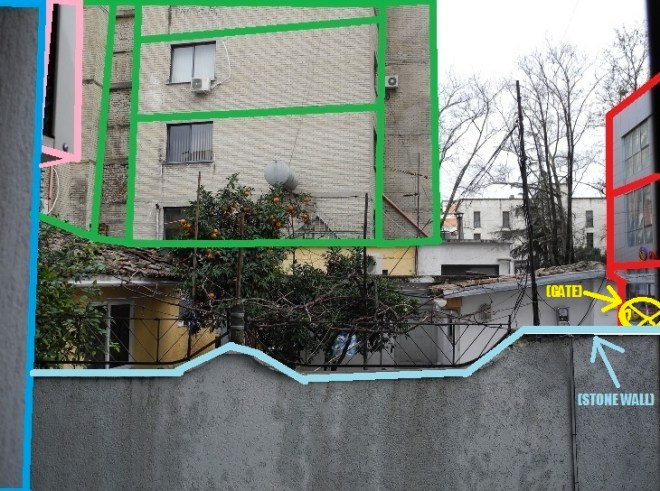
The first floor seems the most likely, given the position of the stone wall (light blue) and gate (yellow). And as this image shows, there’s a ventilation unit (in pink!) by the first floor window, southwest corner, matching the one in the original image:

From the photo’s owner:
On a recent trip to Albania for work, I stayed an extra few days to check out Tirana and the surrounding areas. I stayed at a small hotel on a side street that was recommended by a friend called City Hotel on Rruga Ismail Qemali, Nr 8/1. It was taken from the first floor, room #2. I quite liked the orange tree in the yard outside my window and thought I’d share it.
Congrats to that colorful reader on the tough win. This was truly one of the most impressive contests yet. I had picked what I thought would be a really tough photo because I knew I would be especially busy this week with Andrew on vacation and I wanted to cut down on the submissions. Silly me: there were close to 150 entries, half of which were of Albania. Readers still continue to amaze me when it comes to this contest, after nearly three years of running it. As one reader puts it:
The VFYW contest is creepy. Seriously. How can these people – from just ONE random photograph – pinpoint the EXACT location down to the apartment unit it was taken from?! It’s creepy.
(Archive)


 The Dish