Potheads Don’t Belong In Prison

According to the vast majority of the American population:

Reason-Rupe has just released new polling data that revealed only a minuscule percentage of Americans believe that marijuana use and possession should result in jail time. When asked which approach they thought the government and law enforcement should take toward someone found smoking marijuana or in possession of a small amount of marijuana, only 6% responded that they should be sent to jail. 35% of respondents said that these individuals shouldn’t be punished at all, 32% responded they should pay a fine, and 20% said they should have to attended substance abuse courses.

Mike Riggs notes that this poll “is one of the few instances–possibly the first–in which the usual polling dichotomies of incarceration v. treatment and criminal penalty v. civil penalty have been expanded to include no penalty whatsoever”:

The results suggest that Americans are comfortable with the idea of decriminalization–which reduces the penalty for minor marijuana possession to a civil fine–and more sympathetic than ever to the idea of fully legalizing possession.

Saving Typeface

At a recent typography conference, participants raised concerns about the future of their field. Some pre-conference thoughts:

“The future of type is the same as football: everyone does it, and even more people have an opinion about it. Only a few make a living out of it, and some of these are very good,” says designer, educator, typographer Petr van Blokland while when Design Week posed the question to Erik Spiekermann, he responded “You might as well ask “What is the future of mankind?”. Why could anybody ask such a general and unspecific question? I’ll still answer it. The future of type is the past of type: visual language. As long as we speak and write, we’ll have type. Different voices, different messages, different media: different type.”

Please Power On Your Devices

The FCC recently proposed expanding in-flight Wi-Fi:

That may sound like good news for faster and more reliable in-flight Wi-Fi—and in a way, it is. But as Joe Sharkey, the New York Times’s veteran business-travel columnist, explains, the decision isn’t about making it easier for you to stay in touch with people on the ground—it’s all about selling you things while you’re up in the air:

The great advances in airplane internet connections are being driven far more by the opportunities that high-speed broadband service presents for airlines themselves to essentially sell more things to the customers, whether the product is in-flight entertainment, food and drink, customised services to elite-status passengers or products at the destination, including hotel packages, sports and concert tickets, restaurant and theatre reservations. On an airplane, you have a captive market, and with sophisticated technology, you can sell to passengers in very personal ways.

If Mr Sharkey is right, in-flight Wi-Fi may be able to finally escape the vicious cycle in which quality improvements rely on more passengers deciding to pay for bad service (and the problem of wider use on any given flight slowing down service on that flight). Instead, Wi-Fi will be the new SkyMall—provided free to passengers so they can buy things they don’t really need.

The Weekend Wrap

This weekend on the Dish, Andrew praised the sanity of the American people, saw the deep Christianity in an Obama commencement speech, and continued to dissect the awfulness of a recent Peggy Noonan column.

We also provided our usual eclectic mix of religious, literary, and cultural coverage. In matters of faith, dish_kumi-1doubt, and philosophy, David Zahl found the Christianity in Stephen Colbert’s message to college graduates, James V. Schall contemplated sin and faith, and Morgan Meis pondered the similarities between Kierkegaard and the New Atheists, Paul Bloom found the limits of empathy, Alex Shaw discussed why we desire fairness, Maria Bustillos came to hugging’s defense, and Todd May considered love and eternal life. Andre Dubus ruminated on the Eucharist, Jaroslav Pelikan mused on Dostoevsky’s critique of moralism, and a new Tumblr imagined Wes Anderson writing the Bible.

In literary and arts coverage, Tarn Wilson discovered an unexpected benefit from MFA programs, Caitlin O’Neil compared writing to mixing drinks, and a reader furthered our discussion of Orwell in Spain. Michael Saler revealed the deeper meaning of Mary Wollstonecraft Shelley’s Frankenstein, Robert Macfarlane argued Cormac McCarthy’s The Road isn’t a typical novel about the apocalypse, and Kate Chisholm charmingly described the idiosyncrasies of Dr. Johnson. Angelo Alaimo O’Donnell led her students on a literary pilgrimage, Salman Rushdie thought about a writer’s relationship with race and geography, Clive James offered an epic takedown of Dan Brown, and Sadie Stein pointed to a droll Amazon UK review of Roger Hargreaves’s “Mr. Men” series. Kenneth R. Morefield revisited the films of Roberto Rossellini, Ruth Graham analyzed wedding poetry, Clayton Cubitt explored “the decisive moment” in photography, and Jaron Lanier worried that new technology conceals the personal effort involved in creative work . Read Saturday’s poem here and Sunday’s here.

In assorted news and views, Colin Schultz thought about a new college degree in heavy metal music, Aminatta Forna chronicled the creation of the Museum of Broken Relationships in Croatia, Pleated-Jeans collected misheard 90s song lyrics, and Andrew Romano looked to a study about why we become addicted to TV shows. A new weed product proved especially potent, Melissa Mohr expounded on profanity, Marc Maron believed comedy to be about exposing your vulnerability, and we met two robots designed to behave as a human couple. MHBs here and here, FOTDs here and here, VFYWs here and here, and the latest window contest here.

– M.S.

(Image: Kumi Yamashita‘s “Constellation – Mana no.2”. Details here.)

The House That Heineken Built

The grandson of the brewery’s founder is credited with “one of the first eco-conscious consumer designs”:

In 1960, Freddy [Heineken] took a trip to the island of Curacao in the Caribbean Sea and discovered that he could barely walk 15 feet on the beach without stepping on a littered Heineken bottle. He was alarmed by two things: First, the incredible amount of waste that his product was creating due to the region’s lack of infrastructure to collect the bottles for reuse. (Back then, bottles were commonly returned for refilling, lasting about 30 trips back and forth to the breweries). Second, the dearth of proper building materials available to those living in the impoverished communities he visited. So he thought up an idea that might solve both of these problems: A brick that holds beer.

The rectangular, Heineken World Bottle or WOBO, designed with the help of architect John Habraken, would serve as a drinking vessel as well as a brick once the contents were consumed. The long side of the bottle would have interlocking grooved surfaces so that the glass bricks, once laid on their side, could be stacked easily with mortar or cement. A 10-foot-by-10-foot shack would take approximately 1,000 bottles (and a lot of beer consumption) to build.

The brick bottles never made it to large-scale production, but they inspired others to take up the challenge.

(Photo by Flickr user greezer.ch)

How They Got To “Sesame Street” Ctd

A reader reflects:

That first Sesame Street episode made a big impression when I was five. The show’s premier was a major event for the white progressive moms in my neighborhood in Evanston, IL.  I was actually wrangled before the TV set and told to watch it, a strange act for my mother, who was very anti-TV and later, in my early adolescence, refused on principal to repair the same set, leaving me tube-less until I moved away to university.

I was hooked on Sesame Street from the downbeat of the almost funky comp that underlies the theme song. The beautiful, gritty but fun scenes of children in New York fascinated me. They reminded me and eased my fears of what I considered to be a scary, urban world, only blocks away, across Howard St., the border of leafy, suburban Evanston with the City of Chicago.

At the time, the show didn’t seem so radical. Evanston was integrating. I had strong, quiet, proud, loving black teachers like Sesame Street’s Gordon, as well as black, Latin and Asian friends. I was a non-denominational child surrounded by Jewish and Catholic neighbors.  But looking at it again from four decades on in the age of Obama, my goodness! It premiered the year after Martin Luther King’s murder, and its first scene has Gordon leading a little white girl down a big-city street and introducing her to all her new neighbors as if it was normal.  My God, it wasn’t normal, but because of the show many of us were given the idea that it could be and, you know what, it’s no longer strange. We weren’t in bloody Kansas anymore.

Sesame Street was such a glorious, stealthy challenge to the status quo. I and millions of others, all blank slates, had the A-B-Cs, 1-2-3s and message of how people from different backgrounds can learn, grow and live together, written on us. It was given gently and with love by Gordon, Mr. Hooper, Big Bird, Cookie Monster, Ernie & Bert and Grover.  Even Stevie Wonder got into the act. If you want to see how cool Sesame Street is, look up the video of Stevie playing Superstitious on the show.  It would make a great Mental Health Break if you haven’t run it already.

How people can get so worked up about PBS when it costs so little and has delivered things as great as Sesame Street and Mr. Rogers, Julia Child, Masterpiece Theatre and Nova  seems to me small and cruel.

The Reward Of Rituals

Francesca Gino and Michael I. Norton performed experiments suggesting that people benefit from ritualized behavior after experiencing a loss:

We invited people into the laboratory and told them they would be part of a random drawing in which they could win $200 on the spot and leave without completing the study. To make the pain of losing even worse, we even asked them to think and write about all the ways they would use the money. After the random draw, the winner got to leave, and we divided the remaining “losers” into two groups. Some people were asked to engage in the following ritual:

Step 1. Draw how you currently feel on the piece of paper on your desk for two minutes.
Step 2. Please sprinkle a pinch of salt on the paper with your drawing.
Step 3. Please tear up the piece of paper.
Step 4. Count up to ten in your head five times.

Other people simply engaged in a task (drawing how they felt) for the same amount of time. Finally, everyone answered questions about their level of grief, such as “I can’t help feeling angry and upset about the fact that I did not win the $200.” The results? Those who performed a ritual after losing in the lottery reported feeling less grief. Our results suggest that engaging in rituals mitigates grief caused by both life-changing losses (such as the death of a loved one) and more mundane ones (losing a lottery).

The Sanity Of The American People

US-POLITICS-OBAMA

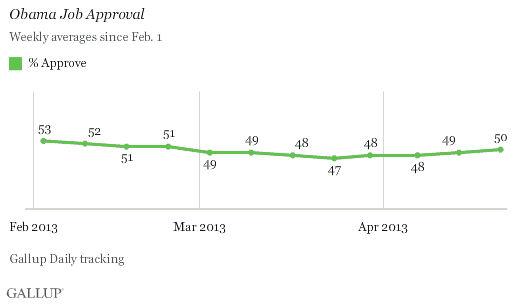
CNN finds what Gallup does: no impact on the president’s approval ratings, even as Americans do take the current scandals seriously:

According to the survey, which was conducted Friday and Saturday, 53% of Americans say they approve of the job the president is doing, with 45% saying they disapprove. The president’s approval rating was at 51% in CNN’s last poll, which was conducted in early April.

Here’s Gallup’s timeline of approval:

dzolk9nghkmemz-wnnhd5q

The tone of the CNN piece seems to find this data surprising. It isn’t. It simply reflects the fact that no real connection has been directly made between these scandals and the president. And, I’d say, he’s buoyed somewhat because the economy here is better than any in Europe – and less vulnerable than Japan’s current Keynesian jolt – and because he’s still a broadly liked president. In the post-re-election lull, the press corps needed a storyline, rather than just three stories. But sometimes the line falls apart for lack of evidence (at least among the non-GOP base).

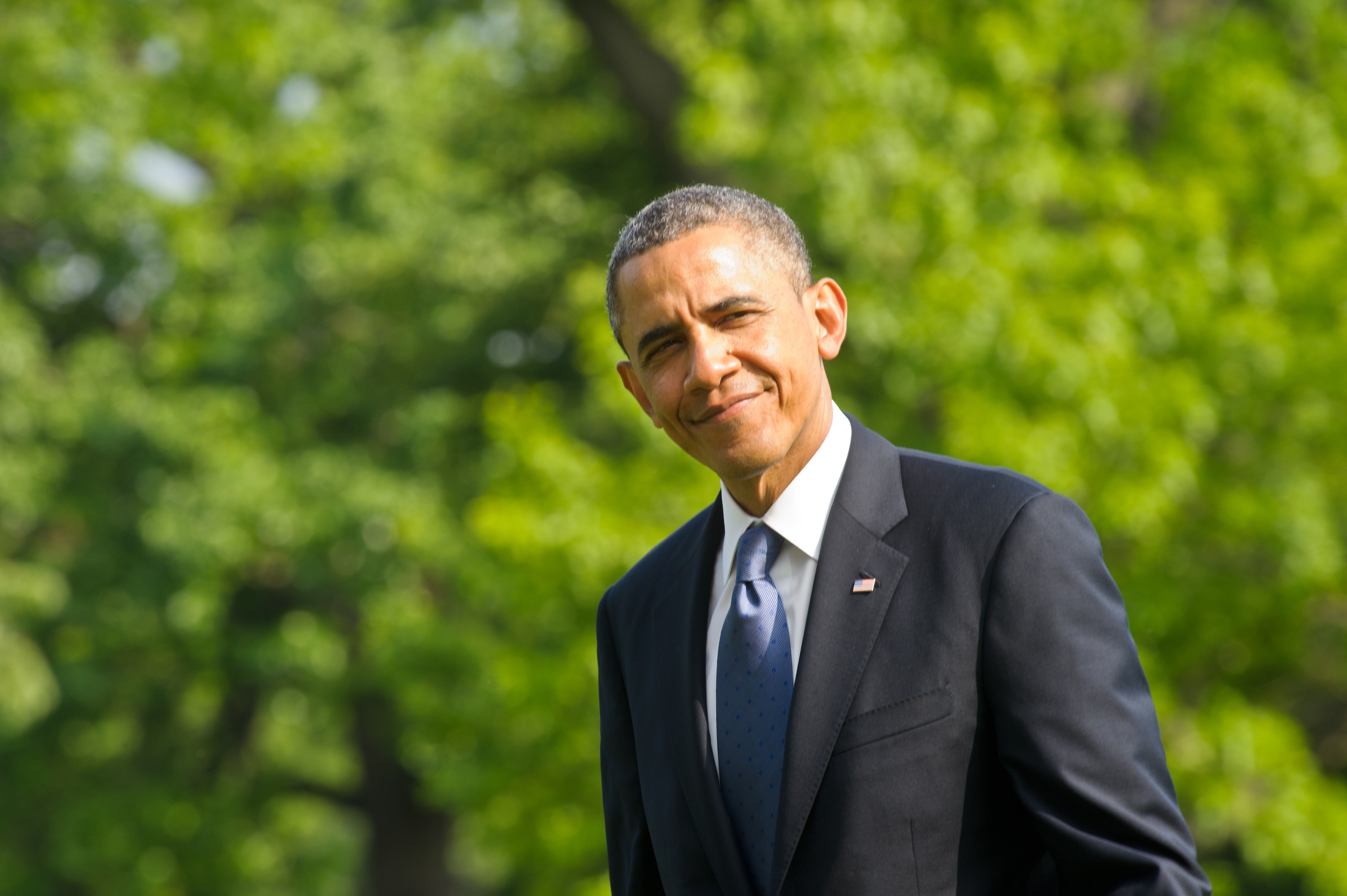
(Photo: US President Barack Obama smiles as he returns to the White House in Washington on May 19, 2013 from Atlanta. By Nicholas Kamm/AFP/Getty Images.)

Noonan Just Loses It, Ctd

Among the many awful things about her latest column was this:

The Journal’s Kim Strassel reported an Idaho businessman named Frank VanderSloot, who’d donated more than a million dollars to groups supporting Mitt Romney. He found himself last June, for the first time in 30 years, the target of I.R.S. auditors. His wife and his business were also soon audited. Hal Scherz, a Georgia physician, also came to the government’s attention. He told ABC News: “It is odd that nothing changed on my tax return and I was never audited until I publicly criticized Obamacare.” Franklin Graham, son of Billy, told Politico he believes his father was targeted. A conservative Catholic academic who has written for these pages faced questions about her meager freelance writing income. Many of these stories will come out, but not as many as there are.

I pointed out this was only random and even anonymous anecdotage. Nate Silver proves it:

The point is that even with no political targeting at all, hundreds of thousands of conservative voters would have been chosen for audits in the I.R.S.’s normal course of business. Among these hundreds of thousands of voters, thousands would undoubtedly have gone beyond merely voting to become political activists.

The fact that Ms. Noonan has identified four conservatives from that group of thousands provides no evidence at all toward her hypothesis. Nor would it tell us very much if dozens or even hundreds of conservative activists disclosed that they had been audited.

For another enjoyable dissection of a Noonan column, showing her fatuous circularity, see Rick Hertzberg on a March 22 doozy here.