Enter The Media Martyr

A reader writes:

With this dramatic reveal of the identity of Greenwald’s source, Edward Snowden, it was also revealed that Snowden has been working with the firm Booz Allen since March. So, this off-hand tweet from Greenwald struck me as particularly odd: “@TheStalwart The reality is that Laura Poitras and I have been working with him since February, long before anyone spoke to Bart Gellman”

If Greenwald has been working with his source since February, a month before Edward Snowden began working for Booz Allen, why is that not included in the Guardian story? That seems like a bit of a sticking point.

Another:

Here are the problems I have with Ed Snowden and his choice to leak NSA information to news organizations.

The DoD and classified programs have a variation of the Ethics Hotlines that most corporations have to support employees who have concerns about bad behavior. Snowden could have worked his concerns with this hotline. Barring that, he could have worked his concerns with the members of Congress briefed on the program. He could have even gone to a member of Congress who wasn’t briefed and gotten him or her involved. There were numerous responsible ways to deal with the conflicts he was wrestling with. Instead, he chose to go to the Guardian and the WaPo and data-dump our capabilities to the world. I heard his interview on television and he seems to be painting himself both as a (quite paranoid) martyr and as a latter-day Assange. For somebody who was entrusted with the nation’s most delicate secrets, such behavior is appalling.

Edward Snowden is not a hero. He was a weak man who took an oath to protect the nation’s secrets, found something he felt was contrary to our ideals, and decided to resolve the issue in an irresponsible manner by making the biggest, loudest bang he could. He failed the country he claims to want to save.

Ask Dan Savage Anything: Worried About TMI?

In our first video with Dan, he discusses the one part of his new book, American Savage: Insights, Slights, and Fights on Faith, Sex, Love, and Politics, that he most hesitated to publish:

My recent conversation with Dan about sex and marriage at the New York Public Library is here. Our full Ask Anything archive is here.

Should We Scrap A Zero-Terrorism Policy?

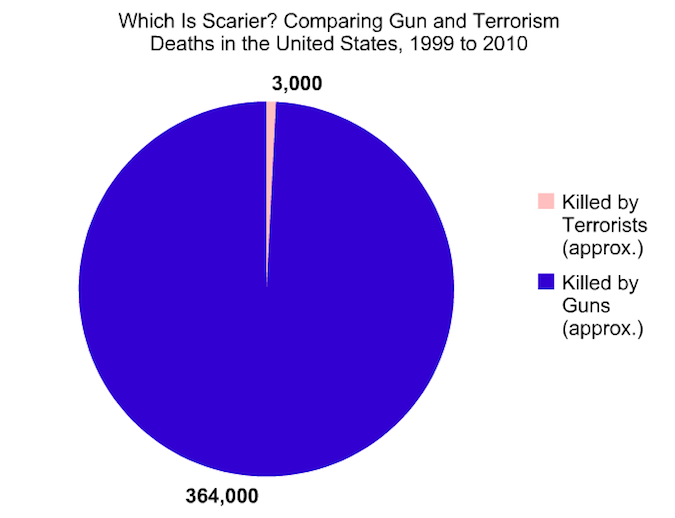
Guns Terrorism Comparison

Conor Friedersdorf posts this chart, and shifts the debate to what seems to me more productive ground. The great opportunity of this moment is to start a debate about how we tackle terrorism as 9/11 gets more distant in the rear-side mirror, as we absorb the fact that the last decade has been far more terror-free than the decade before 9/11, when many of us thought we were living in an elysian fin de siecle. Now may be the moment, in other words, to examine the entire premise of Imaginationland.

Conor argues that “Americans would never welcome a secret surveillance state to reduce diabetes deaths, or gun deaths, or drunk driving deaths by 3,000 per year.” Barro hopes the NSA story will increase pushback against the post-9/11 mindset:

We don’t think about other social ills this way. Nobody says we should have a goal of zero heart disease deaths or zero auto accident deaths, because that would be nuts. We balance the objective of saving lives against other considerations, like cost and individual rights and the fact that bacon is delicious. We should apply this cost-benefit approach to terrorism too. This approach would allow us to say that the phone records dragnet can be a bad idea even if it saves lives. But the big resistance to that analysis doesn’t come from Congress; it comes from the American public.

And the trouble is: you wouldn’t know that from Glenn Greenwald, the Guardian or the NYT editorial board, would you? And yet this is the core issue. Without public support, this war cannot be unwound. Matt Steinglass compares the War on Terror to the Vietnam War:

[C]onventional terrorism poses no major threat to America or to its citizens. But that’s not really what it aims to do. Terrorism is basically a political communications strategy. The chief threat it poses is not to the lives of American citizens but to the direction of American policy and the electoral prospects of American politicians. A major strike in America by a jihadist terrorist group in 2012 would have done little damage to America, but it could have posed a serious problem for Barack Obama’s re-election campaign. For the president the war on terror is what the Vietnam War was to Lyndon Johnson: a vast, tragic distraction in which he must be seen to be winning, lest the domestic agenda he really cares about (health-care, financial reform, climate-change mitigation, immigration reform, gun control, inequality) be derailed. It’s no surprise that he has given the surveillance state whatever it says it needs to prevent a major terrorist attack.

If this contretemps prompts an actual discussion about whether we now need any sort of serious counter-terrorism policy (and anything serious would include searching huge databases for patterns), great. So lets have that debate. Are we now safe enough to end these programs? Are we finally saying we’d be fine with a terror attack that could have been foiled earlier because we prefer that only private businesses collect this kind of Big Data? Are we prepared to back a president who puts liberty before security – especially in the wake of a mass casualty event?

I think Conor has put his finger on the core issue here.

The trouble is that the only way to find out empirically whether the threat is massively over-stated is to reveal intelligence that perforce has to be secret. There is a genuine trap here. But it could be one in which the administration offers some serious answers. Instead of being entirely reactive, the president should make the case for the necessity of this system, and give us the actual trade-offs involved. I’m for transparency in most things; but I’m not so utopian as to believe that our society can function without some government – and personal and corporate – secrecy.

So instead of polarizing on this, lets debate it. Is Jihadist terrorism an overblown threat? If it is, unwind the apparatus slowly. If it isn’t, is this program better or worse than the practical alternatives? If we are not to occupy foreign countries (dumb) or torture prisoners (dumb and evil) or take out Jihadists by drones (increasingly counter-productive), isn’t mass data gathering about as anodyne a remedy for this ill as you can find?

“This Is Bullshit”

Straw bales, Cotswolds, Oxfordshire, UK

If you read one commentary on the meta-data gathering by the US government, do yourself a favor and read David Simon’s. The creator of “The Wire,” he is not exactly unversed in the intricacies of government power, police work and, er, surveillance. And he, even more than I, is baffled by the tsunami of self-righteous indignation:

Frankly, I’m a bit amazed that the NSA and FBI have their shit together enough to be consistently doing what they should be doing with the vast big-data stream of electronic communication. For us, now — years into this war-footing and this legal dynamic — to loudly proclaim our indignation at the maintenance of an essential and comprehensive investigative database while at the same time insisting on a proactive response to the inevitable attempts at terrorism is as childish as it is obtuse. We want cake, we want to eat it, and we want to stay skinny and never puke up a thing. Of course we do.

I, like Simon, am actually impressed by the government’s efficacy in exploring these electronic trails and patterns. I thought that was largely being done by Facebook, Google or the Obama campaign. I never thought the feds would be that competent.

And when we stumble onto a government program that is clearly legal under the Patriot Act, when not a single case of abuse can be specifically found, when it only looks for patterns and algorithms, and would have to go to a court to do any more, are you not more relieved than creeped out? Wouldn’t you prefer that this stuff be found and isolated from two steps removed? Doesn’t this new Big Data actually increase privacy compared with the pre-FISA era wire-tapping? Not for the first time, Daniel Ellsberg is wrong. It’s not that Obama is not Nixon; it is that the new program is inherently different from previous ones, because of the new nature of the technology. And its sheer scope may actually be a refuge in some ways:

When the government grabs the raw data from hundreds or thousands of phone calls, they’re probably going to examine those calls. They’re going to look to establish a pattern of behavior to justify more investigation and ultimately, if they can, elevate their surveillance to actual monitoring of conversations. Sure enough.

When the government grabs every single fucking telephone call made from the United States over a period of months and years, it is not a prelude to monitoring anything in particular. Why not? Because that is tens of billions of phone calls and for the love of god, how many agents do you think the FBI has? How many computer-runs do you think the NSA can do? When the government asks for something, it is notable to wonder what they are seeking and for what purpose. When they ask for everything, it is not for specific snooping or violations of civil rights, but rather a data base that is being maintained as an investigative tool.

Exactly. And then this point, which seems to elude Snowden and Greenwald:

There is a lot of authoritarian overreach in American society, both from the drug war and the war on terror.

But those planes really did hit those buildings. And that bomb did indeed blow up at the finish line of the Boston marathon. And we really are in a continuing, low-intensity, high-risk conflict with a diffuse, committed and ideologically-motivated enemy. And for a moment, just imagine how much bloviating would be wafting across our political spectrum if, in the wake of an incident of domestic terrorism, an American president and his administration had failed to take full advantage of the existing telephonic data to do what is possible to find those needles in the haystacks.

Just for a moment. Imagine. Now listen to Snowden.

(Photo: haystacks in Oxfordshire, England. By Tim Graham/Getty.)

Dumb Dumb Dumb Dumb Dumb

Fallows isn’t the only one to wonder why Snowden sought refuge in Hong Kong (the young contractor explains his choice above):

Hong Kong is not a sovereign country. It is part of China — a country that by the libertarian standards Edward Snowden says he cares about is worse, not better, than the United States. China has even more surveillance of its citizens (it has gone very far toward ensuring that it knows the real identity of everyone using the internet); its press is thoroughly government-controlled; it has no legal theory of protection for free speech; and it doesn’t even have national elections. Hong Kong lives a time-limited separate existence, under the “one country, two systems” principle, but in a pinch, it is part of China.

I don’t know all the choices Snowden had about his place of refuge. Maybe he thought this was his only real option. But if Snowden thinks, as some of his comments seem to suggest, that he has found a bastion of freer speech, then he is ill-informed; and if he knowingly chose to make his case from China he is playing a more complicated game.

I have to say that Snowden’s apparent dumbness in picking Hong Kong surprised me. Does he not have access to the web? Did he really believe he’d be safe there? Alex Seitz-Wald studies Snowden’s present options:

There are plenty of other countries that have arguably better records on freedom of speech than Hong Kong, and some that might resist extradition. Iceland, which has been favorable to Wikileaks, comes to mind and, indeed, a member of country’s parliament who worked closely with Jullian Assange has already offered assistance to Snowden. But the country’s ambassador in Bejing told the South China Morning Post that under law, a person has to be in Iceland to apply for asylum.

Snowden told The Guardian’s Glenn Greenwald that he does not plan to defect to mainlind China, but that would be an obvious option. The PRC has no extradition treaty with the U.S. and his cryptographic and intelligence knowledge could be hugely valuable to Beijing in its ongoing cyberwar with the U.S. Hong Kong is just a short ferry ride from the mainland and it would probably be easier for Snowden to slip out via boat than through the international airport.

Osnos doubts the Chinese authorities will leave him alone:

It is doubtful that Beijing sees a net advantage in holding on to Snowden as a bargaining chip. Neither side likes exogenous ingredients in complex diplomacy. When the persecuted blind laywer Chen Guangcheng sought refuge at the U.S. Embassy in Beijing, in 2012, it caused nearly as much agitation among American officials as did it among their Chinese counterparts. Xi Jinping has just returned to Beijing from a summit with President Obama, in which both sides sought to downplay differences and emphasize an attempt to accommodate each other’s interests, up to a point. Beijing spends much of its time trying to persuade other governments to send back former or current government officials who have fled abroad.

Without my making any judgment on the virtues of Snowden’s actions, the U.S. government perceives him in much the same light that the Chinese government perceives its cadres who flee abroad in order to publicize wrongdoing or to escape debts or prosecution for corruption. The Chinese state media frequently describes diplomatic efforts to “pave the way for the return of hundreds of government officials wanted for graft” and it has crowed about gaining greater coöperation from the United States.

Josh Marshall spotlights a TPM reader based in Hong Kong who agrees:

There is no political upside for Beijing in allowing Snowden to stay here. They would see him as an incitement to human rights defenders and whistleblowers, a foreign troublemaker who would prompt awkward questions from Chinese citizens about their own heavy domestic surveillance. Barring a scenario in which Snowden escapes Hong Kong and somehow makes his way to, say, Ecuador, I expect the Communist Party will allow the extradition court case to run its course through the Hong Kong legal system and declare that it demonstrated once more the matchlessly smooth workings of ‘one country-two systems’. Diplomatically it can win some brownie points with the Americans.

Why Was The NSA’s Snooping Secret?

Fallows is puzzled:

President Obama says that he is “happy to debate” the tradeoff between security and privacy. The truth is that we probably wouldn’t be having any such debate, and we certainly couldn’t have a fully informed debate, if this program (and others) remained classified. The greatest harm done by the 9/11 attacks was setting the US on a ratchet-track toward “preventive” wars overseas and security-state distortions at home. In withdrawing from Afghanistan and Iraq, Obama has partially redressed the overseas aspect of that equation. (On the other hand: drones.) These leaks, which he denounces, may constitute our hope for redressing the domestic part.

And on the minus side, what about the harm of the PRISM revelations? Again at face value, it seems minimal. American citizens have learned that all their communications may have been intercepted. Any consequential terrorist or criminal group worth worrying about must have assumed this all along.

Eric Posner sees the issue differently:

I am sympathetic to those who believe that the general existence of a program of analyzing global metadata should have been made public. But I doubt meaningful democratic debate about the program would have been possible unless details were given, so that people actually understood what they were debating about. Details like who is targeted, and why, and on the basis of what evidence; details like what abuses might take place, and how they are corrected. Details about the involvement of private sector companies. Retrospective assessments of whether particular acts of surveillance were justified. But once the N.S.A. reveals the details of the policy, its effectiveness diminishes as targets learn how to evade it. I wish there were a solution to this problem but I don’t see it.

Yglesias chips in his two cents on the question.

Kids And Schadenfreude

Research suggests that the feeling of taking joy in someone else’s misfortune appears in children as young as four:

[Researcher] Katrin Schulz and her colleagues presented simple picture stories to 100 children aged four to eight years (52 girls). The stories involved a child dish_mrschadenfreudeperforming a good or bad deed – such as a girl climbing a tree to collect plums for her little brother, or climbing the tree so as to throw plums at her little brother – and then experiencing a misfortune, in this case falling from the tree and hurting herself.

The kids of all ages showed evidence of schadenfreude, suggesting their emotional response to another person’s distress was influenced by their moral judgements about that person. That is, they were more likely to say they were pleased and that it was funny if the story character experienced a misfortune while engaging in a bad deed. They were also less likely to say they’d help a bad character. These effects were strongest for the children aged over 7. And it was only for this age group that intensity of schadenfreude mediated the link between a character’s good or bad moral behaviour and the participants’ willingness to help.

Rose Eveleth adds:

If you prefer your children sweet and kind, you can take solace in the fact that while they did find schadenfreude in these kids, the levels were far lower than you might see in adults.

Update from a reader with a great little story:

When my twin sons were eight months old, one could crawl and the other could not. Both were on the floor with a number of toys surrounding them. My crawler (Milo) was playing with a rattle; his brother (John) watched him closely.

Milo dropped the rattle within reaching distance of John and scooted to a corner of the room to get a new toy. John picked up the rattle, examined it, and then began shaking it. Upon hearing the sound, Milo whipped his head around, then turned his whole body, raced over to John, and ripped the rattle out of his hand.

As John looked on both helplessly and indignantly (but, interestingly, he did not cry), Milo began shaking the rattle vigorously. Milo shook it so hard that almost immediately he whacked himself in the head and burst into tears, dropping the rattle. To John, it was as if the skies had opened up and a choir of angels had begun to sing. I have never seen a look of joy as ultimately pure as the look on John’s face as his brother cried. He didn’t even remember the rattle was there. It was in easy reaching distance. He just grinned a giant grin as he enjoyed the show of his brother wailing.

So I believe I can categorically state, at least for some children, they feel schadenfreude as young as 8 months. Do they know what it is? Probably not. (Then again, they don’t understand that you shouldn’t eat your own poop.) However, I think it’s a safe bet that it is ingrained in us from a very early age.

(Photo: Flickr user dullhunk)

The Origin Of @

dish_@

John Brownlee traces the ubiquitous @ symbol from its obscure beginnings:

Ever since the 1500s, and for hundreds of years after, the only people who used @ were bookkeepers, who used it as a shorthand to show how much they were selling or buying goods for: for example, “3 bottles of wine @ $10 each.”

Since these bookkeepers used @ to deal with money, a certain degree of whimsical fondness for the character developed over time.

In Danish, the symbol is known as an “elephant’s trunk a”; the French call it an escargot. It’s a streudel in German, a monkey’s tail in Dutch, and a rose in Istanbul. In Italian, it’s named after a huge amphora of wine, a liquid some Italian bookkeepers have been known to show a fondness for.

Even with such cute names to recommend it, though, @ languished in obscurity for three and a half centuries, only ending up on a new invention called the typewriter when salesmen realized that accountants and bookkeepers were buying them in droves. In 1971, however, a keyboard with a vestigial @ symbol inherited from its typewriter ancestors found itself hooked up to an ARPANET terminal manned by Ray Tomlinson, who was working on a little program he’d come up with in his goofing-off time to send messages from computer to computer. Tomlinson ended up using the @ symbol as the fulcrum of the lever that ultimately ended up lifting the world into the digital age: email.

Previous Dish on the origins of Internet symbols here.

(Image: Evidence of the usage of @ to signify French “à” (meaning “at”) from a 1674 protocol from a Swedish lower court and magistrate, via Wikimedia Commons)

Cool Ad Watch

enhanced-buzz-wide-32412-1370624634-9

Copyranter explains:

Prostitution is legal in Argentina. But it is basically unregulated and unprotected. So recently, a national sex workers union launched a sly street art campaign in Buenos Aires. Around the corner from the sexy fantasy image was the reality, and a startling statistic. Copy translation: “86% of sex workers are mothers. We need a law to regulate our work.”