A critique of one of the Dish’s most popular recent posts.
Month: June 2013
Dissents Of The Day
A reader quotes me:
But like Ambers, I’m neither shocked nor that outraged. Meta-data is not the content of our phone records.
You’re grossly underestimating the contents and richness of modern metadata. The line between
“contents” and “metadata” has blurred in the age of mobile, and the government is taking advantage of that. In 1970s and 1980s, when we passed most of our current government privacy laws, phones were dumb, stationary, shared devices that we used several times a day and otherwise left alone. Today’s phones are “smart” personal devices that are turned on and on us all day. They generate a record of a specific individual’s calls. They also create a constant, moment-by-moment record of our movements. And once I have that, I know where you work, I know where you sleep, I know the church you attend and the doctors you visit. I can also make a pretty good guess of whether you’re gay or straight (are you always at 17th and Q on weekends?). As a few of the articles point out, it appears highly possible that the data authorized by the 215 order includes this kind of location data.

I guess I assumed that was already taking place, and don’t have the visceral reaction many have. I understand the gravity of the worry – and think this should have been an open, discussable program, rather than a super-secret one. With any luck, this new leak – how’s that aggressive plugging of holes going, Mr Holder? – will prompt a review and an update to guard against easy oversight of new modes of communication.
But, sorry, I don’t find such data-mining for national security purposes to be that horrifying. If that’s the price we have to pay for deterring Jihadist attacks, then we should recognize there’s a trade-off. The problem is that we, the public, cannot judge the gravity of those threats and so cannot even weigh the necessity of giving up our privacy. The threat may be far less than we fear. Another reader pushes back even harder:
Metadata is important.
Your phone metadata tells the NSA who your friends are,and which political groups you associate with. It tells them where you are, within a quarter of a mile, nearly every minute of the day, as it it no doubt includes every time your phone switches from connecting to one cell tower to another, whether or not you make a call. It tells them who you bank with, and probably where and when you travel. It tells them where you shop. And they never delete it.
BTW, you have no real evidence that it doesn’t tell them the contents of your texts or email. The disclosed document talks about voice calls, but it is likely there are comparable orders in place for text, email and for other carriers, probably including landline providers. And the “business records” section of the Patriot Act makes no distinction between the contents of communication and the associated meta data.
It sounds to me like the NSA’s request was simply trying to be pragmatic and limit the information vacuumed up to information that could be stored and forwarded easily by the phone company. The contents of voice communication is probably a bit too large there; even a one minute call at 64Kbits/sec is 480,000 bytes. But texts are tiny; 140 bytes for a long one. Pragmatically, they could easily be stored and sent to the NSA.
We could ask Verizon if they send the contents of texts to the NSA. If they don’t/can’t answer, there’s your answer; the law doesn’t seem to require that they lie, simply that they not answer at all if asked.
Another:
I’m pretty shocked by your blasé attitude about the revelation that the government in all likelihood maintains a database of when (and in many cases where) every single US phone call in the last seven years was made, and all the phone numbers involved.
It’s possible that there’s a good case to be made for all of this – but shouldn’t that case have been made first? I’m all for secrecy when it’s necessary for an investigation. But in this case, what could possibly be gained, operationally, from keeping this program a secret? If the case for wholesale surveillance is so strong as everyone is now belatedly claiming, why were they so afraid to make the case publicly?
I think the answer is fairly obvious: Americans would never stand for it. And that’s a fundamentally illegitimate reason to keep something classified.
If you were wondering where the true scandal of the Obama administration is – the one that really belongs at the president’s feet and nowhere else – it’s here. Even if no laws were broken, and even if this is truly an “indispensable” tool in the fight against terrorism, hiding the existence of something like this for no reason other than to avoid public outrage has no place in a democracy.
On that last point I agree. The only justification for it is the prevention of Jihadist terrorism. Personally, I’m not that troubled by this kind of oversight. But why not debate it openly? It might even gain some support.
On Being “Conservative”

Barro, despite my arguing otherwise, insists that he isn’t a conservative:
I’ve never quite understood Sullivan’s attachment to the term “conservative.” It seems to me that conservatism is whatever ideology is shared by most of the people who call themselves conservatives — roughly, that taxes should be low and non-progressive; that the safety net should be strictly limited and particularly should not include a universal health care guarantee; that more financial risk should be shifted away from the government and toward individuals; that the government should promote some concept of “traditional morality.”
I don’t believe those things and neither does Sullivan, so I’m not a conservative and neither is he. What members of the Whig party favored in England in the 1700s doesn’t enter into the question. I’ve had a lot of similar conversations over the years with libertarians who are upset that the left somehow got control of the term “liberal.” They need to let it go, too.
Here’s why I cling to that word as still meaningful:
I’m a utilitarian, so my first principle is “make people better off.” You could have some alternative set of first principles, perhaps based around protecting a concept of natural rights or a set of religious beliefs. But the justifications we most often hear for conservative economic policies are utilitarian ones — that they foster economic growth, create jobs, and make people wealthier.
Those are empirical claims, and Republicans ought to change their policy prescriptions if they turn out to be false. And my finding is that they have.
But I’m not a neo-liberal utilitarian like Josh (and I use ‘liberal’ there in the classical sense). I totally take his point about the quixotic nature of using that word in America today for anything other than what conservatives call themselves – and his matter-of-factness about that is refreshing. But the tradition I have long studied and thought about is not a conservatism finding solutions to problems. It is about finding solutions to problems you suspect may not be solutions at all, and may be moot once you’ve done your best; it’s about the elusive nature of prudential judgment; the creation of character through culture; the love of what is and what is one’s own; and a non-rational grasp of the times any statesman lives through. It is about a view of the whole that keeps politics in its place. It is, in the end, a way of being contingently in the world.
I could go on – or you can read my best attempt at explaining; (the longer, original version is here). Or you can try this classic [PDF] from the master.
(Photo: A fisherman practices fly fishing in the river Loue near Chenecey-Buillon, eastern France on July 16, 2012. By Sebastien Bozon/AFP/Getty Images.)
Jobs Report Reax: Treading Water
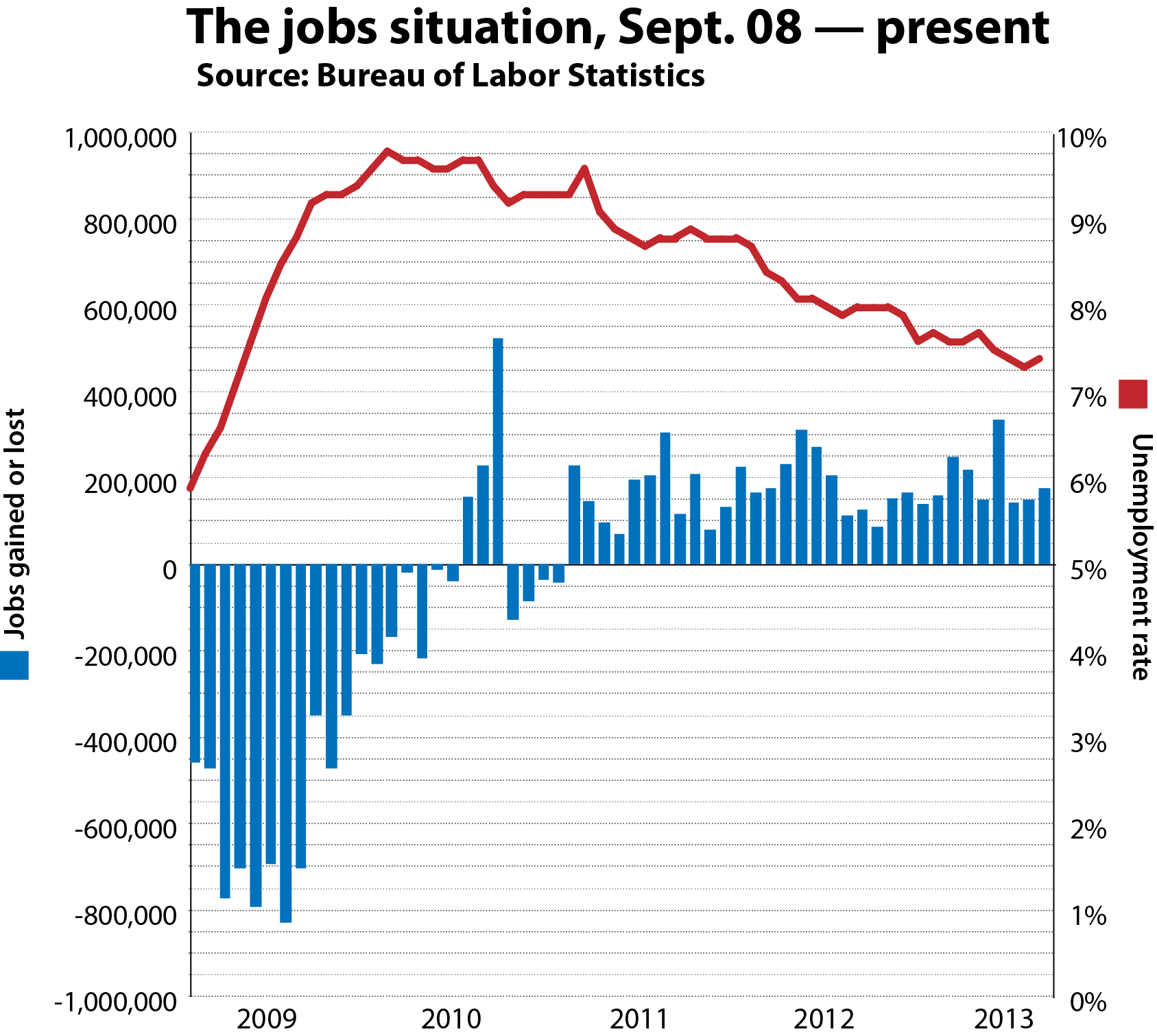
Dylan Matthews provides the above chart and a quick summary:
The May jobs report wasn’t spectacular, and it wasn’t disastrous. Unemployment ticked up to 7.6 percent, largely due to a slight increase in labor force participation. The nation gained 175,000 jobs, which is heartening, but the pace is not nearly fast enough to close the jobs gap anytime soon. In fact, according to the Hamilton Project’s calculator, it will take 9 years and 5 months to get back to pre-recession employment levels at this rate.
Ed Morrissey has a similar take:
This still isn’t a great jobs report. It’s just better than expected. The US economy needs ~150K new jobs each month to keep up with population growth, so this is just a little better than a maintenance level for job creation. … Basically, we treaded water, which is always better than sinking, but it really doesn’t get you anywhere.
Ryan Avent looks at the recovery as a whole:
Despite all the fretting over the slow pace of job creation in the recovery, and despite major shifts in the stance of economic policy, employment has risen at an extraordinarily stable pace.
That stability is a bit illusory. There are wiggles. In February private employers added 319,000 jobs, one of the best performances of the recovery. Last June the gain was only 78,000—the worst since payrolls began growing again. The composition of the employment recovery has also changed. Early on manufacturing helped lead the way forward. Now construction is pulling more weight (though less than many had hoped, and less than professional services and retail). At the first, federal government jobs were flat while state and local government employment tumbled. Now the latter is recovering while federal payrolls are shrinking rapidly. Over the whole of the employment recovery, of course, governments have been a major drag, slimming down by 622,000 workers since February of 2010. Strikingly, work in health care—long the stable core at the heart of the employment recovery—slowed noticeably in May.
Mark Perry puts a positive spin on the sector-specific numbers:
Although overall US job growth continues to be weak, we are seeing strong job growth in some sectors of the economy – temporary help services, construction, architectural and engineering services, motor vehicles, and oil and gas extraction. Together, those five sectors added 40,600 jobs in May, which represents more than 23% of the overall increase in US payrolls last month of 175,000. Looking forward, we can expect increased hiring in those sectors, as America’s energy revolution continues, the housing recovery gains momentum, and auto production and sales continue on an upward trajectory.
Dean Baker reads the sector breakdowns differently:
Job growth was again narrowly concentrated, with the restaurant sector (38,100 jobs), retail trade (27,700) and temporary employment (25,600) accounting for more than half of the job growth in May. These are all low-paying sectors. It is worth noting that the job growth reported in these sectors is more an indication of the weakness of the labor market than the type of jobs being generated by the economy. The economy always creates bad jobs, but in a strong labor market workers don’t take them.
Neil Irwin finds some positive news buried in the unemployment stats:
While the headline unemployment rate ticked up one-tenth of a percent in May, a broader measure of joblessness actually showed slight improvement. U-6, a measure of unemployment that includes people who have a part-time job but want full-time work and people who want a job but have given up looking out of frustration, fell to 13.8 percent in May, from 13.9 percent in April. That measure has come down tremendously in the last year, from 14.8 percent in May 2012.
Drum searches the effects of sequestration:
Once again, the fiscal cliff deal and the sequester don’t seem to be showing up in the job numbers yet—though public sector employment was flat and federal employment was down, which might be partly due to cutbacks. In any case, the changes aren’t huge. So far, it looks like we’re continuing to tread water.
Annie Lowrey, on the other hand, thinks sequestration is beginning to show up in the numbers:
The monthly jobs report is starting to show the effects of the $85 billion in across-the-board budget cuts that the government needs to carry out before the end of the fiscal year in September. That’s not much in a $16 trillion economy, of course. But economists still expect it to slow growth and reduce employment in the coming months and years. And it is. Federal employment had been on a downward trend since the start of 2011, with the government shedding about 3,000 or 4,000 positions a month through February. Then sequestration hit on March 1. And in the last three months, the federal work force has shrunk by about 45,000 positions, including 14,000 in May alone. …
Sequestration is having an impact on private businesses as well, even if it is harder to see given the way the recovery continues to chug along. Millions of their customers have less money to spend. The government is trimming back on contracts awarded to private firms. But just because sequestration’s impact is diffuse and cumulative over time does not mean it is not there.
Catherine Rampell focuses on the sequester’s impact on the 7.6% still unemployed:
Almost every state has cut its unemployment insurance benefits as a result of the sequester, according to the National Employment Law Project, a labor-oriented research and advocacy organization. Some states, like Florida and Maine, are cutting the weeks for which jobless workers will continue receiving benefits, and others, like Illinois, are reducing the size of the weekly benefit checks (in Illinois, the cut was 16.8 percent). Some states, like Washington and Idaho, are also laying off employees who work in the labor agencies that help workers apply for benefits and find jobs. North Carolina is ending its federally funded extended unemployment benefits on July 1 because reductions in its state benefits left it ineligible for the federal money.
Jared Bernstein withholds judgment on the unemployment statistics:
What we have here is a high stakes game of musical chairs, as payrolls grow at a steady, if not-that-impressive, clip, essentially adding chairs to the game. Meanwhile, more players are coming off the sidelines looking for places to sit. Last month, there were more new players than seats. In future months, we’ll keep a close eye on how that balances out.
A Transgender Breakthrough

Anderson gets an exclusive interview with Kristin Beck, who used to be Navy Seal Chris Beck (with a big gnarly beard). Money quote:
Though her identity was hidden, the rest of what Beck offered was true. “I gave true brotherhood. I did my best, 150% all the time, and I gave strength and honor and my full brotherhood to every military person I ever worked with.”
Never under-estimate the power of the US military to foment social change. They shifted American culture when they integrated in 1948; they have done more to debunk the notion of female weakness or subjugation than any other comparable institution; they proved that gay people are and always have been among this country’s patriots and war heroes; now we learn that a member of the Navy Seals has become truly herself.
More to the point, she’s engaged with fellow veterans in the staggeringly tough job of living in America after living and dying in Iraq. Here’s her webpage, called Healing Grounds. Money quote:
The purpose of the “Healing Grounds” is to have a specialized “community service” focused nursery and gardens for returning Iraq and Afghanistan Veterans. This will be a place to receive landscaping information and training as well as plants, trees and simple kits to start a garden or fishpond in the veterans’ own backyard. We will also offer to ship items and install as necessary in their houses. Depending on need and funding available there will be many free installations for the veteran who qualifies. Too many of my comrades are returning from the battle grounds of Iraq and Afghanistan and do not find peace and worse are committing suicide.
See the zen garden above. Once a service-member, always a service-member. Many just don’t know anything else but serving and saving their comrades.
We have yet to grapple culturally with transgender equality in any sufficient way. But here we have a genuine war hero who needed to become a physical woman to match who she felt she was inside. That matters, even as I mourn the beard. From the Special Forces blog – which uses a priceless illustration:
This just in, and yes it’s true. I first met Chris when she was at SEAL Team One. While Chris was always a little different I had no idea what was lying under the surface, as I’m sure a lot of people will have the same experience. I do know that Chris went on to serve out a full retirement, and finished his twenty years of service as an E-8 at US SOCOM, and a tour of the recently scandal-clad ST-6.
At its core, the gay rights movement is not about enabling people to be gay; it’s about helping more people to be themselves, without persecution or ostracism. And that’s why transgender issues also are at the heart of this movement – and of broader civil rights. What we need is more familiarity, more courage, more discussion. Thanks, Kristin, for advancing that by putting yourself out there. It isn’t easy. But it’s the only way we will shift the world.
The FBI May Have Your Phone Records, Ctd
Stephen Walt responds to my initial post on the NSA-Verizon story:
The United States is still going to be a major world power long after the contemporary jihadi movement is a discredited episode in modern history, even if the country repealed the Patriot Act and stopped all this secret domestic surveillance tomorrow. Second, after acknowledging the potential for abuse in this government surveillance program, Sullivan warns that the “consequences of its absence” could be “terrible.” This claim depends on the belief that jihadism really does pose some sort of horrific threat to American society. This belief is unwarranted, however, provided that dedicated and suicidal jihadists never gain access to nuclear weapons. Conventional terrorism — even of the sort suffered on 9/11 — is not a serious threat to the U.S. economy, the American way of life, or even the personal security of the overwhelming majority of Americans, because al Qaeda and its cousins are neither powerful nor skillful enough to do as much damage as they might like. And this would be the case even if the NSA weren’t secretly collecting a lot of data about domestic phone traffic.
Indeed, as political scientist John Mueller and civil engineer Mark Stewart have shown, post-9/11 terrorist plots have been mostly lame and inept, and Americans are at far greater risk from car accidents, bathtub mishaps, and a host of other undramatic dangers than they are from “jihadi terrorism.”
Meanwhile, Benjamin Wittes zeroes in on the key phrase justifying the court order that granted the NSA access to all Verizon’s domestic phone records:
To acquire such an order, the government does not have to do much—just as it doesn’t have to do much in a criminal investigation: It merely has to offer, in pertinent part, “a statement of facts showing that there are reasonable grounds to believe that the tangible things sought are relevant to an authorized investigation . . . to obtain foreign intelligence information not concerning a United States person or to protect against international terrorism or clandestine intelligence activities.”
I’m trying to imagine what conceivable of facts would render all telephony metadata generated in the United States “relevant” to an investigation, presumably of the bombing. This would include, of course, all telephony metadata that, as matters turned out, postdates the killing of one bomber and the capture of the other—though there’s no way the government could have known that when the application was submitted. And it would also include all telephony metadata that postdates the government’s conclusion that the Tsarnaev brothers were apparently not agents of any foreign terrorist group. But even if this were not the case, how is it possible that all calls to, say, Dominos Pizza in Peoria, Illinois or all calls over a three month period between two small businesses in Juno, Alaska would be “relevant” to an investigation of events in Boston—even if we assume that the FBI did not know whom it was investigating in the Boston area and did not know whom that unknown person was communicating with?
Orin Kerr’s answer:
If the [court] order is what it appears to be, then the order points to a problem in [the US legal code] Section 1861 that has not been appreciated. Section 1861 says that the “things” that are collected must be relevant to a national security investigation or threat assessment, but it says nothing about the scope of the things obtained. When dealing with a physical object, we naturally treat relevance on an object-by-object basis. Sets of records are different. If Verizon has a database containing records of billions of phone calls made by millions of customers, is that database a single thing, millions of things, or billions of things? Is relevance measured by each record, each customer, or the relevance of the entire database as a whole? If the entire massive database has a single record that is relevant, does that make the entire database relevant, too? The statute doesn’t directly answer that, it seems to me. But certainly it’s surprising — and troubling — if the Section 1861 relevance standard is being interpreted at the database-by-database level.
Cool Ad Watch
Copyranter chokes up a little:
The goddamn Brits know how to use emotion to sell products, don’t they? Remember this amazingly moving commercial for Robinsons fruit drinks from last month? This time, we visit some wonderful European town, a town infinitely more wonderful than where you or I live. In this town lives a wonderful elderly gentleman and his wonderfully cute, obedient doggie. They are soulmates on a daily mission.
With these mini-story types of commercials, the introduction of the product often ruins the vibe. Not so with these two spots which are executed exquisitely. Almost makes me want to get back into advertising.
Why would you when you can get into the fantastic new kickass world of fucking awesome sponsored content.
Dissing Glenn?
I don’t begrudge a reporter truncating quotes on deadline, but if you were to read the NYT’s profile of Glenn Greenwald today, you might think I’m a bit of a douchey critic. So just because I can, here’s the actual full email quote I gave to the NYT and forwarded on to Glenn just now:
I count Glenn as an honest blogger whose passions in real time can sometimes lead to misreadings of others. But we’re all vulnerable to that in the blogosphere, and in our various spats, I’ve always enjoyed the give-and-take, rather than resenting some of the occasionally unfair barbs. They come with the territory. But once you get into a debate with him, it can be hard to get the last word. A friend described debating him as like engaging with a rhetorical trampoline. But I actually enjoy rhetorical trampolining, as long as no one gets hurt too much. I do not take anything he writes about my work personally.
His passion is a great antidote to the insidery access-driven village of Washington journalism, but at times, I think he has little grip on what it actually means to govern a country or run a war. He’s a purist in a way that, in my view, constrains the sophistication of his work.
Yes, we’re friends. We’ve hung out a bit, and are bonded by a couple of things. He relies on readers for much of his income (and I rely on readers for all of mine) – and has made online debate much sharper in many ways. I’ve benefited from his criticism, even as I remain to his “right.” And he is forced to live abroad with his partner David because the US refuses to acknowledge the validity and dignity of bi-national gay couples. I was in that exact position for a long time with my American husband – and our shared experience matters a lot to me. Our husbands have also bonded over the same issue.
And I genuinely like him as a human being.
you can use any all or none of that
Ask Fareed Zakaria Anything: Stay Out Of Syria
Earlier this week, Fareed weighed in on the ongoing unrest in Turkey. In today’s video, he offers an unequivocal warning about getting more involved in Syria:
Fareed Zakaria GPS airs Sundays on CNN, as well as via podcast. Zakaria is also an Editor-at-Large of TIME Magazine, a Washington Post columnist, and the author of The Post-American World, The Future of Freedom, and From Wealth to Power: The Unusual Origins of America’s World Role. Our Ask Anything archive is here.
What Does PRISM Mean For You?
The president is responding to your questions:
1. Will I be charged extra for this service?
I’m happy to say that the answer is no. While the harvesting and surveillance of your domestic phone calls were not a part of your original Verizon service contract, the National Security Agency is providing this service entirely free of charge.
 The Dish