A new PEW survey indicates that a vast majority of parents believe that reading printed books is “very important” (81%) or “somewhat important” (13%) for their children:
In our focus groups, one father said he valued reading print books because they helped model reading habits for his children:
“I’m reading like a book [on a tablet] and my children don’t know if I’m reading a book or if I’m playing on Twitter, so I think it’s important to have the book so that they go, ‘Oh Dad’s reading’ . . . not just, ‘Oh he’s updating his Facebook page.’ I think there is like a difference in that.”
Other focus group members voiced similar sentiments, saying they valued the physicality and the relative permanence of printed books because they can be passed down “from generation to generation.” One participant said while e-books have some advantages — for instance, they are more convenient to carry when traveling — “I like those books in my hands sometimes.”
The survey provides an interesting contrast to a recent study by the UK Literacy Trust, which found that only 32% of nearly 35,000 British children surveyed prefer the printed word to screens. Other findings:
[Research] found those who read daily only on-screen are nearly twice less likely to be above average readers than those who read daily in print or in print and on-screen (15.5% vs 26%). Those who read only on-screen are also three times less likely to enjoy reading very much (12% vs 51%) and a third less likely to have a favourite book (59% vs 77%).
Manjoo touts Karma, a mobile hotspot device. Its main advantage:
Karma charges $14 for 1GB of broadband, which is enough for a few days of heavy Web surfing (or several hours if you’re watching videos or streaming music). Karma’s plan has two major advantages over pay-as-you-go data services offered by large carriers.
First, Karma’s coverage doesn’t expire every month. For instance, my Verizon iPad’s 1GB plan resets every month—if I only use half of my gig, I lose the rest on the first of the month. Karma’s plan never resets. You can pay $14 and use your gigabyte over as long a time as you like—you can use 500 MB in June, nothing in July and August, and then 500 MB in September, and you’ll still have spent only $14 for access.
The second selling point:
Every Karma hotspot is “open”—that is, if you turn it on in an airport or coffee shop, other people can connect to it and begin surfing the Web. But get this: When they connect, they don’t use “your” data. Instead, when a new Karma user joins your hotspot for the first time, you and that user each get 100MB of free data access. The more people that you bring to Karma, the more free data you get.
Ben Yagoda surveys the etymology of “smart” and concludes with a word of warning:
I would advise caution before completely casting our lot with very smart people. After all, the jokers behind Enron were fond of calling themselves “the smartest guys in the room.” That phrase—TSGITR—was the title of a book, then movie, about the scandal, but predates it by a good bit (it first shows up in the Lexis-Nexis database in 1985) and suggests some of the smug hubris that can come with this particular kind of intelligence. Richard Ben Cramer wrote in his 1992 book What It Takes, “Dukakis does not like to be the dumbest guy in the room. Michael is always the smartest guy in the room.” In 1995, an anonymous Democratic activist disparaged Mario Cuomo as “someone who always has to be the smartest guy in the room.” The following year, William Safire imagined Bill Clinton (himself known as a proud SGITR) reflecting about a potential Secretary of Defense, “the trouble with John [Deutch] is that he’s the smartest guy in the room and is driven to make sure everybody knows it.”
In some circles, Newt Gingrich is known for being smart. But as former congressman, current TV host Joe Scarborough once remarked, “Let me just say, if Newt Gingrich is the smartest guy in the room, leave that room.”
In the last half-century, baby-naming has become more susceptible to trendiness:
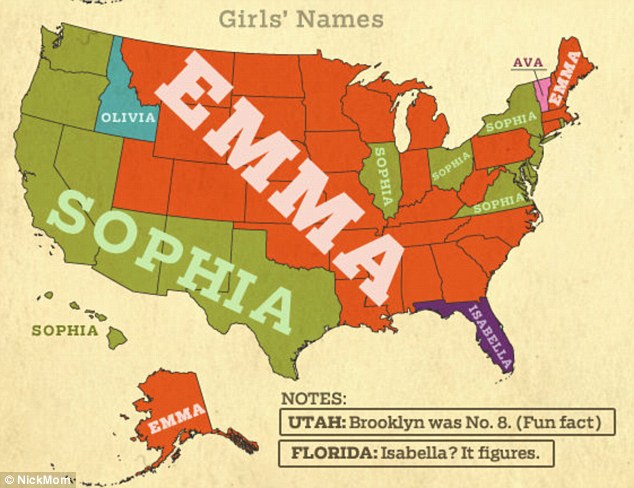
Last year, a total of 20,791 Emmas were born in the United States. The size of that cohort was only surpassed by the 22,158 Sophias added to the US population in 2012. Together, both names came out on top in 47 of the 50 states. …
Considering the top names for girls per state, we see two distinct blocks emerging: Sophialand is anchored on the West Coast, with 7 of its 16 states forming a contiguous territory, from Washington State all the way down to Texas. Its giant next-door neighbour Emmaland occupies a gigantic swathe of land across the west, ranging unimpeded into Pennsylvania. A few mutual enclaves and exclaves complicate the situation in the Midwestern to Northeastern area: there are four Sophia-enclaves (Illinois, Ohio, Rhode Island and a complex of 5 contiguous states: New York, New Jersey, Delaware, Maryland and Virginia). All the Emma states are contiguous, except for Emmaland’s New England province: Maine, New Hampshire, Massachusetts, and Connecticut. The US’s two non-contiguous states each declare for either of the main nations: Alaska is Emmaland, Hawaii is Sophialand.
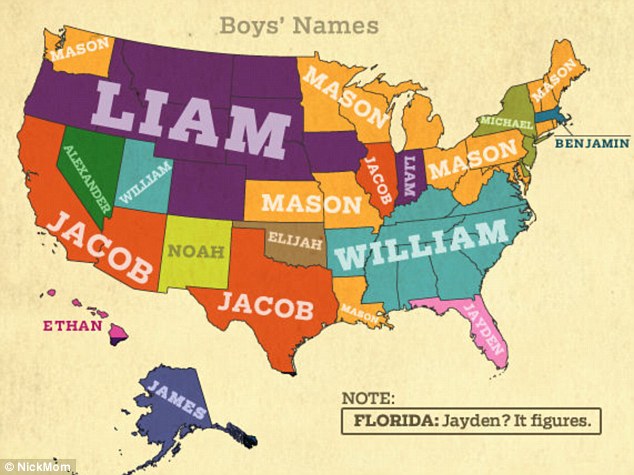
Frank Jacobs notes that the boy version of the map is “much more fragmented: 11 names circulate as states favourites, instead of only 5 on the girls’ side” – as seen below:
Predator satiation – or predator swamping, as it is also called – is hardly confined to cicadas and salmon. It is a common strategy of prey animals. The females in caribou herds, which are shadowed by wolf packs, will all drop their calves within a three-day period. It’s a feast for the wolves, but a short one. Far more calves survive than would if the birthing went on for two or three months. Passenger pigeons, which had only one chick at a time, used to gather to nest in astounding groups of two hundred fifty million birds, attracting predators from miles around. The babies would hatch all at about the same time, providing a lavish but short feast for the predators. It worked well for them until they encountered the most voracious and determined predators of all – us. Studies have suggested that women living in groups tend to synchronize their menstrual periods. That could be a leftover from a time when our own ancestors engaged in predator swamping.
By the way, I wonder if people will ever stop writing nonsense like “it [the cicada species] intends for a huge percentage of its population to be eaten.” It intends no such thing, not having the brainpower to plot out the future. It is simply the course the species has taken, which happened to be successful. Other cicadas took a different course and are no longer with us.
A charming profile of a typewriter repairman illustrates why some people prefer a vintage writing experience:
“To me the typewriter is better than the computer, not because I’m old fashioned, but because it slows you down. You have to choose the words carefully because you cannot correct,” [Ermanno Marzorati] told [Agence France-Presse]. “It takes a long time to press the key.” … Marzorati said the advantages of computers are over-rated. “Writing on a computer is very distracting, because you get email coming in, you type a word, you delete it, you change it, you get stuck,” he said.
His view is echoed by Christopher Lockett, who regularly takes his 1950 Hermes Baby typewriter with him to write in the open air in Los Angeles’ Griffith Park, next to the hipster Los Feliz district. “There are no text windows in blue popping up, you can’t play music on it,” he said. “I shut off my iPhone, I take my typewriter and sit and I don’t worry about the typos, I keep moving forward, and I go dah dah dah dah ding!”
(Photo: William Faulkner’s Underwood Universal Portable typewriter, by Gary Bridgman, southsideartgallery.com, via Wikimedia Commons)
Rodge Glass pens an introduction to the emerging genre of climate fiction, or “cli-fi” – a sub-genre of sci-fi:
Engaging with this subject in fiction increases debate about the issue; finely constructed, intricate narratives help us broaden our understanding and explore imagined futures, encouraging us to think about the kind of world we want to live in. This can often seem difficult in our 24‑hour news-on-loop society where the consequences of climate change may appear to be everywhere, but intelligent discussion of it often seems to be nowhere. Also, as the crime genre can provide the dirty thrill of, say, reading about a gruesome fictional murder set on a street the reader recognises, the best cli-fi novels allow us to be briefly but intensely frightened: climate chaos is closer, more immediate, hovering over our shoulder like that murderer wielding his knife. Outside of the narrative of a novel the issue can seem fractured, incoherent, even distant. As Gregory Norminton puts it in his introduction to an anthology on the subject, Beacons: Stories for Our Not-So-Distant Future: “Global warming is a predicament, not a story. Narrative only comes in our response to that predicament.” Which is as good an argument as any for engaging with those stories.
Some places to begin for the intrigued:
Whereas 10 or 20 years ago it would have been difficult to identify even a handful of books that fell under this banner, there is now a growing corpus of novels setting out to warn readers of possible environmental nightmares to come. Barbara Kingsolver’s Flight Behaviour, the story of a forest valley filled with an apparent lake of fire, is shortlisted for the 2013 Women’s prize for fiction. Meanwhile, there’s Nathaniel Rich’s Odds Against Tomorrow, set in a future New York, about a mathematician who deals in worst-case scenarios. In Liz Jensen’s 2009 eco-thriller The Rapture, summer temperatures are asphyxiating and Armageddon is near; her most recent book, The Uninvited, features uncanny warnings from a desperate future. Perhaps the most high-profile cli-fi author is Margaret Atwood, whose 2009 The Year of the Floodfeatures survivors of a biological catastrophe also central to her 2003 novel Oryx and Crake, a book Atwood sometimes preferred to call “speculative fiction”.
If you enjoy our weekend coverage – rare among blogs – of breaking news, and the web’s gems on literature, philosophy, religion, art and poetry, do [tinypass_offer text=”consider becoming a subscriber”]. It’s our only source of income – and is only [tinypass_offer text=”$1.99 a month”] or $19.99 a year. It takes two minutes max. [tinypass_offer text=”Subscribe!”]
Look: I can’t stand Mayor Bloomberg. He has a classic Napoleon complex – and is completely sure he knows what’s best for everyone. His recent outburst of unreason and prejudice in defense of his beloved program of ruining countless young black men’s lives by stopping and frisking them for a joint (which is much healthier than alcohol) drove me up the wall. And I have to say that, despite being an avid cyclist in Washington, there is no way on earth I would ride a Citibike in New York City. I’m not suicidal. This is a town where cars run pedestrians down on crosswalks where the pedestrian has the light. Yes, I could bike down the Hudson River Park, but that’s about it in Manhattan. Friends say otherwise – Rick Hertzberg loves cycling in Manhattan and is still very much alive. But I’m still spooked.
Nonetheless, the bike share program is obviously a great development in a city which now has enough bike lanes to limit the carnage. And it is healthier for you to ride a bike than, say, the subway – although my lungs have been unable to function properly since the pollen hit. The bike stands look great, the system is working, and it enhances the freedom of everyone by giving them a new way to get around, without getting your bike stolen.
Along comes Dorothy Rabinowitz. Check out the full hilarious rant here. For her, the whole thing is fascism:
“Do not ask me to enter the minds of the totalitarians running this city.”
Totalitarian? I agree he’s a meddling nanny. But Stalin or Hitler or Mao? It’s an insight into the worldview of the WSJ editorial board – and a sign of just how nuts mainstream conservatism has become.
He is forced to concede by CNN’s wonderful Candy Crowley that even his cherry-picked statements from IRS employees prove absolutely nothing for his working assumption that the president somehow organized an inquisition of Tea Party groups via the IRS. Watch him come up completely empty:
Note his bald description of Jay Carney: a “paid liar.” Maybe this is a good opportunity to revisit the past of the chief moral scold and smear artist in Washington. He’s been arrested for being a car thief, suspected of being an arsonist, and exposed as a proven liar. Let’s take the arson first, shall we?
Issa had a warehouse full of electronics that, one night in 1982, caught fire. Investigators later found “suspicious burn patterns,” Ryan Lizza reported, and found that Issa had done some odd things.
A co-worker claimed that before the fire, Issa had put important electronic prototypes in a fireproof box, and that he’d removed the business’s computer and financial files from the building. Investigators also found that less than three weeks before the blaze, Issa had increased the company’s fire insurance from $100,000 to more than $400,000.
“So you add the more than quadrupling of the insurance along with the taking the computer and putting the other stuff in a fireproof box, and you can see why both the arson investigators and the insurance investigators pointed a finger, you know, at Issa after this fire,” said Lizza.
Issa said he had nothing to do with the fire, but the insurance company refused to pay the claim. The two later settled out of court…
The insurance company, meanwhile, had found something peculiar about Issa, unrelated to the arson: there was no indication of where his initial capital came from. After interviewing a family member, an investigator reported, “She was unable to advise us as to his financial banking [sic] to become an officer in Quantum Inc.” A second report noted, “We were unable to find the source of his financing for the business ventures he is engaged in at the present time.”
A member of Issa’s Army unit, Jay Bergey, told Williams that his most vivid recollection of the young Issa was that in December, 1971, Issa stole his car, a yellow Dodge Charger. “I confronted Issa,” Bergey said in 1998. “I got in his face and threatened to kill him, and magically my car reappeared the next day, abandoned on the turnpike.”
On March 15, 1972, three months after Issa allegedly stole Jay Bergey’s car and one month after he left the Army for the first time, Ohio police arrested Issa and his older brother, William, and charged them with stealing a red Maserati from a Cleveland showroom.
The brothers were indicted for grand theft. Darrell argued that he had no knowledge of William’s activities; William claimed that his brother had authorized him to sell the car, and he produced a document dated a few weeks before the robbery that gave him power of attorney over his brother’s affairs. On February 15th, with the investigation ongoing, Darrell returned to the San Jose dealership and repurchased his car, for seventeen thousand dollars. In August, 1980, the prosecution dropped the case. Darrell insisted that he was a victim, not a criminal. William had produced evidence that he had the legal authority to sell the car, and the injured party was reimbursed.
No one’s past is perfect and everyone deserves a second chance. But if you apply the standards of evidence Issa uses to indict the president – pure innuendo, speculation and smears – then you can fairly say that Issa was a likely car thief, con-man, and arsonist. Having figured out how to steal cars, he then repurposed his expertise to set up a company to prevent car theft. In the end, it made him a multi-millionaire. And former crook.


 The Dish