The Shrinking Of Big Law, Ctd

Mark Obbie takes issue with Scheiber’s thesis:

From the cover lines and title (“Big Law in Free Fall,” “The Last Days of Big Law”) to an outlandishly flimsy nut graf (claiming just one in 10 top firms will survive the imminent apocalypse, or so says “one common hypothesis” that then never gets explained or examined), the story looks at one sore throat and proclaims it a cancer pandemic. Its prognosis on the death of the mid-sized full-service firm echoes a forecast made so many times it has lost all credibility. Then the piece takes yet another giant step into journalism hell by shooting readers through a time warp that conveniently skips the past 30 or so years of Big Law business history. Big Law has been declared dying for decades. Pieces touting the death of Big Law have been written for decades. Unfortunately, “Big Law Still Really, Really Dying,” while arguable (except where it’s still really, really profitable), doesn’t sell copy.

Meanwhile, Leah Plunkett focuses on the Americans who can’t afford legal help:

When people can’t get lawyers to help them with complex problems, they stand to lose (pdf) the things that are most precious to them, like custody of their children, the roof over their heads, or that quintessentially American opportunity to make a fresh start after crashing and burning.

Even if all Americans could afford to pay for lawyers, there may well not be any lawyers around. Outside of cities, lawyers can be scarce. As The New York Timesrecently reported, South Dakota has gone so far as to pass a law that will pay lawyers to work in that state’s rural communities. A worthy endeavor, but it’s difficult to imagine that the program will do much to get the over-supply of lawyers on Wall Street to migrate to Main Street: The annual stipend for South Dakota’s program is less than a month’s salary for a first-year Big Law associate in New York.1 And of course, as others have discussed, today’s young lawyers—who might otherwise be intrigued by doing Little Law on the Prairie—frequently face financial debt that is insurmountable on all but a Big Law salary.

Which Way Does The Senate Lean?

The Crystal Ball’s 2014 Senate ratings:

2014 Senate

Kyle Kondik previews the 2014, 2016, and 2018 Senate races:

The Democrats are overextended on the 2014 map, which probably means the Republicans should, at the very least, make a dent in the Democratic Senate majority next year. Two years later, the Republicans will be defending a map on which they are overextended, which could help the Democrats make up for some of their possible 2014 losses. And then the Democrats are overextended again in 2018.

All of which suggests that 60-vote Senate majorities are going to be elusive for either party, and future Senate majority leaders, be they Democrats or Republicans, are going to be continually tempted by some form of the “nuclear option” in limiting the filibuster. Given its rapidly increasing use, future Senate majorities — maybe even as soon as this one — might decide they have little choice but to reach for the button.

Enten thinks that, over the long run, the Senate favors Republicans:

Only about 26% of the country as a whole live in the top 10 metropolitan areas. For minorities, those percentages climb significantly: 37% of blacks, who voted for Obama by a 10:1 ratio, live in the top ten metropolitan areas. This includes Washington, DC, which doesn’t have any representation in Congress. Further, 45% of Latinos, who voted for Obama by greater than a 2.5:1 ratio, live in the top ten metropolitan areas.

That’s why it should be no surprise that 36 of the 50 states in the union have a higher percentage of non-Hispanic whites than the nation as a whole. That puts the Democratic party behind the eight ball in winning more states than Republicans. If racial polarization in terms of voting patterns continue to exist or get worse, then it will only go downhill for Democrats in winning more states.

This isn’t that big of a deal in winning presidential contests. The electoral college may be a lot of things, but it does take into account population in assigning electoral votes. Indeed, at this point, the Democrats seem to be enjoying an advantage in the electoral college. That is, they are in a better position to win the electoral college and lose the national vote than are Republicans.

On the Senate level, it is, however, a very big deal.

It’s Not Racist … Ctd

A reader shifts gears on the subject:

Here’s my example of race influencing being spectacularly stupid: the phenomenon of date/acquaintance rape. I’m a middle-aged white woman who grew up in a city torn by the racial tension of the late ’60s and affected by white flight (I joke that my parents were the only white people who moved INTO town, six months after the riots).  By the time I got to junior high, my 8th grade graduating class was 425 kids, of whom about 20 were Hispanic and 5 of us were Anglo.  The rest were black.

From the age of 7 to 10, I was bullied in a horrible, passive/aggressive and rejecting way by a white female classmate who was the definition of a frenemy. Around that age I also got jumped by a group of black girls from round the way, which frankly was a lot less emotionally damaging.  Two of my best friends were African-American boys who at the age of 12 were already what Fox News likes to call “hulking.”  As you can judge from the variety of “urban violence” and “urban friendship”, it came in all genders and colors.  So I was never taught either by my own experience or certainly by my parents to fear any one group, but instead to keep aware of my surroundings and have a healthy skepticism about the purported “safety” of any place or any persons.

I ended up at a small rural college that was 98% white.

While I did drink, it was always with close friends of both genders whom I knew extremely well. I never got drunk at a frat party because it was filled with young men at the height of influence of hormones and peer pressure and general dickishness whom I did not know.  The only thing I did know about them was that they were “nice boys from good families”, which is a lot of words to say white.  This one attribute made many of my fellow co-eds feel totally safe to get completely bombed out of their minds in their presence, because those boys were not the males they had been taught to be careful of They had been taught that a rapist is a big black guy in an alley.  And sometimes, bad things happened because of this belief that corn-fed guys out of the Lands End catalog were not capable of sexual assault.

Before you think that the above is meant to indicate I am some paragon of post-racial centeredness, I am definitely not.  The biases inherent in living in our society are difficult to escape, and I am no exception. Long after I graduated, I was the victim of an attempted date-rape by a man I had been seeing for a couple of weeks.  He was white, and a doctor, and Jewish.  Imagine all the racial/class level/educational/religious stereotypes of “this dude is totally safe and ultimately harmless” swimming around in that description.  And I fell for every one of them.

Previous posts in the thread here, here, and here.

Why Aren’t There More Female Pilots?

Marc Herman finds some fault with the military:

Women currently make up between three and six percent of commercial airline pilots, according to Women in Aviation, a pilot’s organization. The U.S. has about 50,000 commercial fliers, of which about 450 are women.

The reasons appear in part to be structural. CNN looked at aviation’s lack of diversity in 2011, and noted that it costs about $100,000 to train for a commercial aviation rating. To avoid that cost many would-be pilots enlist in the military, where they can exchange a few years of service for tax-funded flight school. But then the old trap returns. The military is improving its gender and ethnic balance since its first studies in the 1990s, but slowly. Women were first allowed to receive Air Force basic flight training in 1976 and as navigators the following year, but could qualify for fighter jet training starting only 20 years ago, in 1993. The Air Force Personnel Center reports that, as of June 30 of this year, of the nearly 330,000 people in the Air Force, 725 were women assigned as pilots, and 265 were navigators. Even if every one of those people retired and went into commercial aviation, they would represent less than two percent of the country’s professional pilot corps.

A History Of Hate In Burma

MYANMAR-POLITICS-ANNIVERSARY

Juan Cole Matthew Walton looks at the backdrop behind the recent uptick of Buddhist-on-Muslim violence:

Muslims in Myanmar have faced the everyday discrimination and challenges that non-Buddhists face in an overwhelmingly Buddhist majority country, but there have also been instances of more targeted oppression. Riots in 1930 were directed more generally at the immigrant Indian population (as a stand-in for the colonial power), but the 1938 riots (although also intended as anti-colonial actions) targeted Muslims more explicitly. After the establishment of military rule in 1962, Muslims were explicitly excluded from the Burmese military. Anti-Muslim riots occurred again in Mandalay in 1997 and Taungoo in 2001. While these latter incidents involved large numbers of monks, many have speculated that the incidents were organized by the military to deflect attention from other issues or to galvanize nationalist sentiment. …

The 969 movement is the public face of the current resurgent Buddhist nationalism.

The movement derives its name from the nine great qualities of the Buddha, the six great qualities of the dhamma (his teachings), and the nine great qualities of the sangha (monkhood), the “triple gems” of Buddhism. There is also a sense in which 969 is intended as a numerological counter to the Muslim 786 symbol. 786 is a numerological representation of “Bismillah Rahmane ne Rahim” (which, interestingly, is considered haram by some branches of Islam) and is pragmatically used by Muslims in Myanmar and elsewhere in South Asia as an identifying marker, particular in the case of halal restaurants. A groundless yet widespread rumor in Myanmar is that 786—adding up to 21—is a secret Muslim code that indicates a desire to take over either Myanmar or the world (depending on the scope of the teller’s ambitions) in the 21st century.

Recent Dish on religious violence in Burma here, here and here.

(Photo: Myanmar police force stand guard near Martyrs’ Mausoleum during a ceremony as Myanmar marks the 66th anniversary of Martyrs’ Day at the Martyrs’ Mausoleum in Yangon on July 19, 2013. By Soe Than WIN/AFP/Getty Images)

Vandals And Saboteurs, Ctd

Norm Ornstein, about as moderate a figure as AEI could tolerate, tells the truth about the unprecedented nihilism behind the GOP’s current campaign to nullify a presidency and sabotage a duly-enacted law. His comparison with Medicare D under Bush is brilliant. So are these two paragraphs:

When a law is enacted, representatives who opposed it have some choices (which are not mutually exclusive). They can try to repeal it, which is perfectly acceptable—unless it becomes an effort at grandstanding so overdone that it detracts from other basic responsibilities of governing. They can try to amend it to make it 173293592-SD-600x400work better—not just perfectly acceptable but desirable, if the goal is to improve a cumbersome law to work better for the betterment of the society and its people. They can strive to make sure that the law does the most for Americans it is intended to serve, including their own constituents, while doing the least damage to the society and the economy. Or they can step aside and leave the burden of implementation to those who supported the law and got it enacted in the first place.

But to do everything possible to undercut and destroy its implementation—which in this case means finding ways to deny coverage to many who lack any health insurance; to keep millions who might be able to get better and cheaper coverage in the dark about their new options; to create disruption for the health providers who are trying to implement the law, including insurers, hospitals, and physicians; to threaten the even greater disruption via a government shutdown or breach of the debt limit in order to blackmail the president into abandoning the law; and to hope to benefit politically from all the resulting turmoil—is simply unacceptable, even contemptible. One might expect this kind of behavior from a few grenade-throwing firebrands. That the effort is spearheaded by the Republican leaders of the House and Senate—even if Speaker John Boehner is motivated by fear of his caucus, and McConnell and Cornyn by fear of Kentucky and Texas Republican activists—takes one’s breath away.

The current GOP is a threat to this country’s economy, social order and cultural moderation. There is nothing even faintly conservative about their contempt for democratic institutions or their refusal to behave as anything but political vandals.

Dolphins Have Names

We humans aren’t so special:

The evidence that dolphins use signature whistles like names has been building since they were first discovered in the 1960s. They can convey a dolphin’s identity, as well as its mood and motivation. Individuals invent their own whistles at a few months of age, possibly with some influence from their mums. They’ll keep the same call for decades, although males sometimes change theirs to resemble the whistle of a new ally.

The whistles are clearly important, since they account for half of all the calls that wild dolphins make. They can mimic each other’s signatures, but they usually call with their own, perhaps to broadcast their identity and keeping in touch while swimming.

Ask A Window-View Champ Anything

Doug Chini, who nailed the vast majority of the 42 contests he has entered so far, takes questions from readers:

What do you do professionally?

I’m a corporate lawyer in New York City, which actually gives you the discipline to fight through some of the harder searches.

How much time do you typically put in for each contest?
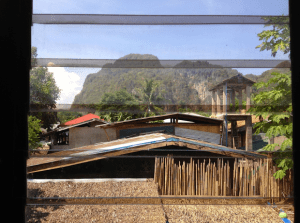
screen-shot-2013-05-10-at-11-26-51-pmIt varies. I typically spend 10-15 minutes just analyzing the image and on occasion, as with last week’s Mostar view, the answer pops right out. But for difficult ones, and if I have time, I can spend several hours over the course of the weekend. In those cases, as with writing, it makes sense to work in small stretches and come back with fresh eyes.

What was your all-time favorite VFYW contest?

Well, in terms of the ones I’ve found it would have to be the El Nido view in the Philippines (VFYW #153). Tracking down the actual window required plotting dozens of images from the local cliffs on a time-line. By the end of that process my computer’s desktop looked like the floor of Baker Street after Sherlock Holmes spent a night digging through a stack of old newspapers.

The most amusing contest, however, was VFYW #116, which I never found. I normally begin a search by adjusting the image’s brightness and contrast, but when I did so that week, boy was I in for a surprise. I’ll let the readers go back and, er, reflect on that one.

What are the most common red herrings?

Recently it’s been red tile roofs. Whenever we get a Mediterranean view, there’s invariably a group of readers who think it’s California because of those roofs, but it rarely is. More broadly, certain architectural characteristics, like shanty construction, are common across a wide swathe of the planet, but people tend to assume they’re specific to regions they’ve previously traveled to. Unless you’re certain, I think it’s better to cast a wide net at the beginning of the search rather than develop tunnel vision.

Do you ever reach a point with some contests when you just admit to yourself that you’re stumped and give up?

Not really, because I rarely push too hard for an extended stretch of time. Instead, I’ll plug away right up to the deadline with whatever snatches of free time are available, even if it means searching on the elliptical at the gym.

Which VFYW victory were you most proud of?

That’s a hard one. Cork (VFYW #117) comes to mind first, as I found it just as I was about to turn the computer off for the night. And the Rohrmoos view (VFYW #148) in Austria required a pure brute-force search because there were no good clues. When I found that one I felt like Rocky running up the steps of the Philly Museum of Art (except swap Stallone with a dork sitting at a computer).

But if we’re talking “pride,” I’d have to say Sarlat-la-Caneda (VFYW #158). I only had one day to work on it, which meant I had to quickly narrow down the likely area using small details until I could locate the final, critical clue. (If the Dish staff allows, I may send in a detailed visual in the next month or so that shows how that one played out.)

What are some photo clues that the average person might not think would be helpful?

The most prosaic of details, like garbage cans, traffic signs and chimneys are often fairly specific to a region or country and can narrow down the search area. Also, the position of satellite dishes and the direction of shadows can give you a sense for the compass direction of the picture, which helps when searching satellite imagery.

Our previous co-champions, who we honored for our 100th contest, also respond:

What do you do professionally?

Mike: Electrical engineer

Yoko: Nursing

How much time do you typically put in for each contest?

Mike: About eight hours, usually a few hours at a time over Saturday and Sunday. About half my time is typically spent documenting the location. (I did most of the documentation – that’s why my time is longer than Yoko’s).

Yoko: It depends… from 15 minutes to the whole weekend.  We usually found the window on Saturday morning, otherwise, we couldn’t go out. Typically, 3 hours or so.

What was your all-time favorite contest?

Mike: Dhaka, Bangladesh. The part I regret is that Yoko was traveling that weekend, so I found it myself. It turned out to be a great win, because it was a solo win – nobody else got the building – but I wish Yoko had been part of it.

Yoko: My favorite was Edinburgh. It was a lovely scene. The cobblestone street in the photo helped me find the window. (Note from Mike: Yoko found this window in about fifteen minutes).

Which VFYW victory were you most proud of?

Mike: #68, Ulaanbaatar. I had found windows before that, but this was the first one Yoko and I solved together. She found the window after we talked about the clues, and I wrote up the entry.

Yoko: Dhaka. Mike found the window by himself. Usually, I helped him too much.

What are some photo clues that the average person might not think would be helpful?

Mike: Curbs and utility poles.

Yoko: Hmm… Electric utility cables (how messy, how old…) can be clues. Also, the window frames sometimes tell me many things.

What are the most common red herrings?

Mike: License plates. There are so many, and they change so quickly. It’s easy to look at a plate and think you know where it’s from (or even to look it up on a license plate site), only to discover that it hasn’t been used for years, or even worse, that the same design is used in myriad countries or states.

Yoko: Mike’s advice. He always says, “It must be China!”

Breaking Hamas

Jeffrey Goldberg offers a reliably bellicose strategy to achieve peace in the Middle East:

Engineer the ouster of Hamas from the Gaza Strip. Both the Palestinian Authority and Israel see Hamas as a bitter enemy; both sides understand that Hamas is an impediment to peace talks. The end of Hamas’s rule — the Gaza Strip constituting about half of what would be a future Palestinian state — could set the stage for actual, fruitful negotiations. …

The White House could lobby Hamas’s remaining benefactors in Turkey and Qatar to trim their funding. If such lobbying failed, Congress could “pull strings to speed up delivery of or withhold the advanced weapons systems that both countries are eagerly awaiting, depending upon how the conversation goes. Turkey, for example, is expecting Sidewinder missiles and Chinook helicopters, and it would like to purchase Predator and Reaper drones. Qatar, for its part, is expecting delivery of Large Aircraft Infrared Countermeasures (LAIRCM) Systems, and 500 Javelin-Guided Missiles.”

Just so long as nothing is done to halt the settlements, and nothing is asked of Israel, while Hamas is targeted. That’s the neoconservative idea of balance. Jonathan Schanzer likewise insists the military takeover in Egypt has given the US the chance:

Since Morsy’s ouster, the military has been unleashed: It has arrested at least 29 Brotherhood financiers, including at least one significant contributor to Hamas’s coffers, according to a senior Israeli security official. It has also reportedly deployed 30,000 troops to the Sinai and purportedly destroyed roughly 800 of the 1,000 tunnels connecting Egypt to Gaza. Ala al-Rafati, the Hamas economy minister, recently told Reuters that these operations cost Hamas $230 million — about a tenth of Gaza’s GDP.

All of this presents U.S. Secretary of State Kerry with a rare opportunity to try to hasten the group’s financial demise. And it is in his interest to do so.  The group, after all, carried out suicide bombings against Israeli civilian targets in the 1990s to torpedo the peace process. It’s a fair bet that Hamas will launch a new campaign of violence now that talks are ramping back up.

More Dish on the potential of the new talks here and here.