
A Serious House No Longer, Ctd

by Chris Bodenner

York 013

To complement our post on deconsecrated churches now used for non-religious purposes, a reader sends the above photo and writes:

I was interested by McClay’s response because it was so different than my own.  When I was a student, I studied for a semester in London.  I lived with a British family in Muswell Hill, a northern part of the city probably most famous outside of London for being home to the Kinks. But one of the things I found there more memorable than anything else was a pub that had once been a church.

I am not a big drinker, but when the daughter of the family I was living with invited me to come with her mates to watch a football match (soccer), I couldn’t say no.  Where the alter had been, a massive bar stood. Where pews of congregants had once played, now a roiling sea of football fans cheered and whooped and sobbed.  And I found it to be a strangely fitting change, because what is a church for if not to take people’s minds from their worries, or to bring some measure of togetherness and joy to a life that can sometimes seem so cruel and so uncaring?  I, an atheist, was brought together in this amazing bond that I have never once felt in a church before.  The loud music might not be coming from the old organ, but it united everyone nevertheless.  There is no other word I can use to describe this experience other than religious.

After I left England, I tried to watch soccer more, hoping for the same experience.  It was never the same. Something about being in that place, with so many like-minded people, had somehow taken hold over me. The church in Muswell Hill might have lost its faith, but it had lost none of its potency.

Another points to a former church in Pittsburgh:

No discussion of re-purposing deconsecrated churches should ignore The Church Brew Works. It’s a place we go on every Pittsburgh trip, which are frequent because of family and other ties in the city. The renovation was done with the utmost respect for the history of both the structure and the neighborhood.  Check out the History tab at the website.  Along the back wall is a collection of photographs of prior clergy and sisters, and of events in the history of the parish. The pub operators know that their customers are the same people who were christened there, or whose parents were married there, or who remember that a grandparent’s funeral Mass was held there.  If you’re ever in Pittsburgh, I recommend a visit, and try the Pipe Organ Pale Ale.

Another shifts away from beer and spirits:

The Voorhees Computer Center at Rensselaer Polytechnic Institute in Troy, New York is inside of an old church (follow the link for pictures). It kind of freaked out my older brother when we did the campus tour but I thought it was perfect – an old way of seeing the world being replaced by the new. When I did the tour, there were still punch-card machines in some of the alcoves, but times continue to change. Actually the inside shots do not show the original columns and windows from the inside along with the vaulted ceilings.  It is certainly a wonderful building from an architectural point of view.

Personally I would love to find an old church turned into a film house, where I always have the most transcendent experiences indoors.

Millennials Won’t Play Politics?

by Brendan James

Boomer Ron Fournier worries that Generation Y is too wary or disgusted with partisan politics to enter Washington and make change:

The trouble is that Millennials believe traditional politics and government (especially Washington) are the worst avenues to great things. They are more likely to be social entrepreneurs, working outside government to create innovative and measurably successful solutions to the nation’s problems, even if only on a relatively small scale. … A generation ago, government had a monopoly on public service. To Millennials, the world is filled with injustice and need, but government isn’t the solution. They have apps for that.

Noreen Malone counters by pointing out that “people have always built fortunes and connections and forged their worldview outside government before deciding in middle age or later to try for political office”:

It’s highly doubtful that, in a few years, an entire generation of adults will look at positions promising vast influence and power and say “no, thanks.” That’s simply not the way human nature works. So if in the meantime some young people aren’t learning at the feet of the very people who’ve broken the system and are instead trying to learn how to fix problems in a new way, I’m not sure that’s such a bad thing.

Microsoft Needs An Update

by Patrick Appel

Microsoft Intel Market Share

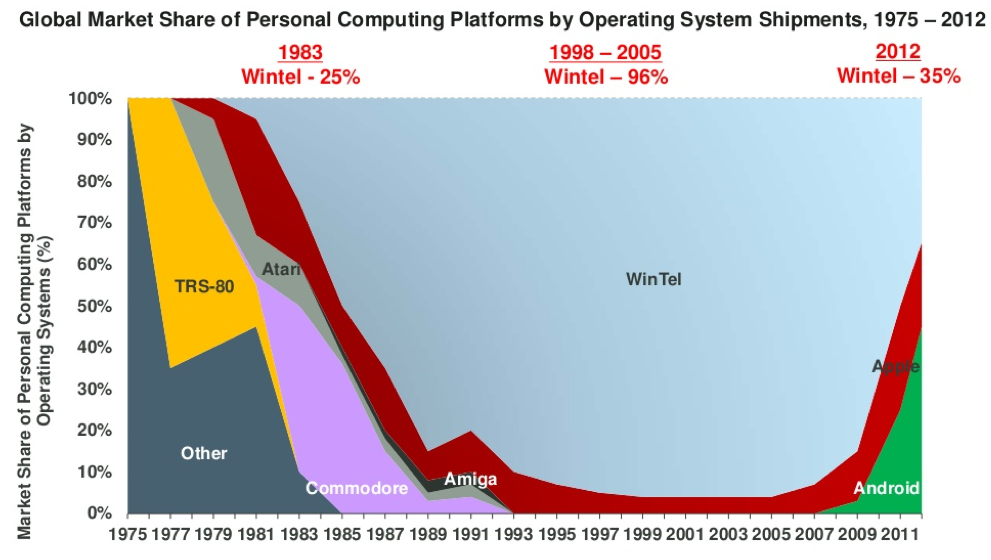
Microsoft CEO Steve Ballmer announced on Friday that he’s retiring. Derek Thompson explains the decision with the chart above:

Windows, along with Intel, got its clock cleaned by Apple and Google in the last decade. Their global market share of operating systems fell from 96 percent around 2000 to 35 percent in 2012. Apple and Google wedged their way into our laptops, phones, and tablets, while Microsoft saw its sliver of the mobile market decline between 2005 and 2012.

Timothy Lee doesn’t blame Ballmer for Microsoft’s woes:

Ballmer’s larger problem is that throughout his 13-year tenure, he was swimming against some very powerful economic currents. His company’s fate was inextricably tied to the success of the PC, and the PC’s fortune peaked with the Nasdaq around 2000. The emergence of interactive Web applications around 2004 began to turn PCs into interchangeable commodities. Then Apple introduced the iPhone in 2007, and the iPad three years later, kicking off a tablet computing boom that left the PC in the dust.

These developments were a classic example of what Clay Christensen called disruptive innovation: cheap, simple innovations that gradually displace a more complex and expensive incumbent technology. History suggests that firms rarely survive when their core product is undermined by a disruptive technology.

Matthew Lynley focuses on more positive numbers. So does Aaron Levie:

The story of Microsoft under Steve Ballmer can be told in two very different ways.

The one that took center stage in the public eye narrated Microsoft’s slow response to emerging, low-end software disruptors like Google Apps and Amazon Web Services; a missed mobile-device wave led by Apple and Google, which dramatically weakened the Microsoft monopoly; and a series of failed service launches like the Zune, Windows Vista, and more.

The other version of the story is the lesser told of the two. Microsoft more than tripled its annual revenue under Ballmer, from $22 billion annually when he took over to $78 billion when he announced his departure. It was with Ballmer at the helm that Microsoft also began to embrace the cloud, launching successful online services and platforms like Office 365 and Azure, and purchasing compelling technologies and companies like Skype and Yammer. Microsoft’s negligible market share in search grew to 30 percent through clever maneuvers like securing all of Yahoo and Facebook’s search traffic. Microsoft also secured the only corporate investment ever made in Facebook. Under Ballmer, Microsoft even began to embrace open source and other competing platforms.

However, in this binary world where you’re either up or you’re down, we must have losers to bolster our winners. Even during the peak of its recent successes, the stock market voted that Microsoft was not the victor.

Larry Dignan doesn’t envy Microsoft’s next CEO:

Simply put, the new CEO for Microsoft will be in a tough spot. The company isn’t a disaster where there will be a 2-year honeymoon just to stabilize the patient. The new CEO won’t look like a savior because Microsoft doesn’t need to be saved. The CEO following Ballmer will be more akin to Virginia Rometty taking over at IBM as CEO than Marissa Mayer at Yahoo or Meg Whitman leading HP out of the abyss.

However, Microsoft also isn’t firing on all cylinders and is transforming its approach. Microsoft is a tweener company that should arguably be broken up. In many respects, the new CEO is like an NFL coach taking over a 10-6 team. You either win a championship or you fail.

Saints On Display, Ctd

by Chris Bodenner

SAM_3852

A reader bristles over this post:

I disagree with the focus on relics, no matter who is doing the venerating or how much the apologetics try to explain that they are not idols. When I look at what people do aside from what they say, the physical objects are serving as idols if only for a small fraction of the orthodox followers. On top of that, to imply that if I do not idolize the relic then I am less worthy of approaching G0d is taking this even further in the wrong direction.

There is a strong human tendency to slip from veneration into idol worship. The Bible goes out of its way again and again to urge us to steer away from idolatry and to focus on one true G0d that does not manifest a physical presence. That the one G0d chose to be unseen and non-physical is the most sublime and wise decision in the history of humanity. Similarly that Moses was taken up without a physical trace, and that Jesus was taken up without a physical trace, goes a long way to preventing the focus on the physical remnants and to keep the focus were it is better set – on the one, unseen G0d. It keeps people focused on living better lives, now bowing to physical objects. (I once watched pilgrims bow to objects at the Church of the Holy Sepulcher.) If we had a grave of Moses or Jesus, there would be a constant stream of millions of people and an almost irresistible tendency to turn them into idols. Similarly the Jews have to keep in mind the Kotel is not the focus and the Torah scroll is just a book, not something to be worshipped.

Another sends the above photo and writes:

From my travels, we recently saw two very different churches where bones were on display. The first was Sedlec Ossuary, in the small town of Kutna Hora, Czech Republic, east of Prague. We had gone on a day tour and this small church is close to the railway station, from where we walked. We saw a construction on the wall that claimed to have used all the bones in a human body, and another one where a chandelier is made of bones.

And more recently, our travels took us to Goa in western India. In the Basilica of Bom Jesus is the remains St. Francis Xavier.

Seen above. Another reader:

Reading the post on the relics of saints, I was reminded of the Bible referencing others who rose from the dead along with Jesus.

Matthew 27:50-53
And when Jesus had cried out again in a loud voice, he gave up his spirit. At that moment the curtain of the temple was torn in two from top to bottom. The earth shook and the rocks split. The tombs broke open and the bodies of many holy people who had died were raised to life. They came out of the tombs, and after Jesus’ resurrection they went into the holy city and appeared to many people. (NIV)

I wonder what happened to those dudes.

As California Burns

by Chas Danner

Rim Fire Continues To Burn Near Yosemite National Park

Lindsay Abrams offers an update on the Chicago-sized wildfire that is laying siege to Yosemite Park:

The so-called Rim Fire first began on August 17, but the extremely hot and dry conditions have caused it to become one of the largest wildfires in California’s history, and a new peak of what’s already been a destructive season for the Western United States.  While at least 12,000 acres of northwest Yosemite have been destroyed, a [spokeswoman] for the U.S. Fire Service told CNN, there’s been little impact on the more popular tourist areas. A more pressing concern, the Associated Press reports, may be the mountain communities north of the park, dried out from two years of drought and to which the fire is quickly approaching. So far, there have been no deaths or injuries and only minimal property damage; the focus right now is on protecting the state’s natural and energy resources[.]

The 234 square-mile fire is currently 15% contained, but is still threatening San Francisco’s water supply and power grid. Earlier this summer, James West foretold events like the Rim Fire, as well as many more in the years ahead:

We can expect “as much as a fourfold increase in parts of the Sierra Nevada and California” in fire activity across the rest of this century, says Matthew Hurteau, assistant professor of ecosystem science and management at Pennsylvania State University. It’s a trend likely to continue: A 2012 study in Ecosphere, the peer-reviewed journal of the Ecological Society of America, found a high level of agreement that climate change will fundamentally alter fire patterns across vast swaths of the globe by 2100. While some areas around the equator will see fewer fires, there will be striking increases in high altitude boreal fires in the Northern Hemisphere. Fire will even reach a thawing Arctic, which will be more capable of growing plants to burn.

Katie Valentine points out that as a consequence of the sequestration, the US Forest Service has already had to reallocate funds from other areas to combat this summer’s wildfires:

As of [last] Wednesday, the agency was down to $50 million after spending $967 million this year on fighting wildfires. So far in 2013, 33,000 wildfires have burned in the Western U.S., spanning 5,300 square miles and destroying 960 homes and 30 commercial buildings.

This year is the second consecutive year and the sixth year since 2002 that the Forest Service has had to divert funds for fighting fires. The Forest Service’s wildfire fighting budget was slashed by $115 million by automatic, across-the-board sequester cuts that went into effect earlier this year. In addition, a wildfire reserve fund created in 2009, known as the FLAME Act has dropped from $413 million in 2010 to $299 million this year after sequestration. These cuts come as costs to fight wildfires each year are soaring: during the 1990s, the federal government spent less than $1 billion a year fighting wildfires, but since 2002, it’s spent a yearly average of more than $3 billion.

In addition to climate change, Brad Plumer highlights another reason firefighting costs are rising:

The number of people living in fire-prone areas has grown dramatically. Some 250,000 new residents have settled in Colorado’s “red zone” over the past two decades, for instance. Not only can that increase the odds of a fire starting in the first place, but more crucially, it increases the cost of suppression, as firefighters focus on protecting nearby homes.

(Photo: A firefighter uses a hose to douse the flames of the Rim Fire on August 24, 2013 near Groveland, California. The Rim Fire continues to burn out of control and threatens 4,500 homes outside of Yosemite National Park. Over 2,000 firefighters are battling the blaze. By Justin Sullivan/Getty Images)

Why The Kosovo Model Won’t Work

by Patrick Appel

A reader rejects the comparisons of Syria to Kosovo:

Kosovo may be a good model for a military intervention carried out in the face of Russian opposition, domestic skepticism, and lacking UN approval, but it hardly offers a roadmap for success in the case of Syria. Kosovo worked because Milosevic’s ouster was not the purpose of the operation. He could relent in the face of our airstrikes because he had a way out, literally: all he had to do was withdraw Serbia military and paramilitary forces from Kosovo. And it wasn’t the Kosovars that eventually took out a weakened Milosevic: it was the Serbian people who decided over a year later that they’d had enough of him.

This is not a model for Syria unless we are willing to declare a de facto partition of the country and demand that Assad withdraw forces from this rebel safe zone. Given that the fighting is taking place within some major cities, I don’t see how such a partition is possible. Moreover, if such a safe zone is expected to be a launching point for further attacks against the regime (in a way that Kosovo was not), then Assad has little reason to agree to it.

Tropes In Motion

by Tracy R. Walsh

Simon Owens offers a brief history of the supercut – that YouTube-ready montage of film clichés, tropes, or catchphrases:

While the supercut – a neologism coined by blogger Andy Baio  has proliferated with the creation of YouTube and its ease of use, the concept of stringing together brief clips to point out a common refrain stretches back decades. Jon Stewart almost single-handedly invented a new form of media criticism by collating the inane and vapid beltway doublespeak that plagues punditocracy. Tom McCormack, who wrote what is perhaps the definitive history of the supercut, traces the genre as far back as 1958 with Bruce Conner’s A Movie, “an early example of found-footage cinema” that “climaxes with interwoven footage of disasters: sinking ships, falling bridges, crashing cars, exploding blimps.”

Owens says it’s not just nostalgia that drives the art form:

For [supercutter Alex] Moschina, [what gives the genre so much emotional resonance is] the sense of recognition that’s triggered when the tropes and themes found through a television show’s arc or in dozens of unrelated movies are pieced together. It creates a kind of “A-ha!” moment when a Hollywood cliché that you perhaps never fully internalized is laid out for you. “It’s definitely something that everyone thinks about, whether they realize it or not,” he said. “They’ll be watching a movie and the main character will do something that makes you think, ‘Who does that in real life?’ Then you realize that if you noticed this weird cliché, other people probably noticed it as well, and so you have a built-in audience that will appreciate the hilarity of that situation.”

Will The Arab Spring Fail?

by Patrick Appel

Ronald Bailey suspects so. Among this reasons:

The George Mason University political scientist Jack Goldstone argues that the low median age of these countries’ populations lessens the probability that they will successfully negotiate a transition to democracy. That would follow the pattern spotted by the Stuttgart University researcher Hannes Weber, who in a 2011 study in the journal Democratization looked at data from 110 countries between 1972 and 2009. “Democratic countries with proportionally large male youth cohorts are more likely to become dictatorships than societies with a smaller share of young men,” he writes.

Why?

One hint might be found in an intriguing 2012 study, “On Demographic and Democratic Transitions,” by the London School of Economics population researcher Tim Dyson. Dyson contends that it is no accident that the shift toward lower fertility rates coincided with the rise of democracy in Western Europe. Falling fertility signals that people are gaining more control over their lives. “As the structure of a society becomes increasingly composed of adult men and women, autocratic political structures are likely to be increasingly challenged and replaced by more democratic ones,” Dyson argues. The median ages of Tunisia, Libya, Egypt, Syria, and Yemen are 30, 25, 25, 22, and 18 years, respectively. For comparison, the median age of the European Union is 41 years and the United States’ is 37 years.

How The Public Will Encounter Obamacare

by Patrick Appel

Jason Cherkis reports on an amusing exchange:

A middle-aged man in a red golf shirt shuffles up to a small folding table with gold trim, in a booth adorned with a flotilla of helium balloons, where government workers at the Kentucky State Fair are hawking the virtues of Kynect, the state’s health benefit exchange established by Obamacare.

The man is impressed. “This beats Obamacare I hope,” he mutters to one of the workers.

“Do I burst his bubble?” wonders Reina Diaz-Dempsey, overseeing the operation. She doesn’t. If he signs up, it’s a win-win, whether he knows he’s been ensnared by Obamacare or not.

Drum discovers that, on “the Kynect website, you can look far and wide and never get a clue that it has anything at all to do with Obamacare or ACA or even the federal government.” Sarah Kliff thinks this story speaks volumes:

When Americans actually interact with Obamacare, it won’t be called Obamacare at all.

In Kentucky, for example, it will be Kynect, the state health marketplace. In Idaho, local residents will purchase coverage from Your Health Idaho. Covered Oregon will serve (surprise!) Oregonians, while neighboring Washingtonians will purchase coverage from WAHealthPlanFinder. If you watch the ads that states have produced to support their marketplaces, they rarely mention the federal law that has set these changes in action.

Jonathan Bernstein adds:

[I]t’s still very likely that “Obamacare” will stay just as unpopular as ever, especially among Republicans, even as it becomes political suicide to take away Affordable Care Act benefits.