Choosing Suicide For Your Birthday

by Chris Bodenner

Several readers are seizing upon this story:

Sports journalist Martin Manley, who left the Kansas City Star in early 2012, killed himself in front of a police station on Thursday on his 60th birthday. He left a website that explains his decision making. The gist: he didn’t want a slow lingering death in nursing homes or heroic battle with cancer that he would ultimately lose. He wanted to control his death – every detail.

And that’s one thing I haven’t seen discussed on your great thread about suicide – the need for control. I think about suicide all the time; I have for years. That troubled me until I realized it gave me a sense of control. I, like Manley, am single, in my 60s and have no desire to deal with a lengthy illness or long-term care. Unlike Manley, I’m also broke. And for me, the idea of ending my life is a great comfort. But, of course, it has to be my little secret.

It’s called rational suicide, and I think it will be part of the legacy of the Boomers. We’ve got to get a national conversation going about the need to let people who are at the end of life, have some control about ending their life. Thanks for helping make that happen.

Another reader:

Now that Yahoo! has taken down his site and his sister is battling them to put it back up, I think it’s appropriate for you to add this to your suicide thread: I wish he’d been able to choose some other sure method that would have been less dramatic.

This would require a major shift in how we think about death. We’d have to accept that there are some people who can cooly, dispassionately decide that it’s their time to go, while others will fight to survive for as long as they can – and that both are valid choices. A system that accommodated that, and treated the person choosing suicide with respect rather than as a danger to himself who must be stopped by any means possible, could include counseling to ensure that the choice wasn’t being driven by depression or influence from third parties. The longer we force people to be furtive about it and shame surviving families into silence or into condemning the loved ones they have lost, the worse it is for everyone.

I hope the sister wins her battle. I still have not read his entire website, but what I’ve read presents an interesting and complex picture – neither a hero nor a coward. He had concerns that are not unlike the concerns of others at his age. But to me, his choice doesn’t seem radically different from that of my aunt when she decided not to undergo radiation for breast cancer for a third time. She died within days of the date the doctor said she would upon making that choice, and, of course, it was unclear whether what finally did her in was the cancer itself or the increasing doses of morphine she was taking to counteract the pain.

I respect her decision, as I do Manley’s. I just wish he hadn’t been in a situation where he felt his best option was a police parking lot.

Marijuana Is Going Mainstream

by Patrick Appel

At Hempfest, the Seattle Police Department handed out Doritos with a special educational message:

Reihan thinks the stigma against marijuana is fading:

[T]he deeper shift is not so much political as cultural. Pew has found that the stigma against marijuana use is quickly evaporating. In 2006, 50 percent of Americans maintained that smoking marijuana was “morally wrong,” a share that has fallen to 32 percent as of 2013. Not surprisingly, marijuana use has increased as the stigma against it has faded. The United Nations Office of Drugs and Crime reports that the annual prevalence of cannabis use has increased from 10 percent of the general population (persons 15-64 years of age) in 2007 to 14.1 percent in 2010. By way of comparison, the annual prevalence of cannabis use is less than half as high in Uruguay. Marijuana is no longer seen as a drug for people on society’s fringes, or the exclusive preserve of hippies and hip-hop devotees. It is used by an impressively wide range of Americans, many of whom use it for banal purposes like reducing stress.

For better or for worse, voters are far more likely to favor marijuana legalization if they think of marijuana users as “people like us” and not “people like them.” So I’d guess that marijuana legalization in some form is all but inevitable.

The End Of Undercover?

by Brendan James

Ambinder envisions a bleak future for the traditional spy:

This next generation of spies, the men and women who are in high school now, are going to find that it will be virtually impossible to live a life undercover. The CIA knows this, and it is gradually changing the way it integrates intelligence officers into their assignments. Malevolent and friendly entities are gobbling up data from U.S social networks to try and identify current and future spies; a big source of intelligence is the Facebook and LinkedIn profiles that former CIA officers establish once they’ve retired. Just like the NSA, foreign intelligence services can use Google, Twitter, LinkedIn, and Facebook to track the activities of current and former American intelligence operatives. And who, at the age of 12, thinks about the record he or she is leaving online at that age as a barrier to future employment as a spy?

Faith And Intelligence

by Jessie Roberts

772px-Grace1918photographEnstrom

A meta-analysis of 63 scientific studies conducted between 1928 and 2012 has found that 53 of the studies showed “a negative correlation between intelligence and religiosity, while 10 showed a positive one.” Frank Furedi criticizes the claims:

It’s not that researchers are dishonest but that they like anyone else suffer from a tendency to discover what they already suspect. In the current era where religion is increasingly associated with out-dated beliefs, dubious traditions, dogma and prejudice it is inevitable that the authority of science will be harnessed to prove the religious stupid. Is it any surprise that in a smug tweet Richard Dawkins refers to this meta-analysis with feigned surprise as to why the cleverness of atheists should even be questioned?

The polemical use of science – called scientism- has nothing to with real science, which is the disinterested pursuit of the truth. It uses the authority of science to invalidate the moral status of groups and individuals and their practices on the ground of their natural inferiority. It is the 21st century equivalent of 19th century craniology.

Regrettably the mantra “research shows” has become a substitute for a critical engagement of views. Devaluing the intelligence of your opponents is what children do when they call one another stupid. It absolves its practitioners from taking the arguments of their opponents seriously.

Jack Vance at Atheist Revolution is also skeptical of the study, as is Deacon Nick Donnelly:

‘[R]eligiosity’ is defined as ‘involvement in some (or all) facets of religion’. ‘Religiosity’ is restricted to a very stark, undefined ‘functionality’ with no attempt to examine the role of reason, or insight, the apprehension of truth and meaning, the intelligence of the heart, the perception of values, let alone the activity of grace, the response to revelation, the presence of God.

Recent Dish on scientism here and here. On the above image:

Grace is a 1918 photograph by Eric Enstrom. It depicts an elderly man, Charles Wilden, with hands folded, saying a prayer over a table with a simple meal. It was taken in Bovey, Minnesota. Originally black-and-white, the photo was colorized by hand by Enstrom’s daughter, Rhoda Nyberg. It was this colorized version that attained widespread distribution. In 2002, an act of the Minnesota State Legislature established it as the state photograph.

Egypt’s Martial Media

by Brendan James

Sarah Carr worries about the Egyptian state controlling the press:

It looks like we are heading towards media oppression that will be worse than under 2011. There is a public appetite for it, and the security bodies have apparently been given a green light to do as they please.  Wars on terrorism rely on crude binaries: You are either with us or against us, and this is the constant message being relayed to us ([presidential advisor Mostafa] Hegazy even said during the presser yesterday that Egypt is “taking note of who is with it and who is against it”).

Laura Dean connects Egypt’s polarized media to the country’s deepening divisions:

When the army took power they shut down several Islamist channels, and since then the state and independent outlets have shown unwavering support for the army and the military-backed government. When 51 Morsi supporters were killed by security forces outside the Republican Guard, the army said they were provoked and did little to attempt to justify what was, at the very least, a disproportionate use of force. Despite the overwhelming number of dead Morsi supporters, no one in the mainstream media questioned the military’s line. …

Meanwhile, the Muslim Brotherhood is not innocent of biased and faulty coverage. Following the Republican Guard killings, they used images of dead Syrian children, claiming they were Egyptians that had been killed in the shooting.

David Kenner takes note of the military’s intimidation of foreign journalists:

The official criticism of the foreign press corps has coincided with an increase in attacks on journalists as they cover events in Cairo. The Guardian’s Patrick Kingsley, the Washington Post‘s Abigail Hauslohner, the Independent‘s Alastair Beach, the Wall Street Journal‘s Matt Bradley, and McClatchy‘s Nancy Youssef were all threatened by Egyptian security forces or civilians in the past several days. Brazilian journalist Hugo Bachega was also detained while covering the protests on Friday, as was Canadian filmmaker John Greyson and physician Tarek Loubani, whose current location remains unknown.

Pogonophiliacs Unite! Ctd

by Chris Bodenner

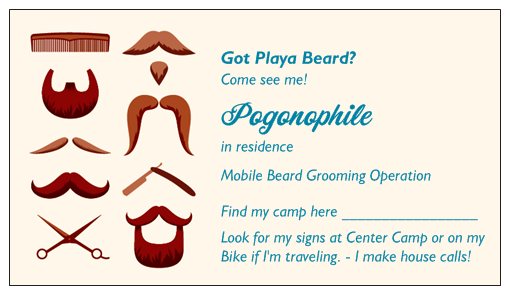
Pogonophile In Residence Card

A reader sends the above image:

In anticipation of Burning Man’s philosophy of gifting, I’m combining my pogonophilia with a free service to all the bearded Burners.  I’m sure your beard will be well cared for, but if you or anyone you know is suffering from “Playa Beard”, feel free to pass along the attached card. I’ll be setting up a part-time operation at Center camp, opening my own camp to beards of all types and even operating a mobile service while passing out cards and performing “house” calls.

Another counters Andrew’s call for letting your facial hair grow:

Why do you get haircuts? Why not just let it grow?  Maybe folks shave the same reasons some people get haircuts. To them, it looks more presentable.

And along those lines, why trim a beard? Another reader:

Oh, the horror of a guy shaving everything – including the pubic area. Do those same male hair lovers (the hetero kind) like women hairy as well? Or do they pride the “hairiness” for males, but females need to shave? Could you delve into that some more? I don’t know – I’m just a curious hairy lesbian …

She should check out the long-running Dish thread, “Why Should Women Shave?” Meanwhile, many readers sound off on a shorter thread of late:

There’s another possible reason why Gillette’s Mach-3 sales are falling. It may well be that the shaving public is getting tired of paying a premium price for their product.

I’m going to be buying razor blades whether I grow a beard or not, since I also shave my head. For years, I was a loyal Gillette customer. The design of the Mach-3 and its follow-on, Fusion, is brilliant. The placement of the hinge is key. It allows you to follow the contours of your face, head, whatever with minimal applied force to the skin.

But that comes at a cost. The cartridges are damned expensive. While they were the only game in town, we paid up. But …

What’s happening now is that the down-market manufacturers are beginning to catch up. Recently, I’ve switched to Wilkinson razors. They’re about as good and the blades are half as expensive. For me that’s an easy choice, beard or no beard.

Another reader:

Some have succumbed to the lure of the old, aided by Reddit. My 22-year-old son bought an old-fashioned razor off the internets, followed the reddited instructions for sanitizing it, and now he shaves with Italian tube shaving cream and a brush. While he has nothing against beards, his would still be a bit scraggly and sparse. But he’s also not supporting the mainstream razor market.

Another Redditor:

Eighteen months ago I bought a Merkur safety razor, a badger hair brush, shave soap, an alum block, and 100 blades, all for around $80. I’ve replaced the soap only, and only once, in that time. The razor and the brush will last indefinitely. At my current rate of shaving (roughly twice a week), it costs me maybe $15 a year to shave. Once one learns how to properly use them, the blades are as comfortable as any multi-bladed contraption. They’re easy to clean and worth several reuses. A straight razor is even more economical, though I found in my own experiment with a straight that I don’t have the patience to learn it.

Reddit has a community of 40,000 dedicated to old-school shaving. It’s just slightly smaller than the one committed to beards.

One more reader:

I pray every day that we have yet to reach peak beard.  This video from a few years back featuring Gavin McInnes (of Vice fame) perfectly captures my predicament (NSFW):

My dear friend and I both suffer from the tragedy of the weak chin.  The era of stubble and bears being acceptable in the workplace was a godsend.  Finally, we could conduct business in the office without looking like Kenneth the Page.  I have not bought a razor in years and I hope society never compels me to do so again.

How To Get More Egyptian Blood On Our Hands

by Patrick Appel

A National Review editorial urges America to “back Egypt’s military.” It claims that the “military’s horrific violence … does not alter the U.S.’s calculus”:

The Muslim Brotherhood and the military government are now at war, and the latter remains the best hope for securing American interests and, ultimately, a free Egypt. We should therefore continue our financial and matériel support for the Egyptian military and maintain as close a relationship as possible to push the government toward our objectives.

In Commentary, Michael Rubin is more unhinged:

So long as the Muslim Brotherhood seeks to turn back the clock, impose its hateful and intolerant ideology upon Egyptians of all religiosities and religions, and refuses to abide by the pathway to transitional elections, and so long as it continues to fight in the streets, then it should suffer the consequences of its actions. And if those consequences result in exponentially higher Brotherhood casualties than army casualties, then so be it. That is the truest path to peace.

Ali Gharib pushes back:

The Muslim Brotherhood is a retrograde, conservative religious movement. In their ham-handed year-long reign over Egypt, they exposed themselves as lacking a serious commitment to democratic principles, such as inclusion and protection of minority rights. But it’s also the largest and best organized political force in Egypt. Rubin’s notion that the Brotherhood should be bloodied into submission represents exactly the same foundational flaw seen in the Brotherhood’s brief rule. Rubin demands, in fashion of old, hard-nosed Republican realists, that the U.S. continue its partnership with the Egyptian military, even amid its massacre of its own citizens. He’s their perfect, and willing, partner.

Larison counters National Review:

The NR editors find the violence earlier this week to be “horrific,” but their preferred policy ensures not only that there will be more of it, but that the U.S. will be actively supporting the most heavily-armed side as it commits new outrages. Instead of distancing the U.S. from the crackdown in Egypt, they would like Washington to be a full partner in it. That means having “as close a relationship as possible” with the government that just committed what is by some accounts the worst one-day massacre of civilian protesters by government forces since Tiananmen.

When Gun Control Is Too Outrageous To Contemplate

by Tracy R. Walsh

We get bulletproof whiteboards:

It’s a potentially life-saving tool, a last line of defense in the event of an active shooter situation, and that was basically the thinking behind [University of Maryland Eastern Shore president] Juliette B. Bell’s decision to spend $59,800 on the whiteboards/shields. “We are not really doing this in response to a specific event; I see it more as an opportunity to be prepared and to be proactive in our approach to safety on campus,” Bell said. “We think that it’s worthwhile.”

When Animals Grieve

by Chris Bodenner

A reader responds to Andrew’s latest post about his dogs:

First, thanks for sharing the story about Eddy’s delayed grief for losing her friend Dusty. I thought I’d share a story about when I lost one of my two cats many years ago. Molly was really the first cat I owned (my mom didn’t like cats, so we grew up with dogs). I was renting a small house and took in the stray who stayed there; it was easier to give Custard a home rather than cleaning up the mess he made of the trash cans. While Molly and Custard generally got along, they never seemed particularly close.

Then one day, I was going out of town to visit some friends in New Orleans for a week, so I made arrangements for a co-worker to feed Molly and Custard while I was gone. On my first day in New Orleans, I got a call from Steve – he had gone to feed the cats and found Custard dead. I never learned what happened, but Custard sometimes had the habit of his former stray self and would stuff himself when he had a really large bowl of food and would later vomit. I had a feeling that is what happened, and he probably choked on the extra food he had consumed. Steve very generously offered to bury Custard.

When I got home, I emotionally prepared myself for the loss of one cat but I suspected no emotional response from Molly. After all, cats never gave you any sympathy when you needed it. When I got home, I found a house with no cats and a note from Steve. He said that Molly had gotten away from him and escaped from the house. She then watched him bury Custard from a distance.

He returned a couple of times and left food on the porch but didn’t see Molly. I also didn’t see anything of her the night I got back, but she was at the door early the next morning. The first thing I noticed were that her front claws were completely worn down, and there were marks on the ground where Steve had buried Custard.

She had spent some time digging at the spot where her friend had been buried. My idea of having a cat who paid no attention to Custard’s death was completely wrong. Molly was clearly upset, and my formerly tough, independent cat kept very close to me the next few days. While she eventually calmed down, this represented a permanent change; she spent the rest of her life being much more dependent on me because of the loss of Custard. There clearly had been some deep bond between them I had never perceived.

I’m old enough now to have experienced the death of several pets – dogs in childhood, cats since I’ve been on my own. Dogs and cats can bring a tremendous richness to our lives – it’s just unfortunate we have to experience the pain of their deaths. I hope that you and your husband will take care of each other, along with Eddy, and perhaps consider adopting another dog when your hearts tell you it is the right time.

Another reader remarks on the unparalleled company that pets often keep:

I care for two dogs, brothers/littermates, now just over 10. They have literally never spent a night apart (although at times have slept in different rooms). It is almost unheard of them to not both go on walks at the same time. The only time they are separated for any time is when one or the other goes to the vet.

I live in dread of the impact of the loss of one on the other. They have different personalities, and I can see them reacting differently, but I know the survivor will show grief and possibly worse (if already aged, I think it could speed the process). As much grief as I’ll be feeling, the most important thing I can do at that point is to be there for the surviving brother.

The post that sparked this thread – a reflection on Barbara King’s recent book, How Animals Grieve – can be read here. The long and emotional thread “The Last Lesson We Learn From Our Pets” can be found here.

Screwing College Kids Has Bipartisan Support

by Patrick Appel

types of debt[1]

Matt Taibbi tackles the college loan industry and the political machinations that enable it:

Democrats – who, incidentally, receive at least twice as much money from the education lobby as Republicans – like to see the raging river of free-flowing student loans as a triumph of educational access. Any suggestion that saddling befuddled youngsters with tens of thousands of dollars in school debts is somehow harmful or counterproductive to society is often swiftly shot down by politicians or industry insiders as an anti-student position. The idea that limitless government credit might be at least enabling high education costs tends to be derisively described as the “Bennett hypothesis,” since right-wing moralist and notorious gambler/dick/hypocrite Bill Bennett once touted the same idea. …

Conservatives, meanwhile, with their usual “Fuck everybody who complains about anything unless it’s us” mentality, tend to portray the student-loan “problem” as a bunch of spoiled, irresponsible losers who are simply whining about having to pay back money they borrowed with their eyes wide open. When Yale and Penn recently began suing students who were defaulting on their federal Perkins loans, a Cato Institute analyst named Neal McCluskey pretty much summed up the conservative take. “You could take a job at Subway or wherever to pay the bills,” he said. “It seems like basic responsibility to me.”

Paul Campos recommends the article:

The most interesting revelation in this important and disturbing piece is that, by its own estimates, the government ends up collecting close to or even more than the original principal balance on student loans that default.

(Chart from Mother Jones)