This Week In Mind Manipulation

by Tracy R. Walsh

Nathan Ingraham reports on a major advance in brain-to-brain communication:

Using a non-invasive brain-to-brain setup, a researcher in one lab was able to send a signal from his brain to control the movements of a second researcher in a lab on the other side of campus. It’s believed to be the first human brain-to-brain interface; previous demonstrations have featured rat-to-rat and human-to-rat communication.

The demonstration focused on a simple computer game: Rajesh Rao, a professor at UW who has worked on brain-computer interfacing for more than a decade, looked at a screen and had to fire a cannon to shoot down an enemy plane while avoiding friendly planes. On the other side of campus, Andrea Stocco had the keyboard to execute those commands, but couldn’t see the game itself. But using their brain-to-brain interface, Rao imagined that he was using his right hand to click the space bar on a keyboard  and Stocco’s right hand carried out the command without any conscious movement on his part. Stocco likened it to an involuntary twitch or a nervous tic.

John Biggs emphasizes that this “is not mind control”:

The subject cannot be controlled against his or her will and neither party can “read” each other’s thoughts. Think of this as sending a small shock controlled via the Internet to trigger a fairly involuntary motion.

But Dan Farber sees big possibilities:

“It’s very much a first step, but it shows what is possible,” [project contributor Dr. Chantel] Prat said. “Right now, the only way to transfer information from one brain to another is with words,” she said. With advances in computer science and neuroscience, people could eventually perform complicated tasks, such as flying an airplane, and dancing the tango, by transferring information in a noninvasive way from one brain to another. “You can imagine all complex motor skills, which are difficult to verbalize, are just chains of procedures,” Prat said.

Painting Over W’s Sins

by Brendan James

Screen-Shot-2013-03-08-at-3.47.30-PM

Marc Tracy explains why Bush’s critics are captivated by his art:

The paintings are proof that Bush is an artist—that he invests his energies and imagination in creating works that are meant to be aesthetically pleasing and serve no utilitarian purpose. And being an artist is proof that Bush is an honest-to-God person, not the nightmarish, vague presence we all remember. It’s not even that Bush has a soul, just as it’s not even that the paintings are all that good. (And, I mean, are they, really?) It’s that he is of the same species as we are. He possesses an inner life—the very thing whose apparent absence seemed to connect all of his worst outer traits, from his intellectual incuriousness to his bullying nature (the nicknames!) to his economic cruelty to his foreign militarism.

The paintings are a reminder that—as Philip Roth wrote of the White House during the Clinton years—a human being lived there. Someone who provided unprecedented funding for combating AIDS in Africa and evinced tolerance at a personal level. A son, a husband, a father.

A Good Poker Face

by Patrick Appel

Can make reading others’ emotions more difficult:

Someone with a poker face will not miss an opponent with a big smile on her face when she look at her cards – participants suppressing their expressions were not significantly worse at correctly stating the expression they saw on the final slide. But when it comes to identifying slight signs of emotion – the hints revealed by a careful player – someone trying to hold a poker face is more likely to miss them.

Poker players cloaking their emotions is probably still wise. But other stone-faced professionals should take note:

As the authors point out, these findings may be most important for professions like law enforcement or medicine. Police officers interviewing a victim try to maintain a professional demeanor, devoid of expression, while seeking out information about others’ emotions. Yet this research shows the inherent difficulty of doing so. This is particularly true of a therapist’s work.

Why Do Chinese Tourists Have Such A Bad Rep?

by Chris Bodenner

A reader illustrates how even cultures known for their patience can frustrate people:

Being from Canada, the simple act of trying to exit a crowded city bus usually involves trying to inoffensively indicate to the other passengers that your stop is next. Contrast that with China, where people just push their way through. I went there for the Olympics in 2008 and I soon realized that my apologies weren’t even registering with the locals – in fact, I probably looked like an idiot saying “sorry” every time someone bumped into me on the Beijing metro.

On a similar note, I went to Israel in 2006 and the company that was hosting the visit took us to Masada, the ancient mountaintop fortress. At one point during the tour we ended up in narrow corridor while our group of five Canadians waited for a group of Israelis to pass. After about a minute they cleared out and, as we moved on, our guide laughed at us saying that in Israel, if you don’t push your way through you’ll never get anywhere.

This got me thinking of how my inoffensive Canadian behaviour (standing patiently, not saying anything) could be considered annoying to any Israeli tourists that happened to be stuck behind us.

Another reiterates how rude tourists accompany any economy that suddenly booms:

The “ugly Chinese” tourist has a precedent in the “ugly Japanese” (and the “ugly American” before that).

I remember a couple of decades ago, being in a Munich beer tavern, when the previous generation of Japanese suddenly found themselves rich enough to hit global tourism sites. A group of Japanese tourists, seriously stressed over too much wurst and a lack of rice and miso, celebrated the end of their German tour by knocking back a few too many beers and singing impromptu karaoke in very loud voices. In the end, they got absolutely hammered and jumped atop the tables to show the stunned Western patrons a rousing version of their traditional Japanese summer “O-Bon” dance. It was behavior you see here in Asia during any given local community’s annual harvest festival.

This all has a cogent economic explanation. Paul Krugman, before his current role as shrill liberal attack dog, used to explain the Asian economic miracle in terms of “inputs” boosting productivity, or agrarian laborers leaving farms and rice fields for the factories, stores or those other middle-class employment opportunities that migrated to Asia from the developed world. These jobs pay more than farming. First Japan, a now other Asian countries have created a middle class able to afford travel for the first time.

Yet this new middle class remains steeped in their agrarian roots. At heart, they are rowdy serfs with little time for our stodgy bourgeois notions of personal space, privacy or speaking in a relatively quiet voice in restaurants. In China’s case, you need to throw in the fact that decades of socialist mismanagement of distribution networks instilled in its citizens a deeply – deeply – held notion that waiting patiently in line is a great way NOT to get what you’re waiting for.

These notions don’t disappear just because you now have had a few years of better management. Japan, again, shows how this will play out. You now have a generation of Japanese that have adopted a more restrained way of conducting themselves when abroad.

Another turns the spotlight on American culture:

I was born and raised in Brazil, and live in DC. Americans are indeed very strict about enforcing their personal space in ways that can be frustrating. For instance, when riding the Metro, one will often see a “crowded” train car that actually has a lot space that would be available if people were more comfortable standing in slightly closer proximity. Perhaps Americans’ strong sense of individuality gets in the way of accomplishing collective needs, and we could learn something from our Chinese counterparts.

Still, I wouldn’t go as far as the three Chinese tourists I saw sharing one urinal in a restroom by the Washington Memorial.

Read the whole discussion thread here.

Map Of The Day

by Chas Danner

Kyle Vanhemert passes along a remarkably detailed look at America’s racial makeup. Here’s the Eastern US:

dustin-cable-race-map-key

Vanhemert explains what makes this map so special:

The map, created by Dustin Cable at University of Virginia’s Weldon Cooper Center for Public Service, is stunningly comprehensive. Drawing on data from the 2010 U.S. Census, it shows one dot per person, color-coded by race. That’s 308,745,538 dots in all–around 7 GB of visual data. It isn’t the first map to show the country’s ethnic distribution, nor is it the first to show every single citizen, but it is the first to do both, making it the most comprehensive map of race in America ever created.

White people are shown with blue dots; African-Americans with green; Asians with red; and Latinos with orange, with all other race categories from the Census represented by brown. Since the dots are smaller than pixels at most zoom levels, Cable assigned shades of color based on the multiple dots therein. From a distance, for example, certain neighborhoods will look purple, but zooming-in reveals a finer-grained breakdown of red and blue–or, really, black and white.

This is Detroit:

detroitlabel

Explore the full interactive map here. Recent Dish discussion of the South, race, and social mobility is here.

“A Liberal Is A Conservative Who Has Been Mugged By An Illness”

by Patrick Appel

Daniel Gross finds evidence that Republicans are warming to many of Obamacare’s individual components:

In the old days, they used to say that a conservative is a liberal who has been mugged by reality. When it comes to health insurance, it seems a liberal is a conservative who has been mugged by an illness. After having a devastating stroke in 2012, Sen. Mark Kirk had an epiphany about the inadequacy of rehabilitation services for poor people. “My concern is what happens if you have a stroke and you’re not in the U.S. Senate, and you have no insurance and no income,” he told National Journal. “That’s the question I have been asking, and the reality is that if you’re on Illinois Medicaid and are a stroke survivor, you will get just five visits to the rehab specialist.”

The same holds for the pre-existing condition ban.

Clint Murphy, a former political operative, McCain campaign staffer, and cancer survivor turned Georgia real estate agent, recently wrote of his conversion on Obamacare. Although he had long since been cancer free, Murphy still wasn’t able to get insurance as a self-employed person. “I have sleep apnea. They treated sleep apnea as a pre-existing condition. I’m going right now with no insurance,” he said. Murphy said he can’t wait for the exchanges to bet set up in Georgia, so that he’ll be able to purchase insurance without being denied for a pre-existing condition. And even as they cavil about ripping up Obamacare, and hence the ban on pre-existing conditions, it is common to hear some Republicans speak kindly of the ban.

This is a dynamic we’ve seen over and over again in the past 80 years. Republicans shriek, cry socialism, and offer full resistance to any effort to expand social insurance. Then, after a certain amount of time passes and social insurance measures become popular and effective, they stand foursquare behind them and demand they be protected. Every single stinking component of FDR’s New Deal was a disaster, but don’t you dare touch Social Security! Lyndon Johnson’s Great Society program was a debacle, but keep the government out of Medicare! Obamacare must be torn up root and branch, just don’t kick junior off my insurance plan!

The Awesome And Destructive Power Of Politicians

by Tracy R. Walsh

Bill McKibben’s environmental group is campaigning to name hurricanes after climate-change deniers:

Phil Plait approves:

This ad campaign is pretty clearly tongue-in-cheek, but maybe this isn’t such a bad idea. Clearly, when politicians stick their heads so deeply into the sand that they can see the Earth’s core, something needs to be done. Public mockery isn’t the worst thing that can happen.

On The Shoulders Of Literary Giants

by Matt Sitman

William Giraldi hails Herman Melville as “one of the best American examples of how every important writer is foremost an indefatigable reader of golden books”:

In the general rare books collection at Princeton University Library sits a stunning two-volume edition of John Milton that once belonged to Herman Melville. Melville’s tremendous debt to Milton — and to Homer, Virgil, the Bible, and Shakespeare — might be evident to anyone who has wrestled with the moral and intellectual complexity that lends Moby Dick its immortal heft, but to see Melville’s marginalia in his 1836 Poetical Works of John Milton is to understand just how intimately the author of the great American novel engaged with the author of the greatest poem in English. Checkmarks, underscores, annotations, and Xs reveal the passages in Paradise Lost and other poems that would have such a determining effect on Melville’s own work.

His broader argument about the connection between deep reading and great writing:

Would Cervantes and Shakespeare have made their masterworks if they hadn’t been devoted readers? Perhaps. But I hope it goes without saying that the rest of us aren’t Cervantes and Shakespeare. Try to imagine a teenager who never read an important book and yet produced a novel as permanent as Middlemarch. It cannot be done. Literature isn’t music or painting; there are no idiot savants in literature. Of course quality reading never assures success on your own pages. Judging from his latest insult to trees, Dan Brown has apparently tried to read Dante, and yet his sentences are still stacked like so many corpses. Still, quality reading is the only chance born writers have of succeeding in the creation of art.

The Best Of The Dish Today

by Chris Bodenner

As the US careens toward bombing Syria – without UN or NATO consent, congressional approval, or the interference of Russia – we pointed to strong evidence that intervening in civil wars does more harm than good, a reality that doesn’t conform to the wishes of Reuel Marc Gerecht, Roger Cohen, or the laughable “experts” at the Weekly Standard. Even if the US helps the sectarian rebels overcome Assad, the humanitarian conditions for Syrians could get worse. On a momentary high note, below is a recap of the above video, which “purports to show a father reuniting with his young son, who he thought had been killed [by the Syrian regime]”:

If you can hold it together through all seven minutes, you’re stronger than I am. But this video provides a welcome, if all too rare, moment of solace and joy in a war that has had precious little of either.

On the anniversary of MLK’s legendary speech, we assessed the condition of the mountaintop, recalled the obstacles King overcame, didn’t forget the legacy of Bayard Rustin, and devoted the FOTD to a black woman who reached the promised land and then some.

Reader contributions to the Dish have surged this week; lawyers defended the three-year model for law school against Obama’s critique, many others continued to discuss the curious habits of Chinese tourists, some pointed to more unsavory scenes from childhood classics, others offered historical context to “Support Our Troops”, and still others passed along more deconsecrated churches.

Meanwhile, Matt sounded off on the capitulation of that conservative Catholic on gay marriage. The view from your wildfire here. And this viewless dog still manages to find joy in playing fetch.

The State Of The Dream

by Tracy R. Walsh

View_of_Crowd_at_1963_March_on_Washington

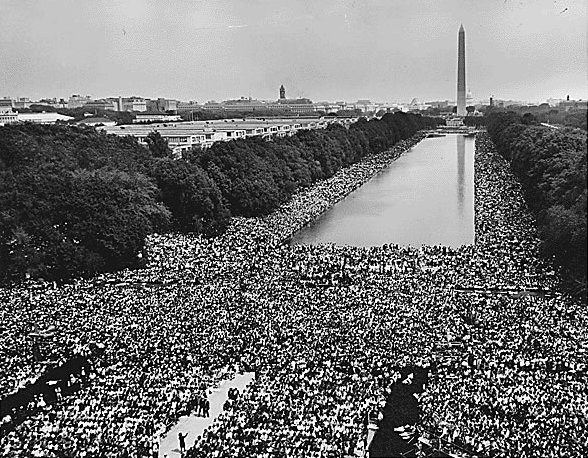
As America marks the 50th anniversary of the March On Washington for Jobs and Freedom, Jelani Cobb sees a country beset by contradictions:

There’s a bizarre dissonance that comes with watching the first black Attorney General give a speech to mark the fiftieth anniversary of the March on Washington and recognizing that the themes of his speech might have fit well with those given at the original march, in 1963. … That Eric Holder’s speech made explicit some implied truths – “But for the movement,” he said, “I would not be Attorney General and Barack Obama would not be President”—and nodded toward the humbling tenacity of unnamed thousands is not particularly surprising. That he went on to articulate a demand that the right to vote be protected for every citizen, and that the criminal-justice system be freed of bias, is alternately noteworthy and depressing.

Martin Luther King III agrees there’s far more to be done:

There are many in our nation who thought that the civil rights movement was done. They saw the election of Barack Obama as a moment ushering in a post-racial era in American history. But what happened? You’ve seen a backlash. Leaders of the Republican Party have demonized the president as an outsider, as if he doesn’t belong in the Oval Office. The Supreme Court has gutted the Voting Rights Act, which undermines the very work my father gave his life for. And Trayvon Martin has met the same fate as Emmett Till  not just in death, but by virtue of an unfair verdict that aimed to render his life less valuable. This is enough to show that the dream is not yet fulfilled and the mission is ongoing.

Bill Fletcher reminds everyone that it was a march for jobs as well as freedom:

The Americans, a high school history text by publishing giant Houghton Mifflin Harcourt, tells students that the march was called simply “to persuade Congress to pass the [1963 civil rights] bill.” In reality, the demand for jobs was not a throwaway line designed to get trade union support. Instead, it reflected the growing economic crisis affecting black workers. Indeed, while Dr. King was a major player, the March on Washington did not begin as a classic civil rights march and was not initiated by him. There is one constituency that can legitimately claim the legacy of the march – one that has been eclipsed in both history as well as in much of the lead up to the August 2013 commemorations: black labor.

Imara Jones adds:

Four out of the 10 demands march organizers listed were explicitly economic, and the announcement calling marchers to Washington cited “economic deprivation” as the impetus. Fifty years on, many of the same critical economic challenges the organizers targeted remain unmet. In fact, the African American unemployment rate is higher now than in 1960: roughly 13 percent in 2013 vs. 8 percent in 1963. Moreover, as Robert Fairlie and William Sundstrom laid out in the The American Economic Review, the employment gap between blacks and whites widened in the 1960s and has never closed. These data point to the fact that addressing racial inequality without a steady unwinding of economic injustice hardens and expands white supremacy.

At the same time, Brentin Mock warns that the Dream can’t survive without equal voting rights:

There’s no separating voting rights struggles from civil rights—the former is basically the source code for the latter. Which is why [John] Lewis and civil rights leaders knew back in 1963 that you couldn’t simply fold voting rights into a small section of the Civil Rights Act. It needed its own bill. Without the ability to vote, other civil rights gains would be suboptimal. …  [T]he voting rights of African-Americans and people of color are in their most vulnerable position since the [Voting Rights Act of 1965] was passed. This is why the call for Congress to restore VRA and to pass a constitutional amendment that guarantees the right to vote was such a prominent feature of Saturday’s march.

Jamelle Bouie says America should remember the march as “militant and unpopular”:

The striking thing about the original March on Washington 50 years ago is how it wasn’t a moment of interracial unity—at least, not in the way it’s portrayed today. Rather, the 1963 March for Jobs and Freedom was militant, a demand for equal treatment under the law and direct investment in the long-neglected fields of black America. It wasn’t a popular agenda. That January, George Wallace was inaugurated governor of Alabama and declared: “Segregation now, segregation tomorrow, and segregation forever.” That June, Medgar Evers, field secretary for the NAACP, was assassinated in Mississippi while coming home from a meeting with lawyers. And that September, in retaliation for the march, four little girls would be killed after their church was bombed in Birmingham.

And Peniel E. Joseph thinks it’s worth taking a moment to celebrate what the march achieved:

In one week, during the run-up to two national celebrations of the 50th anniversary of the March on Washington (the second will occur on Wednesday when Obama makes a speech at the Lincoln Memorial, joined by former Presidents Jimmy Carter and Bill Clinton and members of the King family), we have witnessed two remarkable events: A black president in a nation founded on racial slavery promotes racial healing and economic equality. And an African-American attorney general vows to wage a robust struggle to defend and restore voting rights that were thought to have been won two generations ago.

Both of these instances attest to how far we have come as a nation since 1963 and the long road that lies ahead.

(Photo: Wikimedia Commons)