MoDo Strikes Out Again

I couldn’t help but notice the following kicker in Maureen Dowd’s column today:

“I think that folks here in Washington like to grade on style,” Obama said dismissively of his Syria critics. But why is it so often the president’s style to be unable to sell the substance — even on issues where most people agree with him?

The substance of the Syria deal is that we do not go to war; and that, in return, Assad acknowledges his chemical stockpiles and cooperates with the UN and Russia to secure and destroy them. So let’s see how well that substance polls:

An overwhelming 79 percent of Americans support the proposed deal for international control over Syria’s chemical weapons Obama has embraced.

Yes, Americans did not approve of the messiness, gambles and pivots along the way. So maybe almost 80 percent support for the result is what MoDo regards as an inability to sell the substance. God knows what an ability would do – get to Kim Jong-Un’s approval ratings? And there’s more from that poll:

Sixty percent say [Obama] “sticks with his principles,” roughly unchanged since January 2012. A plurality thinks the initial threat of missile strikes helped the situation by pressuring Syria to give up its chemical weapons — meaning Americans accept Obama’s argument about the impact of the threat (even if they oppose action) and don’t see his change of course as somehow diminishing it. A plurality also says Obama made a good case in his speech the other night — despite widespread pundit derision.

I guess in MoDo’s land, 79 percent approval for the substance of the deal is being “unable to sell the substance.” I think she’s mistaking her Washington coterie for the American people.

The Cannabis Closet: A Female Double-Standard

This embed is invalid


Tracie Egan Morrissey articulates it well:

Last year I wrote a post about how I’m a mother that smokes pot, but I published it anonymously because I wussed out at the last minute. It struck me as a pointless measure, even at the time, because it’s not like I’d ever kept my weed habit a secret before [see above, and also in Pot Psychology the book]. But that was back when I was a new mom and cared about the kind of new-mom shit that I roll my eyes at now, like sterilizing binkies that fall on the floor or having a couch without stains all over it. Frankly, I’m ashamed of my own shaming. (BTW, this is your official notice that “stoner-shaming” has been added to the shame docket of feminism.)

When people think of a “stoner” they think of someone who sits around all day, with greasy hair, in pajamas on the couch, watching TV or playing video games, laughing at stupid shit, and eating junk food. It’s a method of relaxation for males that is totally acceptable and even kind of endearing. For women, it’s a different story. We aren’t allowed to be lazy and we sure as shit aren’t supposed to be sitting around eating junk food.

Previous Dish on women in the cannabis closet here. Update from a female reader:

I agree with Tracie’s point that society thinks women aren’t supposed to be lazy; we’re supposed to be cooking and cleaning and keeping house. And that’s SO MUCH more enjoyable when stoned.

Protecting An Icon

Candlelight Vigil For Slain Gay Wyoming Student Matthew Shepard

An insight into the resistance to re-examining the complicated and horrifying murder of Matthew Shepard: Wikipedia’s edit page. Money quote after an edit which included some of the findings of The Book Of Matt:

(Reverted 1 edit by 76.186.253.207 (talk): Consensus is currently not to include this book. See talk page discussion. . (TW))

Steve Jimenez’s videos explaining his book here. Update from a reader:

The relevant “consensus,” if you consult the talk page as directed, is that The Book of Matt’s inclusion wait until after the book is actually published, and can then be properly sourced. This is a standard technical issue on Wikipedia. Somewhere in all this there’s an irony regarding the discernment of intent.

I can see that and may have jumped the gun. Looking forward to its addition to the entry.

(Photo: Candlelight vigil for Matthew Shepard in New York City on October 19, 1998. By Evan Agostini/Getty Images)

On The Path To A Government Shutdown

TO GO WITH AFP STORY By Otto Bakano -- T

Robert Costa reports that the “the House will soon vote on a continuing resolution that simultaneously funds the federal government and defunds Obamacare.” Altman digests the news:

Why would House Republicans pass a symbolic measure so late in the game? Democratic aides believe it may be the only thing that can get through at the moment. The defund provision buys Boehner breathing room with conservatives, passes the buck to firebrand Senators who have irked GOP leaders by touting an unachievable goal, and, perhaps, forces the Senate to share the blame in the event of a shutdown.

Suderman expects that a shutdown would damage the GOP:

Now, there’s an argument to be made that a government shutdown wouldn’t be so bad. But here’s the thing: A government shutdown wouldn’t stop the implementation of Obamacare, according to the Congressional Research Service. Funding for the implementation process would continue. What a shutdown almost certainly would do is put a lot of public pressure on Republicans to give up and let Democrats take a win—as happened in the 1990s. (The polls on this are pretty clear: The public doesn’t like Obamacare, but they like government shutdowns even less.) And if and when that happens, Republicans stand to lose gains they’ve made on federal spending through the sequestration as well.

Drum predicts what will happen if the government shuts down:

[T]he public, to the apparent surprise of the tea partiers, will run out of patience very quickly.

Democrats will start previewing campaign ads for next year. Phones will ring off the hook. Poll numbers will plummet. Suddenly La Revolución won’t seem quite as much fun anymore. The whole thing will then peter out amid much acrimony and scapegoating while Erick Erickson mutters on his blog about how Republicans can never be trusted to stand their ground in support of true conservatism.

Josh Marshall’s read on the American public:

I don’t think the country’s prepared for a full on government shutdown over Obamacare. Or a full on government shutdown over anything for that matter. I don’t mean the country won’t be able to handle it. I mean, I don’t think anyone is expecting it. The country thinks this stuff ended back in 2011 and 2012 and doesn’t have any real idea we might be about to take another ride on this roller-coaster.

Barro notes that most Republican congressmen don’t want a shutdown:

If you believe the press accounts, there are 30 or 40 House Republicans who won’t vote for a continuing resolution that funds Obamacare. With 30 defections, Speaker John Boehner can’t get what he desperately wants: 217 Republican votes for a bill that protects his key spending priority (maintaining low spending levels from sequestration) while avoiding a fight over Obamacare.

But if 30 to 40 House Republicans won’t vote for a CR that funds Obamacare, that means 190 to 200 of them would vote for such a CR. People talk about the “radicalized House GOP” but on this particular issue, most House Republicans aren’t radicalized. They’ve been dragged into this fight, unwillingly, by Cruz. And that’s why they’re so irritated.

Ezra explains why the GOP can’t round up the necessary votes:

Here’s the Republican Party’s problem, in two sentences: It would be a disaster for the party to shut down the government over Obamacare. But it’s good for every individual Republican politician to support shutting down the government over Obamacare.

These smart-for-one, dumb-for-all problems have a name: Collective-action problems. … The best way to understand the plight of the modern GOP is that the party leadership is no longer powerful enough to solve its collective-action problems.

Collender’s bottom line:

Is it possible that we get to the brink on September 30 at 11 pm and everyone decides that a short-term CR and a cooling off period is needed? Absolutely. Is it as likely this year as it has been in the past? Absolutely not.

A Bold New Network Just Like All The Others

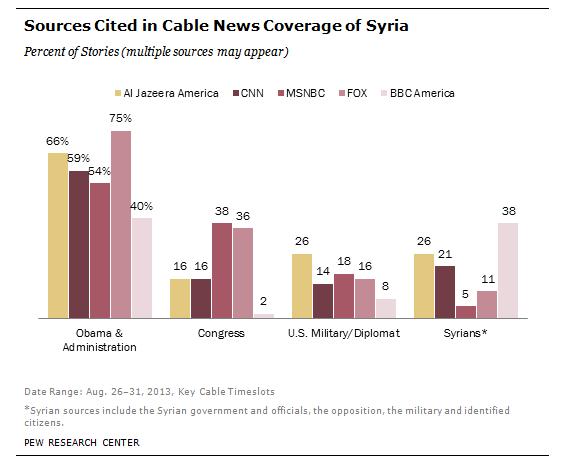
130916_pewgraph2

A new Pew study on Al Jazeera America (AJAM) suggests that the nascent network doesn’t stray far from the cable-news pack:

[A]fter viewing 21 hours of cable news on Syria across five networks, measuring coverage using five metrics, the researchers have arrived at an answer: So far, anyway, Al Jazeera America is more or less CNN – minus Wolf Blitzer, and with a snazzier logo. “The content that Al Jazeera America provided in many ways resembled the coverage on the three major cable competitors” – that is, CNN, Fox News, and MSNBC, Mark Jurkowitz, associate director of the Project for Excellence in Journalism, told Foreign Policy.

AJAM actually reported fewer stories directly from the Middle East than did BBC America or CNN, and it also devoted less airtime to Syrian citizens than either network. Matt Wilstein detects a strategy:

[The study] helped underscore the network’s aim of being a fundamentally American product. While some U.S. viewers may be looking to Al Jazeera America to offer an international perspective not often found on CNN, Fox and MSNBC, for now the network appears happy to broadcast news by and for Americans first.

Arit John sees a waste of potential for what could be a “non-partisan anomaly in this crazy, mixed up liberal-conservative media world”:

The last thing we need is another network putting on the same old song and dance as the other ones, especially to a much smaller audience. But despite our disappointment, AJAM seems pretty happy with the news – they even tweeted about it.

Previous Dish on AJAM here, here and here. Update from a reader:

Being a hard-core supporter of Al Jazeera English (AJE) and its terrific web content (video and essays), I had welcomed the advent of Al Jazeera English (AJA). Imagine my surprise when I received an email in July noting that video content on AJE’s website would no longer be available to those of us who reside in the US.

I didn’t really think about it, as I assumed the new AJA would make a seamless transition (both web and TV based), with the same wonderful international content known and respected on AJE. Big mistake on my part.

I tried to give AJA the benefit of the doubt, I really did. I watched the new cable channel; I checked their website. Sigh. AJA is no clone of AJE. None of the top international reporting; none of the great international video content. In short, AJA is just an expensive clone of the mundane US channels, regurgitating the pablum of the American press – and why on earth would Al Jazeera want to do that? If I want to have my intellect sucked out of my brain, there are already so many options to choose from on American TV.  I (and many others) watched AJE on the web specifically because it wasn’t like those other catatonic-inducing news cable channels.

AJE videos remain blocked in the US. Why? This is what has really stoked my ire: in order to have AJA on US cable TV, Al Jazeera caved to the traditional US cable/ satellite providers and agreed to block AJE web content. It has even managed to block AJE videos on third-party sites. A once-pioneering news organization has in effect drunk the cable KoolAid. They might as well start showing cute cat videos.

Thanks for listening to my diatribe. I tried to vent in emails to AJA, but all I got back were cheery automatic responses that sang the new channels praises. Sigh.

Another reader defends the new network:

An element left out of the “network just like all the others” comparison is that AJAM is 24/7 news, whereas BBC America TV (not radio) only has news on a few times a day. At least that’s true on my cable lineup. So a direct comparison to BBC America TV is kind of phony. You might as well include CBS, which has turned its morning show into a harder-news format, and which I’ve started watching as a result. But the bottom line is that I’m happy to see AJAM as an alternative.

(Graph: Pew Research Center)

How Blogging Makes You A Better Writer

Maureen O’Connor notes growing evidence that, instead of rotting kids’ brains, “technology is making [them] smarter by encouraging hyper-literacy”:

As writing becomes technically easier (try writing 1038 words by hand) and information more abundant, students not only get better at schoolwork — but improve writing and critical thinking skills in their free time. Further studies suggest that 40 percent of student writing occurs outside of the classroom, “everything from penning TV recaps to long e-mail conversations to arguments on discussion boards.” When schools encourage students to blog, the hobby can have a powerful effect on verbal test scores; social feedback motivates students to finesse their rhetorical skills.

When I started blogging – writing as clearly, briefly and colloquially as possible – I worried that my ability to write longer essays or books would suffer. The brain muscles associated with longer compositions, structured essays, or book-length arguments like Virtually Normal might atrophy. My writing might become what Leon Wieseltier would derisively call typing (even as I have never witnessed a faster writer than Wieseltier).

But I was wrong. What it did was help me unclog some of my longer pieces and books – I wrote The Conservative Soul while blogging round the clock – and make them clearer and more succinct. The thing about blogging is that it forces you to stop throat-clearing, its chatty, provisional nature mandates simplicity and clarity, and it punishes long-winded guff. I’ve found that the writing skills of interns improve much faster with blogging than they did with old media writing – and I’m lucky enough to have witnessed both in action as a one-time editor of The New Republic and as the pied piper of the Dish. In other words, Evgeny Morozov could do with blogging more. It would help his writing.

Clive Thompson expands on how educators are catching on to the benefits of blogging:

One reason students phone in their school assignments – and only halfheartedly copy edit and research them – is that they’re keenly aware that there’s no “authentic audience.” Only the teacher is reading it. In contrast, academic studies have found that whenever students write for other actual, live people, they throw their back into the work – producing stuff with better organization and content, and nearly 40 per cent longer than when they write for just their instructor.

Smart teachers have begun to realize they can bring this magic into the classroom. In Point England, New Zealand – a low-income area with high illiteracy rates – the educators had long struggled to get students writing more than a few sentences. So they set up blogs, had the students post there and, crucially, invited far-flung family and friends to comment. At first, the students grumbled. But once they started getting comments from Germany and New York, they snapped to attention.

Affording Good Parenting

Derek Thompson points to research showing that the marriage gap between the rich and poor is creating yet another problem:

[T]here is a persistent and widening parenting gap in America. Rich college-educated families score well on parent quality tests, according to a new paper by Brookings scholars Richard Reeves and Kimberly Howard. But poor, less-educated, and often-single parents are falling short, spending less (and less-quality) time with their kids. Just 3 percent of parents in the bottom quintile – and just three percent of single moms and dads — scored among the best parents in the time-use research collected by Reeves and Howard.

He writes that intervention may be required:

Americans seem less comfortable with direct efforts to make bad parents better, such as sending professionals into houses to teach parenting skills. Families, after all, are considered the most private institution there is. But Reeves and Howard focus on precisely these house visits as an answer to the parent gap.

Timothy Taylor considers the potential of such visits in the US, noting that “other countries like Netherlands and the United Kingdom have much more active programs of home visitation for parents of newborns”:

In the U.S., the Affordable Care Act passed in 2010 allocates $1.5 billion over five years for increased home visitation programs. Studies by the Department of Human Services have identified several home visitation programs that had some effect at least one year after enrollment. A private organization called the Nurse Family Partnership has been testing and expanding approached to home visitation for several decades. Under these kinds of programs, new parents and parents of pre-school children might receive biweekly home visits invitations to regular meeting groups of new parents, and perhaps also some access to educational books and toys.

Again, the evidence about long-term efficacy of such programs, especially at a large scale, is still in a nascent stage. But these authors offer a radical thought: It may well be true that the government should reallocate a substantial share of the money that it currently spends on preschool programs and move it toward parental visit programs for families with very young children.

Kay Steiger is glad the issue is gaining attention, and adds another suggestion:

[T]he gap the media spends the most attention on — those pesky high-income helicopter parents with their attachment parenting styles and how they compare to the “rest of us” who read newsweekly magazines — isn’t really where the focus should be. (Surprise.) Rather, it’s those at the bottom of the income ladder who have the the most to gain from small gains in parenting skills.

The authors lay out some really great solutions — universal pre-K, nursing visits — and miss a pretty major one: Paid family leave. But the idea that parenting is a gap to which attention needs to be paid is worth considering.

The Old Bros Club

Ann Friedman senses a shift in the lexicon:

Mainstream news has been dominated lately by stories lamenting “bro culture” — a term that used to be found solely on feminist blogs — everywhere from Silicon Valley to the U.S. military to the financial sector to pockets of academia. Last week, National Journal published an examination of the military’s fratty atmosphere under the headline “How the Military’s ‘Bro’ Culture Turns Women Into Targets”; and in Sunday’s New York Times, reporter Jodi Kantor examined Harvard Business School’s attempt to de-bro itself. Also over the weekend, at a TechCrunch-sponsored hackathon, two “grinning Australian dudes” got onstage and pitched a “joke” app called Titstare. (Yeah, it’s exactly what it sounds like.) “It’s as if,” wrote the Atlantic Wire, “the brogrammers seen here didn’t know their audience wasn’t all bros like them.”

“Bro” once meant something specific:

a self-absorbed young white guy in board shorts with a taste for cheap beer. But it’s become a shorthand for the sort of privileged ignorance that thrives in groups dominated by wealthy, white, straight men. “Bro” is convenient because describing a professional or social dynamic as “overly white, straight, and male” seems both too politically charged and too general; instead, “bro” conjures a particular type of dude who operates socially by excluding those who are different. And, crucially, a bro in isolation is barely a bro at all — he needs his peers to reinforce his beliefs and laugh at his jokes. That’s why the key to de-broing our culture just might be the straight white guys who aren’t bros.