Hathos Alert

That’s the best category I could think of to describe this:

It is, perhaps, a perfect illustration of how politics can descend into risible entertainment and how argument be replaced by pure emotionalism and symbolism. There is also, shall I say, an element of irony in a former half-term governor’s call for “honesty” – when her own record of constant lies, delusions and fantasies is so demonstrably clear.

Then there’s the rhetoric of violence. The woman who put cross-hairs on Gabby Giffords is still saying things like “It’s time to bomb Obamacare.” It’s never time to “bomb” anything outside a declaration of war. To urge such a thing in domestic political disputes, even in empty rhetoric, is the mark of a crazy person.

But we knew that already.

The Syria Conspiracy Theories Have Begun

Bouie tours the fever swamps:

Yes, there’s no hard confirmation that Assad gave the order to use sarin gas against civilians. Still, each of these theories is easily debunked with the available evidence. The United States, for instance, isn’t alone in its conclusions: France, Germany, and the Arab League also agree that Assad’s regime was behind the attack. Indeed, to believe that the rebels are responsible is to ignore the extent to which the Syrian military possesses the materials for chemical weapons, to say nothing of the logistical complexity of setting up the attack and a subsequent cover-up.

As for the idea that President Obama is behind the attacks? The only thing I have for you is common sense. In order to pull off a conspiracy of that size, Obama would have to have the absolute loyalty and cooperation of hundreds—if not thousands—of people. He would also have to be an evil genius on par with some of the worst people in history. Even his most devoted opponents can agree that this is wildly implausible—the stuff of Alan Pakula political thrillers, not reality.

But conspiracy theories have never been about plausibility. More than anything, they reflect our uneasiness with the modern world, its complexity, and often its capriciousness. And at times, they’re a natural consequence of past actions. Given the circumstances of the war in Iraq — where high-level officials, up to and including the president, misled the public — it’s not a surprise that some people are paranoid about the situation in Syria.

But eschewing conspiracy theories does not mean abandoning skepticism of all self-serving accounts of what happened. The motive for such a brazen attack has yet to be cleared up definitively. We should never dismiss the possibility of divisions within Assad’s regime, mistakes, miscalculations, misunderstandings, and so on. A new analysis from German intelligence services, for example, has found intercepts that suggest that Assad repeatedly refused requests to use chemical weapons:

The report in Bild am Sonntag, which is a widely read and influential national Sunday newspaper, reported that the head of the German Foreign Intelligence agency, Gerhard Schindler, last week told a select group of German lawmakers that intercepted communications had convinced German intelligence officials that Assad did not order or approve what is believed to be a sarin gas attack on Aug. 21 that killed hundreds of people in Damascus’ eastern suburbs.

I’m haunted by the simple fact that almost no one believed that Saddam was bluffing about his WMD arsenal before we went to war. It seemed impossibly naive to believe that. But it was true.

Depression In A Recession

Suicide

Elias Groll considers the connection between economics and suicide:

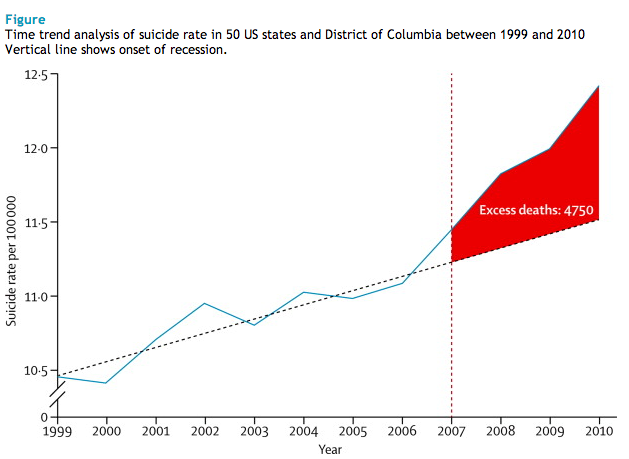
The question of whether suicides increase as a result of financial crisis is a hotly debated topic, and experts in the field emphasize that each case of a person taking his or her own life stems from a web of complex factors. Financial difficulty may be but one part of that web. “We all seek understandable reasons for that kind of behavior,” Dr. Yeates Conwell, a professor of psychology and the co-director of the Center for the Study and Prevention of Suicide at the University of Rochester in New York, told ABC in October 2008. “To say that somebody kills themselves because of their financial stress is going to be a gross oversimplification.”

But the numbers certainly indicate that financial crisis corresponds to an uptick in suicide rates. Between 2007 and 2008, Greece and Ireland – two of the countries hardest hit by the recent spate of economic troubles – saw increases of 17 and 13 percent, respectively. More recent data suggest that, between 2010 and 2011, the suicide rate in Greece increased by 26.5 percent, or an additional 100 suicides. In the United States, researchers estimate that the suicide rate has increased four times faster during the recession than in previous years. That means an excess of 4,750 suicide deaths.

Austerity can literally kill.

The Limits Of The Military Machine

In the fooferaw over Obama’s allegedly chaotic foreign policy over the last few weeks, it seems important to me to note that what is now on the table is what Obama has long explicitly said he wanted on the table. He isn’t being presented with a defeat; he is being offered the thing he said he was looking for all along. Read the presser after the G20 – before yesterday’s transformation. Here’s the money quote:

My goal is to maintain the international norm on banning chemical weapons.  I want that enforcement to be real.  I want it to be serious.  I want people to understand that gassing innocent people, delivering chemical weapons against children is not something we do.  It’s prohibited in active wars between countries.  We certainly don’t do it against kids.  And we’ve got to stand up for that principle.

If there are tools that we can use to ensure that, obviously my preference would be, again, to act internationally in a serious way and to make sure that Mr. Assad gets the message.

Hasn’t this now been accomplished? And this time, the means and the end are better matched than if America’s use of military force had somehow smacked Assad into compliance (an unlikely outcome in any case). What we’ve learned most acutely this past decade is that overwhelming military force is not the sole criterion for power or for achieving international goals. It is even becoming anachronistic and self-defeating in some respects. Charles Kenny gets it:

[L]ong gone are the days when being the top nation militarily meant you could invade half-continents, get countries to adopt your national sports, and set up global economic institutions to your preferred design.

There’s an irony that a U.S. military system that has the power to wipe civilization off the face of the planet through thermonuclear Armageddon is considerably less capable of actually imposing its political leaders’ will on the world than were the British armed forces of 150 years ago that gave pride of place to a cavalry using lances.

Our world has changed. And the old neo-imperial model – categorically proved wanting in Iraq – has to cede to a new form of global interaction. A mixture of great power maneuvering and effective use of the norms of the United Nations system is what will likely be the result, if we are lucky. It’s always better to use the institutions you’ve got. And the core point is that it would be the best means of advancing our interests. Will Assad be more likely to surrender his chemical weapons if the US attacks or if Russia insists on their destruction? Please. It isn’t close.

And if “power” is to mean anything, it must surely mean the ability successfully to advance and defend our national interests. By surrendering some obvious power, we gain much more beneath the surface. Of course, the underlying capacity for massive force makes this work – and there is no obvious or preferable alternative to the US providing that. I’m not arguing for some kind of peacenik abandonment of military strength. I’m simply arguing that the military machine itself is not power. It is, in some frustrating ways, a constraint upon it.

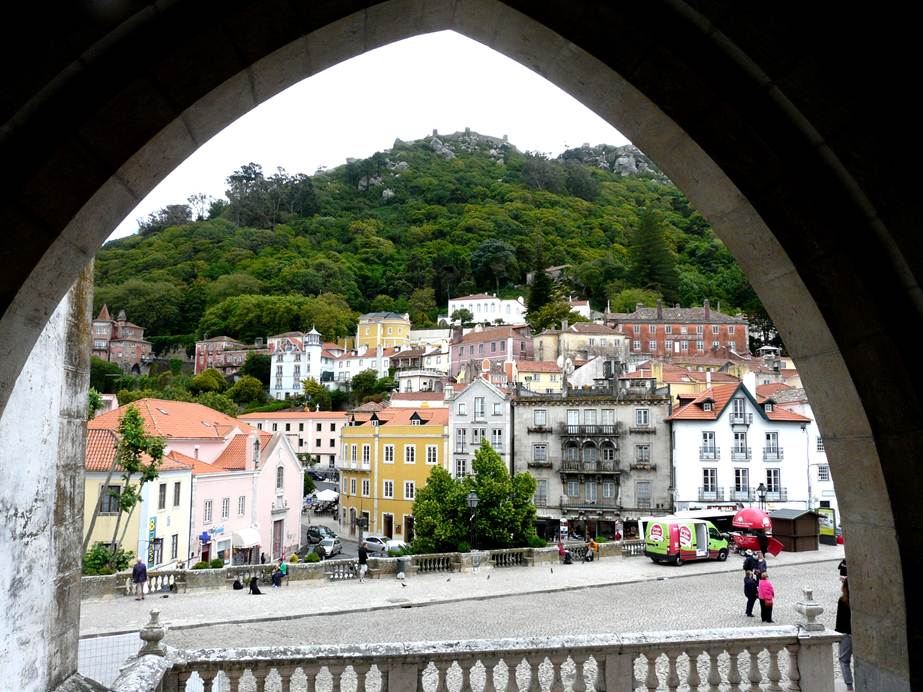
The View From Your Window Contest: Winner #170

image001

A reader writes:

Surely this week’s charming view has delighted and engaged many people. Who would not want to spend time in a place where the sun is shining, people are enjoying themselves, and even the dogs know they’re in the right place! This is one of the most beguiling scenes you have ever shown.

I think this is a picture from Portofino, Italy. The blue cross is typical of certain pharmacies in Europe. The mixture of old and new in the architecture of the buildings, the stone terrace wall, the cobblestone streets, and the delightful color schemes, led me to think Italy would be a reasonable choice. How I narrowed it down to Portofino: Sheer dumb luck. Elsewhere on the net this weekend was a feature showing wonderful hotel getaways. Among them was a picture of Portofino that was so reminiscent, in so many respects, of your contest photo this week that I could not resist sending in an entry.

Another:

Probably wrong, but I’m going with Prague, Czech Republic. That’s what it reminds me of, but I was there long ago, and pretty drunk most of the time.

Another:

Looks like Karst formations to me. Minor googling got me to somewhere between Trieste and eastern Slovenia. I’ll go for Trieste and leave the exact location to those with better google skills or more local knowledge.

Another:

Split, Croatia. End of guess.

Another:

This is my very first entry. The view is suspiciously evocative of Heidelberg, Germany, with the photo having likely been taken from one of the arches at the Old Bridge Gate over the Neckar River. I returned to the city earlier this summer, having first spent a few short hours there several years ago, and confirmed my belief that Old Town Heidelberg is one of the most beautifully lush, quaint, and dare I say dreamy locations I have personally visited. The view from atop the hill at the end of Philosophers’ Way is especially spectacular. Even if my answer is wrong – which I hope it isn’t – the thrill of recognition when I first saw the photo on your blog has already made my morning.

Another is less delighted:

OK, this is infuriating. I was initially positive that this was Petřin Hill, Prague, Czech Republic. What else could it be? I reasoned. The Habsburg yellow building in the foreground. The tourists blocking the street in standard clueless fashion. (Mostly kidding, tourists! Don’t stop going to Prague! The economy needs you and the Praguers would be left with nothing to complain about!) the Malá Strana cobblestones. Had to be.

But that wall, dammit. It’s not the Hunger Wall, and i don’t remember other walls up on Petřin. Could be a shot of the Dripping Garden wall in the Valdštejnský palac, but from where, I have no idea. And I don’t think that tram stop sign is the right shape, either. I suspect this is going to keep me awake at night and I may need to write you again to dispel the angst.

Another gets on the right track:

This image reminds me a lot of the Offshore Portugal areas of Madeira and Azores. I am going to go ahead and guess that this picture was taken in Funchal in Madeira.

Another nails the right location – but with some real effort:

This one was brutal.

At first sight, there wasn’t anything to give it away. The mixed architecture didn’t offer any obvious clues and pointed in all sorts of directions. All that was certain was that this is Europe. But then what?

The somewhat weathered state of some walls and roofs suggested a warmer, more humid climate – but apparently not warm enough for people to shed their coats. Altitude, perhaps? I spent a good amount of time looking at obscure medieval towns nestled on hillsides in Slovenia, Northern Italy and Hungary. To no avail. It also didn’t help that what looked like a blue cross in the photo is actually a green one – either way, pharmacies are a dime a dozen.

Looking up added to the confusion. Half of Europe sits at the foot of some form of castle, fortress or palace. This was getting more difficult by the minute. And then there was that van. That flashy green-red van. Red-green. Red-green? RED-GREEN! Exactly. But I didn’t get it either.

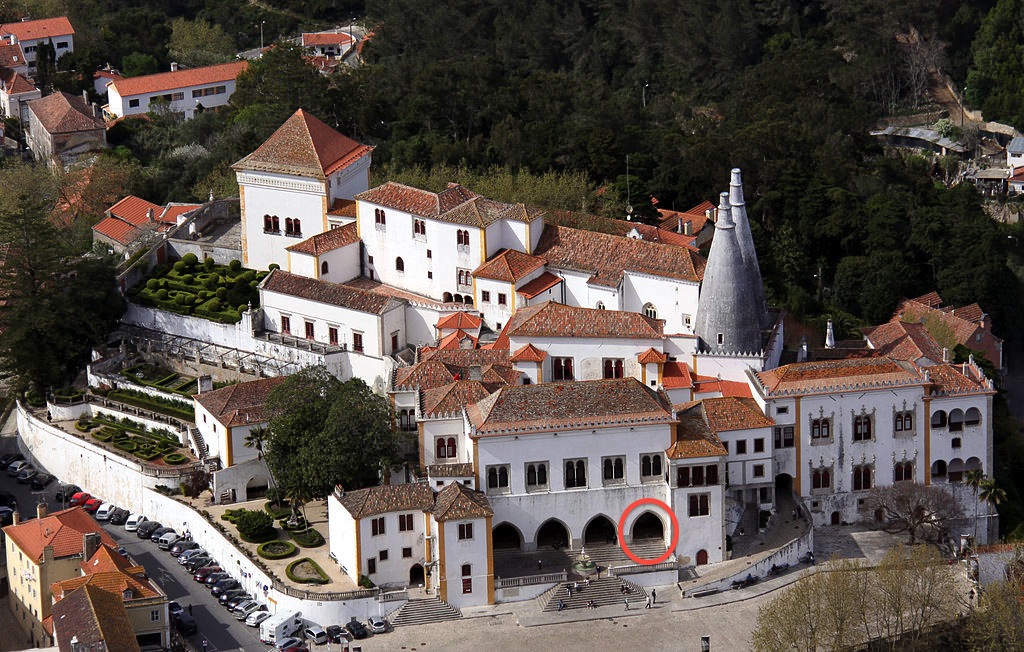
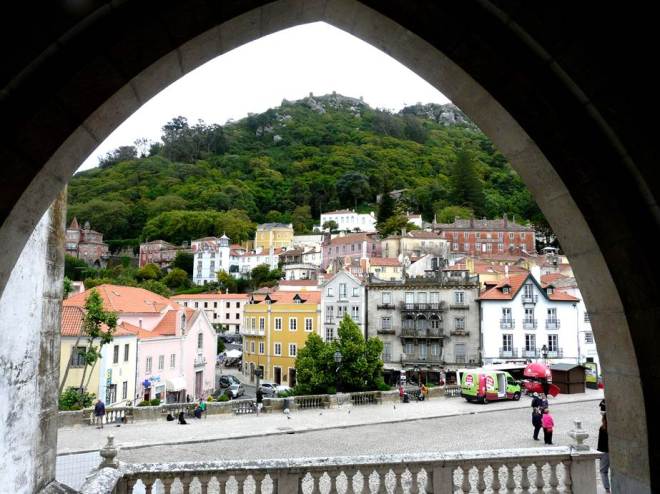
What set me on the right path was good old Google (in German). Old town. Hillside. Merlons. In that order. Three pages into results, I found nearly the same view. This photo shows part of the old town of Sintra, Portugal. The picture was taken from inside the eastern end of the entrance arcade to the Palácio Nacional de Sintra, which served as one of Portugal’s royal palaces from the 15th through the 19th century. Here’s a Wikipedia picture with the photographer’s location in the red circle:
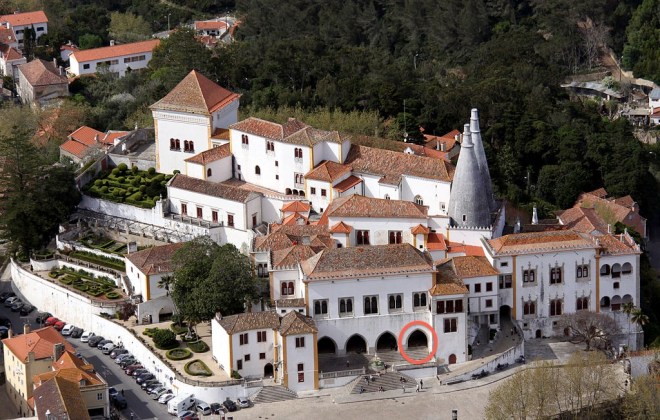
sintra

The whole town is a UNESCO World Heritage Site. Situated less then 20 miles west of Lisbon, this looks like a lovely place to visit.

Another agrees:

If you’ve never been to Sintra, it is well worth a visit. Once you get away from the crowded, narrow streets in the town itself, the Pena Park is incredibly peaceful.  My only tip is that you avoid the humidity of late August – trekking up the hills to the Pena National Palace, which nestles in the mountains overlooking the town, becomes pretty unpleasant in 100 degree weather!

Another points to another palace:

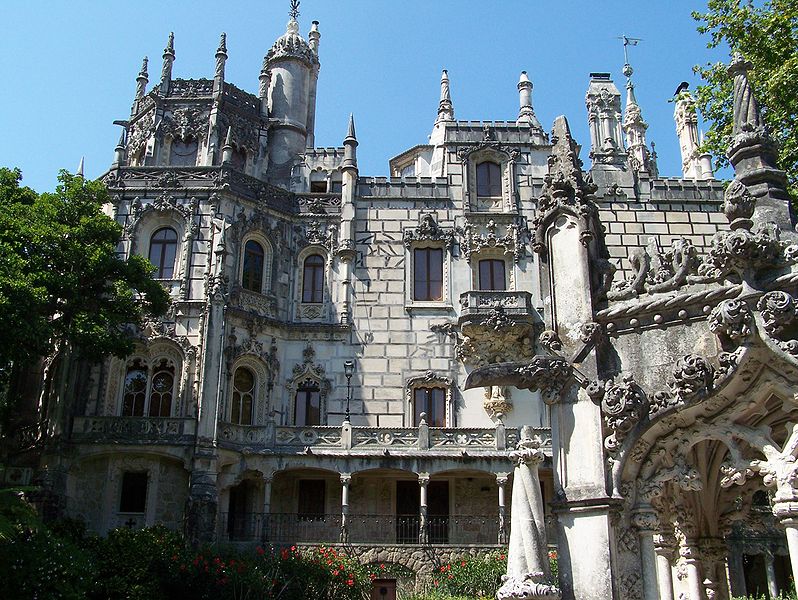
I think this is the first VFYW where I’ve actually been to, so I recognized it immediately.  The view is taken from the Palacio Nacional de Sintra in Portugal. To be honest, where this photo was taken was pretty much as far as I got into the palace; we ended up skipping past the bus tours of people and heading up the hill to the other castles and palaces in the area.  The most memorable was the Quinta da Regaleira, with its gothic architecture and network of tunnels extending below the property:
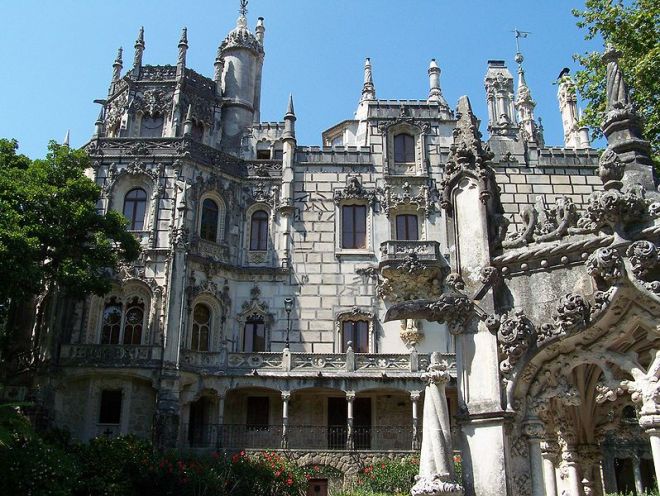
798px-Palacio-da-Regaleira1_Sintra_Set-07

It’s hard to overstate the excess.

Another reader:

I grew up not too far and went to visit the town and its palaces many times with my parents, but I still find new things when I go visit. If anyone goes there, go see the toy museum around the corner from where the photo was taken, go have a travesseiro (a particular pastry) at the Periquita café, go up the mountain to the Disney-like Palácio da Pena or go explore the terraces and caves of the Quinta da Regaleira, full of Romantic symbolisms. Or just wander around through the town and the mountain and enjoy the splendid views.

A word of warning, though: the area between the town of Sintra and Lisbon is heavily overbuilt, so if you take the train directly from Lisbon, close your eyes until you get to the last stop.

Another:

The closest we have ever come to death was walking along the side walls of nearby Castelo dos Mouros (blasting wind, thick fog, no guardrails). I went there in 2006 with my best friend.  I can guarantee you will have at least 30 winning entries with this one (too easy).

Actually closer to 100 readers correctly answered Sintra. Five of them have correctly guessed difficult views in the past without yet winning, but one of them clearly stands out as having participated in a whopping 55 contests over the years, so he breaks the tie this week:

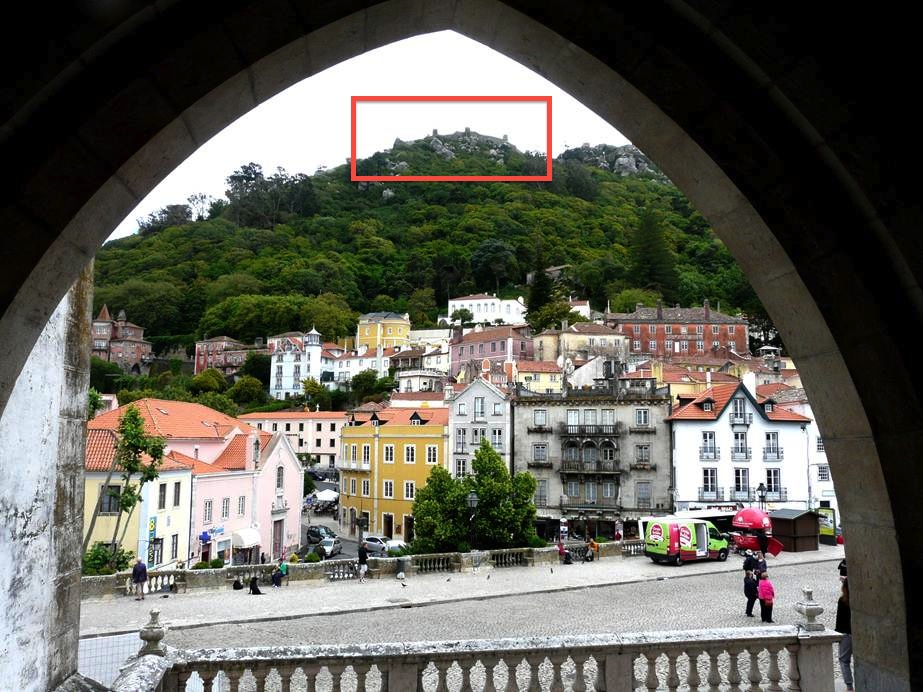
This week’s contest only took a few minutes to solve once I noticed a tiny detail:
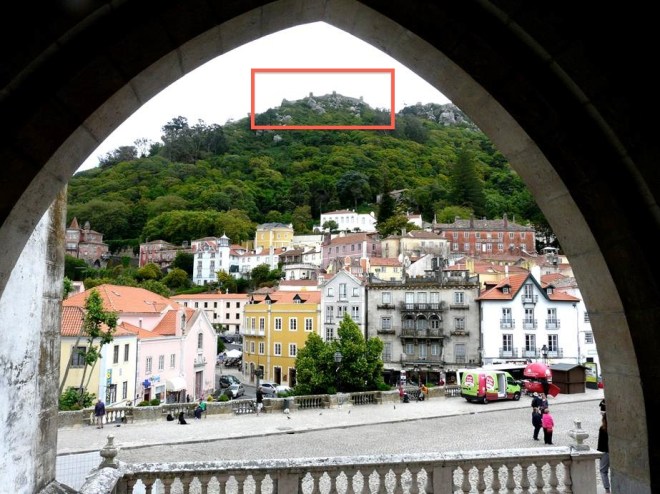
9-7-1

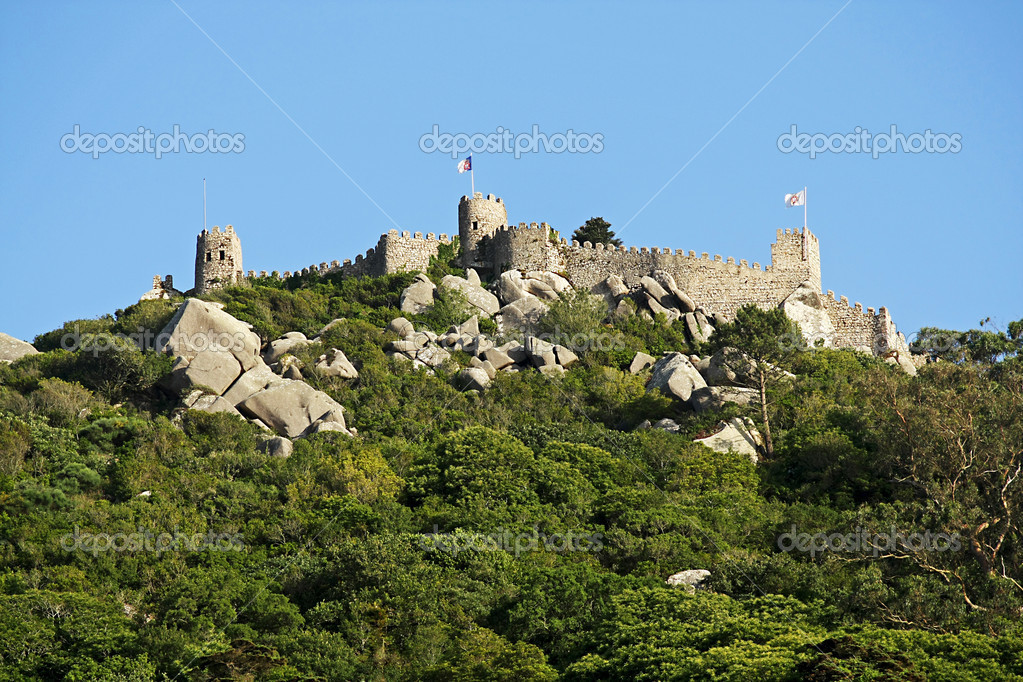
That’s no moon, it’s a spa … I mean, that’s no mountaintop, it’s a castle. Crank up the trusty search engines, and after a handful of misfires, “mountain top castle” did it. The title of one photo I found is “Moorish Castle-Sintra”:
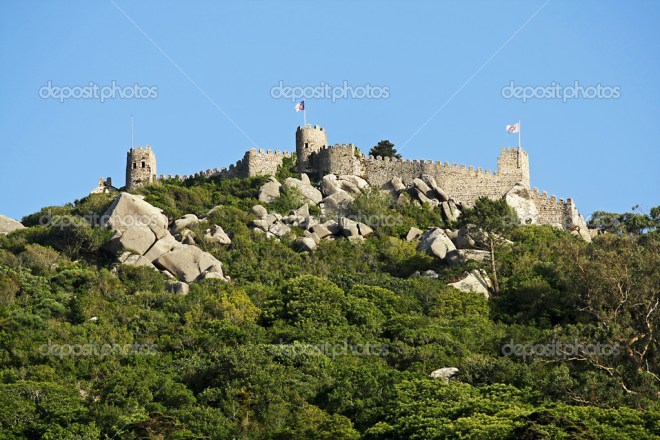
Moorish castle-Sintra

So we’re looking at a castle above Sintra, Portugal, meaning we are IN Sintra. Given the layout of the foreground of the contest photo, there’s only one option for the location, and that’s the Sintra National Palace. There are four large arches on the front of the palace, but given the location of the little fence in front, we are looking out of the left-most arch, or the right-most if you’re facing the building.

That was a particularly fun one. See you next week.

(Archive)
Email Of The Day

A reader writes:

Hey Andrew! I was composing an email to my girlfriend about your Poem For Saturday, because she and I are separated by both time and circumstance and often live vicariously, together, through the Dish. We play the VFYW contest together, we call each other at least once a day to bitch about this or that story you’ve posted, and at least once a week you put something up that makes us both say, “O course Sully would post that today.” Saturday, it was the poem, and the email I wrote her about it led me to this supercut [seen above].

The Dish has played an enormous role in our romance, being one of a select few virtual glues binding our relationship together. So thank you, as always, for being so relevant. And I hope you enjoy the supercut as much as we did.

I did. I have truly tried to watch The Newsroom, largely because Aaron likes it. But the dialogue is so absurd and the fantasy about journalism in 2013 so untethered to any reality at all, it only makes me think about Aaron Sorkin. And after a certain number of dizzying words, my brain hurts.

But it’s always great to read about how the Dish interacts with readers’ lives. And, of course, if you also have a friend or loved one you share the Dish with, or want to share the Dish with, you can always buy a gift subscription here. It’s one thing our current subscribers can do to help us that you haven’t done already.

We Don’t Need To Trust Russia

Josh Marshall makes smart points about the Syria situation:

Don’t look at the offer but the trajectory of events it puts in place. Russia coming forth with this proposal puts in motion a chain of events which totally reshuffles deck internationally in a way that is much more favorable to the US and to the elimination of Syria’s chemical weapons capacity. The Russians (and Chinese) Security Council veto has always been the key variable in this drama. But Russia has proposed this course. The White House quickly floated it past UN Secretary General Ban Ki-moon. He wants to bring this before the Security Council. So that will happen. And it will be extremely difficult for the Russians to veto it.

The key to understand is that this starts a UN Security Council process that probably won’t be vetoed (the Chinese being the wildcard). Soon you’ll have some sort of force on the ground in country inspecting and securing these weapons or knocking at the door of an isolated and recalcitrant Syrian regime.

It is, if it transpires, a huge victory for the US. Yes, it means we have to relinquish ownership of all this and let Russia take the credit – and all the blowback domestically and internationally that might entail. Expect a whole slew of “Munich” stories; a chorus singing the A-word (appeasement); and the usual derision of Obama from the loony right. The great thing about this president is that he doesn’t care how the short-term optics look or how the news cycle plays as long as the result is one he wants. The process toward that goal is inherently messy, but what matters is the result.

The key development of this week is clearly the UN Security Council finally taking this on – led by Russia and backed by China. The credible threat of military force made that breakthrough possible. If it succeeds, Obama will have created a new template for global affairs – one that retains the US as the critical actor, but that also allows for other great powers to assume more responsibility.

This is not a repeat of Bush; it is, rather, the liquidation of the Bush-Cheney mindset, entrenched in the UN and potentially in the Congress. If and when the dust settles, the moment that is currently being seen as Obama’s low-point in foreign policy may eventually be seen by historians as his signature achievement. We don’t know that yet – and much can still go wrong. But this is potentially transformative in America’s engagement with a post-Cold War, post-Iraq War world.

Will The Russian Plan Work?

Michael Crowley claims that it is “likely to fail”:

Last year, the Pentagon estimated that securing the dozens of sites at which Syrian chemical weapons are thought to be stored could take up to 75,000 U.S. troops. A much smaller number (of what would almost certainly will be Russian, and/or United Nations personnel) should be required here, given the presumed cooperation of the Syrian government; they won’t have to shoot their way in. But it’s still a mighty task that could require many hundreds, if not thousands, of trained professionals — plus ample security to protect them: remember that U.N. inspectors were fired upon in Syria earlier this month. “It is a daunting task to get a hold of all these weapons,” deputy national security advisor Tony Blinken told CNN Monday afternoon, “and you probably need a cease-fire.” The odds of that seem awfully small, not least because it would require the fanatical Islamist fighters of al Nusra to agree.

Jeffrey Goldberg also throws cold water:

All Assad has to do to forever stave off a punitive strike is to keep promising that he’s in the middle of giving up his chemical weapons. (No one, by the way, has addressed the fate of his biological weapons.) This is a process that could go on for months, or even years. Yes, that’s right — we might be reading stories soon about United Nations weapons inspectors roaming Syria (a war zone, it should be noted) in a hunt for missing WMD. There are hundreds of tons of chemical munitions in Syria, and very few people think Assad would part with all of them. Why would he? Chemical weapons are a major deterrent to those outside Syria who seek his demise.

Here’s what I’d say in response. Our fundamental interest is in upholding the norm against chemical weapons and ending their use in Syria. Even if the process Jeffrey describes were to take the length of time he suggests, would it not nonetheless do the trick? Would Assad actually use chemical weapons again now that his key patron, Russia, has put its weight behind the Chemical Weapons C0nvention, is in charge of implementing it, and is on record as saying chemical weapons use is intolerable?

The formula for WMD disarmament is pretty simple: the reformed government hands over all it’s got, the stockpiles are checked, the weapons completely destroyed. Russia is now committed to this – and although the process would be possible, as long as Assad still has total control over the weapons, it should be feasible. As for the danger of delay, think back to Iraq.

Do we really believe we were right not to simply keep pressing for more inspections rather than going to war when we did? Delay would not have been fatal then, despite the hawks’ (i.e. my) rhetoric at the time, and it would not be fatal now. Maybe if we stopped rehashing the tired, lazy conceits of zero-sum politics (see this classic from Politico), we could focus on what the US actually wants to achieve as an end-result, and focus like a laser on it.

But skepticism – profound skepticism – toward the Russians and Syrians on this maneuver is certainly valid. The practicalities need to be explored, the deadlines clear, the consequences obvious. And delaying the Congressional vote is no big deal. It makes perfect sense for the US to wait and see if the Russian proposal pays off. If it doesn’t, if the deal falls apart, and if there is another use of chemical weapons by Assad, the case for striking may well be much stronger.

Yes, this is all very unsatisfying – but often tangible success is unsatisfying. You want satisfaction? Jump from a helicopter in front of a banner calls “Mission Accomplished.” You want to achieve your goals? It’s OK to look weak or to cede credit to others. As long as you get what you want.

Dead Children As Talking Points

Former Obama speechwriter Jon Favreau makes an emotionally-charged case for military action:

I don’t like war, or the risks that accompany even the most limited conflicts. But I cannot un-see the images played on CNN over the weekend of little children gasping for their last breath while an invisible poison destroys their nervous system. The world is a messy, complicated place, and I know we don’t always have the ability, or frankly the will, to stop bad things from happening everywhere, all the time.

But years from now, when the history is written about the time a madman gassed hundreds of children while the whole world watched in horror, I want to be able to tell my own kids that I was part of a country that did something about it; that we acted to save more innocents from this special kind of horror, in Syria and in other places where such evil is contemplated.

Obama has also cited the deaths of children on countless occasions – and I don’t doubt it’s informed by a father’s instinctual anguish and recoil. I do not doubt the sincerity of this feeling, or the rightness of it. We just have a duty not to let our frontal cortexes be flooded with that kind of non-negotiable. It was exactly these kinds of absolutes – the torture of children under Saddam, for example – that replaced calm thinking in 2003.

And in the end, far, far more children died because of the US invasion than would have happened in most feasible alternative scenarios. Garance sees the same emotionally blackmailing rhetoric in speeches by Susan Rice (see above) and Samantha Powers:

Either U.S. Ambassador to the UN Samantha Power and National Security Adviser Susan Rice have been working from a script or the two foreign-policy pros, both mothers, share a remarkable affinity for making similar points in the same way, as evidenced by their vivid descriptions of gassed Syrian children during recent speeches making the administration’s case for congressional authorization to use force against the regime of Bashar al-Assad.

As the administration finds that its other messages are, to be kind, not breaking through, its top female national security officials have been making the case that it’s about the kids. They know that it is impossible to look at the pictures of fat babies and adorable toddlers wrapped for burial in late August and not be horrified — not if you have an ounce of humanity. But the question has never been that there was an atrocity committed; the debate has been what to do in response to it.