One of the Internet’s favorite sports:
Month: September 2013
Pulling Out All The Stops, Ctd
Readers respond to that great piece from Ann Friedman on “the pullout generation”:
Your post on pullout method is lacking. For many couples, pulling out simply works. A 2009 study found that when practiced correctly, withdrawal only failed 4% of the time. Condoms, by contrast, had a failure rate of 2%. All things considered (health, risk, and pleasure), this risk differential is acceptable for disciplined, stable couples.
Another agrees:
I think Marcotte misses big on this point: she talks about “decisiveness” versus “ambivalence”, and choosing “in the heat of the moment” (basically, “you should really be more responsible”) but neglects to think that some families simply choose not to make it a decision. Young couples who want children eventually don’t have to be “trying” or “not trying” – they can simply be married, have sex, and maybe conceive a child.
Another reader:
The biggest pregnancy scare I’ve ever had was actually with a condom.
On my birthday several years ago, in the heat of having sex with my girlfriend, I suddenly came when things felt especially good – because the condom had just broken, something I didn’t think to check in that moment of blinding pleasure. She wasn’t on the pill, since it clashed with her medications, so we both started to freak out. We immediately checked an online fertility calendar and discovered she was at peak fertility – so we freaked out some more. First thing in the morning she got Plan B from the pharmacy and no baby ever came of the incident, but it did make me realize how much condoms can give you a false sense of security. Nowadays I pull out even I am wearing a condom, paranoid it might be broken.
In a subsequent relationship, which lasted almost two years, she also wasn’t on hormonal birth control. We stopped using condoms after several months and switched to the pullout method -every single time we had sex, without any slip-ups. Maybe I just have Zen-like self-control, but we never had any pregnancy scares or actual pregnancies (and she had accidentally gotten pregnant twice in her life, both on the pill, so she was plenty fertile … though I guess it’s possible I’m not). At times I still felt irresponsible for only relying on the pullout method, and maybe we just got really lucky, but that long relationship left me convinced that coitus interruptus isn’t the horribly risky method that we were all warned about in sex-ed class.
“Unbelievably Small”
That’s how Kerry described the proposed military strikes against Syria:
Waldman comments:
This was an off-the-cuff remark that he’d obviously like to take back, but it was just an unfortunately exaggerated version of what the administration has been saying all along. It’s going to be limited in duration and scope! It’s hard to convince people that only a minimal effort is required at the same time you’re trying to convince them that this is so very critical.
Fallows focuses on the same disconnect:
The concern all along about the administration’s plans has been the gap between the problem it describes — moral outrage, gassing of children, overall carnage — and the response it is proposing. You can talk about that disconnection: Will an attack make a difference? Might it make things worse? I’ve tried to look into such questions in the posts gathered here. Or you could run back-to-back clips of the same Cabinet secretary saying “this is Munich” and “unbelievably small.” It’s unfair to the admirable and usually eloquent Kerry, but in a moment’s slip-up he crystallized a counter-argument.
Joshua Keating’s two cents:
I may not have much experience with brinksmanship, but it seems to me that threatening to hit someone becomes a lot less effective when at the same time you’re telling your friends,Don’t worry, I’m not going to hit him that hard. And convincing the public that this situation is analogous to the buildup to the largest war in human history is difficult when you’re also saying that an “unbelievably small” effort will be sufficient to deal with it. Given the blows the Assad regime has already absorbed over the last two years, it’s hard to imagine statements like these changing his thinking.
Undercover Critters
After Egypt detained a stork on suspicion of spycraft last month, Mohamed Madi considers the history of animal espionage:
[N]ot all reports of pets on patrol are as far-fetched as they seem. Animals have been serving in the military as early as 1908, when Germans first attached cameras to pigeons to take aerial photographs. Some programs have been more successful than others. The CIA’s attempt to implant listening devices into a cat – dubbed Operation Acoustic Kitty – ended in failure on day one, when the kitty was run over by a car outside the Soviet embassy in Washington DC. The project was estimated to have cost more than $14 million. …
Perhaps the most successful recruits from the animal world have been dolphins. The US and Russia have confirmed the existence of marine mammal training programs, where dolphins and seals are trained to identify underwater mines and disable enemy swimmers. But just like young soldiers, dolphins have hormones and can go AWOL. In March this year, Ukraine’s Defense Ministry had to deny reports that three military dolphins had escaped and were roaming the Black Sea in search of sex.
“A Miraculous, Doomed Campaign”
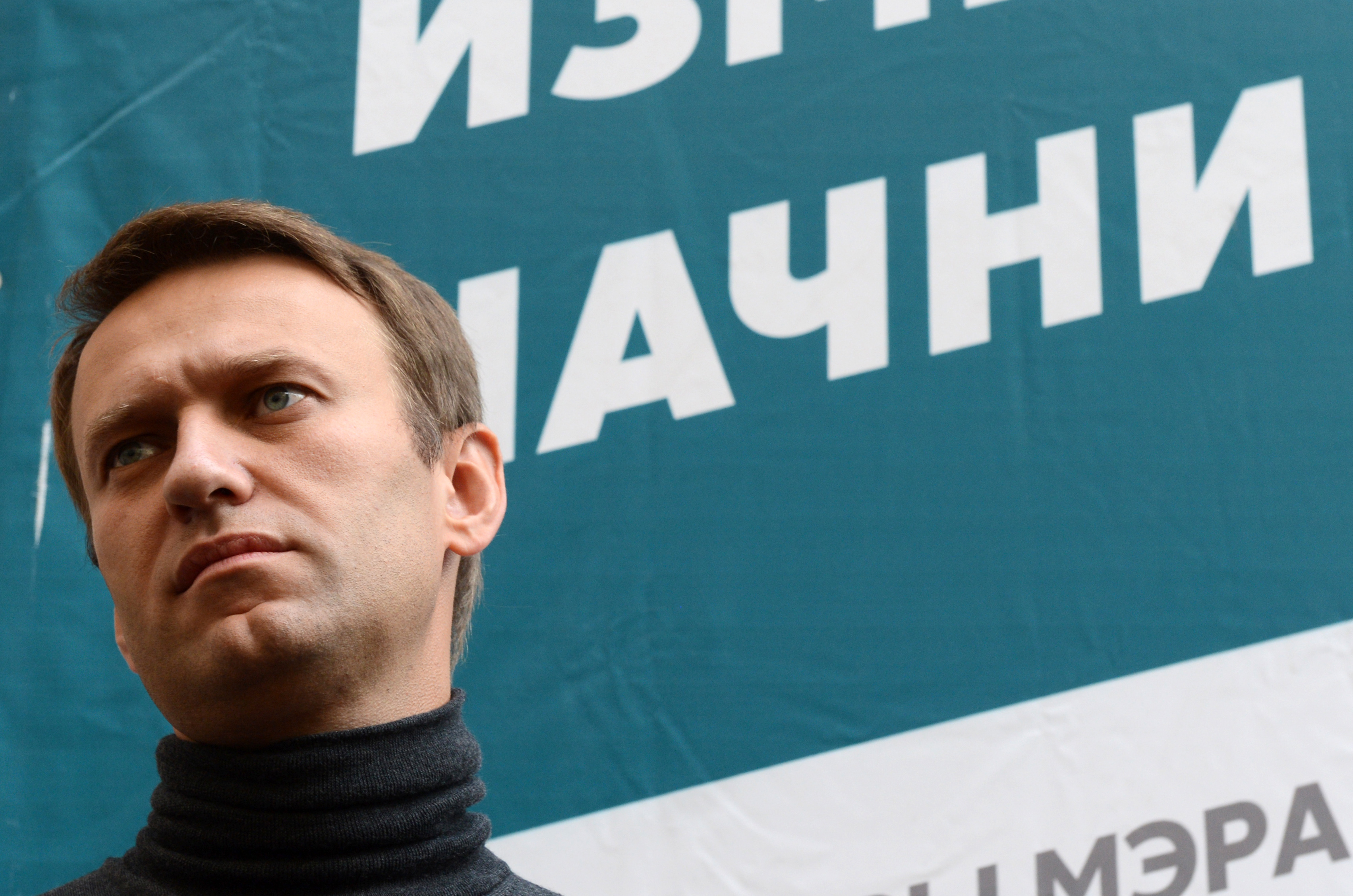
That’s how Masha Lipman assessed Alexey Navalny’s run for mayor of Moscow prior to the voting yesterday:
The system may have let Navalny run, but his campaign has unfolded in a difficult environment. Moscow officials have made public announcements accusing him of irregularities and campaign-policy violations (none of the allegations have been substantiated). Navalny personally was alleged to be hiding his ownership of real estate abroad—but no solid evidence was presented. Police raided an apartment where Navalny supporters allegedly kept “illegal” campaign materials; the door to the apartment was broken, and two young men were detained for ten days. No one explained what was illegal about the materials. Stacks of campaign newspapers have routinely been stolen. At one of his neighborhood meetings, Navalny himself was seized by the police and driven away. He was released shortly thereafter with no explanation.
Muscovites who decorated their apartment balconies with Navalny banners received visits from municipal officials or police, who demanded that slogans be removed. On several occasions, “visitors” emerged on straps outside the apartments, like window-washers but with cutting equipment. At least once, a “hanging visitor” physically threatened the host in a highly expletive manner. Episodes of similar harassment were reported day in and day out.
According to the official election results, Navalny ended up with 27 percent of the vote. Timothy Frye sees his strong showing as an embarrassment to Putin-backed incumbent Sergei Sobyanin, who narrowly achieved a first-round victory:
Sobyanin, who was thought to be generally popular in Moscow, a city that has prospered in recent years, likely thought that he could coast to victory against an inexperienced candidate with little organization in a very short campaign without relying on the most crude forms of falsification. Earning an easy victory in an election against a “real” opposition figure could have greatly increased Sobyanin’s standing – perhaps even as a potential successor to President Putin. Yet in squeaking by with just over 51% of the vote, Sobyanin returns to office diminished. Navalny, on the other hand, may end up in jail but by beating expectations he cemented his position as a leader of the opposition.
The runner-up is requesting a recount:
Navalny said he does not recognize the results, which he said were falsified. He insisted Sobyanin polled less than 50 percent and should have faced a runoff.
Previous Dish on Navalny and his arrest this summer here.
(Photo: Opposition candidate in Moscow’s mayoral race, Alexei Navalny, speaks to the media at his campaign headquarters in Moscow, on September 9, 2013. Russian opposition leader Alexei Navalny warned of protests after narrowly failing to push Moscow’s pro-Kremlin mayor into a run-off in tight elections he claimed were rigged. By Vasily Maximov/AFP/Getty Images)
Why Doesn’t China Just End Its One-Child Policy?
Because it’s a huge source of revenue:
[F]or a long time, the fee [paid by parents for extra-legal births] has been collected and spent in opacity, without even a hint as to how revenues generated from it are allocated in most local governments’ annual budgetary reports.
On July 11, 2013, Youshui Wu, a lawyer from Zhejiang Province, tackled this issue by submitting applications to the family planning commissions and treasury bureaus of 31 provincial-level political authorities, requesting the reports of how the money was levied and spent in 2012. By August 31, 17 provinces had responded with information on the amount of money collected in social support fees in 2012, yet none explained how the money was spent. The fees levied in the 17 provinces totaled 16.5 billion RMB (about $2.7 billion US dollars). …
Within this context, it is easier to understand why, despite strong public objection to the policy and academic proof of the policy’s long-term harm on China’s demographic structure, the strict birth control policy has remained resistant to reform.
How Many Syrian Rebels Are Terrorists?
https://twitter.com/Partisangirl/statuses/365042816046489600
Michael Kelley touts the work of researcher Liz O’Bagy, a lobbyist for the rebels:
O’Bagy estimates that supporters of Jabhat al-Nusra and ISIS — the two main al Qaeda-linked groups — probably involve about 5,000 to 7,000 fighters while the number of rebels participating in offensive operations is about 80-100,000 rebels. So a subset of Syrian rebels are certainly linked to al Qaeda, but terrorists only make up about 10% to (at the very most most) 20% of the opposition.
The idea that we should accept as fact these self-serving notions is preposterous. We really shouldn’t be Chalabied again. Judis puts it more dispassionately:
Is the administration right about rebels? Or has it changed its line to accord better with the case it wants to make for military action in Syria? One cannot answer this question definitively. Reporters and independent researchers have very limited access to Syria; and the situation on the ground continues to shift. When I asked Yezid Sayigh, who is a senior associate with the Carnegie Middle East Center in Beirut, about the relative strength of the moderates and extremists, he said, “None of us really knows, not us outsiders and not most Syrians.” But this much can be said: There is at least as good evidence against the administration’s claim of rising moderation as there is for it.
Heads Up
I’ll be on Anderson Cooper’s CNN show tonight at 10 pm on Syria with Christiane Ahmanpour, Charlie Rose, and Glenn Greenwald, among others. I’ll be on the show every night this week – and will be a regular guest in the coming months.
Kerry Gaffes; The Russians Blink, Ctd
Josh Marshall advises the administration to “grab on to” the Russian proposal:
I’m not saying I think it will be easy or that the Russians are sincere. But getting all the regimes chemical weapons arsenal under international control would be no small achievement. Simply focusing on it would give the US something to apply leverage against (something it sorely lacks at the moment) and put the Russians in an awkward spot. The introduction of foreign forces of whatever sort is always something a regime trying to remain in power seeks to avoid. It would be a development that might well be used to leverage Assad out of power.
The key is that this potentially allows the US to reshuffle the deck and come at the problem on terrain which is inherently more favorable, given the Russian opening. Take the whole thing back to the Security Council. Have the Russians veto what they just proposed.
Jed Lewison adds that, “if Russia were actually able to get Syria to relinquish its chemical weapons, it’s hard to imagine a scenario where the administration would proceed with an attack”:
Of course, that’s the best case scenario. The flip-side is this: What happens if Russia and Syria say they are in the process of handing over weapons, but don’t take action quickly enough to satisfy the administration? Would the U.S. attack Syria at the same time that Russia was claiming to disarm it of chemical weapons?
Fisher is unsure whether Russia’s plan is legit:
[I]f Russia and Syria do go through with this plan, it would signal that both believe Assad can still win without chemical weapons. They would probably be correct. And it would significantly reduce the odds of any U.S. action against Assad, although it’s debatable whether that would be a good or bad thing for Syria. But, as Washington Institute for Near East Policy Executive Director Robert Satloff pointed out to me on Twitter, the “exit of chemical weapons would end any possibility of U.S./Western military action to balance the battlefield.” That’s a sign that Lavrov’s plan might be for real.
Drum weighs in:
[W]hat if the Russians aren’t playing games, but are seizing an unanticipated opportunity? It’s possible that for all their bluster, the Russians would actually like a way out of this that saves some face. It’s also possible, if you believe the latest reports in Bild am Sonntag, that Assad never wanted last month’s chemical attack to go forward in the first place. His generals did it without his go-ahead. So maybe he’d just as soon be rid of the stuff.
I doubt it. But it’s at least an intriguing thought.
Mataconis suggests that it “may not even matter if this Russian proposal is all that serious”:
The President’s request for authorization to use force is already in perilous trouble in Congress and even members of his own party are having a hard time getting in line behind him. If there’s a proposal sitting out there that could potentially avoid military action, which the Syrians have seemingly expressed a willingness to consider seriously, then it strikes me that it’s going to become all the more difficult to convince reluctant Members of Congress to get behind the President. The President has already said on more than one occasion that there is no imminent threat to the United States from Syria’s chemical weapons and that the attack that he has in mind can essentially be delayed indefinitely. He conceded that much by submitting the matter to Congress while at the same time insisting it was not an urgent enough matter that they needed to reconvene early. Indeed, it’s already been nearly three weeks since the attack which is supposedly the basis for the attack. If it was okay to wait this long, the reluctant legislator is likely to ask, then why not wait a little longer to see if this proposal pans out?
Dreher asks why the administration wouldn’t support this proposal:
Why would the Obama administration walk back Kerry’s statement, especially if the Russians are on board with it? I thought that the US goal here was simply to destroy Syria’s chemical weapons capabilities. If we can get a verifiable international operation to peacefully disarm Syria’s chemical stockpiles, why not?
Unless the Obama administration is using “chemical weapons” as cover for regime change.
Why Is Bombing The Something We Must Do?
I asked that question last night. Fallows is on the same page:
From what I can tell, approximately 100% of the pro-strike arguments have been devoted to proving what no one contests. Namely, that hideous events are underway in Syria, that someone (and most likely Assad) has criminally and horrifically gassed civilians, and that something should be done to reduce the ongoing carnage and punish the war crimes. And approximately 0% of the argument has addressed the main anti-strike concern: whether U.S. military action — minus broad support, any formal international approval, or any clear definition of goal, strategy, or success — is an effective response.
The Russian proposal is a start, don’t you think? Or what Congressman Chris Smith has suggested:
I think there is the potential to get China and Russia to agree to a [war crimes] tribunal, provided it applied equally to the rebels as well as the Syrian regime. This would be a non-lethal approach to Syria and would put them on the wrong side of justice for all and holding mass murderers to account. The pressure would be very profound. But it hasn’t even been tried. So why not try it before this bloodletting gets much worse?
 The Dish