Benjy Hansen-Bundy and Tasneem Raja survey the 50 states to determine the maximum penalty for texting while driving in each. Sending that SMS can cost you anywhere from $10,000 (in Alaska) to diddly-squat (in Arizona, Montana, and South Dakota):
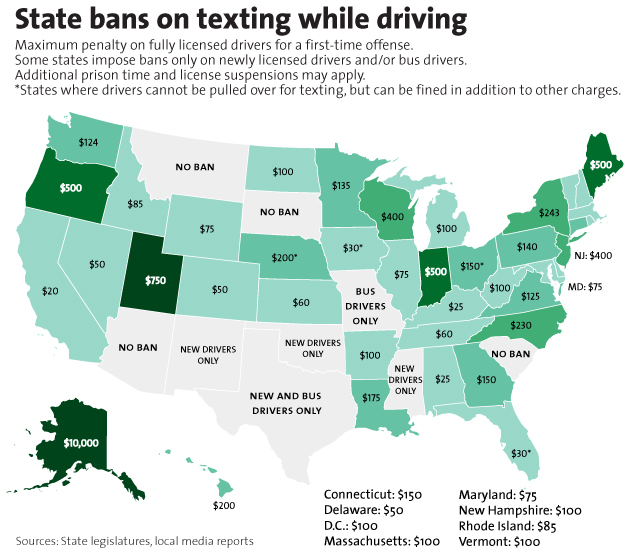
Benjy Hansen-Bundy and Tasneem Raja survey the 50 states to determine the maximum penalty for texting while driving in each. Sending that SMS can cost you anywhere from $10,000 (in Alaska) to diddly-squat (in Arizona, Montana, and South Dakota):
In Hitler’s Furies: German Women in the Nazi Killing Fields, Wendy Lower documents how German women contributed to the horrors of the Holocaust. An excerpt:
For the young women who were assigned to the East or who volunteered to go—to fulfill their ambitions and the regime’s expectations, to experience something new, and to further the Nazi cause — witnessing the realities of the Holocaust had usually several effects: it hardened their determination; it confused or eroded their sense of morality (as is clear in the assertion that the Jews in the ghetto “don’t feel this humiliation”); and it triggered the search for outlets to escape what was unpleasant or repulsive, for opiates such as sexual pleasure and alcohol. Vodka flowed in nightly parties with, as one secretary recalled, the “nice lads in the office.” Moral transgressions seemed to go unnoticed, or at least unpunished. Scenes of unfettered greed and violence were common. Those who tried to stay away from what was happening around them found few places untouched by the war’s devastation, and little solace.
In a review of the book, Michael Kimmage calls the aftermath – when some guilty women defended themselves as “incapable of crime because they were women and mothers” – “the bleakest page of a bleak book”:
In many cases, Holocaust survivors were able to testify against women who had committed horrendous crimes, and either the women were not tried or their accusers were not believed. If incarcerated, the women were released—often early. Johanna Altvater—the woman who undertook to murder Jews on her own—was tried and acquitted twice. She worked, after the war, in a child welfare office.
The biography of a woman named Erna Petri is no less extraordinary. Put on trial in East Germany, she “confessed to murdering six Jewish children between six and twelve years of age.” She was found guilty and imprisoned. After German reunification, she negotiated her release, possibly with the help of Stille Hilfe (Silent Aid), a postwar SS organization in Germany. She moved to a Bavarian village “where she enjoyed the Alpine mountains and lakes with Gudrun Burwitz, the daughter of Heinrich Himmler and a prominent member of Silent Aid.” The entire village attended her funeral.
This is a new genre of Holocaust story. Unlike Schindler’s List, a cinematic version of it would be unbearable.
Recent Dish on women’s role in the Third Reich here.
Branding Terror, a design book by former UN counter-terrorism analyst Artur Beifuss and creative director Francesco Trivini Bellini, catalogs the logos of 65 terrorist organizations across the globe. Jez Owen is a fan:
To be able to study the real thing … is an unusual opportunity for designers and
historians. What we discover is that it is a rhetoric of idealism combined with a heavy dose of pageantry that drives these logos, and in turn the organizations that they represent. … Whilst some of the marks are theatrically elaborate, others are incredibly simple; where some are expertly created, others are crudely drawn; many employ cliché upon cliché: however, all apparently have the capacity to convey powerful messages. A world emerges where aesthetic and graphic design skills take second place to connotation. The goal, first and foremost, is to persuade.
Owen’s objection:
Branding Terror is a tour de force of visual research with one fundamental flaw: its categorization as a design book. As one reads, one can’t help feeling that to talk about terrorism in pure graphic terms is to ignore the violence that has been and will be committed in its name, that a discussion of color references and font choices trivializes the subject.
In a July review, Dawn Perlmutter scorned the book: “The authors should stick to producing art books, as they have no training in the significant subtleties of the subliminal and covert imagery contained in terrorist propaganda”:
The book “Branding Terror” essentially sugarcoats the jihadist threat by applying a biased interpretation of the emblems, minimizing the iconography of martyrdom and sanitizing obvious violent indicators, such as the black flags of jihad and swords that are depicted in many of the Islamist logos. The sword is described throughout the book as a premodern weapon that represents the historical struggle in early Islam. Two crossed swords in the emblem of the Indonesian group Jemmah Anshorut Tauhid are described as indicating “JAT’s commitment to jihad. As a pre-modern weapon, the sword is linked to early Islamic jihad campaigns; it is also associated with the purity and nobility of early Islamic heroes. By using swords as a design element JAT confers legitimacy on its jihadi activities, and portrays them as a modern extension of historical jihadi campaigns” (p. 187). There is no reference at all to the swords’ significance in representing “the sword verses” in the Quran, which jihadists use to justify their violence or that they represents Jihad by the sword (jihad bis saif), which refers to armed fighting in holy war. …
Merrell, the book’s publisher, claims on its website that “Branding Terror does not seek to make any political statements; rather, it offers insight into an understudied area of counter-intelligence, and provides an original and provocative source of inspiration for graphic designers.” The statement that this book’s aim is to be a source of inspiration for graphic designers is truly obscene and makes it clear that the authors have no concept of what these symbols represent. These groups are not selling cereal; they are selling fear and their “brand” is backed up by murder, suicide attacks, beheadings and bombings. They are not misunderstood freedom fighters, or peaceful protestors — they are mass murderers. Sugarcoating the violence minimizes the threat, and referring to their emblems as “brands” also diminishes the seriousness of their violent ideologies.
(Image of Jemmah Anshorut Tauhid emblem via TRAC)
Barbara J King extends anthropologist Marshall Sahlins’s concept of “mutuality of being” – a relationship in which “the individuals involved remain emotionally and cognitively taken up with each other’s lives even when they are not together” – to the animal kingdom:
In 2005, two Moulard ducks were rescued from a foie gras factory and brought to Farm Sanctuary, an organisation with safe-haven properties in New York and California. The two ducks, named Harper and Kohl, had suffered significant emotional and physical trauma at the factory.
When they arrived at the sanctuary, both animals were frightened of humans, both had the liver disease hepatic lipidosis, and each had his own serious medical issues too. For four years at the sanctuary, they were nearly inseparable. When Kohl could no longer walk or his pain be treated effectively, he was euthanised, and Harper was allowed to watch. When Harper approached the still body of Kohl, he first prodded it, but then lay down and draped his neck over Kohl — for hours. In the following days and weeks, Harper withdrew socially, preferring to spend his time alone near a small pond where he had often gone with Kohl. Two months later, Harper died, too.
This sad story moves me because it asks us to think beyond ‘the usual suspects’ at the frontiers of animal emotion and intelligence. While scientists and animal caretakers have only just begun to record qualitative data about animals’ responses to death, and to address larger questions that bear on mutuality of being, we have strong clues that suggest the fully interdependent nature of animals’ non-kin relationships. Mutuality of being need not be expressed only through language. Animals, too, can feel their lives deeply, and they might even feel the co-presence of others — whether related by blood or not — in those lives.
Previous Dish on the complexities of animal life here, here, and here.
Dan Colman captions:
Shaun Clayton got into the spirit, took a series of 1950’s and 60’s-era coffee commercials from the [Prelinger] Archives … and “edited them down to just the moments when the guys were the biggest jerks to their wives about coffee.” The point of the exercise, I’d like to think, wasn’t just to show men being jerks for the sake of it, but to throw into stark relief the disturbing attitudes coursing through American advertising and culture during that era. And nothing accomplishes that better than mashing up the scenes, placing them side by side, showing them one after another. It gives a clear historical reality to views we’ve seen treated artistically in shows like Mad Men.
The World Economic Forum has once again named Iceland the most equal country for women, while the US has slipped in the rankings to #23 (pdf). Catherine A. Traywick tells economists to take note:
The notion that gender equality drives development (rather than the other way round) has been so widely celebrated in recent years that it begins to seem trite. But as the newly released 2013 Global Gender Gap Index – which measures gender parity in 136 countries – reminds us, gender equity isn’t simply a matter of equal rights. It’s a matter of efficiency. …
Take the Philippines. It ranks #5 on the Global Gender Gap Index, higher than any other Asian nation. It’s the only country in Asia that has fully closed the education gender gap, and its labor force boasts growing ranks of women workers, especially professionals and managers. Not surprisingly, the Philippines is now the fastest growing economy in Asia, having recently edged out China (#69 on the index).

Last week, a Pew survey found that one in ten Americans qualifies as an “online dater.” Among the other findings:
In general, online daters themselves give the experience high marks. Some 79% of online daters agree that online dating is a good way to meet people, and 70% of them agree that it helps people find a better romantic match because they have access to a wide range of potential partners.
Yet even some online daters view the process itself and the individuals they encounter on these sites somewhat negatively. Around one in ten online daters (13%) agree with the statement that “people who use online dating sites are desperate,” and 29% agree that online dating “keeps people from settling down because they always have options for people to date.”
Lance Whitney points to other perils:
More than half of online daters said they met someone who “seriously misrepresented” themselves in their online profile. And 28 percent said they were contacted by someone in a way that made them feel harassed or uncomfortable. Around 42 percent of women expressed that feeling, compared with just 17 percent of men.
Read a related Dish thread, “A Dating Site For Every Subculture,” here and here.
Barry Werth examines how prescription drugs are evaluated for effectiveness and cost. From the intro to the in-depth piece:
Prices are set and raised according to what the market will bear, and the parties who actually pay the drug companies will meet whatever price is charged for an effective drug to which there is no alternative. And so in determining the price for a drug, companies ask themselves questions that have next to nothing to do with the drugs’ costs. “It is not a science,” the veteran drug maker and former Genzyme CEO Henri Termeer told me. “It is a feel.”
There are inherent problems with a system where the government is one of the biggest payers, and where doctors, hospitals, insurers, pharmacy benefit managers, drug companies, and investors all expect to profit handsomely from treating sick people, no matter how little real value they add to patients’ lives or to society.
Drug companies insist that they need to make billions of dollars on their medicines because their failure rate is so high and because they need to convince investors it is wise to sink money into research. That’s true, but it’s also true that the United States, with less than 5 percent of the world’s population, buys more than 50 percent of its prescription drugs. And it buys them at prices designed to subsidize the rest of the industrial world, where the same drugs cost much less, although most poor governments can’t afford them at even those lower prices.
Still, we have to ask: When is the high price of a drug acceptable? Perhaps it is one thing when Vertex [Pharmaceuticals] charges $841 for two pills a day—every day of a patient’s life—for medicine that will save that life, and quite another when [French drug maker] Sanofi offers a cancer drug that is twice as expensive as its alternative but offers no obvious advantages.
Previous Dish on the subject here. Update from a reader:
Your post that touched on Vertex Pharmaceuticals was startlingly well-timed for me. I am a devoted Dish reader. I also have cystic fibrosis, and at this very moment I am doing my treatments for the condition at a hotel, where I’m staying prior to my appointment for a clinical trial of Vertex’s next CF drug in the pipeline.
Your entry brings up several important further issues and questions, some of which are covered in the remainder of the Werth piece. Vertex’s research has been heavily supported by the Cystic Fibrosis Foundation, a charity that supports CF research, so it’s startling to see a charity-funded drug coming in at $300K per year. Vertex has also pledged to provide its drugs free of charge to any patient who cannot afford them or whose insurance will not cover them, which causes one to wonder whether more and more insurance companies would take a look at the situation and decide there’s no reason for them to cover the drugs.
Finally, Vertex has based its pricing based in part on the costs of other CF treatments that patients would theoretically – and hopefully – no longer need. However, living with CF, you learn quickly that if you don’t adhere to your treatment regimens, you can lose your health pretty rapidly, and I bet a lot of patients will be reluctant to simply cease all their other treatments right away, preferring to take their time confirming that Vertex’s drugs work as well as advertised before placing all of their eggs in the Vertex basket.
Thanks for your coverage of this important issue. While CF is a relatively rare disease, it has long been important as a harbinger of emerging trends in medicine, and this is certainly another instance in which that is the case. As our capabilities increase, more personalized drugs will become available or at least possible to produce for a wide range of conditions and diseases – but at what price?
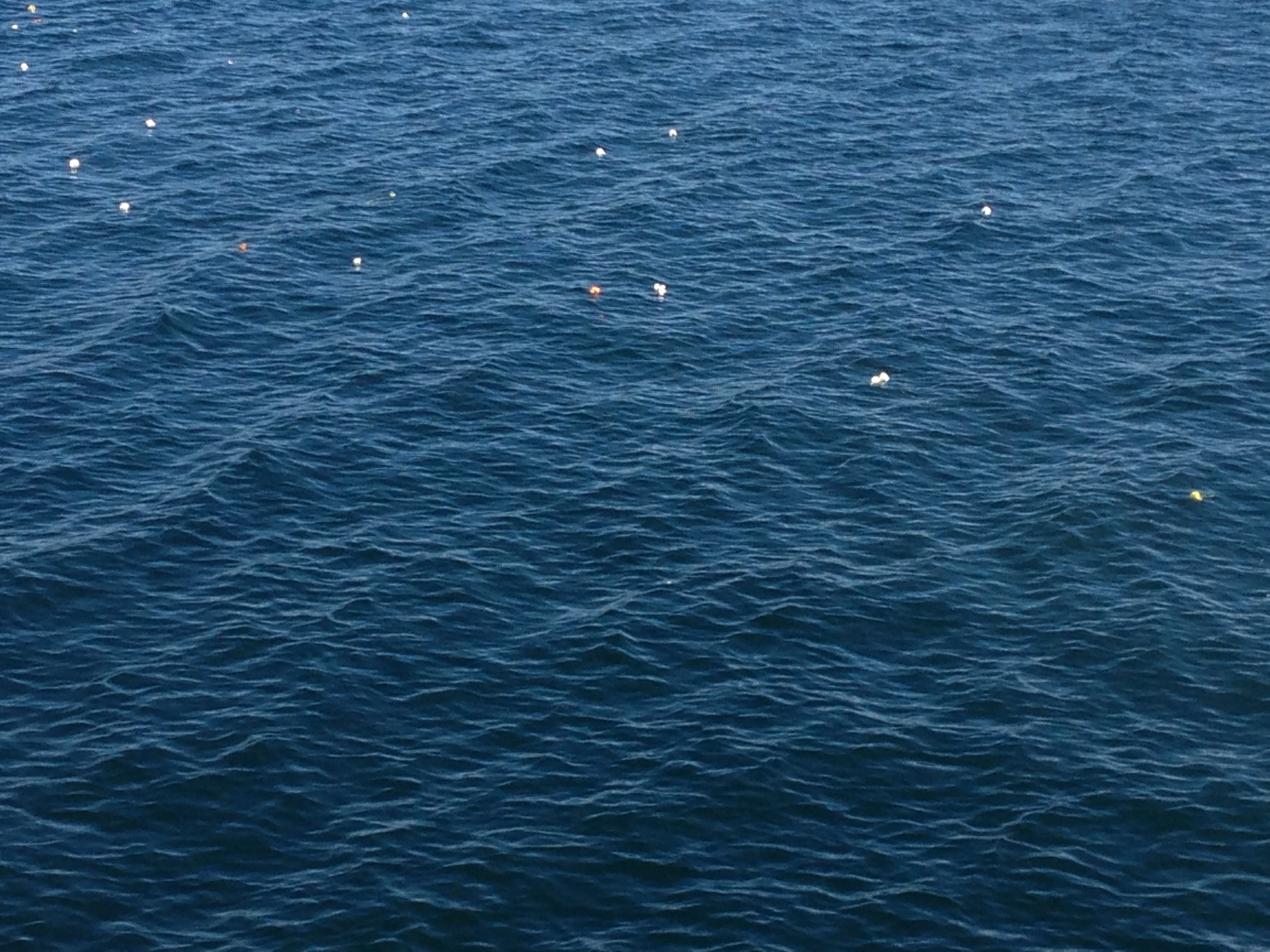
We headed up to Provincetown yesterday to say goodbye to our dear friend, Norma Holt. Today would have been her 95th birthday. It was a beautifully crisp fall day, with a wind gusting around us, as we stood at the end of MacMillan Wharf and spoke and read and danced and then each took a flower and a handful of dust that was once Norma and tossed them into the bay. Almost as soon as it was over, I felt suddenly weighed down by some irresistible pressure, and, instead of going to the reception afterwards as I had intended, I took to bed. I woke up a couple of hours ago, as the dusk was creeping across the cottage. We were supposed to throw Dusty’s ashes into the bay today as well. Tomorrow.
My favorite post of the weekend was Pope Francis’ homily on faith and ideology – and the difference between them being prayer. And by prayer, Francis meant opening oneself to God in silence, wordless, doing nothing, merely – merely! – being-with-reality. Francis has told us of his own recent moment of intense prayer, just before his papacy became public:
My head was completely empty and I was seized by a great anxiety. To make it go way and relax I closed my eyes and made every thought disappear, even the thought of refusing to accept the position, as the liturgical procedure allows. I closed my eyes and I no longer had any anxiety or emotion. At a certain point I was filled with a great light. It lasted a moment, but to me it seemed very long. Then the light faded, I got up suddenly and walked into the room where the cardinals were waiting and the table on which was the act of acceptance. I signed it, the Cardinal Camerlengo countersigned it and then on the balcony there was the ‘”Habemus Papam”.
It has nothing to do with, as Buddhists understand, thinking.
And when Francis says ideology, he means (I think) both a neurotic and public fixation on a set of truths or doctrines – and also a fusion of religion and politics. This is the distinction I have tried to make between Christianism (an ideology) and Christianity (a faith). Ridding the latter of the former could do a huge amount to improve public life – and politics – in America.
Four others: the power and freedom of friendship as a virtue; a child’s face painted in earth on eleven acres; a reality show about the ultimate reality – death; and why it may be worth taking your kids to see the explicit lesbian love story, Blue Is The Warmest Color.
Plus: Stark. Naked. Skiing. And reader discussions of online hookups and dating.
The most popular post of the weekend was How Faith Becomes An Ideology; The second was the astonishing recreation of what a song from Ancient Greece would have sounded like: A Hellenistic YOLO.
See you in the morning.

For Lee Billings, the author of Five Billion Years Of Solitude: The Search For Life Among The Stars, space exploration offers “the only chance available for life on Earth to somehow escape a final, ultimate planetary and stellar death”:
We really owe our progress and our current state not only to our biology, but also to our planetary resources – to the fossil fuels we burn, the ores we mine, the rich diversity of other species we exploit, and so on. We’re presently using most of those resources in very unsustainable ways. We’ve already plucked all the low-hanging fruit, and much of what we are burning and mining and exploiting now is only available to use through our already sophisticated technology.
So if we somehow drive ourselves extinct, if all our great edifices collapse, I think it would be very difficult if not impossible for anything else to rise up and rebuild to where we are now, even given a half-billion or a billion years. People can and will disagree with me about that, but my position errs on the side of caution, on the side that says humanity’s present moment in the Sun is too valuable to treat as something disposable.
And before the Sun dies out, we will continue to get incredible footage like this:
(Photo: Image of the Earth and Moon taken by the MESSENGER spacecraft from a distance of 61 million miles. By NASA/Johns Hopkins University Applied Physics Laboratory/Carnegie Institution of Washington)

 The Dish