Cartel Tourism

In an increasingly stable Colombia, the decline of drug violence has led to the rise of drug-violence-themed tourism. Karen Catchpole eyes the market that’s developed around one-time kingpin Pablo Escobar:

Now there are at least 10 companies offering Escobar tours in Medellín – making stops at his grave, the site where he was killed, and other grisly landmarks. My guide on the $45 Escobar tour offered by Medellín City Tours, John Echeverry, says he had to think long and hard before agreeing to take the job. As we turn our backs on Escobar’s grave, Echeverry tells a story about the time that he and 44 of his classmates (including the son of Escobar’s cousin and Medellín Cartel business manager Gustavo Gaviria) were invited to Escobar’s private retreat, Hacienda Nápoles, for the weekend. “There were mini motorcycles for all of us,” Echeverry remembers. “We sat at a long table and we could have whatever we wanted.” He shakes his head. The memory has him caught, like the rest of the country, between Escobar excitement and Escobar shame.

Seeing Human History Through Herpes

A new paper does just that. George Dvorsky summarizes:

The specific virus used for the new study, which was conducted by Curtis Brandt and Aaron Kolb of UW-Madison, is the herpes simplex virus type 1 (HSV-1) which typically causes nothing more than cold sores around the mouth. It’s not lethal, but it’s incredibly virulent. It tends to run in families owing to the manner of infection, which can include simple contact like kissing or through saliva. It’s been such a part of the human story that Brandt refers to herpes as “a kind of external genome.”

For the study, the researchers compared 31 strains of HSV-1 collected in Africa, Europe, Asia, and North America. Then, by mapping the mutation patterns of the virus, they were able to reconstruct the way herpes hitchhiked on humans as they traversed around the globe. By using high-capacity genetic sequencing and advanced bioinformatics, the researchers were able to parse through the massive amount of data embedded within the 31 discrete genomic strains.

Joshua Keating adds:

In general, the paper suggests that the data “supports the “out of Africa model” of human migration with HSV-1 traveling and diversifying with its human host”. There was one North American derived strain which they found was related to the East Asian family of the virus. They estimated the “divergence time” between this strain and its relatives as around 15,000 years which corresponds “with the estimated time period in which the North American continent was populated from Asia, approximately 15,000 years BP.”

In other words, the first arrivals on the North American continent may have brought their cold sores with them.

Laughing In The Face Of Trauma

Lindy West praises the short film Meet My Rapist (seen above) as an effective comedic take on rape, especially from a victim’s perspective:

It’s a brilliant, troubling example of how “rape jokes” can be cathartic and complex and difficult and empowering—for victims and allies, not for the predatory and indifferent. As I’ve said many times before, I don’t want to ban rape jokes; I want to see more rape jokes, everywhere, targeting rape culture instead of perpetuating it. Because nothing punctures and deflates hypocrisy like humor. Nobody speaks truth to power like a sharp-toothed goofball.

The filmmaker, Jessie Kahnweiler, describes how she translated her own experience of rape into comedy:

I think the distance between making the film and the actual rape (which occurred eight years ago) and the frustration came with this feeling, like, “what the fuck, it’s been eight years and I’m STILL not over this? what the hell, man?!” The film deals a lot with my frustration and trying to reconcile being a “strong/ badass feminist” with a “hurting victim,” and being a sexual being as well. There is such a certain amount of guilt and shame around my own body with this experience, and the film was a chance to confront all these lurking fears.

My immediate reaction was just that: a reaction. I was formulating my feelings around my rape based on what other people felt and thought about it. Does that make sense? Like, I was so busy making sure my friends and family knew that I was “OK” that I forgot to ask myself if I actually was “OK.” Perhaps I used humor to skip over the pain and move straight to the hero rape victim, but obviously that shit caught up with me.

How Much Math Do We Really Need?

Long-time math teacher Gary Rubinstein confesses that he would “gleefully chop at least 40 percent of the [math] topics that are currently taught from K to 12”:

Two hundred years ago, students who finished high school learned about as much mathematical content as modern fifth graders learn today. And over the past 200 years, topics were gradually added to the curriculum until the textbooks have become giant bloated monstrosities. And though the modern high schooler ‘learns’ algebra, geometry, algebra II and trigonometry, statistics, and maybe even precalculus and calculus, the average adult still only remembers about as much as the adults from 200 ago did, or about what the average fifth grader is supposed to have learned.

His modest proposal: Make all math instruction optional after 8th grade.

Getting Real About Regret

Carina Chocano finds that those who insist we “just look on the bright side” are “not just as inhumanly opposed to emotion, but also as anti-intellectual”:

In starting to lay out the possible uses of regret, [Janet Landman, author of Regret: The Persistence of the Possible,] quotes William Faulkner. ‘The past,’ he wrote in 1950, ‘is never dead. It’s not even past.’ Great novels, Landman points out, are often about regret: about the life-changing consequences of a single bad decision (say, marrying the wrong person, not marrying the right one, or having let love pass you by altogether) over a long period of time. Sigmund Freud believed that thoughts, feelings, wishes, etc, are never entirely eradicated, but if repressed ‘[ramify] like a fungus in the dark and [take] on extreme forms of expression’. The denial of regret, in other words, will not block the fall of the dominoes. It will just allow you to close your eyes and clap your hands over your ears as they fall, down to the very last one.

Not surprisingly, it turns out that people’s greatest regrets revolve around education, work, and marriage, because the decisions we make around these issues have long-term, ever-expanding repercussions. The point of regret is not to try to change the past, but to shed light on the present. This is traditionally the realm of the humanities. What novels tell us is that regret is instructive. And the first thing regret tells us (much like its physical counterpart — pain) is that something in the present is wrong.

The Führer’s “Performing Flea”

In a 1982 review from TNR’s archives, Samuel Hynes evaluated a biography of P.G. Wodehouse, the British humorist behind Jeeves and Wooster.  He zeroed in on Wodehouse’s lowest moment, when he provided broadcasts for German radio after being captured during WWII.  But Hynes wrote that “as Fascist propaganda [the broadcasts] were surely no more useful than [Ezra] Pound’s were”:

Still, it’s not surprising that the British took a harsher view, and considered that Wodehouse had given comfort to the enemy. He was never tried, but the incident darkened his life, and made him an exile until his death. Even long after the war he could get no assurance from the British government that he would not be prosecuted if he returned to England, and so he ended his days at Remsenburg, on Long Island, though at the last moment the British did relent enough to offer him a knighthood (the Queen Mother’s work, no doubt).

The whole episode is a sad one, reflecting only discredit on everyone connected with it. It is interesting, though, for what it suggests about Wodehouse the man, and also about the kind of writing of which he was so much a master. Throughout the German years, and for long afterward, Wodehouse behaved like one of his own characters—like the imbecile Bertie, or Lord Emsworth, that “vague and woolen-headed” peer whom he admitted he resembled. He never really did understand what he had done that was wrong, and though he regretted having broadcast, it was only because it had offended his readers. The moral issues of the war seem never to have penetrated his woolen head.

Update from a reader:

As is often the case, Orwell got there first. In his wonderful essay “In Defence of P.G. Wodehouse” (July, 1945), he makes the argument that Wodehouse was really only guilty of stupidity and to charge him with treason, etc. was “untenable and even ridiculous.” Orwell believed the that fascism was a distinctly modern (i.e. interwar) phenomenon. Orwell’s contention is that Wodehouse’s mind never moved beyond 1914 (nor did the mental universe of any of his characters, including the knee loving “fascist” Roderick Spode). To Orwell’s mind, Wodehouse was a Victorian who couldn’t even comprehend fascism and Nazi tyranny, let alone be complicit in it. It’s interesting that this is also his argument for why Kipling, that “good bad poet,” was also innocent of fascism – his mental universe never grew beyond the summer of 1914. 

(Video: “P.G.Wodehouse faces the music from his wife, Ethel, following the reception of his broadcasts on German radio during WWII.”)

The Rape Double-Standard, Ctd

A reader writes:

I think one of the things that is being missed by most of the contributors to this thread is that male-on-female rape is rarely about sex.  Typically, it’s an assertion of power on the part of the male, not a desire to get off sexually without seeking the consent of the other.  But in most of the stories sent in by your male readers about non-consensual sex, the dynamic seems different.  In none of those stories does it seem like the female is trying to exert power over the male; it seems like the females just want to get off.  Maybe that’s why the guys respond so differently to being “violated.”

Another reader:

Interesting conversation you’ve been having about the many forms of rape and how we as a society perceive them. I actually think language is posing an obstacle here. Look at “killing”. All killings end with the same result: death. But look at how many legal names we have for it. There’s murder (and even murder one and murder two), manslaughter and involuntary manslaughter. There’s also justifiable homocide, killing in self-defense, suicide, euthanasia, assassination, killing during war – all these distinctions and definitions to describe a variety of traumatic acts that end in the same exact result: death.

And yet we use the word rape to describe a widening range of actions with a vast range of outcomes.

We use rape to describe a man hiding in the bushes, pouncing on a woman in the dark and penetrating her while holding a knife to her throat. And we now also use it to describe a man buying a woman too many drinks at a bar and having sex with her while she’s conscious but inebriated. Both acts are wrong, but do they really deserve to be described with the same word?

Yes, we do sometimes distinguish between rape and statutory rape, but even there, when a male authority figure coerces a young child into sex, is that the same thing as a high school senior smoking a joint with his sophomore girlfriend and engaging in sex that is seemingly consensual, even if the law doesn’t recognize it as such?

And now we bring in the variety of male-victim rapes, many of which are certainly as traumatic as those of the female variety. However, having a stronger man force himself upon you and penetrate you is not the same thing as waking up to find your girlfriend using your sleep-induced erection for her pleasure without your permission. I was once the “victim” of the latter, some 15 years ago. Prior to that, had you asked me, I would have said that waking up to such a scenario might be fun. But it wasn’t. It was annoying, disturbing and felt like a violation. I expressed my displeasure, she apologized and then I felt a little bad for making her feel bad about it. I forgot about it shortly after and never think about except at the rare times like now, when the topic is brought up.

Had it been reversed, had she woken up with me on top of and inside her, I’m pretty sure she would have been far more upset and far more traumatized. In the instance of my being violated, I think it would have been a gross overreaction for me to call the police and cry rape, but in the reverse scenario, that might be a reasonable reaction.

There is a double standard, or a multiple standard, and one of the key factors is penetration. I think I would have felt differently had there been a digit or object inside me than I felt waking up inside her. And I think the distinction is enough to give the two acts different names. One is rape and the other is… something else, maybe harassment?

As for the story that started this all, that of Chris Brown’s loss of virginity at 8 to a girl of 14, it seems there are so many distinctions that keep it from feeling like rape to my mind, and the fact that he is male is NOT one of them. First, he was underage, but so too was the girl. Second, according to his description, she did not in any way seduce him; rather the desire was mutual. And finally, while there was pressure put upon Brown, it did not seem so much to be from the girl as from his environment. You could blame those around him who applied the pressure, but then who would be the culprits … 11 and 12 year old neighborhood boys?

Did the incident in question shape Brown’s attitude toward sex and later actions? Possibly. Probably. But does that make it rape? I just don’t see it.

One more story:

Ok, you finally have provoked me to respond. I unfortunately have a lot of thoughts on this subject. For one thing, I have unequivocally been “taken advantage of” by a girl before. In my college days, back in the ’90s, I went to a friend’s apartment, and when I arrived, I was invited in by her roommate. Her roommate was extremely attractive, and in the process of waiting for my actual friend, somehow she talked me into taking a pill. Now, I liked pills back then, and this is not about my genuine lack of good judgment at a time when I was totally reckless. Besides, I think this girl could have talked me into just about anything.

Regardless, it was a Rohypnol, the infamous roofie of date rape fame. What ensued that night was a total blur. I remember bits and pieces, like ending up at a party with the girl, but not what happened at the party, or what happened when it was over. What I do remember, however, was waking up the next morning, naked in the bed with her, and then taking a shower with her (we were both late for class), as if it were perfectly normal, and wondering, “what the hell just happened?” I wasn’t upset over the thought of having been with her. I was upset that I couldn’t recall any of it. Not one bit. The most satisfaction I got out of it was seeing her naked, and wondering.

Now, I clearly was culpable in the sense that I freely popped a pill which I didn’t have any experience with. But as other readers have pointed out, had the gender roles been reversed, I would clearly have been the aggressor, and she the victim, and subject to prosecution had she desired it.

The bigger picture here is that we, as a society, are using one term, “rape,” in an overly broad fashion. Rape is a crime of sexual violation, with elements of aggression, violence and/or control. What happened to me, was not a crime of aggression, was not violent, and arguably was not about control, as I more than certainly would have had sex with the girl freely, if my consent had been solicited.

Therefore, it can not be rape. It was a non-violent exploitation, maybe even some violation of me (was the violation sexual? Or was it a violation of trust?), with a sexual component, and it didn’t live up generally accepted ethical standards, but it wasn’t rape. Unfortunately, we don’t have a criminal system that recognizes “ethical lapses” as very real, albeit misdemeanor, classes of sexual misconduct. The lack of such distinction, however, means that many people are wrongly accused and convicted over a minor ethical lapse for the same crime as legitimate menaces to society; conversely, many people are never brought to any kind of justice because (in my case) there is no way I would make an accusation of rape against that girl, even if what she did was “wrong,” and I am sure there are many examples of women who have been wronged that aren’t prepared to make a rape claim for similar reasons. And even worse, the contorted legal standard creates the terrifying reality that men in emotionally abusive relationships have to live in fear of being accused of rape, as at least one of your readers alluded to.

As usual, thank you for airing such a sensitive topic.

The Best Of The Dish Today

Upper Ojai-CA-720am

We asked whether the default debacle had wounded the GOP badly enough. I hoped so. I made a way-too-early judgment about Chris Christie’s chances of becoming president in 2017. We noted the fact that the liberal blogosphere was not spinning away the failure of healthcare.gov the way the rightwing blogosphere refused to see the errors in Iraq until it was way too late. One Republican Senator bemoaned the GOP’s current unfitness for any actual, you know, government. And we found out why male bugs bugger each other – because of epistemic closure.

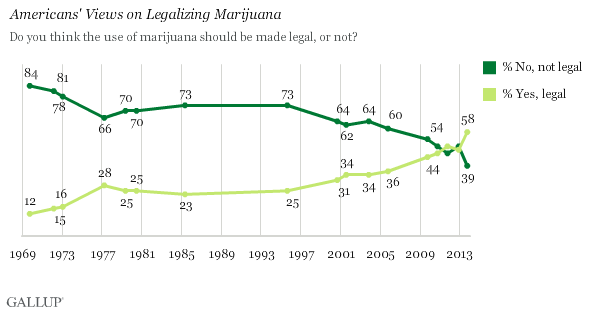
I celebrated the life and spirit of Mother Antonia of La Mesa prison in Tijuana, Mexico, and made a case for the centrality of women in the future of Catholicism. We all celebrated the astonishing new majority – 58 – 39 – for legalizing a drug the US government still insanely argues is as dangerous as any substance we know of. And you’ve never seen a dog shake like this, or a cuter baby platypus.

The most popular post of the day remained Jesus Wasn’t A Republican. The second? Just How Badly Did The GOP Lose The Shutdown?

The window view above is from Upper Ojai, California, at 7.20 am. One final reader email that made my day:

I finally became a subscriber today, after months of ambivalence. I have no particular interest in religious matters, grand bargains, or matters of facial hair. But your unequivocal characterization of Cheney as a war criminal on CNN compelled me to support you financially. If you continue to do for the prosecution of war crimes (including the crime of “looking forward, not backward”) what you’ve done for gay marriage, then I’ll multiply my contribution ten fold over the next couple of years – and tell my friends to do the same.

I will continue to campaign for full awareness of the war crimes of Dick Cheney and for accountability – including from those in the current administration – yes, I’m talking to you, Mr Brennan – who continue to aid and abet the denial. And, as you might have noticed on some other topics, I tend not to give up. You can support that effort quite simply: by [tinypass_offer text=”subscribing here”].

See you in the morning.

A 60-40 Majority For Marijuana Legalization!

Gallup polled Americans on marijuana and found that “for the first time, a clear majority of Americans (58%) say the drug should be legalized”:

Gallup Marijuana

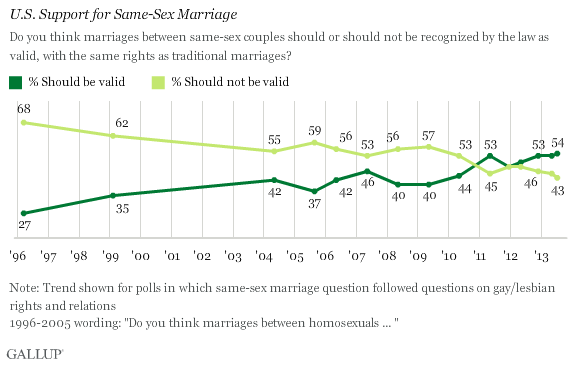
The Dish has waged many campaigns over the years, from ending torture to tackling the long-term debt, but I’m particularly proud of championing two social reforms: the legalization of marijuana and civil marriage for gay couples. They appear very different, but both are about bringing outlaws into the civil mainstream. Being gay went from being a crime to being a citizen in my lifetime. Now, smoking or vaping the harmless, ubiquitous drug, marijuana, is beginning to be thought of as indistinguishable from drinking the much more harmful, ubiquitous drug, alcohol.

jwowsa1ks020ehlt19i1la

What the two reforms also have in common, in my view, is adjusting our social norms to empirical reality. It was always absurd to think of gay people as somehow outside the norms of love, commitment and family. It is empirically insane to treat pot as having no conceivable medical use and classified in the most dangerous category there is. And yet our government proved itself incapable of adjusting to reality on both blindingly obvious questions, until the people long moved past it.

Well, Tocqueville is proven right again, isn’t he?

An experiment in two states with full legalization has revealed the pure fear behind our current criminalization of a plant, just as a single state with marriage equality almost a decade ago began a tidal wave of acceptance. Joshua Tucker sees things the same way:

If anything the public opinion swing on marijuana legalization seems a bit more dramatic … suggesting that policy change could come even faster. Splits based on partisanship are almost the same in both cases — Democrats come in at 65 percent in favor marijuana legalization, 69 percent  in favor of gay marriage, while Republican support is at 35 percent  (marijuana) and 26 percent  (gay marriage) — and in both cases, there is overwhelming support among 18-29 year olds, 67 percent  of whom believe marijuana should be legal and 70 percent  of whom think gay marriage should be legal.

More important: on this issue as with marriage equality, Independents are much closer to Democrats than Republicans, with 62 percent support. The GOP is now effectively the oldest generations’ angry veto of the younger generations’ demography, values and politics. Jacob Sullum looks at other recent polling:

Gallup’s survey asks, “Do you think the use of marijuana should be made legal, or not?” That leaves open the question of whether commercial production and distribution should be legal as well (as in Colorado and Washington). But other national polls that go beyond marijuana consumption also have found majority support for legalization.

In a Reason-Rupe survey last January, for example, 53 percent of respondents said “the government should treat marijuana the same as alcohol.” And last month a Public Policy Polling survey in Texas found that 58 percent of respondents either “somewhat” or “strongly” supported “changing Texas law to regulate and tax marijuana similarly to alcohol, where stores would be licensed to sell marijuana to adults 21 and older.” The latter finding was especially striking given the state’s conservative reputation.

And Josh Barro puts support for marijuana legalization in perspective:

More Americans want to legalize marijuana than think President Obama is doing a good job (44%), want to keep or expand Obamacare (38%), favored attacking Syria (36%), support a 20-cent gas tax increase to pay for infrastructure (29%), or like the Republican Party (28%). And legal marijuana has more than five times as many supporters as Congress does (11%).

The Obama administration is following behind, gingerly. Perhaps it’s because this president was such a hard-core stoner in his youth that he feels a little constrained in even discussing the subject. But his administration could easily revisit the – I repeat – insane classification of marijuana as the most dangerous kind of drug there is. What are they waiting for?