Gopnik ponders Diane Francis’s new book on US-Canada merger:
One never quite knows how seriously to take books of this larksomely utopian kind. That once famous book making an argument for the abolition of television was really meant to point out that we could do well with less—but the seemingly equally unreal “Will the Soviet Union Survive Until 1984?” turned out to be prescient. And Francis’s book, though cheerily deadpan, has some serious points to make. The really significant thing may be that the one crucial holdup to the merger is American medicine. In a section called “America’s Health Care Blind Spot,” she writes, “The US system of health care is indefensible from an economic as well as a business standpoint.” And, she adds, “If Americans had the same system as Canada or Germany the savings would total 1.079 trillion per year.” She also has some harsh things to say—again, strictly from a balance-sheet point of view—about our military. In other words, the takeaway of this free-market, business professor’s view is not that America would engulf Canada but that Canada would need to be sure America was up to grade before it could consider the merger. With all the difficulties Obamacare has had getting set up, that fundamental point is not about to go away.
Back in the early ’90s, NASA determined that newborn jellyfish nurtured in space are probably not fit for life back on Earth. What does that mean for us?
Jellyfish, foreign to us in so many ways, are like humans in one very particular manner: They orient themselves according to gravity. As the biologist RR Helm explains it:
When a jelly grows, it forms calcium sulfate crystals at the margin of its bell. These crystals are surrounded by a little cell pocket, coated in specialized hairs, and these pockets are equally spaced around the bell. When jellies turn, the crystals roll down with gravity to the bottom of the pocket, moving the cell hairs, which in turn send signals to neurons. In this way, jellies are able to sense up and down. All they need is gravity.
Humans, of course, are similarly sensitive. We sense both gravity and and acceleration using otoliths, calcium crystals in our inner ears that move ultra-sensitive hair cells, thus informing our brains which way gravity is pulling us. So if the space-raised jellyfish didn’t fully develop their version of gravity-sensors, the thinking goes, it’s likely that humans raised in microgravity would have similar trouble.
A new Amnesty International report on drone use in Pakistan captures the physical and psychological damage caused by drone strikes. Friedersdorf hightlights troubling findings from it, such as this one:
“When children hear the drones, they get really scared, and they can hear them all the time so they’re always fearful that the drone is going to attack them,” an unidentified man reported. “Because of the noise, we’re psychologically disturbed, women, men, and children. … Twenty-four hours, a person is in stress and there is pain in his head.” A journalists who photographs drone strike craters agreed that children are perpetually terrorized. “If you bang a door,” Noor Behram said, “they’ll scream and drop like something bad is going to happen.”
Far from solely blaming the United States, the report also points what its authors perceive as failures on the part of Pakistan—for leaving this region of its jurisdiction under-developed, and creating a vacuum to be filled by armed groups who “have been responsible for unlawful killings and other abuses constituting war crimes and other crimes under international law in Pakistan, Afghanistan and elsewhere.”
Pakistan has a poor record for bringing these perpetrators to justice without resorting to the death penalty, and the country’s neglect of the region has also failed to ensure that its residents enjoy key human rights protections.
But also Pakistan has a duty to independently and impartially investigate all drone strikes in its own country and “ensure access to justice and reparation for victims of violations,” just as the United States is obliged to investigate drone strikes and hold those responsible for innocent lives lost accountable.
Human Rights Watch also has a new report on America’s use of drones but its report focuses on Yemen. Abby Haglage analyzes:
The findings paint a portrait of a drone strike program starkly different than the one spelled out during remarks by President Obama in May of this year. “America does not take strikes to punish individuals—we act against terrorists who pose a continuing and imminent threat to the American people,” the president said, adding that terrorists would only be considered a viable target for a drone strike if capture was not feasible.
Contrary to this declaration, however, the report alleges that Obama has continued to approve drone strikes in which a target’s “imminent threat” is not defined, or the option of capture not fully exhausted. On top of potentially unlawful strikes, [report author Letta] Tayler writes, the U.S. has neither offered consolation to the families of civilians killed, as promised by former CIA Director John Brennan, nor so much as acknowledged their role in the death of innocent Yemenis.
America’s failure to acknowledge these wrongful deaths is demonizing it, Tayler concludes. “It’s gotten to the point where many Yemenis fear the U.S. more than they fear al Qaeda in the Arabian Peninsula,” she said. “When the U.S. government is considered more of a demon that one of the most notorious groups in the world…Obama has a major image problem.”
The reports come at a time when the administration is signaling its intention to shift away from the use of drones toward other counterterrorism tactics. However, as the report argues, President Obama’s few statements on the topic indicate that he favors a policy shift away from drones rather than legal guidelines on when and how they can be used.
A woman performs as a fool during a ceremony as part of the Royal Wedding Held For Sultan Hamengkubuwono X’s Daughter Gusti Ratu Kanjeng Hayu And KPH Notonegoro in Yogyakarta, Indonesia on October 22, 2013. Wedding celebrations will take place October 21-23 October. The wedding parade will include 12 royal horse drawn carriages and will be streamed live on the Internet so that it can be watched by people all over the world. By Ulet Ifansasti/Getty Images.
Are there any dishes or foods that you would classify as typically, or even exclusively, “American?”
A number of iconic foods—hot dogs and hamburgers, snack food—are hand-held. They’re novelties associated with entertainment. These are the kinds of food you eat at the ballpark, buy at a fair and eventually eat in your home. I think that there is a pattern there of iconic foods being quick and hand-held that speaks to the pace of American life, and also speaks to freedom. You’re free from the injunctions of Victorian manners and having to eat with a fork and knife and hold them properly, sit at the table and sit up straight and have your napkin properly placed. These foods shirk all that. There’s a sense of independence and a celebration of childhood in some of those foods, and we value that informality, the freedom and the fun that is associated with them.
The footage is from the talented and twisted Carli Davidson, whose work the Dish has featured quite a bit over the years. You can order her new coffee-table book Shake, a collection of 61 photos, here.
Jessica Love flags a new paper that indicates “our responses to poems that defy our formal expectations may also have an emotional component.” Researchers presented study participants with limericks that, in their final lines, violated a formal property of the poem, such as rhyme scheme, expected rhythm, proper syntax, or overall poem coherence:
[R]esearchers measured participants’ pupils as they listened to the poems. Here, they found that the rhyme violations—and only the rhyme violations—caused the pupils to dilate.
Now, as behavioral measures go, pupil dilation is pretty new, and nobody can argue with any confidence how it should be interpreted. But an earlier study pegged it to mental effort: the faster the mind spins, the more the pupils react. So first the researchers reasoned that rhyme violations in limericks simply elicit more surprise or confusion (and thus require more mental work to overcome that surprise or confusion) than other sorts of violations. But no, a closer look at responses to individual poems revealed that even those rhyme violations that received relatively “ok” ratings still caused pronounced dilation, while other types of “highly anomalous” violations did not. This led researchers to their next preferred interpretation: above and beyond evoking surprise, rhyme violations in limericks pack a singularly emotional wallop.
Ramesh Ponnuru talked to a senator “who requested anonymity so he could describe the party’s problems candidly”:
At a Senate Republican lunch the day of the vote, someone mentioned that the party wasn’t ready to run the Senate: If Republicans had held a majority in both the House and the Senate, they wouldn’t have been able to pass anything in either chamber. The senator thinks such a turn of events would have been “incredibly damaging.” He heard a similar sentiment from the other chamber of Congress: House Republicans from his state have told him how much happier some of their colleagues would be if they were in the minority and could just lob spitballs at the Democrats. “We have to really think how we become the governing party,” he says.
Similarly, Chait argues the Tea Party’s goals are divorced from policy and governing:
On the surface, demanding an end to Obamacare in return for reopening the federal government was an insane negotiating strategy. Attempting to analyze these demands in strategic terms misses the point. It’s not a plan to achieve a defined legislative end. It’s a demonstration of dissent from a political faction that has no chance of winning through regular political channels. The problem they are attempting to solve in each case is not “how do we achieve this policy objective?” but “how can we express our outrage?”
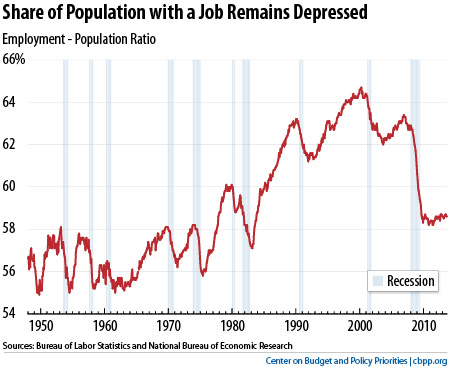
That’s how Binyamin Appelbaum describes today’s jobs report. Neil Irwin’s analysis:
Choose your non-inspiring adjective, possibly in Yiddish, and it nicely describes the long-awaited September jobs report. It wasn’t terrible by any stretch — the nation added 148,000 jobs, and the unemployment rate edged down a tenth of a percent to 7.2 percent. But it is far short of the kind of robust jobs recovery that Americans have been waiting for these last four long years.
The only positive, if it could be called that, is the decline in the unemployment rate to 7.2%, a near-five year low, from 7.3%. Before rounding, the drop was barely noticeable. Meanwhile, the labour force participation rate held at a multi-decade low of 63.2%.
We should be doing better than this. And if it weren’t for the fiscal cliff deal and the sequester and all the other austerity measures we’ve put in place since 2010, we probably would be. These numbers might very well be double what we’re actually seeing. This, as always, is a self-inflicted wound.


 The Dish