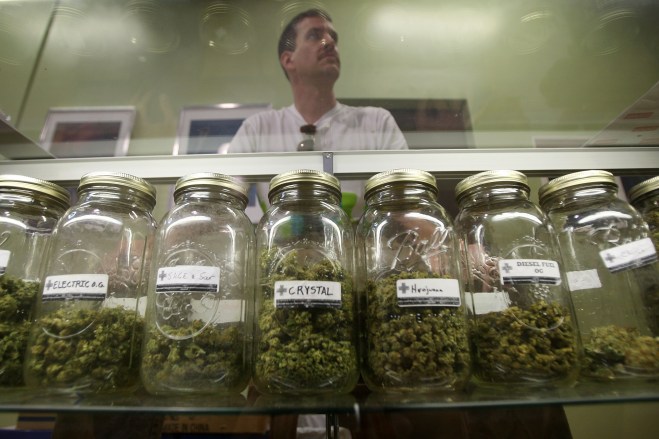
Cheney’s Ticking Time Bomb

ku-bigpic

A reader writes:

I just watched Sanjay Gupta’s interview with Dick Cheney about his new book chronicling his long-time heart problems that finally led to a full transplant a few years ago.  While the headlines have been harping on the “terrorist could’ve hacked his defibrillator”, the striking thing to me was just so sure he was that his extensive list of health problems didn’t have any effect on his decision making. And he sure didn’t like Sanjay’s questions; he most likely presumed he’d be getting softball questions.

One excellent fastball:

[O]n March 28, 2001, Vice President Cheney wrote a “pending” letter of resignation because he suspected he might at any moment become incapacitated by health problems. This was surely a surprise for those affiliated with the Bush campaign who had vetted Cheney’s health before asking him to run. But Cheney’s cardiologist was a big fat liar and told the Bush campaign cardiologist that Cheney “was in good health with normal cardiac function.”

When Gupta asked Cheney to explain the doctor’s false claims, Cheney responded, “I’m not responsible for that.” Gupta answered, “But sir, you saw it.” And then Cheney, refusing to address the lie, dug in: “Listen to me, I think the bottom line is: was I up to the task of being vice president? And there’s no question. I think based upon the fact that I did it for eight years that they were right.”

The transcript from Gupta’s interview is here. Last night he popped on AC360 Later to discuss the interview, prompting my reaction in the video seen below. It’s rare to hear a dispassionate case for the war crimes of Dick Cheney on cable news, so check it out. I didn’t pull any punches:

This embed is invalid

The Administration Can Delay The Mandate Itself

According to Nicholas Bagley and Austin Frakt:

As things stand, the rules the [HHS] secretary has put in place provide for an individualized application process. But nothing in the law prevents her from tweaking that approach. If necessary, she could draft a new rule instructing nonfunctional exchanges — including the federally operated ones — to issue blanket certifications on behalf of all of the uninsured in their states. With those blanket certifications, the penalty would be waived — and all without congressional action. With luck, it won’t come to that and the exchanges will all be operational long before mid-February. But if they aren’t, the Obama administration could spare the uninsured from being punished just because government officials couldn’t build a few websites on time.

Chait welcomes this news:

The real upside here is that, because it doesn’t require Congress, the administration could use a mandate delay to actually improve the functioning of the law, as opposed to using it to destroy the law, as Republicans in Congress have suggested.

The Republican’s mandate-delay plan was to pass a fixed-length mandate delay — they proposed this before any website failures became public — as a condition for reopening the federal government, and then just continue to trade mandate delays for bills reopening government, so that the mandate would be delayed indefinitely. That’s rank sabotage.

Delaying the individual mandate only for states that can’t get the exchanges working, and reinstituting it when the exchanges come online, would be a way of making the program work. Again, that option is a long way off. But it’s there if the need arises. The fact that Obama has the power to do it, and doesn’t need to rely on a Congress bent on repealing the law, probably kills off Congress’s enthusiasm for delaying the mandate.

Sarah Kliff is wary of delaying the individual mandate:

Delaying the individual mandate only in states with glitchy Web sites could, in a weird way, make the federal health-care coverage there a whole lot worse. Without the requirement to purchase coverage, fewer healthy people would likely sign up, and more sick people would flood the system. That, in turn, would likely lead to higher premiums next year in those states that are already having problems with HealthCare.gov. They would, after all, have to figure out a way to cover the costs of their very sick enrollees pool.

A slightly different option would be to extend the open enrollment period, as many investors already expect. The current period, which stretches from Oct. 1 through March 31, was set in Health and Human Services regulations. It doesn’t show up anywhere in the Affordable Care Act. Extending the open enrollment period would give people more time to enroll in coverage, but could still leave them vulnerable to at least part of the individual mandate penalty.

But extending the open enrollment period would, apparently, require action from Congress.

Yglesias Award Nominee

“You have to explain to people, people like me, that the rest of the world doesn’t think the way we do. That’s upsetting for people. But if we want to have our party be effective, we have to accept opinions like that,” – Susan Geddes, an Iowa Republican activist and devout social conservative, on marriage equality.

The Premium On Legal Weed, Ctd

Obama Admin. Unveils New Policy Easing Medical Marijuana Prosecutions

A reader writes:

Just a reality check:  Most coffee shops in Amsterdam charge between 10 and 15 euros per gram ($13 – $20) – and on rare occasions, more than that – for their highest quality weed, which, after conversion in dollars, is equal to or higher than the per gram street price for comparable weed in NYC or Washington D.C.  Perhaps medicinal marijuana users will feel pain from excessive taxation (assuming medical usage is not exempted from that), but for the recreational user, $15 – $20 per gram is a small price to pay for being able to obtain and consume high quality pot legally, without risk of incarceration.

I have bought any number of bottles of wine for $300 or more.  And some wines costs thousands of dollars per bottle because of scarcity.  I guaranty that each expensive bottle of wine that I have purchased was consumed within 8 hours, and pissed into the toilet shortly after that.  Whereas that ounce of high quality weed that I bought for $450 a month ago, and have used at every opportunity outside of work since, is still going strong.

Another reader:

I’ve followed the Dish since ’08 and I’m happy today to join your illustrious list of [tinypass_offer text=”subscribers”].Thank you for all you do; you dish_crop have given me a deeper appreciation of poetry and divinity, not to mention politics. Regarding your short thread on “The Premium On Legal Weed”, enclosed is a pic of me in my medical cannabis grow catching up on the news after getting back from a seminar held for potential applicants to the new state-run marijuana market by the Washington State Liquor Control Board.

I’m not sure how many “industry voices” you get to hear, but as someone who has extensive knowledge growing the highest quality medicinal cannabis, and as someone who is considering his options and the merits of my state’s foray into unknown waters, I thought you might be interested in a “boots on the ground” report to go with the “ivory tower academics thinking they’re businessmen” side of the story I’ve seen so much of lately.

Your readers should know that the report Jacob Sullum references in Forbes about over-taxing leading to really expensive marijuana was made by Mark Kleiman’s company BOTEC. Washington State hired BOTEC as its lead consultant to draft the new rules.  And so along comes Kleiman in his Oct. 19 post writing that legal cannabis will be much, much cheaper than illegal cannabis.  He says, “Anyone who’s worried about the price of cannabis is spending far too much time stoned”.  Are his BOTEC analysts a bunch of stoners then? Because he seems to contradict the findings of his own report to the state of Washington.  To a small business owner weighing cost and benefit, blogger Kleiman seems to be talking from the opposite side of his mouth that he uses when he’s playing consultant Kleiman.

A lot of economists and policy wonks throw around a lot of predictions, but the fact is, nobody knows what will happen with the price of legal marijuana.  Let me share my outlook from what I’ve learned in the six years since I started growing and selling for a living.

Consumers of course want cheap weed.  Kleiman notes Colorado dispensaries selling $5 grams (untaxed). But guess what Mark?  That’s nothing; today it’s even cheaper than that!  In Seattle you can get it for $2 or $3 a gram; the product is called Mexican schwagg.  This is the stuff smuggled over the border in semi-truck tires, usually mostly seeds and stems, state of the art circa 1974.  Point being, consumers already have this choice in the black market but few buy it because its very poor quality.

The current black market may be illegal, but it is definitely an efficient one.  It’s a market that has been in place in Seattle for a very long time, and if there’s one thing Seattleites have learned to love with their improved coffee, improved microbrews and culinary culture, it’s improved buds.  Consumers expect better but want it cheaper, ’twas ever thus.  It’s more realistic to say cheap weed compared to what?  Cannabis comes in many grades. To not mention that we already have super cheap crappy weed seems to me disingenuous, or maybe he doesn’t know.

The conventional wisdom is that once marijuana’s fully legal, the prices will crash.  This may happen.  But based on what I’ve researched and lived, I’m siding with Mr. Sullum’s concern, for the following reasons. First, I seriously doubt how much cushion the black market provides to price support.  Can you name a commodity used by hundreds of millions, maybe billions of people daily that has maintained the same price since 1988? How about illicit drugs?  An eighth ounce bag of decent smoke has cost $40 on the street for 25 years.  I think gasoline was about a dollar a gallon in ’88.  Here in Seattle, home of Hempfest, it’s practically legal already, leading to wholesale prices that have already fallen 25-50% since medical dispensaries really took off about four years ago.  The War On Drugs has been a failure, most would agree, illicit drugs of all stripes have had their real prices go down.  You could say this war is also a failure at keeping prices high.  It’s not a stretch to think maybe illegality isn’t the big reverse price subsidy to the pot industry some people think it is.

People make a good point that economies of scale will bring down costs of production and distribution, and I definitely believe this to be true, to a small extent.  But I also think it’s true consumers I serve have been rightfully spoiled by the high level of product development lately; they expect the best.  When Kleiman equates weed to tea in a teabag or Marlboros in a pack, the practical product equivalent is freeze dried coffee or rot gut in a pop top can.  That’s because marijuana, unlike most plant crops, as you probably know, has trichomes, which break with handling; they’re fragile; they taste bad when grown poorly and keeping them in the good condition discerning buyers expect takes some work and skill. Nice flowers command the price they do because of the labor involved.  Demand is high because most growers aren’t very good at it.

I also think it’s probably safe to say that big factory grows (which already exist and supply the medical market) will probably have the same problems they already have in their quest to equal the quality of smaller ma-and-pa farms.  Budweiser doesn’t make an India Pale Ale.  Legal production may offer efficiencies to lower the price a little on some grades of product, but probably not the better ones, because here in western Washington it is practically legal already and broadly tolerated, even encouraged.  The big price shake-out has probably already occurred courtesy of the medical marijuana market.

Considering these views of price history, current consumer product expectations, a practically already legal environment, the comparative difficulty in producing and the high market demand for quality buds, we now have a very diverse existing market about to be taxed and heavily regulated for the first time. BOTEC’s reports say about 40% of the consumer’s new price will be excise taxes.  For growers, there are also new compliance costs, new testing costs, new security costs, difficulty obtaining banking services, difficulty writing off expenses on federal taxes, difficulty finding suitable real estate (some landlords here are bumping rents 20-40% if you’re cannabis related) etc., etc.  Market efficiencies will most likely not offset these new administration and tax expenses.

Kleiman blogs that this time next year the legal market’s prices will be much, much lower than prices in medical dispensaries today.  That’s a pipe dream. Real prices might decline in five years time, as they gradually have since the late ’80s, but if the Feds come in and add an excise tax on top of the states’, all bets are off.

Regarding this reader’s complaint that “blogger Kleiman seems to be talking from the opposite side of his mouth that he uses when he’s playing consultant Kleiman,” Jacob Sullum explains why Kleiman has changed his tune:

When I interviewed UCLA drug policy expert Mark Kleiman about marijuana legalization in Washington a couple of months ago, he worried that the state-licensed stores will have trouble competing with black-market dealers and medical marijuana dispensaries. He called the projected price advantage for those alternative sources “a big problem,” adding, “The legal market is going to have a hard time competing with the illegal market, but a particularly hard time competing with the untaxed, unregulated sort-of-legal market.” Kleiman, whose consulting firm, BOTEC, was hired to advise Washington’s marijuana regulators, now says he is more optimistic, partly because of the Justice Department’s August 29 memo suggesting that federal prosecutors will refrain from interfering with legalization as long as regulations are strict enough, which Deputy Attorney General James Cole issued a few days after I talked to Kleiman. “I think the DoJ announcement makes a big difference,” Kleiman says in an email message. “Of course things could change. But if they don’t, we’re going to see prices drop like stone.”

Kleiman adds that BOTEC’s June 28 projections suggesting that marijuana in state-licensed stores will cost two to three times what it costs in the black market were based on the assumption that legal pot would be grown indoors, which imposes additional regulatory and logistical burdens. But the Washington State Liquor Control Board later decided, perhaps partly in response to BOTEC’s projections, to allow outdoor growing as well. “Marijuana as a dirt-farmed licit product will be dirt-cheap,” Kleiman says.

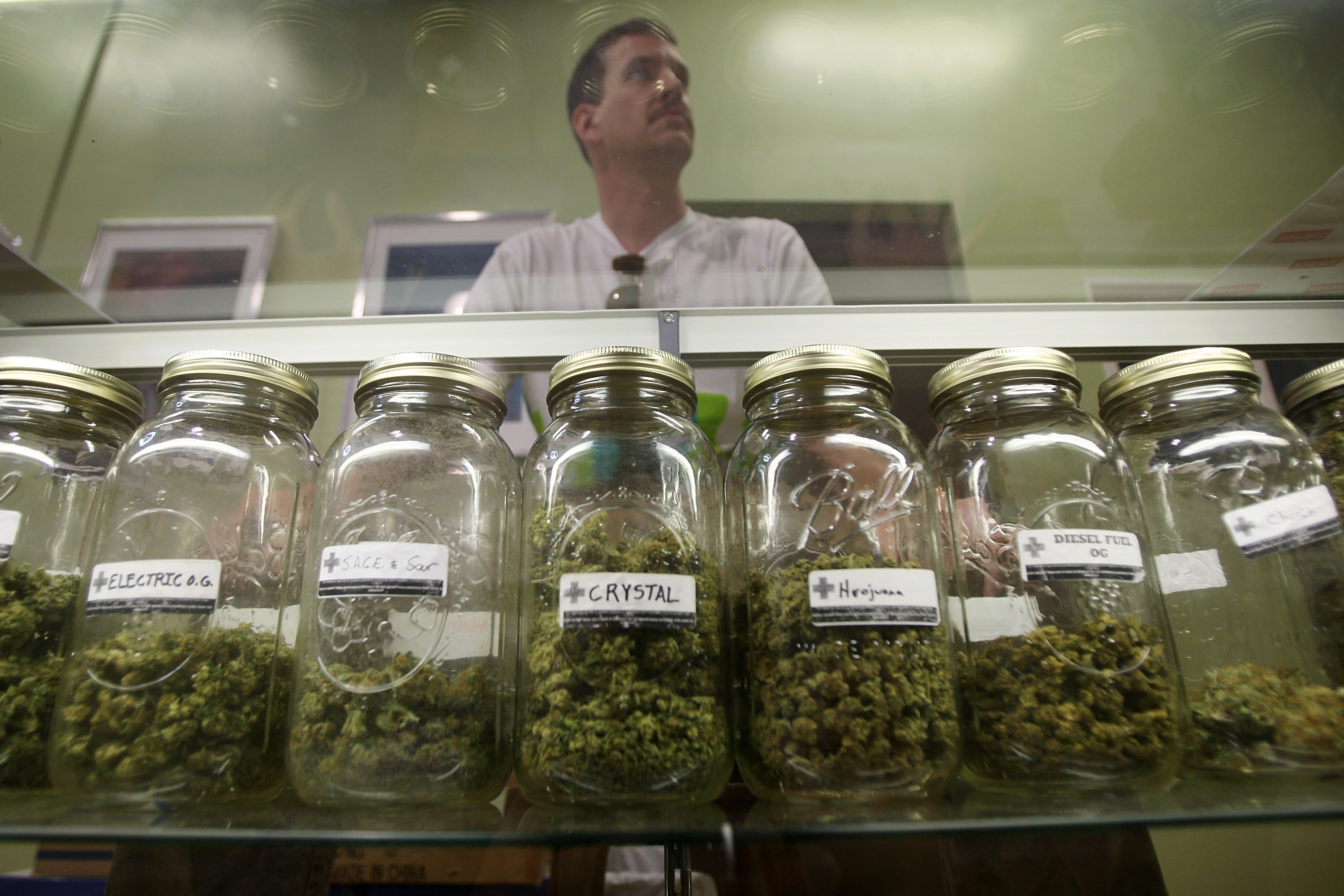
(Photo: Dave Warden, a bud tender at Private Organic Therapy (P.O.T.), a non-profit co-operative medical marijuana dispensary, displays various types of marijuana available to patients on October 19, 2009 in Los Angeles, California. By David McNew/Getty Images)
The Rape Double-Standard, Ctd

A few male readers add the factor of unconsciousness to the thread:

I’m reminded of an incident that occurred while I was backpacking in South America in 1995. I was staying at a hostel in Chile with a friend, and went out for the night with a couple of local girls, one of whom lived/stayed at the hostel. We got real drunk. We danced and flirted. We went back to the hostel. I woke up with this girl on top of me, basically having sex with me. And to this day can’t remember what exactly happened – I just know it wasn’t consensual (on my part). I just shrugged it off, but it definitely wasn’t OK. If this was a guy (me?!) doing this to a girl, I think that it would be judged much more harshly. I don’t know what this says other than what you other contributors have said – there are a lot of shades of grey.

Another:

Well, here’s another similar story for the thread. First of all, this was years ago, when I was in college. And I was absolutely not traumatized by it at all.  In fact, it was pretty awesome.  But it could have been different …

So, this girl and I were just sort of starting to see each other.  Not “dating” per se, but we had had sex once or twice before.  In other words, a new, not-yet-committed kind of relationship. (Ultimately, it never really went past this stage.)

We were at her parent’s house for her birthday party.  Her parents let her have the place to celebrate – which was actually pretty cool of them.  You know, a safe place to drink, etc.  And not a crazy-big party or anything.  A lot of her friends from high school, maybe one or two others from college.  So she was pretty much the only person I knew there, but I was her (informal) date for the party of course.

Anyway, later in the evening I got a pretty bad headache.  One of those (thank God) rare ones that makes you not care about anything.  So I bowed out and turned in, and assured her nothing was wrong – just a migraine from hell, gotta go to sleep.  Sometime later I woke up (no idea how much later) and we were having sex.  My headache was completely gone, so – as I mentioned – the sex was awesome.  And strange, to wake up in the middle of it like that.

So, it was implicit, I guess, that it was okay for her to have sex with me that night.  But really what happened was: she was drunk and horny, and just decided to fuck me.  Didn’t ask first, didn’t even wake me up; just moved my boxers out of the way, got me hard, and climbed on top.  And then I just happened to wake up.  (I mean come on, how could I not?  But ‘waking me up’ was way down on her priority list.)

Reverse the roles and that’s maybe-rape, and maybe just creepy as hell.  But your previous reader is right – there are all kinds of shades of grey on this topic.  And I think in a situation like this – the difference between “cool” and “creepy” – is also the difference between trauma and no trauma.  I mean, how society defines this particular act also influences how we, individually, would define it.

Another story, with a different angle:

I am a male. A large male. A strong male. A not “unbelievable pussy” male. I am a former bouncer in a bar, and have been in more brawls than anyone outside of security/bouncing would normally be in. I take martial arts. I can take pretty much anyone down.

I was in a marriage with an unstable woman who became more unstable as the marriage proceeded. For the record, we had two kids and I tried to make things work and get her to go to counseling – which she would go to and work on sometimes, but not enough. My wife would at times demand sex when I wasn’t interested. I knew that the pain that would follow if I refused. She would make the next month of my life a living hell.

I was coerced into having sex out of fear of a month of emotional pain and emotional abuse and screaming and yelling – and sometimes physical violence – from her to me. I never hit her ever, even if it was part of my personality to hit a woman (which it isn’t), my mom would have killed me if I’d ever even raised a hand.

I called myself “the hairy dildo” to my friends as I lamented the demands and threats my wife made. Is it marital rape? Or something in between rape and bad sex?

I know that I feel awful about being used and forced in that context – that sex had the love and connection part removed for her to get her rocks off – especially because if I ever wanted sex and she said no, that was the end of anything; I respect that boundary. The one time in our 18-year relationship that I “wheedled” my way into sex that she really didn’t want to have (but she explicitly said yes to) she took to calling “rape”. After our marriage ended, she told people I had maritally raped her in that instance. When I challenged her on her claim, she said, “but I really didn’t want to, so technically that’s rape.”

Dramatizing Journalism

Aatif Rashid contrasts The Newsroom with the recently canceled BBC series The Hour:

Unlike The Hour, [The Newsroom] doesn’t take the inherently liberal agenda of journalism seriously. Journalism has always been a liberal institution, and while this may give some credence to the conservative argument about a liberal media bias, it makes sense when one considers that the function of a journalist is to reveal information that the existing power structures won’t reveal, to in a sense challenge the dominance of the institutions by giving a voice to the voiceless.

The Hour takes this liberal agenda seriously. Journalists like [The Hour‘s] Freddie go out of their way to depict immigrants in a climate of xenophobia, gay people in a climate of homophobia, or anti-war protestors in a climate of war mongering. Additionally, The Hour tackled the issue of government censorship directly in its first season, pitting the new team of journalists against government ministers trying to influence the coverage.

The Hour is also not afraid to skirt the extreme liberal edge of politics (namely, communism). Not only are Freddie’s liberal views tinged with Communist ideas (he considers quoting Marx in his interview), but the first season also contains a significant plotline about a potential Communist spy in the BBC. When this spy is finally revealed, however, the show doesn’t sanctimoniously glorify his downfall but allows him a more subtle and conflicted exit. “I don’t know why they don’t suspect us more, journalists,” the spy says to Freddie. “We’re thrust into world events, life changing events. They expect us not to be changed.” It’s a sentiment worthy of John le Carré and a piercing look at liberal journalism with The Hour‘s characteristic nuance.

Previous Dish on The Newsroom here, here, and here.

Ask Elyn Saks Anything

From her Wiki:

Elyn Saks is an expert in mental health law and a Mac­Arthur Foundation Fellowship winner, which she used to create the Saks Institute for Mental Health Law, Policy, and Ethics. She is also Associate Dean and Orrin B. Evans Professor of Law, Psychology, and Psychiatry and the Behavioral Sciences at the University of Southern California Gould Law School. Saks lives with schizophrenia and has written about her experience with the illness in her award-winning, best-selling autobiography, The Center Cannot Hold: My Journey Through Madness, published by Hyperion Books in 2007.

You can also watch her TED Talk about living with mental illness here.

What should we ask Elyn? Let us know via the survey below (if you are reading on a mobile device, click here):


This embed is invalid

The Self-Parody Of Wes Anderson

Lily Rothman watches the above trailer and snarks, “If there was ever any question whether director Wes Anderson’s next film, The Grand Budapest Hotel, would look like a Wes Anderson film, those doubts are hereby assuaged.” Marc Tracy, on the other hand, applauds the director’s dependable style:

Consistency is today the hallmark of our most valuable artists. There is so much stuff produced now—so many movies and albums and books and articles and magazines and browser tabs and Internet memes and hashtag jokes and autotuned crying babies and athlete Instagrams and museum shows and, yes, blog posts. Sometimes word of mouth (or extremely good publicity) guides us to what we should be devoting our ever-diminishing quantity of attention to; occasionally we might be really lucky to happen upon the thing itself. Most of the time, though, we miss what is great, and what is good is not fully appreciated, divorced as it is from a larger context. Increasingly, everything, even works of art, feel like really good BuzzFeed posts: Charming, satisfying, and completely self-contained.

Works produced by artists like Anderson are different. There is inherent virtue to their having a dominant style, even if any individual one is bad. It gives us something to talk about (and to read books about: New York’s Matt Zoller Seitz has a brand-new volume on Anderson). It gives us someone to argue over. It gives us a context in which to enjoy something.

Previous Dish on the director here and here.

The New Face Of Chinese Propaganda

CHINA-ECONOMY-MANUFACTURING

Ian Johnson investigates how the Chinese government has shifted from Marxist sloganeering to more of an American-style nationalism:

Propaganda posters have a long tradition in Communist China, beginning with posters in the 1950s that celebrated the new revolution and urged support for the Korean War. … Xi Jinping’s China Dream posters are linked to this earlier era of Communist sloganeering. The difference is that while the old posters touted Communist values, the new ones largely replace them with pre-Communist Chinese traditions—drawing on traditional folk art like paper cutouts, woodblock prints, and clay figurines to illustrate their message. This is a redefinition of the state’s vision from a Marxist utopia to a Confucian, family-centric nation, defined by a quiet life of respecting the elderly and saving for the future. … Almost all the art used in the posters, with its depictions of traditional dress and poses, used to be derided by the Party as belonging to China’s backward, pre-Communist past; now, these aesthetic traditions are a bulwark used to legitimize the Party as a guardian and creator of the country’s hopes and aspirations.

(Photo: A group of Chinese workers walks past a ‘Chinese Dream’ promotion billboard in Beijing on September 2, 2013. By Wang Zhao/Getty Images.)