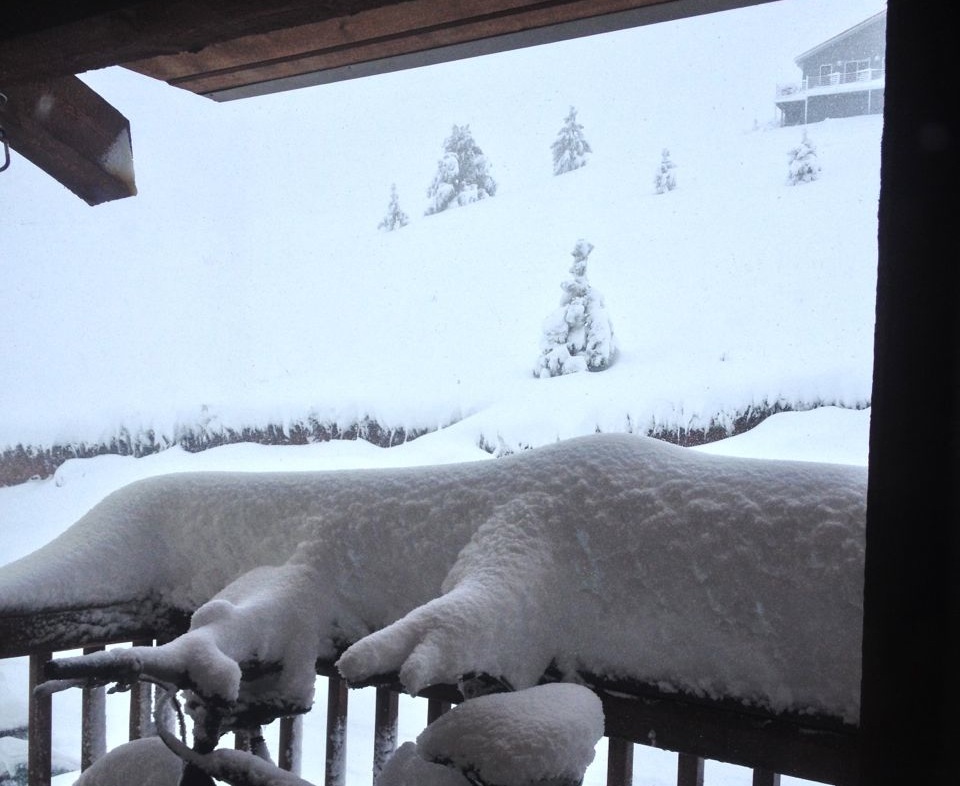
Spearfish, South Dakota, 12.15 pm
Spearfish, South Dakota, 12.15 pm
English professor David Mikics links the rise of Wikipedia to a decline in student writing:
Wikipedia, which is against style on principle, crushes the individuality of student voice. For the kids in my class, this is what knowledge sounds like: balanced and bland, never indignant or provocative or committed—the voice of the crowd, the everyman. Student essays still occasionally contain remarks that sound jaunty, or freewheeling, or tragic, or ironic. But there are far fewer of these liberated moments than there were before Jimmy Wales gave us Wikipedia’s pasteurized version of scholarship.
But other academics are considering ways to improve the free encyclopedia. This year, the University of California, San Francisco will offer a class that gives credit to fourth-year medical students for editing Wikipedia articles. Dr. Amin Azzam, who will teach the course, explains:
When you look at [the quality of the articles], the fraction of high-quality information on Wikipedia in the medicine-related topics is significantly lower than other domains of Wikipedia. I think a large part of that is because we in the medicine community have not been embracing this model of democratized information. But when you realize that this is where all the world goes for information first, I think we’re missing an opportunity. Why don’t we contribute to improving the quality of information that the public has access to, and that the public goes to? So that’s why I became passionate about this model. I started realizing that this was a much bigger way to make a much bigger impact on public health.
As the New York City Opera heads toward financial ruin, Russell Platt takes stock of the industry’s troubles. Greg Sandow focuses on orchestras and their ever-older audiences:
[N]ow we see what a systemic crisis means. Because from the aging and shrinking of the audience follows every other problem that we’re having. Declining ticket sales. Declining funding. Performing arts centers (as the New York Times reported back at the start of the 1990s) booking fewer classical music events, because the audience for them was starting to fall. …
Maybe the current orchestra crisis shows us this danger starting to be real, meaning that it’s hitting now, and isn’t just something we project into the future. So many managements arguing with their musicians, over dividing a shrinking financial pie, the result (no matter how it plays out in each situation) of an overall drop in demand, and drop in funding (which of course is tied to the drop in demand), while expenses continue to rise.
Previous Dish on the struggling classical music industry here.
Art Brodsky calculates how unfair e-book pricing is for libraries:
Take the example of J.K. Rowling’s pseudonymous book, Cuckoo’s Calling. For the physical book, libraries would pay $14.40 from book distributor Baker & Taylor — close to the consumer price of $15.49 from Barnes & Noble and of $15.19 from Amazon. But even though the ebook will cost consumers $6.50 on Amazon and Barnes & Noble, libraries would pay $78 (through library ebook distributors Overdrive and 3M) for the same thing.
Somehow the “e” in ebooks changes the pricing game, and drastically. How else does one explain libraries paying a $0.79 to $1.09 difference for a physical book to paying a difference of $71.50 just because it’s the electronic version? It’s not like being digital makes a difference for when and how they can lend it out.
First off, an email:
I’m having an immensely shitty day. My girlfriend and I aren’t speaking. I’m having trouble with
my heart, both Romantically and Physiologically, and even some really good news from work hasn’t been enough to lighten my spirits and cheer me up.
Then I saw this, and had this wonderful vision of you sitting at home putting these little fellas on your fingers and waggling them about joyfully while making them argue about Oakeshott and Niebuhr and how crap JFK was at foreign policy, all in your “I’m Having Imperial Obama Hysterics Voice” (which I’ve invented out of whole cloth; I’ve never actually heard you Freak Out, but I’m sure it’s adorable), and I just laughed and laughed and was instantly cheered. For about 90 seconds.
Seriously, Imma buy you all of these for Boxing Day. Or whatever you British people do in December.
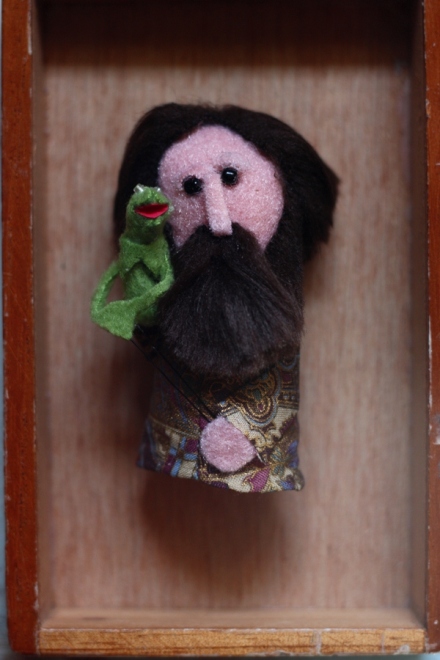
They’re L’il Beards and the one above is of Jim Henson. From Thistledown Puppets. I’m a lucky blogger.
The day was dominated by the lingering showdown on the Hill, as the House GOP continued to threaten to keep the government shut down and to destroy the US and global economy unless their agenda is substituted for existing law. I took note of how deeply alienated the GOP base now is – and how immune to any reason. We noted the awful technical roll-out of many healthcare exchanges (and the reasons for it) and the worryingly narrow divide in favor of constitutional government in the polls. Plus: a beautiful window view from France and a gorgeous time-lapse window view from Minnesota.
The most popular post? Why They’ll Die On This Hill. Second? The Nullification Party.
See you in the morning.
A reader writes:
The clearest signal yet that the marijuana mainstream is here to stay: fast food marketing is turning to the growth market of stoner diners. The latest evidence is Jack in the Box’s rollout of their “Munchie Meal Menu,” marketed as the “cure to mellow even the meanest manifestation of the munchies.” Carmel Lobello describes the marketing tactic and explores other ways in which the fast food industry has begun to embrace this customer base.
More commercials in the “Munchie Meal” series here.
J. Dana Stuster is amused by a new Diane Francis book, Merger of the Century: Why Canada and America Should Become One Country:
What would a united Ameri-Canada look like? In terms of acreage, it would be the largest country in world — surpassing Russia, even all of South America, in size. Its economy would be larger than the European Union’s. Since each country is the other’s largest trading partner, trade deficits would shrink. Canadian oversight at the Fed would bring stability to American banking. With all its energy needs met domestically, Ameri-Canada would be a lucrative petrostate, exporting oil to the developing world.
For all the benefits — energy self-sufficiency, secure borders, a cross-border maple syrup pipeline if we’re lucky — the merger would not be without consequences. Francis bets that the long-term economic incentives would outweigh the baggage Canada brings with it. But is that really the case? Would it be worth grappling with how to integrate U.S., Canadian, and Québécois laws, or trying to standardize health care across the two countries? Would Washington ever want to inherit First Nations land disputes, Quebec separatists, or Justin Bieber? And would Canadians want Washington, especially after such a case study in dysfunction this week?
Get informed and entertained:
A reader writes:
I’m a grateful subscriber, so I thought you might enjoy a copy (pdf) of the first Annual Report issued by the Vatican Bank (IOR) in its 126-year history. This is a direct result of Pope Francis’s call for oversight and transparency. In June 2013, Pope Francis appointed a Papal commission to conduct an “exhaustive report” into the IOR’s juridical standing and activities. The goal of this Commission is “to better harmonize the work of the IOR with the mission of the Church and Apostolic See.” Of note is how small and profitable the IOR actually is: “total assets are approximately EUR 5 billion, while fiscal year 2012 registered a profit of EUR 87 million. Of this, EUR 50 million was given back to the Church for operating purposes.”
One of my Wall Street wizard brothers is working with the Commission. He confirms that even Rome is infused with startled enthusiasm for this Pope. Many of us have been more homesick for the Church than we realized. So thanks for your ongoing coverage. I’m sure you take some heat for it, and not only from Hitch’s spirit.
Oddly, not so much heat. The spirit of this Pope is so obviously sincere and so disarmingly Christ-like I find myself a Catholic cheered on by many atheists right now. Just not the theocons. Or Hitch, I’ll bet you a bottle of Johnnie Walker Black.
Tyler McMahon reviews John McMillian’s dual rock biography:
Beatles vs. Stones captures an era that was confusing, tumultuous, often teetering on the edge of violence. At many concerts, there was more Altamont in the air than there was Woodstock. For pop stars, entering the public eye also meant wandering into an ideological vacuum. The backlash after the release of the Beatles’ “Revolution” (and later, the inverse reaction to the Stones’ “Street Fighting Man”) vividly shows the fault lines within the New Left. Oldham, Jagger, and the rest of the Rolling Stones consistently managed to win approval with more radicalized commentators. Their success was more about dexterity than values. As the author puts it: “Without ever devising or articulating a formula for instigating a cultural revolt, the Rolling Stones began to stumble upon one.” The Beatles, on the other hand, avoided controversy but provided a generational touchstone. One of the book’s most telling episodes recounts a Berkeley SDS gathering in which the students—unable to recall the lyrics to old labor standards—broke out into a blissful rendition of “Yellow Submarine.”
(Video: The Rolling Stones perform “Street Fighting Man” in 1969)
 The Dish