Richard Cohen, In Context

TNC’s take-down deserves a wider audience:

The problem here isn’t that we think Richard Cohen gags at the sight of an interracial couple and their children. The problem is that Richard Cohen thinks being repulsed isn’t actually racist, but “conventional” or “culturally conservative.” Obstructing the right of black humans and white humans to form families is a central feature of American racism. If retching at the thought of that right being exercised isn’t racism, then there is no racism.

Context can not improve this. “Context” is not a safe word that makes all your other horse-shit statements disappear. And horse-shit is the context in which Richard Cohen has, for all these years, wallowed. It is horse-shit to claim that store owners are right to discriminate against black males. It is horse-shit to claim Trayvon Martin was wearing the uniform of criminals. It is horse-shit to subject your young female co-workers to “a hostile work environment.” It is horse-shit to expend precious newsprint lamenting the days when slovenly old dudes had their pick of 20-year-old women. It is horse-shit to defend a rapist on the run because you like The PianistAnd it is horse-shit to praise a column with the kind of factual error that would embarrass a j-school student.

Richard Cohen’s unfortunate career is the proper context to understand his column today and the wide outrage that’s greeted it.

Weigel tackles Cohen’s excuses. My thoughts here. A reader writes:

As the parent of biracial children, I am naturally attuned to the cultural shift regarding interracial couples and biracial children that has occurred in this country.

When my ex-wife and I had children, I perceived that my kids would face situations in both black and white communities where their particular status would cause them grief and I tried to determine when it would be best to address it with them; deciding that it was probably best when something triggered the need.  To my pleasant surprise, my now high-school aged kids have never had an incident of any note as biracial children and no identity problem for themselves, because quite frankly their status isn’t much of a status.  They just don’t stand out very much.  If you go to any suburban or urban grade school or high school today, you will find many kids whose origin you couldn’t identify and if given a list of names, would be unable to match the surnames to the kids.  My kid’s soccer team has an Asian looking kid with a Greek name, a Black looking kid with a Jewish surname a vaguely Latin looking kid with a generic Anglo name and my own Irish surnamed kid who looks vaguely Black or Latin.

Reading Mr. Cohen is like listening to the old relative at Thanksgiving dinner who is so far out of touch with the actual conventional thinking of his own world that rather than be outraged, you blush and then pity the man. His own newspaper reported on this shift a couple of years ago, but who reads papers anymore?
The Necessary Contradictions Of A Conservative

Sorry for missing the Best of the Dish Today deadline last night. I was giving a speech on conservatism at Eastern Michigan University, and the conversation didn’t stop.

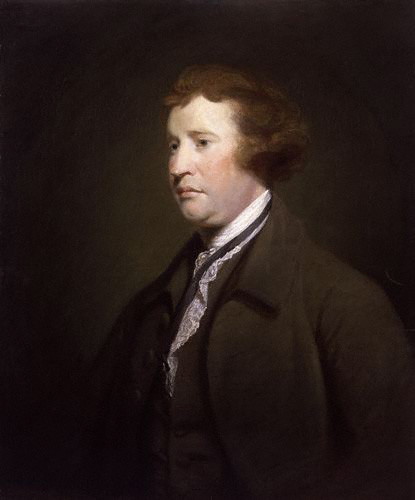
I prepped by re-reading parts of my friend Jesse Norman’s terrific book on Edmund Burke: The First Conservative. I was reminded again of NPG 655,Edmund Burke,studio of Sir Joshua Reynoldshow routinely and extravagantly Burke was ridiculed and mocked in his time for his alleged contradictions: supporting the American colonists then unleashing a barrage of brio against the French revolution, a British MP defending the rights of Catholics in Ireland, a patriot obsessed with colonial abuses of power, and an enemy of empire .

He was not a reactionary and yet remained a skeptic of unbridled liberal aspirations to improve society. He was a conservative Whig, and a liberal conservative. It’s that prudential balance – partaking of both traditions in Anglo-American thought and practice, and tacking toward one or to the other depending on the specific circumstances of time, people and place that makes him, in my mind, a conservative.

For a conservative should not be implacably hostile to liberalism (let alone demonize it), but should be alert to its insights, and deeply aware of the need to change laws and government in response to unstoppable change in human society. Equally, a liberal can learn a lot from conservatism’s doubts about utopia, from the conservative concern with history, tradition and the centrality of culture in making human beings, and from conservatism’s love and enjoyment of the world as-it-is, even as it challenges the statesman or woman to nudge it toward the future. The goal should not be some new country or a new world order or even a return to a pristine past that never existed: but to adapt to necessary social and cultural change by trying as hard as one can to make it coherent with what the country has long been; to recognize, as Orwell did, that a country, even if it is to change quite markedly, should always be trying somehow to remain the same.

That is rooted simply in a love of one’s own, in feelings of pride in one’s country or family or tradition. And unlike liberalism, conservatism does not shy from these sub-rational parts of what being human is. They are not to be conquered by sweet reason, because they cannot be. They need to be channeled, not extinguished, guided not fetishized. A conservative will be a patriot, but not a nationalist. He will be proud of his own country but never tempted to argue that it is a model for all humankind, or that it can be exported to distant, different places with vastly different histories.

This means a true conservative – who is, above all, an anti-ideologue – will often be attacked for alleged inconsistency, for changing positions, for promising change but not a radical break with the past, for pursuing two objectives – like liberty and authority, or change and continuity  – that seem to all ideologues as completely contradictory.

But they aren’t. Churchill, in his great essay, “Consistency in Politics” wrote of Burke:

On the one hand [Burke] is revealed as a foremost apostle of Liberty, on the other as the redoubtable champion of Authority. But a charge of political inconsistency applied to this life appears a mean and petty thing.

History easily discerns the reasons and forces which actuated him, and the immense changes in the problems he was facing which evoked from the same profound mind and sincere spirit these entirely contrary manifestations. His soul revolted against tyranny, whether it appeared in the aspect of a domineering Monarch and a corrupt Court and Parliamentary system, or whether, mouthing the watch-words of a non-existent liberty, it towered up against him in the dictation of a brutal mob and wicked sect.

No one can read the Burke of Liberty and the Burke of Authority without feeling that here was the same man pursuing the same ends, seeking the same ideals of society and Government, and defending them from assaults, now from one extreme, now from the other.

And the same, of course, can be said of Churchill, a member at one time of both the Liberal and the Conservative parties in Britain, often misunderstood, even now somewhat disdained in his own country as a necessary blowhard. But a true conservative will defy the label of party and of ideology as well as a foolish consistency, when times shift.

In trying to figure out where American conservatism can now go, reading Jesse’s book, and thinking about Burke, would be a little more productive than constructing new amendments to the Constitution, or figuring out how to repeal the New Deal, or declaring too precipitous a lurch toward non-interventionism. The First Conservative would, I suspect, look at the current Tea Party, for example, with the same baffled disdain that he viewed all reactionary, radical populisms. And he would urge a new moderation and pragmatism in tackling the specific problems of 2013 – not 1980, let alone 1780 – and finding a way to solve them that makes America more like America – because he loves America – and not less.

A Promise The Administration Is Likely To Break

The WaPo reports that Healthcare.gov is unlikely to be ready by the end of this month:

Software problems with the federal online health insurance marketplace, especially in handling high volumes, are proving so stubborn that the system is unlikely to work fully by the end of the month as the White House has promised, according to an official with knowledge of the project.

James Capretta, an Obamacare opponent, argues that the law is in major trouble, even if the administration hits its deadline:

The immediate problem for the administration is that even with a perfectly functional enrollment and data transmission system, it would be challenging to process new insurance enrollments of 4 million or so people in a two week period. Given the track record of healthcare.gov to date, it is highly unlikely that the system will be able to handle that much volume in that short of a time frame.

Moreover, it is also completely unrealistic, not to mention unreasonable, to expect so many Americans to suddenly become comfortable again with healthcare.gov, enter their personal financial information into it, and then select an insurance plan—in just a two-week period. For starters, contrary to the president’s assertions, many of the current enrollees in individual market plans will not be impressed by the premiums, cost-sharing requirements, and provider networks of the exchange plans. If and when the web site becomes more operational, the administration will face another political firestorm from the rate shock that is built into Obamacare’s cost structure.

And yet, the administration would like us to believe that, once the tech wizards work their magic, it will all be smooth sailing. In effect, the Obama administration wants us all to believe that the system is going to be prepared to go from today’s dead stop to 100 miles per hour in a matter of days, with no risk whatsoever of a crash. Who wants to take that bet?

Avik Roy, another Obamacare critic, wants the website shut down until it works properly

Based on what we’ve seen to date from the administration, it appears likely that the website will take four to six months to function properly. The Obama administration should take the advice of the Democratic chairman of the Senate Finance Committee, Max Baucus (D., Mont.) and shut the thing down until they can fix it.

But the administration appears hell-bent on keeping the exchange open, because they want to enroll as many people into Obamacare before the President’s term is up. That way, the law will become harder to repeal, even if Republicans win in 2016.

Reality Check

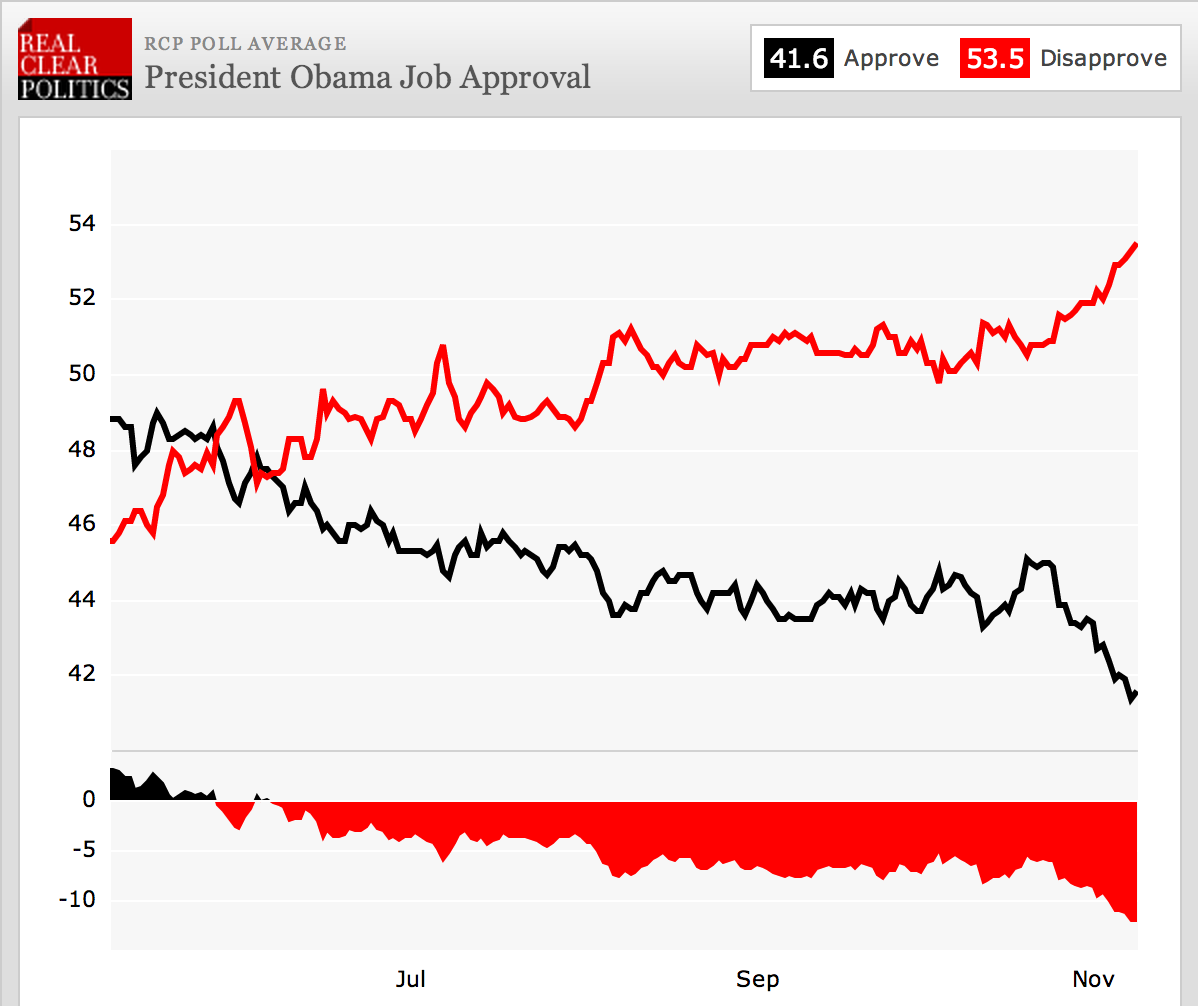
Obama’s approval rating is dropping:

Obama Approval

And Obama’s advantage on healthcare has disappeared. How Weigel understands Obama’s recent numbers:

The only explanation for any of this? The “if you like your plan, you can keep your plan” controversy, or IYLYPYCKYPgate. (Maybe that acronym won’t take off.) What should worry Democrats (not that they need the help) is that the broken promise actually isn’t affecting a huge proportion of Americans. Maybe 6 percent of them are losing individual plans; 52 percent of them distrust Obama.

Bernstein considers what these numbers mean:

Presidential approval has real effects on midterm elections. Right now, what matters is perceptions among elites, and potential candidates, about those elections. There’s some evidence Dems benefited from the shutdown, with a small wave of successful recruitment. If the conventional wisdom shifts to a sense that Obama (and Democrats) are doomed, it’s unlikely Democrats could build on those successes. We might see some Republican recruiting coups. Separate from that is the direct effect of presidential popularity; the better Obama is doing in November 2014, the better Dems can expect to do.

Will Obamacare Divide The Democrats?

Douthat thinks it’s possible:

To the extent there’s any policy issue with the potential to actually scramble the 2016 primary season for Democrats, it’s probably the one that’s scrambling 2014 for them right now: Obamacare. That’s because if the law still isn’t working out as promised in two years time, and if President Obama ends up locked in some sort of agonized struggle with a Republican Congress over various controversial “fixes,” it isn’t clear exactly what the sweet spot for a Democratic candidate in 2016 will be. In Bill Clinton’s recent comments on how the law should be amended to let more people keep their plans, you can see a hint of one tack that his wife might take — essentially focusing on whatever looks like the least popular aspect of the fully-implemented law and promising to fix that.

But what if there isn’t an obvious, plausible fix for whatever might still be going wrong? And what if a piecemeal critique of the law from candidate Clinton ends up echoing whatever the G.O.P. talking points of 2015 happen to be? Could she then be attacked effectively as a sellout and a compromiser by a left-wing challenger who essentially campaigns against the insurance industry, and promises that the solution to Obamacare’s faults is the single-payer plan of liberal fantasy?

I still think the answer is, “no, probably not.” But if I were tasked with planning an anti-Hillary insurgency right now, I’d be thinking a lot more about how to pitch Medicare For All than about the exact details of my plan to blow up Wall Street.

Chait, on the other hand, argues that Wall Street regulation could be a major factor in the primaries:

It’s odd that a staggeringly lopsided issue has played so little a role in national politics the last five years. The initial 2008 bailout vote took place in emergency conditions, with the cooperation of a Democratic House and a Republican president, and so close to the election that neither party had the chance to tailor its campaign message to take advantage of the public backlash. Republicans subsequently benefited from the backlash against the financial bailout merely by being the opposition party, but they never crafted a serious agenda against Wall Street. President Obama fought for and passed a legislative response, the Dodd-Frank regulations, which placed him in the position of defending the status quo. That, in turn, helped provoke a wild, paranoid backlash on Wall Street, memorably chronicled by Gabriel Sherman, that drove the industry into a full alliance with the GOP. By the 2012 cycle, Wall Street had titled its donations heavily to Republicans, who were pledging to repeal Dodd-Frank while nominating a financier at the top of the ticket.

So what may be the most powerful issue in American politics has lay unused by either party since the crisis. Either party could pick it up. A bill to break up the big banks has the sponsorship of liberal Democrat Sherrod Brown and conservative Republican David Vitter. Warren has a tough regulatory proposal of her own, which has the support of John McCain. A Warren campaign could force Clinton to follow suit, and possibly even pressure the Republican nominee.

Map Of The Day

Twitter users dropping the F-bomb in real time:

Screen Shot 2013-11-12 at 11.46.54 AM

John Metcalfe elaborates:

What ties together a Bostonian upset over being ignored, a woman in Dallas angry about her empty refrigerator, and a resident of Portland, Oregon, who’s still steaming over the wars of George W. Bush? It’s their potty-mouths: Last night, each of these people blasted their Twitter followers with the word “fuck,” or one of its variants like WTF or OMFG. Each of these guys are included in this gloriously profane “FBomb Map,” which displays real-time instances of Twitter cursing as mushroom clouds popping up all over the world.

Whom Does Cyberwar Favor?

Henry Farrell summarizes Erik Gartzke’s article (pdf) on the question:

Gartkze’s arguments imply that cyberwar isn’t a weapon of the weak. Instead, it’s a weapon of the strong — it will be most attractive to those who already have powerful conventional militaries. It works best in conjunction with traditional warfare, or, in a pinch, when deployed by states that no one else dares to attack in retaliation. The conventional wisdom among cybersecurity specialists is that cyberwar upsets the balance of traditional power  by making it easier for weak states or non-state actors to deploy powerful attacks against countries such as the U.S. If Gartzke is right, this assumption is completely wrong — cyberwar is likely to strengthen the military predominance of the U.S. and other powerful countries rather than undermine them. Many people are strongly invested in the current wisdom — Gartzke’s piece is likely to stir up quite a bit of debate.

Norman Rockwell, Modernist

the-connoiseur-1962

Peter Schjeldahl recounts how he became “the first hip young art critic” to defend the illustrator:

My tipping point regarding Rockwell had come in conversation with Willem de Kooning. Our greatest modern painter quite adored Rockwell – as he did most things about the United States since arriving here, as a 22-year-old Dutch stowaway, in 1926. … [Rockwell] drew and painted angelically, with subtle technical ingenuity, involving layered colors, that is still under-appreciated. I took instruction on this point from de Kooning, who opened a book to a reproduction, handed me a magnifying glass, and made me peruse Rockwell’s minuscule but almost fiercely animated painterly touch. “See?” said de Kooning. “Abstract Expressionism!” [Biographer Deborah] Solomon reports that de Kooning remarked of Rockwell’s astonishing imitation of a Pollock drip painting, being viewed by a fancy gent in “The Connoisseur” (1962), “Square inch by square inch, it’s better than Jackson!”

Previous Dish on Rockwell here.

Obamacare Needs GOP Support

Harold Pollack wants the administration to do everything within its power to get buy-in from “Republican state office-holders who have actual responsibilities to govern who will eventually own their state’s version of health reform”:

Liberals like me may be disappointed by compromises the White House is likely to make to provide GOP governors with a dignified path to accept Medicaid expansion. Some states wish to impose (modest) co-pays for non-generic drugs or for emergency department use. Others ostensibly maintain the right to opt-out of the Medicaid expansion if the federal government lowers its matching rates. Republican governors require such concessions. After all, they have spent the past five years bitterly opposing health reform. Maybe HHS will follow the Arkansas compromise and allow more poor people into exchanges rather than Medicaid in states that request that option.

The administration always seemed willing to negotiate on medical malpractice, too. This proved to be a moot point in 2009 and 2010, as Republicans preferred to trumpet this issue politically rather than to negotiate any deal. But perhaps we have another chance for movement.

We may also be wise to revisit just how minimal the most minimal insurance packages should be.

In 2011, an Institute of Medicine committee was asked to clarify what the “essential health benefits” under the new law. The IOM recommended a package based on what the typical small business would cover, and noted the importance of such restraint to keep premiums low. It was a much more limited plan than many advocates support, and the committee was sharply criticized. But this month’s backlash underscores the wisdom of the IOM’s approach. I don’t know yet what can be done without compromising public health components such as substance abuse and mental health coverage, but these matters deserve a real look.

For liberals, these may be painful concessions. Yet this isn’t November 2008, when Democrats could plausibly look forward to imposing their legislative will. Democrats need Republican buy-in for health reform to secure public legitimacy and to help millions of needy people. Democrats also need the administrative capacity of state governments, willingly deployed, to make health reform actually work.

Don Taylor suggests other reforms. A big one:

For 2015, replace the individual mandate with the auto-enroll provisions envisioned by Rep. Paul Ryan’s Patients’ Choice Act. Strong auto-enroll policies enacted while allowing an opt out (presumably with some consequences, correct Libertarians?) could actually pool risk better than the weak individual mandate we now have. We will also have to develop a default insurance option to make auto-enroll work, which is the one thing I would add to the ACA if I could do just one thing.