The Politics Of Pigskin

Ryan O’Hanlon suggests that politics inevitably play a role in the Super Bowl:

For better or worse, the Super Bowl is America. More than twice as many people watched last year’s Super Bowl delay than watched the Oscars, the most-viewed non-football event of 2013. And in 2012, the only thing more people chose to do than watch the Giants/Patriots Super Bowl was vote. It’s impossible to remove politics from an event so big and widespread, which makes you wonder why we even try and if we really should. Creating some kind of boundary between sports and politics—or maybe more accurately, imagining that there’s no connection between the two—seems, if anything, just incorrect.

That’s not to say that if Richard Sherman intercepts Peyton Manning in overtime on Sunday and runs the ball back for a game-winning touchdown that it’s some metaphor for liberals wresting control of the racial-politics conversation from their conservative foes. Rather, it’s to acknowledge that, even on Sundays, the conversation exists—and that the guy screaming into your television is right in the middle of it.

Albert R. Hunt objects to painting the contest “with racial (white versus black) or political (red state versus blue state) overtones”:

This is inane. The majority of players for both the Broncos and the Seahawks are black; that’s true with about every National Football League team. Colorado and Washington state, the respective homes of this year’s Super Bowl contenders, both voted Democratic in the most recent presidential election, as did New Jersey, the site of Sunday’s game. So much for any political connotations.

Who Watches The Super Bowl?

Americans, by and large. One reason why it has a far smaller international audience than other, similar sporting events? Scheduling:

In 2010, European soccer’s governing body moved the Champions League final from its traditional Wednesday Sports Audiencesnight time slot to Saturday night. That makes it much easier for audiences in populous and soccer-obsessed South America and Asia to tune in, Alvay says. “People in Asia have got a greater capacity to be up at the middle of the night when it’s on a weekend and they don’t have to work the next day,” he says. …

Contrast this with the Super Bowl, which is scheduled to maximize U.S. viewership; audiences peak during the showbiz-heavy halftime show. That makes it problematic for international audiences outside the Americas. It allows for daytime viewing in Asia, but this is where American football has its smallest following. In Europe, where the league has been focusing its recent international expansion efforts (the NFL has hosted a game in London annually since 2007), the timing couldn’t be worse: Kickoff is at 6:30 pm in New York, which is 11:30 pm in London and 12:30 am in Western Europe. And games typically last for three hours.

Chart Of The Day

NFL Facebook

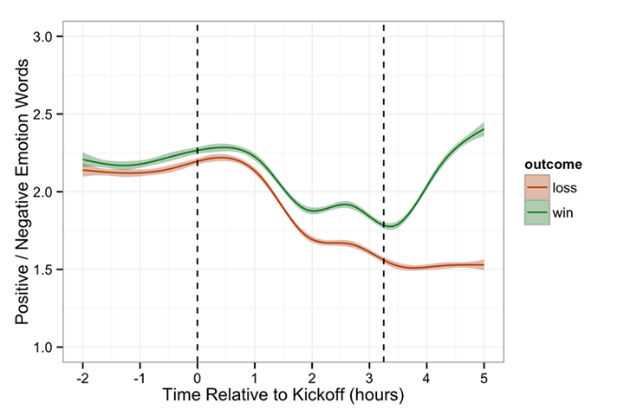
Noah Chestnut explains what you’ll be feeling tonight:

Throughout the 2013-2014 NFL season, Facebook data scientists anonymously tracked messages posted by millions of football fans in order to measure their minute-by minute emotional reactions during a game. Football fans wind up following a predictable pattern: excitement before the opening kickoff and then frustration, anxiety, anger and depression set in for almost 2 hours until the winning team’s fans start to experience relief and joy.

Methodists For Marriage Equality

They are rebelling:

In December, the Reverend Frank Schaefer, a pastor in Lebanon, Pennsylvania, was defrocked for officiating his son’s wedding. Earlier this month, the Reverend Dr. Thomas Ogletree, a retired minister and professor emeritus at Yale Divinity School, was charged for officiating his son’s wedding, and will face an ecclesiastical trial, on March 10th, in Stamford, Connecticut. Pastors often preside at the weddings of their children. But Schaefer and Ogletree married their sons to other men. …

Ecclesiastical disobedience is on the rise: in November, more than thirty United Methodist clergy jointly blessed the wedding of two men at a church in Philadelphia to show their solidarity; in December, the Seattle district superintendent married two lesbian Methodist pastors in Washington; and thousands of United Methodist clergy around the country have declared publicly that they will officiate such weddings. There are almost as many clergy now facing charges for engaging in same-sex relationships and participating in same-sex weddings as have been brought to trial in the history of the United Methodist Church.

When Faithlessness Leaves Family Behind, Ctd

A reader can relate to atheist guilt:

I spent my teens reading Camus and saying that God doesn’t exist. Then, in my late teens, I joined a youth group and tried to believe – partly because of my family, my friends, and the social stigma of not being a believer in the 1980s South (Atlanta).

Fast forward to age 35, when after years of hiding my non-belief, I came out. Mind you, I went to church, wound up teaching Sunday school, went on some mission trips, and was asked to be an elder or deacon. At that point, I figured I needed to come clean. So I came out. My wife and I divorced – partly because of my non-belief (she was on the road to becoming a Christian writer) – and partly because of the lack of intimacy we had between us. I felt guilty just watching The Sopranos because it wasn’t ‘uplifting.’ How can you have an intimate relationship when there is that type of judgment on the simple stuff?

Of course, my ex thinks I’m going to hell, literally. My family does too. My sister told me she didn’t know who I was, and we really don’t have a relationship anymore – after 13 years. But I’m happy. I’m open and honest about my beliefs and my wife and kids that I have now share my beliefs.

Meanwhile, an atheist since childhood offers some advice to new “converts”:

It’s important to remember that atheism is an altogether unremarkable thing. Sure, many come to the idea, or the acceptance, with a great degree of awe, and they convince themselves that they must now be true to themselves as atheists and never set foot in that awful place of worship again.

But your parents aren’t going to be around forever. Breathing and heartbeats are a finite resource. Go to fucking church with them. If your atheism is hanging by such a thread that you can’t sing a song from some old book with your parents, you probably aren’t really an atheist.

Update from a reader:

Your reader’s experience of attending church with parents might be “singing a song from some old book,” but attending church with my mom (before I affirmed every cliche of the de-converted and left the South for California) was a very different prospect, and much more of an assault on my identity.

It would have involved, at minimum, 30-45 minutes of energetic singing, clapping, and hand waving, during which at any moment a member might break out into several laps around the sanctuary before falling out in religious ecstasy. (If this member happened to be a woman, another female member would quickly cover her splaying, spasming legs with a coat, since women were forbidden to wear pants or shorts.)

Following this warm-up, my willingness to make this sacrifice for my mom would have been tested by a sermon averaging 90 minutes, during which the very idea that someone could doubt God’s existence, question the sacrifice of Christ on the cross, choose a “worldly” lifestyle based around money and hedonism (the only pursuits that could be conceivably imputed to those outside the fold), or heaven literally forbid, go the whole hog into sin and TURN GAY, would be relentlessly mocked, scorned, or just regarded with a sad, knowing pity. (Anyone in attendance would also be encouraged to subsidize this worldview during the offering, with a strong reminder that failing to reach into your pocket could be the difference between someone’s salvation and damnation.)

Finally, this would all wrap up with an altar call, which was very likely to culminate in people kneeling and weeping for their sins, while groups of “prayer warriors” surrounded other individuals who needed a little extra help to “pray through” for the first time (or maybe just recommit themselves to the cause, e.g. “pray BACK through”). Anyone who attempted to tactfully sit back and disengage during this ritual ran the risk of being approached by a concerned member asking if they could lay hands on them. A firm no was sure to be met with suspicion, while any hesitation would invite said laying on of hands, which, if administered by a particularly vocal church member, would serve as a beacon for others to latch on to the hapless subject and add their hands and voices to the prayer.

Finally (I know I said the altar call was the end, but really it wasn’t), with tears being wiped and beatific smiles being exchanged, someone would extend an invitation to re-convene at Denny’s or Cracker Barrel, where in smaller groups of a dozen or less, members would go over some of the strongest points of the night’s sermon or talk about how wonderful it was to see Bro. Smith or Sis. Jones “pray back through.” If a political issue was in the news, a more respected member of the group might point out how clearly silly the “worldly” view (oddly enough, almost always the one opposed to the Republican view) was. (For those who say “Just go home” at this point…my mom was always one of the more social members of the church, so accompanying her would have inevitably ended up here.)

Despite my deep love for my mom and my genuine guilt at the pain that I know my falling away from the fold has caused her, I refused to run this gamut for her. Maybe I should have sucked it up, but I know that by even walking in the door, I would have been marked as a target for re-conversion. I really wish I had been raised Episcopalian, so that I could have gone to church with her after I stopped believing and just “sang a song from some old book” to make her feel better.

Face Of The Day

dish_featherfotd

Artist Lucy Glendinning’s “Feather Child” series explores “the allure and dangers of artificially propelling human evolution”:

Inspired by the Greek myth of Icarus, she imagines future humans treating our DNA as a medium of expression and wish-fulfillment; in the poem accompanying the sculpture, she envisions feathers like “A decoration applied with / a gene, not a needle.”

The Art Circus Review adds:

Covered from head to toe, the feathers may act as a camouflage, keeping the children hidden or they may enable them with a unique ability to survive whatever landscape they now populate They may also just be tired freaks, taking refuge in art galleries. Glendinning’s tactile sculptures are beautifully crafted, showing a very sensitive and vulnerable side to her bizarre subjects, leaving the viewer uncertain whether to take the mutant child into their care or throw them into the fire.

More photographs of Glendinning’s sculptures here.

(Photo of work by Lucy Glendinning. More here and here)

Quote For The Day

“Life is tragic simply because the earth turns, and the sun inexorably rises and sets, and one day, for each of us, the sun will go down for the last, last time. Perhaps the whole root of our trouble, the human trouble, is that we will sacrifice all the beauty of our lives, will imprison ourselves in totems, taboos, crosses, blood sacrifices, steeples, mosques, races, armies, flags, nations, in order to deny the fact of death, which is the only fact we have. It seems to me that one ought to rejoice in the fact of death – ought to decide, indeed, to earn one’s death by confronting with passion the conundrum of life. One is responsible to life: It is the small beacon in that terrifying darkness from which we come and to which we shall return,” – James Baldwin, “Down at the Cross,” in The Fire Next Time.

The Power Of Fruit

Back To Light

Artist Caleb Charland recently added new images to his Back to Light series:

My current body of work, Back to Light, expands upon a classic grade school science project, the potato battery. By inserting a galvanized nail into one side of a potato and a copper wire in the other side a small electrical current is generated. … [M]y hope is that these photographs function as micro utopias by suggesting and illustrating the endless possibilities of alternative and sustainable energy production. The cycle that begins with the light of our closest star implanting organic materials with nutrients and energy, is re-routed in these images, Back to Light, illuminating earth once again.

Erika Rae adds:

Since the long-exposure photographs are illuminated solely by their subject matter to make for a kind of autonomous still life, the light source is paramount; the arrangements are either backlit or clustered around the bulb, huddled together in quasi-ritualistic fashion powering small light sources. The project is not only intriguing for highlighting the unusual use of fruit in an energy-giving sense, but also for fueling our curiosity about just how many citruses it would take to sustain household lights.

More photos from the series here.

(Photo by Caleb Charland)

When Friends Weren’t Welcome

Quakers initially struggled to achieve acceptance in America:

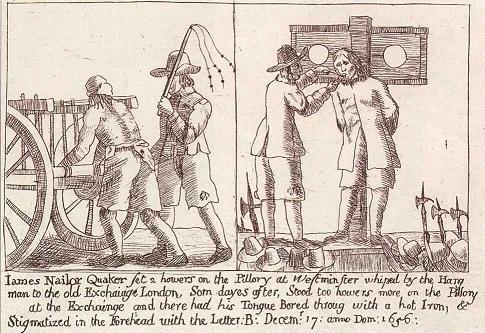
Known today for their pacifist and quietist ways, Quakers had an altogether different reputation in the seventeenth century: belligerent and boisterous rabble-rousers. Fueled dish_quakers by evangelical zeal, and asserting radical ideas for the time, the Quakers were aggressive proselytizers. As a result, they faced violent persecution in England and, to a lesser extent, in the Netherlands, where many migrated. News of their beliefs (e.g. equality for women, refusal to swear oaths, etc.) and their tactics (e.g. preaching loudly and publicly, disrupting worship services, etc.) reached the colonies before the Quakers did.

Connecticut, in fact, banned Quakers in October 1656—prior to any Quakers having ever reached the colony. Other English colonies followed suit (Massachusetts would be particularly harsh on the Quakers), with the sole exception of Rhode Island—though Roger Williams, its founder, spent much of his later life debating Quakers and being frustrated with their refusal to adhere to the “sober rules of civility and humanity.” Quaker missionaries arrived in New Netherland in 1657. Following the sentencing of one of their number, Robert Hodgson, for public preaching, Peter Stuyvesant passed a law that penalized anyone who housed a Quaker, and at the same time incentivized locals to become informants of Quaker activities. The law had gone into effect by December 1657, when local men John Tilton and Henry Townsend were convicted under it.

(Image of Quaker James Nayler (1618–1660) being pilloried via Wikimedia Commons)

(Hat tip: 3QD)