Pot Polling Update

by Patrick Appel

Colorado doesn’t regret legalization:

Two months after legal marijuana sales began in Colorado, its legalization has become more popular in the state. 57% of Colorado voters now say they think marijuana usage should be legal to only 35% who think it should be illegal. That 22 point margin in support represents an increase since the November 2012 legalization ballot measure that passed by 10 points with voters in the state.

Jon Walker adds his two cents:

The results are very similar to the Quinnipiac poll from February which also found support for legalization edging up since implementation. It would seem that once voters get a firsthand experience with legalization and realize the sky hasn’t fallen they become more supportive.

A Search Engine With A Bug

by Patrick Appel

Google Flue Trends

According to a recent report, Google Flu Trends has major problems:

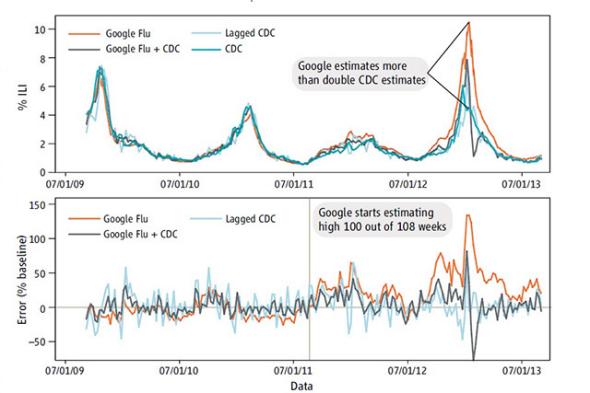
Flu Trends has gotten it badly wrong in at least two cases. The reason for these errors is remarkably simple: the flu was in the news, and people were therefore more interested and/or concerned about its symptoms. Use of the key search terms rose, and, at some points, Google Flu Trends predicted double the number of infected people than were later revealed to exist by the Centers for Disease Control data. (One of these cases was the global pandemic of 2009; the second an early and virulent start to the season in 2013.)

On its own, this isn’t especially damning. But the authors note that flu trends have consistently overestimated actual cases, estimating high in 93 percent of the weeks in one two-year period. You can do just as well by taking the lagging CDC data and putting it into a model that contains information about past flu dynamics. And, unlike the Flu Trends algorithm, they point out that this sort of model can be improved.

David Auerbach takes Google to task:

One of the main problems is that Google’s data is private—very private. Google does not release its raw data or the details of its analyses or even the set of keywords it uses for a particular result. This makes the studies impossible to replicate or check . . . Even if Google’s methodology is perfect—and there’s reason to believe it’s not—there needs to be validation. Here Google’s corporate and research agendas come into conflict: If it wants credit for scientific research, it needs to show its work, even at the cost of compromising competitive advantage.

But the project can be salvaged:

As a test, the researchers created a model that combined Google Flu Trends data (which is essentially real-time, but potentially inaccurate) with two-week old CDC data (which is dated, because it takes time to collect, but could still be somewhat indicative of current flu rates). Their hybrid matched the actual and current flu data much more closely than Google Flu Trends alone, and presented a way of getting this information much faster than waiting two weeks for the conventional data.

“Our analysis of Google Flu demonstrates that the best results come from combining information and techniques from both sources,” Ryan Kennedy, a University of Houston political science professor and co-author, said in a press statement. “Instead of talking about a ‘big data revolution,’ we should be discussing an ‘all data revolution.'”

When The Eiffel Tower Disappears

by Katie Zavadski

paris smog

On Monday, pollution in Paris got bad enough to warrant a response:

Using a system commonly used in China, vehicles with license plates ending in odd numbers are banned from the roads today. Tomorrow, it switches to those ending with even numbers. The length of the ban will depend on the change in pollution levels. The key type of pollution driving the ban (no pun intended) is PM10 particles, which are each fewer than 10 micrometers in diameter. “The safe limit is 80 microgrammes of PM10 particulates per cubic metre, but on Friday, the level peaked at 180 microgrammes prompting authorities to urge people to stay indoors as much as possible and to leave their cars at home,” The Guardian writes. To try to cut pollution levels, the government also offered free trips on public transit over the weekend and until the ban is over.

The ban was lifted after a day, when conditions started to ease up. Feargus O’Sullivan suggests that a long-term solution for Parisians may be more pricey:

What France really needs to do, according to a number of environmentalists, is slash its dependency on diesel-powered engines. An estimated 60 percent of French vehicles currently run on diesel. This higher than average level dates from the 1960s, when French governments promoted diesel in the mistaken belief that it was cleaner than gasoline. In fact, diesel has both higher carbon emissions and carcinogenic fine particles, the form of invisible pollution from which France is currently suffering a major spike. The noxiousness of diesel has led to a paradoxical debate where far-from-benign gasoline emissions have gained the perverse position of being perceived as the lesser of two evils. France’s heavy investment in diesel vehicles means that, to date, there’s been little effective pressure to reduce the country’s diesel dependency —even this year, Paris introduced 320 new diesel-powered public buses.

Previous smog-related coverage here.

(Photo via Damián Bakarcic)

Cool Ad Watch

by Katie Zavadski

Ahead of World Down Syndrome Day tomorrow, an Italian advocacy group releases this PSA:

Through 15 people with Down syndrome from around Europe, the video, titled “Dear Future Mom,” outlines that mothers can expect the same things all mothers expect: a child who hugs, runs, helps, works and faces challenges. “Sometimes it will be difficult. Very difficult. Almost impossible,” the people say. “But isn’t it like that for all mothers?”

Gregory Jaquet appreciates the approach:

No lies, nothing hidden, they give parents a objective and touching perspective.

Erin Gloria Ryan can somewhat relate to the struggles that mothers face:

The sad subtext of that message is that in the western world, women who find out they are pregnant with a child with Down Syndrome choose abortion around 90% of the time, often because they fear their child won’t live a “good life.” I’ve written at length about how the 9-out-of-10 statistic is tough for me, a vocally pro-choice woman who grew up with a very close relative with Down Syndrome, to swallow. And I’d never tell other women how they must or must not form their families. But, as a pro-choice woman, I’d want prospective mothers to base their decisions around whether or not to abort a pregnancy to rely on facts rather than fear, and ads like this one help shine light on the reality of living with or raising a child with Down Syndrome.

Odious Debt

by Jonah Shepp

Jamila Trindle and Keith Johnson note an economic silver lining of Russia’s aggression against Ukraine:

It may be cold comfort when enemy tanks are still on its border, but some observers suggest that Kiev should be able to write off at least $5 billion of its debt to Russia because Moscow has effectively stolen Ukrainian territory and energy resources, as well as military hardware and bases. “An obvious focal point for the Ukrainian government now that Russia has intervened across its border, and actually seized land/assets is debts owed to Russia,” said Tim Ash, head of emerging markets research at Standard Bank Group. “No doubt the lawyers are sharpening their pencils as we speak.”

There are already a few ways in which Russian takeover could end up alleviating Ukraine’s debt, the most pressing of which is probably the $1.8 billion (and counting) that Kiev owes Gazprom for natural-gas shipments over the last year.

But Felix Salmon explains that some debt, like the $3 billion Russia lent to Ukraine in December, may prove harder to shake:

[T]he loan was not, technically, a bilateral loan from Russia to Ukraine. Instead, it was structured as a private-sector eurobond. … This is a notorious vulture-fund move: a hedge fund buys bilateral debt from a sovereign, and then sues not as a sovereign but rather as a private-sector creditor. I can think of a few hedge funds which would be interested in Russia’s debt, if they could buy it at a discount to where the rest of Ukraine’s debt is trading. After all, to use a term you might have seen on this blog in the past, this loan is, legally, pari passu with all the rest of Ukraine’s bonded debt.

(In fact, this bond is arguably senior to the rest of Ukraine’s bonds, thanks to a very unusual provision which allows Russia to accelerate the debt if Ukraine’s GDP falls. But since there now seems to be no chance that Ukraine will pay the coupon on this bond, it’s going to be in default very soon anyhow.)

The Victims Of False Rape Accusations, Ctd

by Chris Bodenner

A few readers tackle a recent post:

There is much to say about Matchar’s article, but I only want to comment on one thing.  She writes: “The most reliable statistics available place the number of false rape reports at between 2 and 8 percent of all rape reports. Yet most people, both in and out of the MRM [men’s rights movement] community, believe these numbers to be much higher.”

First off, “most people” believe those numbers to be much higher? Really? That is news to me, and it would probably be to “most people” I know. Moreover, there’s nothing backing that assertion, save that single survey, of which she writes that it found that “both male and female college students believe that about 50 percent of rape allegations are false.” However, if you actually read the linked-to survey, it finds that 50 percent of “intercollegiate athletes” who were “predominately male” believe that. Color me surprised that in a big group of male college athletes and the occasional woman, half of them think that rape victims are lying.

Another focuses on the “2-8 percent” statistic:

It seemed to beg the obvious question: “Does that mean that 92-98% of sex assault reports result in convictions? That seemed impossible. So I clicked through and read the report. The definition is buried pretty deep in the article, but I wanted to send it to you, because it’s a pretty key piece of context for understanding how common this actually is. The study defines “false accusation” thusly:

The determination that a report is false can then only be made when there is sufficient evidence to establish that the sexual assault did not happen (was not completed or attempted.) This does not mean that the investigation failed to prove that the sexual assault happened–in that case the investigation would simply be inconclusive or unsubstantiated.

In other words, an accusation only counts as “false” if there is demonstrable evidence if its falsity – that is, if there’s definitive evidence of deception. That leaves a huge swath of accusations that are not provably “false” but also not provably “true” (i.e. they do not result in conviction.) The article, I guess, is assuming that, out of that undetermined swath, there’s not a single false accusation. This seems an unwarranted assumption, to say the least.

So the reality is: Somewhere between 2-8% of reports are so false that it is actually possible to prove a negative – that they did NOT happen. (Note: This seems like a high number for that, no? 1 out of 20?) Plus, some other number of reports do not admit of strong proof either way, but are false. A third group of cases are true reports, but not provably so, and a fourth group results in sexual assault convictions.

The MRM is unhelpful and out of line when it makes a direct comparison between the problem of being raped and the problem of false rape accusation. Rape, sadly, happens far more, and it’s even more damaging than a false accusation. No one should dispute that. However, progressive feminists are also unhelpful and out of line when they minimize and dismiss the victims of false accusations, or when they insist that anyone who accuses someone of rape must be taken at their word.

The truth is, statistics aren’t very helpful in this area. We don’t know what happens behind closed doors and we don’t know who is telling the truth. But I do know that quoting misleading statistics while acting as if one is being reasonable and generous, as Matchar surely does, is only a more clever and more patronizing way of dismissing a movement that, whatever its faults, addresses a real and serious problem.
Vegas Hits A Dry Spell

by Patrick Appel

Statewide Drought Forces Californians To Take Drastic Measures For Water Conversation

Eric Holthaus checks in on the Sin City’s water supply:

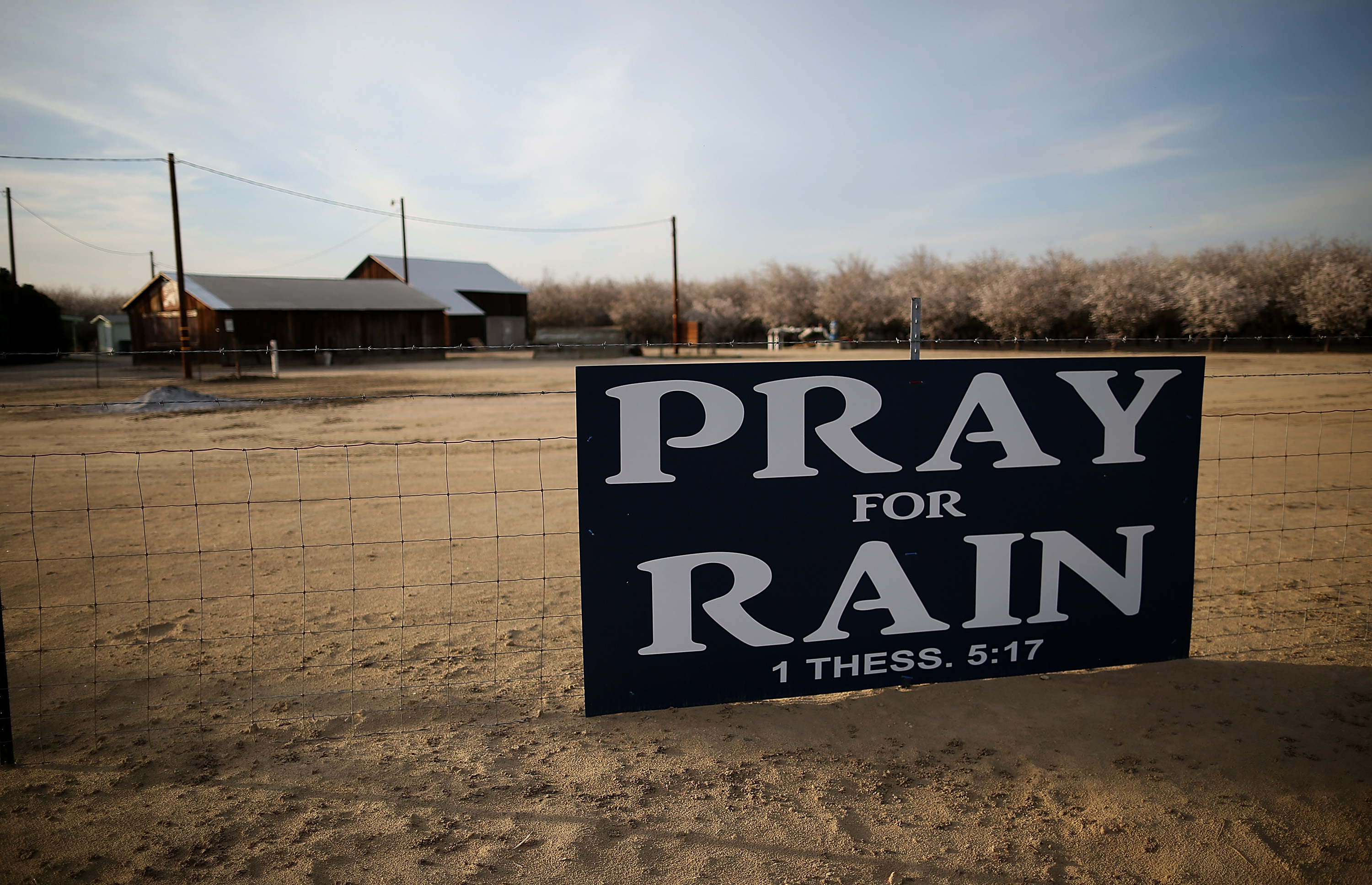
The driest city in America still uses more water per capita than just about any other city in the country. This despite years of steady efficiency improvements and the resounding success of its “cash for grass” program that pays residents for each square foot of lawn they rip out and replace with rocks. Front lawns are now illegal in Las Vegas, yet verdant golf courses are still commonplace. About 70 percent of the city’s nearly maxed-out water diversion from Lake Mead still goes to landscaping.

Don’t get me wrong: The city has made major improvements in water efficiency, using about 40 percent less water per person over the past 25 years or so. The problem is the city’s population has tripled over that same time, and total water usage is up (though down from its peak about a decade ago—an improvement due at least partially to the economic downturn). It’s like a one-ton man patting himself on the back for losing 400 pounds. Great news, but there’s still a long way to go.

(Photo: A sign is posted near an almond farm on February 25, 2014 in Turlock, California. By Justin Sullivan/Getty Images)

The Conspiratorial Sort

by Patrick Appel

Megan Neal summarizes a study on the spread of fake news through Facebook:

[A] team of researchers at Northeastern University, led by Walter Quattrociocchi, decided to study how it is that erroneous information jumps the credibility fence and becomes widely believed to be true. Their theory, published on the arXiv preprint server last week and unearthed by MIT Technology Review, is that it has something to do with the kind of people who read “alternative” news, because they’re generally mistrustful of the mainstream media. …

Logically enough, the folks who were more prone to reading alternative websites (defined as “pages which disseminate controversial information, most often lacking supporting evidence and sometimes contradictory of the official news”) were also more likely to buy into a conspiracy theory. The thinking goes that those radical readers are A) ​less adept at parsing accurate information and B) already skeptical of mainstream journalism, and looking for an different take.

Relatedly, Mary Elizabeth Williams flags a “a new study from the University of Chicago that reveals that nearly half of all Americans believe medical conspiracy theories”:

The findings, published this week in JAMA Internal Medicine, are culled from a study of 1,351 adults who were polled about their beliefs on six popular theories: “The CIA deliberately infected large numbers of African Americans with HIV under the guise of a hepatitis inoculation program,” “Doctors and government still want to vaccinate children even though they know these vaccines cause autism and other psychological disorders,” “The FDA is deliberately preventing the public from getting natural cures for cancer and other disorders because of pressure from drug companies,” “Health officials know that cell phones cause cancer but are doing nothing to stop it because large corporations won’t let them,” “Public water fluoridation is really just a secret way for chemical companies to dump the dangerous byproducts of phosphate mines into the environment,” and “The global dissemination of genetically modified foods by Monsanto is part of a secret program launched by the Rockefeller and Ford foundation to shrink the world’s population.” As the study’s authors write, “49% of Americans agree with at least one medical conspiracy theory and 18% agree with three or more.”

Cass Sunstein lists reasons individuals believe in conspiracy theories:

Here’s an excellent predictor of whether people will accept a particular conspiracy theory: Do they accept other conspiracy theories? If you tend to think that the Apollo moon landings were faked, you are more likely to believe that the U.S. was behind the 9/11 attacks. (With a little introspection, many of us know, almost immediately, whether we are inclined to accept conspiracy theories.)

Remarkably, people who accept one conspiracy theory tend to accept another conspiracy theory that is logically inconsistent with it. People who believe that Princess Diana faked her own death are more likely to think that she was murdered. People who believe that Osama bin Laden was already dead when U.S. forces invaded his compound are more likely to believe that he is still alive.

The second set of explanations points to the close relationship between conspiracy theories and social networks, especially close-knit or isolated ones. Few of us have personal or direct knowledge about the causes of some terrible event — a missing plane, a terrorist attack, an assassination, an outbreak of disease. If one person within a network insists that a conspiracy was at work, others within that network might well believe it.