The Other B-Word, Ctd

Ann Friedman nails it:

The main reason I can’t stomach a bossy ban … is that it represents a feminist strategy that’s failed in the past, and it plays into a negative characterization of feminism more generally. The movement for gender equality is at its best when it emphasizes expanding choices for everyone. … [M]any restrictions are worth fighting for, especially when they protect physical safety and personal autonomy — think of child-pornography laws or perimeters around abortion clinics. When it comes to cultural change, though, applying such hard-nosed tactics doesn’t make much sense.

Culture is a constantly changing thing that we create and shape collectively, not a set of rules that are formally written and rewritten by some governing body.

Sure, radio stations can be persuaded to drop a host who used racial slurs or Wal-Mart can be pushed to stop selling girls’ underwear with the phrase “Who needs credit cards …” on the front. Bans and boycotts can be used to great effect when they’re concrete and narrowly focused. But the feminist movement, at its best, does not simply decry negative media depictions or declare certain words off-limits; it creates better alternatives and rewrites narratives to be more inclusive. Kathleen Hanna didn’t start a “Ban Slut” campaign in the ’90s — she wrote the word on her belly with a Sharpie, owned it, and continued making awesome music.

Which is why it’s so frustrating to watch Lean In try to expand girls’ options by restricting the way we talk about them. It’s counterintuitive, and it makes feminists look like thought police rather than the expansive forward-thinkers we really are.

Along those lines, Zara Kessler adds:

Perhaps instead we should champion bossy, both the word and the behavior, pushing it toward a positive definition instead of attempting to stamp it out of existence. Slate’s Waldman says bossy “seems like a great candidate for rehabilitation” and notes that Tina Fey “started off the recovery process by naming her book Bossypants.” At CNN.com, Peggy Drexler pointed to Sandberg’s bossiness as a likely contributor to her success: “So, how about an initiative to reclaim bossiness as a point of pride?”

Poniewozik looks at the “bossy” double standard in a different way:

As Lean In’s Sheryl Sandberg says, correctly, the problem with the term “bossy” is that we apply it more often to girls, while boys with the same traits are considered “assertive” and “aggressive.” Her solution: stop calling your daughters bossy. Here’s another idea: Start calling your sons bossy. The double standard Sandberg identifies is absolutely real. But why is the solution to encourage aggressive, domineering behavior in women, rather than discouraging it in men? I know plenty of obnoxious, bossy men. And maybe society does applaud them. But I don’t want to be around them, I don’t want to work with them, and I certainly don’t want to work for them.

A reader is on the same page:

As a male who isn’t obsessed with worshiping the reigning masculine paradigm, I absolutely love working under women in most cases. Female bosses are outstanding. Most of them collaborate, share, nurture. My experience is that the ones that suck are the ones who suck for the same reason the men I’ve worked under who suck also suck: they aren’t collaborative, they don’t share, they don’t nurture.

We should be retiring the word bossy because acting like a boss is a pretty shitty way to act. I’d much rather a boss that says, “Let’s,” or a boss that says “What could you do to…” as a way of starting a sentence. Male or female.  Let’s work towards a world where both men and women act like human beings and not bosses. We might get more work done. We might be happier.

Previous Dish on the debate here.
Did The Obama Administration Torture? Ctd

An apology is in order. After reading more reader emails on this subject, and after properly reading and thinking about Conor’s original post, I withdraw my aside that this wasn’t technically torture because it was not done to procure information and could be defended as a medical procedure to keep someone alive. If the facts of the case are as the lawsuit alleges, Conor is dead right and I am dead wrong. Conor is wrong, however, to say I am blinded by fealty to Obama, as my posts this week on the Senate Intelligence Report should prove. I was, rather, guilty of blogging while traveling.

I hope readers understand I wasn’t defending the ghastly practice, just concerned about the legal technicalities. The manner of this force-feeding, if the lawsuit is correct, puts it in an entirely different category from medical procedures. I should have taken more time. This email was especially persuasive:

I am a surgeon well versed in the use of nasogastric tubes.

You wrote, “Many hospital patients are fed with NG tubes, even children. No one would describe that as torture, if medically necessary”. Andrew, I see many patients who have indisputable medical indications for NG tubes who, when informed of my treatment recommendations, refuse insertion of the tube. If I were to then restrain a coherent patient fully in charge of her mental faculties and forcibly jam the NG tube down that patient’s nose, I would be, incontrovertibly, assaulting that patient.

There are plenty of medical interventions that are justifiably “indicated”. A diabetic with gangrene of the foot may truly need an amputation, but if you restrain him against his will and go lopping off his limb, then you should have to face criminal charges.

This is about consent. Torture isn’t just to elicit information. You have said yourself that torture has nothing to do with intelligence gathering or ticking time-bomb scenarios. It’s all about power and domination.

An unfiltered comments section on Facebook is here.

The Smearing Of Ryan As A Racist

One of the worst traits of some left-liberals is their easy resort to calling those who disagree with them bigots or racists or worse. There are some sites on the web that seem almost entirely devoted to patrolling the discourse for any sign of sin. This one’s a homophobe; this one’s a racist; so-and-so said this and that could be – shock! – prejudiced. It can sometimes be a way to avoid engaging arguments rather than tackling them. And so, on cue, Paul Ryan is taking heat for these remarks:

We have got this tailspin of culture, in our inner cities in particular, of men not working and just generations of men not even thinking about working or learning the value and the culture of work, and so there is a real culture problem here that has to be dealt with.

He noted that “Charles Murray or Bob Putnam over at Harvard – those guys have written books on this.” Cue liberal freakout. Josh Marshall focuses on the citation of Murray:

When you start off by basing your arguments around the work of Charles Murray you just lose your credibility from the start as someone actually interested in addressing poverty or joblessness or really doing anything other than coming up with reasons to cut off what little assistance society provides for its most marginalized members or, alternatively, pumping up people with racial resentments against black people and giving them ersatz ‘scholarship’ to justify their racial antipathies.

That’s because Murray’s public career has been based on pushing the idea that black urban poverty is primarily the fault of black people and their diseased ‘culture.’ Relatedly, and more controversially, he has argued that black people are genetically inferior to white people and other notional races with regards to intelligence. Yes, that last part should be crystal clear: Murray is best known for attempting to marshal social science evidence to argue that black people are genetically not as smart as white people.

Sigh. Josh seems to be arguing that Murray blames all resilient urban black poverty on culture …. and then blames it all on genes! Pick one canard, would be my advice. And the truth is: in The Bell Curve, Murray was concerned about the role of genes and environment in the resilient IQ differentials among different ethnic groups, as anyone who actually read his book (I did, most liberals wouldn’t) would know. As Screen Shot 2014-03-14 at 11.32.05 AMfor the notion that Murray is useless in actually attempting to help urban poverty, has Josh ever heard of the book Losing Ground? It was the key text for the Clinton welfare reforms of the 1990s – which even Obama now concedes he dismissed too easily.

And it is simply untrue that Murray has argued that “black people are genetically inferior to white people and other notional races with regards to intelligence.” Murray’s work specifically insists that there are countless African-Americans with higher IQs than countless whites and Asians and Hispanics. (He has recently focused his efforts on white poverty as well – which would seem to disprove some of Josh’s claims.) It’s just that the bell curve (which was the title of the whole fricking book) starts at a slightly different place for different racial groupings – something that drives blank slate liberals nuts with cognitive dissonance. Years later, the differentials still exist. Why do you think there are de facto quotas to prevent brainy Asians from dominating the Ivy League? But of course, nothing drives ideologues nuts like reality.

One more thing: I’m sure Murray has gotten used to this distortion of his work. But it still strikes me as outrageous that a scholar like Murray is subjected to being called a racist of the worst sort and a dishonest scholar – simply because the resilient data support his core point, and because he dares to cite genetics. (It’s an old and great line that liberals believe nothing is genetic but homosexuality, while conservatives believe everything is genetic except homosexuality. For my part, it seems pretty damn obvious that almost all human behavior is a function of both – and the interaction between them.)

Josh goes another round:

Weigel notes that it’s not necessarily clear that Ryan was referencing The Bell Curve. He might just as well have been talking about Losing Ground, the critique of liberal social policies, particularly welfare, which put Murray on the map in the 1980s or his more recent work on the ‘white underclass’. To which I would say, maybe? Who knows? And really, who cares? At the risk of sounding wrenchingly corny, The Bell Curve is a bell you simply cannot un-ring.

As Joan Walsh notes here, in the years since publishing The Bell Curve, Murray has slightly softened his argument. He now refers to IQ and what he believes is the mental inferiority of African-Americans not as ‘genetic’ but rather as ‘intractable.’ By this Murray seems to mean that there are too many factors playing into intelligence to definitively say genetics are behind what he claims are the mental/intellectual shortcomings of black people. The deficit is simply ‘intractable’ – by which he means that whatever mix of genetics, culture and circumstance create it, nothing can be done to change it in any meaningful way.

But if Josh had read the original book, he would have seen that that was Murray’s argument all along! “Intractable” means a function of both culture and genes. Now I should make clear that I’m not entirely persuaded by Charles’ thesis. I think it’s too fatalist and gloomy. The plasticity of IQ is obvious, and culture may matter far more in the long run. If Murray’s thesis requires no government action to help the poor, I’m as opposed to it as David Frum. But Murray is an intellectual adventurer. He speaks things we only talk about in our own heads. And his original prediction – that modern, SAT-based, liberal economies will, over time, lead to greater and greater inequality has not exactly been proven unfounded, has it? And referencing Murray – along with Bob Putnam, one should add – is perfectly appropriate when talking about arguments about poverty and how to tackle it.

Michael Sean Winters gives Ryan the benefit of the doubt:

First, we on the left have been complaining that Republicans like don’t give a hoot about the poor, and not without cause. I remember Cong. Ryan speaking at Georgetown in 2012 and talking about subsidiarity and federalism and how the federal government should not be the lead actor in anti-poverty efforts. I thought at the time: That would be credible if he could point to any single Republican governor or mayor who was actually attempting some innovative anti-poverty efforts, but he can’t, so the invocation of subsidiarity in this regard is a smokescreen. It is obvious that Ryan has been trying to wrestle with the issue of poverty since then, and I think we have an obligation not to throw his words back in his teeth the second they are uttered. That is not the way to create a bipartisan consensus on the need for our nation to confront lingering poverty in our midst.

By the way, check out Murray’s responses in our Ask Anything series to get his recent take on the Bell Curve criticism. A long thread on race and IQ is here.

The Hounding Of A Young Gay Writer, Ctd

A reader writes:

I’m with you on this one.  I’m a late-blooming gay from a fundamentalist background (who came out when I was 34, now 38). After a brief foray into fiery, intolerant atheism, I’ve had to take a few steps back after realizing that not believing in a church’s worldview doesn’t make me better than anyone, especially when I try to enforce that belief with equally rigid legalistic intolerance of dissenting opinions.  And I’ve been growing increasingly irritated by the leftist purity crusade I see in some quarters, where there’s no forgiveness for and listening to people who do not come to the table pre-converted to liberal opinions.

If the left wants to hold itself up as “better than”, then they have to actually BE better.  This will require them to do the things they are mad at fundamentalists for not doing: listening to the stories of people who disagree with them and recognizing their common humanity and basic dignity.

Another dissents:

Why are you making lazy rebuttals in defense of someone making terrible arguments that you mocked only hours earlier? Using language like “the new gay intolerance”? And only a day or two after getting into a cat fight with Rod Dreher about it?

There are specific criticisms being levied at Ambrosino’s take on gay issues, exemplified by the fact that he thinks Jerry Falwell was not a homophobe. The criticisms are: he is overly considerate of the feelings of people who are obviously bigoted while utterly dismissive of the concerns of people who have been and are being discriminated against. Pointing out Ambrosino’s age is well-taken – many develop bad writing habits while young and just need a good editor to break them of their lazy contrarianism. On the other hand, some can never quite purge themselves of their lazy contrarian streak, Andrew.

Zing! More readers defend the young writer:

Isn’t the point of hiring Ambrosino to take a raw talent and help him become a better writer?  Or is that what the folks who are railing against him are afraid of?  That he might actually become a better writer and express himself in ways that are more convincing than they are now?

Another:

I’m the fiction editor of a literary magazine based in Philadelphia, and there are few things more rewarding to me then reading a distinctive voice and a different point of view. I like being taken to unexpected places. A really, really good personal essay can do that like few things can.

And that Atlantic piece Ambrosino wrote about being gay at Liberty U qualifies as to all that. I had never heard of him before yesterday, and with all the pile up on his head, I read that essay expecting to find, from all the invective, some self loathing, conversion therapy endorsing resident of Crazyville.  What I read was a writer neither taking nor giving any easy paths out.  He showed complexity.   He allowed me to see as non caricatures both an institution and the people in it.

I will never like Jerry Falwell. As far as I’m concerned, Christopher Hitchens’ line about giving Falwell an enema and burying him in a shoebox is pretty accurate. But I didn’t know him. Brandon did. And he has the right to allow the reader to see Falwell in a way that is different than Hitch’s was because he knew him in a different way.  It takes both writing skill and courage to do that. And I think the guy has both.

I hope Vox doesn’t back down. And I look forward to reading more of Ambrosino’s work.

Obama Orders More Overtime

ot_fig1

The White House announced on Wednesday that Obama would raise the weekly wage cap on overtime pay:

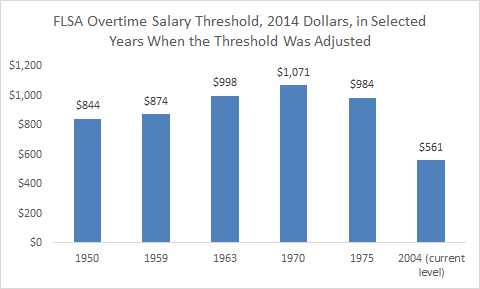
Under current regulations, salaried employees making less than $455 a week must be paid overtime, a threshold set in 2005 by the Bush administration. In 1975 it was $250 per week, the equivalent of $970 in today’s dollars. The White House is not yet revealing its proposed new cap—which will be subject to public comment and will likely face strong opposition from the business community—or when it will kick in. But a White House official said the proposal will help “millions,” and offered up California and New York as models for the proposal. Those states have set thresholds of $640 per week and $600 per week (which will increase to $800 per week and $675 per week in 2016), respectively.

McArdle connects the overtime push to “The Politics of Crap Retail Jobs”:

These days, it seems that a lot more people are finding that these jobs in fast food or retail are “the best we can do”; it’s no longer housewives and teenagers looking for some extra income. Meanwhile, in many ways the work has gotten worse. Employers, themselves facing brutal competition, are using software packages to help them schedule workers in ways that maximize their profitability while maximizing inconvenience to employees. Hours are kept low to ensure that workers don’t qualify for overtime, much less benefits — and because the software requires employees to make available many more hours than they actually get, they often can’t even string together two part-time jobs to make a full-time income.

Meanwhile, the folks scheduling them are often people who would like to get a better job with more opportunity but can’t find one. They too feel trapped in jobs that don’t pay much but require too many hours for them to pick up a second shift somewhere else.

These workers may not be numerous enough to succeed in unionizing Wal-Mart. But they are numerous enough to make up a powerful political force.

Walter Olson points out that the executive order will have unintended consequences:

As with the expansion by decree of minimum wage law, it will be interpreted in some quarters as an undiluted boon to the employees it covers – their employers will either raise their pay or limit the hours they are expected to work, or both, and how could they be anything but happy about that? But as the piece quotes Cato’s Dan Mitchell as warning, “There’s no such thing as a free lunch… If they push through something to make a certain class of workers more expensive, something will happen to adjust.”

At Forbes, Daniel Fisher explains some of the mechanisms by which that will happen. It will probably become harder to retain exempt status, for example, for “management-plus” jobs, such as one where a shift manager is expected to fill in occasionally at the register during a cashier’s break. That will hit smaller establishments especially hard, while yanking away transitional positions by which ambitious hourly hires can cross over to management.

Morrissey agrees:

Right now, the exemption allows businesses to claim overtime exemption for people earning $455 a week or more (annual salary of $23,660)* just by asserting that any part of their duties is “executive” in nature. That’s a ridiculously low level, but businesses have structured their work forces on the basis of this regulation. No matter what level the White House chooses, it’s going to impact staffing decisions; the question is how bad it will get, and how many jobs end up going from full- to part-time in defense of potential unforecasted costs in smaller businesses especially.

Jared Bernstein addresses criticisms of the order:

[Y]ou hear the knee-jerk “job killer” response from the business lobby.  But in this case, the logic doesn’t follow.  If a currently ineligible salaried worker becomes eligible for overtime pay by dint of this change, her employer can easily avoid paying her the overtime premium by hiring a new worker at the “straight time” wage.  And this happens to scratch another labor market itch we have right now: weak job creation.  That’s why Dan Hamermesh, a highly respected labor economist who’s studied this issue for decades, said about the president’s proposal in an article in The Washington Post: “I would argue it’s a job-creation program.”

But this argument doesn’t impress Pethokoukis:

So Obama’s directive might mean less pay for some, but possibly create jobs for others in what is essentially a federal mandated work-share program. Just what is the net effect of the Obama wage floor? … [R]etail shops and other small businesses look to be most affected because they need salaried managers and shift supervisors to monitor “low-skilled workers in need of oversight.” These managers also fill in when these low-skill workers unexpectedly don’t show up for work. Does enhanced OT, then, make it more likely that business is a bit more likely to replace low-skill workers with machines? Tell me, CBO!

(Chart from Jared Bernstein)

Ask Rob Thomas Anything: Giving Fans What They Paid For

In today’s video, Rob explores the Veronica Mars business model and says he had no problem trying to tailor the film to its Kickstarter backers:

In Willa Paskin’s opinion, Rob hits his mark with the Mars movie (which comes out today):

I don’t know how much money Veronica Mars will make, or how much money it has to make to be deemed a success, but as means of fan-satisfaction it is a needle to a major vein. Unlike the new, structurally complex Arrested DevelopmentVeronica Mars’ only ambition seems to be to deliver a product of the same quality as the incisive, quippy show—not at all a low bar. By unapologetically being an extended TV-episode in movie form, Veronica Mars keeps on keeping on with its major theme: taking things that are assumed to be adorable and unserious and safe and complicating the hell out of them.

In the next video from Rob, he explains that while he expected the Kickstarter campaign to be successful with fans, he didn’t anticipate how much the project would raise the profile of a show cancelled seven years ago:

Alan Sepinwall bets that non-fans will enjoy the movie, but he still wonders if the enthusiasm will translate to a good take at the box office:

I would say it’s a film where the story will be easy to follow for a newbie, and where they may appreciate both the performances ([Kristen] Bell’s depth and versatility, in particular, will be eye-opening to anyone who only knows her from the many dumb romantic comedies she’s made in the years since) and the snappy dialogue for its own sake, but where the impact — both the dramatic beats and the smaller character moments — won’t be nearly as satisfying without 64 episodes worth of history with Veronica and friends. …

Like the “Firefly” sequel movie “Serenity,” this one’s going to have to rely almost entirely on pre-existing fans if Thomas wants to be able to make more movies. (There is going to be a series of novels about Veronica, spinning out of the events of the movie, and the story leaves several plot threads dangling for a sequel.) On the plus side, the movie cost Warner Bros. peanuts, even after they chipped in a bit. On the minus side, over 70 percent of the Kickstarter backers get a downloadable copy of the movie, on the day of release, as one of their rewards, that they may not feel the need to spend even more money to see it in a theater.

For more discussion of Rob’s innovative, Dish-like project, go here. His previous Ask Anything answers are here.

(Archive)

The Hounding Of A Young Gay Writer, Ctd

Ezra addresses the controversy over Vox hiring Ambrosino:

Brandon isn’t our LGBT correspondent. He’s not even the only LGBT employee of Vox.com. He is a young writer who we think has talent who’s going to receive a lot of editing and a lot of guidance.

Brandon applied for the news-writing fellowship, a one-year position focused on helping inexperienced writers develop aggregation and reportorial skills. Contrary to some garbled reports, before hiring Brandon I read a lot of his previous work. Brandon’s past writing was often quite pointed and personal, and not a fit for Vox — and I told him so. The writing fellowship requires a very different approach.

But something that often happens to young freelance writers on the Internet is that they end up writing reams of their most controversial opinions before they ever get a chance to do basic reporting or benefit from a routine relationship with an editor. So as part of Brandon’s writing test, I asked him to do eight news articles and two explainers — more than 5,000 words of original content, in all. He needed more editing, training and direction. But he showed himself a strong, fast writer who really wanted to learn. And that training is what the fellowship is there for.

So back off, pitch-forkers! In his comments to Gabriel Arana, Ezra defended the hire partially on the grounds “ideological diversity.” Kilgore hates that rationale:

It kind of makes me crazy when someone appears to assume that only Christian conservatives are authentic religious voices, and that finding a gay conservative evangelical Christian strikes some sort of “balance.” It’s the same mindset that seems to have led the President of the United States to conduct his “religious outreach” mostly among conservative evangelicals who are minority folk or who have some other reasons for playing nice with Democrats. Obama really ought to know better, and so should Ezra: there are these people called mainline or liberal Christians around, too, and if you are trying to give Christians a voice in progressive venues, you might want to start with them instead of always looking for an unconventional conservative.

I have not seen anywhere in Ambrosino’s slim portfolio of clips anything like an unreconstructed fundie. Dreher loves Ambrosino’s Time piece:

This is what sent Mark Joseph Stern to his fainting couch? I had not seen this Time piece, but its sheer humanity made me want to stand up and cheer. Brandon Ambrosino will do more to change minds and turn hearts than a thousand cartoonishly militant Mark Joseph Sterns.

Good for Vox for hiring someone who actually thinks and reflects to cover gay issues, and who tries to see the other side, even if he ultimately disagrees with it, versus Slate, which satisfies itself with employing someone who mistakes outrage for integrity. If Brandon Ambrosino is the Martin Luther King of the gay rights movement, then Mark Joseph Stern is Stokely Queermichael. 

Matt Baume thinks he’s just a bad writer:

Brandon’s not especially insightful. He doesn’t have any particular talent for constructing an argument. There’s nothing all that compelling about what he has to say. There’s no reason to suffer through his work. His only distinction is that he’s a gay guy who writes with disdain for other gay guys. And as anyone who’s ever read the comments on Queerty can tell you, there’s nothing all that unusual about that.

I’m really staggered by this pile-on. It’s not about the quality of his work. It’s about policing the discourse to permit only one gay perspective rather than many. It’s a stultifying, ugly, petty piece of ideological police-work. It repels me as much now that we have made so much gains as it did when exactly this kind of leftist viciousness hounded me in my twenties as well.

Dissents Of The Day

gitmo-feeding-chair630

A reader writes:

I assume you’ll receive dozens of emails pointing out a major error in your post “Did The Obama Administration Torture?“, but I have to chime in too. I was especially surprised at your comment: “The problem here is that there is no indication that this inhumane treatment was designed to procure a confession or admission of some kind – and that’s key to defining it as torture.” Your definition doesn’t fit the dictionary or UN definition of torture.  The UN Convention Against Torture defines torture as:

any act by which severe pain or suffering, whether physical or mental, is intentionally inflicted on a person for such purposes as obtaining from him, or a third person, information or a confession, punishing him for an act he or a third person has committed or is suspected of having committed, or intimidating or coercing him or a third person, or for any reason based on discrimination of any kind, when such pain or suffering is inflicted by or at the instigation of or with the consent or acquiescence of a public official or other person acting in an official capacity. It does not include pain or suffering arising only from, inherent in, or incidental to, lawful sanctions.

This is one of the stricter definitions of torture, yet if the claims about Guantanamo in that article are true, the US is certainly still torturing prisoners under President Obama. Your personal definition of torture doesn’t comport with international law and would even go so far as to preclude a lot of what happened in Saddam Hussein’s torture chambers from being called torture, since often it was to intimidate others or punish perceived enemies, not to get specific pieces of information.

First up, I find force-feeding barbaric and horrifying. What we’re talking here is legal definitions of torture. The reason I brought up the purpose of  it – to get information – was because it gets at the core question of intentionality. The reason force-feeding is problematic as torture is because the stated intention is to keep the prisoner alive, not to inflict pain and suffering. It may entail pain or suffering, but the intent is what counts. Many hospital patients are fed with NG tubes, even children. No one would describe that as torture, if medically necessary. Another reader:

The US definition of torture is even more expansive than the UN’s:

(1) “torture” means an act committed by a person acting under the color of law specifically intended to inflict severe physical or mental pain or suffering (other than pain or suffering incidental to lawful sanctions) upon another person within his custody or physical control;

(2) “severe mental pain or suffering” means the prolonged mental harm caused by or resulting from—
(A) the intentional infliction or threatened infliction of severe physical pain or suffering;
(B) the administration or application, or threatened administration or application, of mind-altering substances or other procedures calculated to disrupt profoundly the senses or the personality;
(C) the threat of imminent death; or
(D) the threat that another person will imminently be subjected to death, severe physical pain or suffering, or the administration or application of mind-altering substances or other procedures calculated to disrupt profoundly the senses or personality;

There’s no requirement at all that it be for a purpose.

Friedersdorf also pushes back:

If Dick Cheney walked into a prison cell at Guantanamo Bay and crushed the testicles of an inmate, not to elicit information but because John Yoo said it might be okay and he wanted to test the limits of executive power, Sullivan would not hesitate to call that act torture.

Why does he hesitate here? I have a theory.

President Obama is a very likable individual. He is handsome, eloquent, and charismatic. He seems to be a good husband and father. He exudes reasonableness in many of his speeches, and at his best, their substance is impressive. He has advanced important causes dear to me and to Sullivan, like gay equality. There is no reason to doubt that Obama believes his domestic agenda is salutary. There are also credible allegations that the U.S. government has tortured on his watch. I can see how this would be especially discomfiting to someone like Sullivan, who has written so eloquently in support of Obama and against torture. Sullivan’s idea of a torturing president and his idea of Obama are at odds.

Conor’s theory is silly. Feeding a prisoner to prevent his death from starvation is not the same thing as crushing an inmate’s testicles. And if you cannot see that distinction, you’re being blinded by otherwise admirable righteousness.

Previous Dish on force-feeding here.

(Photo of a force-feeding chair used at Gitmo taken by Sgt. Brian Godette, Army 138th Public Affairs Detachment)

Hathos Alert

And some inspiration for Cartman’s next Faith + 1 album:

Update from a reader:

It was shocking to see that mashup of Gwen Shamblin, CEO of the Weigh Down Workshop. Around 2000, she founded her own church, the Remnant Fellowship, made up of hardcore adherents of her weight-loss program. It operates like a classic religious cult, using information, emotion, and behavior control to keep members in the group. Many families have been broken up over these beliefs. I know because my wife and myself were very nearly drawn into this group and then spent years helping and counseling ex-members who had been damaged by these crazy, legalistic beliefs. And of course, the legalistic focus on food intake turns into a legalistic focus on all other behaviors by which a believer can be judged, including child discipline. You can see a few ex-member testimonies here.