Book Club: Apocalypse Then

A reader writes:

Beyond all the crap about resurrection, Jesus was an apocalyptic preacher who predicted the end of the world would come very soon, probably in his own lifetime. And that realization colors how I view Jesus’ most important message.

I am not a Christian. But my religious identity has nothing to do with belief (what do I know?) and everything to do with the way I live my life. The only parts of the New Testament that I admire are Jesus’ parables and his teachings. Leave your family. Give up material things and live in poverty. Don’t worry about tomorrow. Don’t show off or try to be better than others. This is radical stuff – a lifestyle I respect, but am too cowardly and weak to pursue. Therefore, I do not call myself a Christian, because I cannot live up to Jesus’ commands. And as far as I’m concerned, anyone who doesn’t live like Jesus (i.e. a vagabond) has no right to call himself a Christian.

So a big thought hit me hard: Jesus’ unique and radical teachings only make sense because he was an apocalyptic preacher. Leave your family and pay no attention to tomorrow because the world is about to end. In the context of the end of the world, it all makes sense. Of course you should abandon material things; they’re all about to be wiped away.

So now I’m left with this conundrum: Jesus’ teachings only work against a background of imminent destruction. AND, obviously, the world did not end. Does that then invalidate his teaching? Without the apocalypse at the foundation of Jesus’ ministry, aren’t we badly misinterpreting what he really meant?

We’re certainly avoiding a rather obvious point: one of Jesus’ most emphatic predictions in his lifetime was wrong. Dead wrong. Now you can try and elide this by insisting that he didn’t put a date on the end of the world, but that ignores the urgency of his warnings. Does that invalidate Jesus’ teaching, as my reader suggests? Well, the first thing to say is that Christianity spread rapidly even as its main prediction turned out to be wrong. And, as Ehrman notes, it seems that the reality of the belief in the resurrection is what galvanized and sustained this religious movement after its guru’s untimely and dishonorable death. The resurrection occluded the failed prophesy.

how-jesus-became-godDoes that in turn render the radicalism of Jesus’ calls for total poverty, homelessness and suffering less powerful? I’d say it makes them more powerful. They become less a last-minute preparation for the end-times than a deeper and more radical critique of worldliness in all its forms. They become less a means to an end, and more an end in themselves. And Jesus taught these things, in the Gospels, without constantly referring to them as mere end-times necessities. Power over others is to be foresaken as an eternal truth about human life; wealth is an obstacle to happiness; what matters at all times is being present to others and to God, not running around with this goal or that; forgiving makes you happier than bearing grudges; revenge only perpetuates the cycle of hatred, rather than breaking it. All of these counter-intuitive ideas are our true destiny as humans if we can only master them. They are the only sure means to internal and external peace.

Now, of course, other religious traditions speak of similar things. You can see in Buddhism, for example, the insight that possessions hurt rather than help. You can see in Taoism the wisdom of letting go, of seeking peace by striving for less. And all of these impulses – which contradict what we now understand as our evolutionary nature – transcend “the restless desire of power after power, that ceaseth only in death.” This profound insight – the early Christians believed – didn’t come from within us, but somehow from above us. And a person who walks this Bronzino-Christ-Nicewalk is indeed living as close to divinity as human beings can get.

This insight is perhaps encapsulated by the word logos, a form of divine wisdom about how to be happy and at peace through the law of love; and it is easy to see why Jesus’ life and example came to seem to his subsequent followers an incarnation of this logos, which of course is eternal. And Jesus’ decision to embrace his own torture and death with stunning equanimity and compassion represented the pinnacle of that divine achievement. How many of us could forgive those driving nails into our body? How many would stand by and say nothing when we are accused of something we never did? The Passion narrative is crafted to show how deeply Jesus walked the walk. It is by giving that we receive. It is by forgiving that we can be forgiven. Even in extremis. We will all die some day – which is our own looming apocalypse. And the only true way of grappling with that is through Christ’s logos.

Another reader:

I want to ask, (1) can a believer truly be open to evidence that Jesus, perhaps at one part of his life, said and believed things very different from what we normally attribute to him, and (2) can one – can a Christian – be open to the idea that, in these early beliefs at least, Jesus was wrong?

Take the body of assertions from Chapter 3 [in Ehrman’s book] about Jesus as an itinerant apocalyptic preacher.

I have heard such descriptions of John the Baptist and Jesus previously, but this is perhaps the first time when the sheer weight of these statements hit home. Ehrman’s evidence – supported by his criteria of independent attestation and dissimilarity – helped me to appreciate just how often the texts focus, as a whole, on judgment, on punishment, on reversals of ultimate fortune, and especially on a rhetoric of fear (and joy) in the face of an imminent end.  This vision of Jesus’ early and perhaps entire ministry seems as well founded as anything in the book.

But if you accept that we can indeed have a sense of what Jesus said and what Jesus meant by his apocalyptical proclamations – if we can get a sense of what these word meant in their historical and textual context – then how can this not have an effect on what one thinks of Jesus?

Sheep and goats; burning and wailing; shame and sinfulness; and the righteousness of new and better judgment: these are words that embody, for me, not an abiding love of humanity, but a mainly a hatred of sin. They do not promise to redeem creation, but rather revel in visions of un-creation, of joyous destruction.  These pronouncements do not so much love justice as much they enjoy imagining the punishment of injustice.  In loving God, this Jesus hates the world.

As a historical fact and a textual interpretation, this reading may be correct or incorrect.  But what if, on the whole, it seems right? What can one, as a Christian, do with these words and feelings?

We can balance them, I’d say, by other words and feelings, and see what was truly radical and new in Jesus’ teaching about how to live and die independently of the apocalyptic vision. But we cannot ignore that side completely. Jesus, Christian believe, was both fully human and fully divine. The human part was bound up in the culture and history of his time, its apocalyptic background, and its roots in Jewish scripture. The divine part escaped that. To believe in the Incarnation requires one to accept both, and to live with a Jesus we will never fully master and never totally understand.

(Read the whole Book Club thread on How Jesus Became God here. Please email any responses to bookclub@andrewsullivan.com rather than the main account, and try to keep them under 500 words.)

Update from a reader:

It seems to me a big reason Christianity spread after Jesus’ crucifixion and resurrection, and the coming of the Holy Spirit, is that his followers began to reexamine his apocalyptic predictions in light of their post-Pentecost experiences. They understood “the age to come” to have actually begun – an age defined by the upside-down Kingdom Jesus had announced in his teachings, in which the last were now first, the greatest were those who served, and Jesus – not the Caesar whose government had put him to death – was Lord. The apocalyptic signs were all around them: “I will pour out my Spirit upon all flesh, and your sons and your daughters shall prophesy, and your young men shall see visions, and your old men shall dream dreams” (Acts 2).

They had no reason to disbelieve Jesus on account of his prophecies not coming true; they were now living in the new age he had predicted would come.

Another:

Enjoying this thread. There are other interpretations of Jesus’ prophetic “mistake” about the literal end of the whole world, which does seem like a pretty big paradox for literalists. Instead, lots of the end times prophecies/symbolism make sense when interpreted as applying to the ~70CE Jewish rebellion against Roman hegemony and consequent destruction of the Temple and massive slaughter of the population of Jerusalem, followed by Nero’s persecution of the early Christians. This lines up nicely with the modern dating of the texts in the New Testament (soon after the historical events), and means we can end the idiotic game of deciding which contemporary political figures are candidates for the role of anti-Christ (though that game is too popular to end anytime soon).

Another:

Wow – great insights from the readers! “In loving God Jesus hates the world.” Strong stuff, and not to be dismissed lightly, since it has remained one pole of the dialectic that has driven Christianity from the outset. The “little apocalypse” of Jerusalem’s fall to Titus solves part of the problem, but it does not really reach the deeper issue, if Christ is speaking to mankind and not just the Jews. The response that the Pentecost renders immediate the new age is intriguing, but it cannot resolve the other great failed prophecy stated in the kerugma – the declaration of the Christian’s faith reduced to its essence: Christ has died; Christ has risen; Christ will come again.

Paul, the architect of the Church, understood Christ’s return to be imminent, like the prophecy of the apocalypse. Like the reader who suggests, correctly in my view, that Christ’s preaching of radical divestiture is made within the context of apocalypse, Paul preaches that his congregations must live their lives not in anticipation of Christ’s return, but live them in preparation for his return – tomorrow. As Christians, we can rationalize, but that path leads nowhere, I think. Best perhaps to focus on the here and now.

The $84,000 Cure, Ctd

A reader remains unsatisfied with the Sovaldi discussion:

I can appreciate the gratitude you feel towards the pharmaceutical industry whose anti-retrovirals Screen Shot 2014-04-27 at 12.53.49 PMdrugs saved your life. They saved my life too. However, the fact that the status quo has done great good does not mean that things could not be better.

Sure, research and development of drugs is expensive. But I would like to read your views on studies like this one suggesting that the pharmaceutical industry spends twice as much on marketing as it does on R&D. Also, I would like to see you grapple with the conflict between pharmaceutical companies’ responsibility to maximize shareholders’ profits, and the ethical responsibility to maximize human welfare. They are clearly often – many would argue always – in direct conflict.

Again, I appreciate the gratitude you feel towards the pharmaceutical companies. But I don’t think that gratitude requires an unconditional support of the status quo in the pharmaceutical industry. I would like to see you grapple more with the ethical conflicts and human costs involved.

My support of the drug companies’ innovation is not unconditional. In fact, it’s constantly derailed by some of the worst practices of those very drug companies. Over-aggressive and sneaky attempts to extend patents, heavy marketing of not-so-vital drugs, lobbying to ensure that the balance between the free market and the moral demands of healthcare is always tilted toward profits: I could go on. But my deeper point is a capitalist one: if the only incentive for curing people was human benevolence, I’d be dead and countless others would be suffering. A free market tries to harness human selfishness for the greater good. And maintaining that balance is what we need to do. Broad-brush condemnation of the private drug sector doesn’t help us with that balance. Another reader notes:

Here is an interesting look at the issue in Forbes. Basically, if every person suffering from Hep C in the US took this drug, Gilead would generate $227 billion in revenue. In comparison, the entire frigging drug industry in the US booked $260 billion in revenue last year. That right there is a sign that market forces have absolutely nothing to do with Gilead’s pricing. This is pure extortionary pricing. I completely understand that there are different aspects to consider for this one issue, but there is really no rational, defensible, quantitative way to justify the current price of Sovaldi … a price, by the way, that by itself will restrict access to this drug for many who need it.

But another defends Sovaldi:

I’ve been following this story on your site and around the web pretty closely, as I work for a consultancy that (in part) specializes in pharmaceutical price setting. We didn’t work on US launch pricing for Sovaldi, but the press reaction has stirred quite a bit of attention around our offices.

Our analysis shows that the price of Sovaldi should have actually been higher.

The drug sets a new standard for both efficacy and safety (and has a significantly shorter duration of treatment), and is potentially even better than the competitor drugs coming to market over the next few years. The crux of the problem is that Sovaldi is so effective and so tolerable that many more patients than expected want to initiate treatment immediately. For years, insurance payers have taken for granted that doctors “warehouse” patients who do not have HCV advanced enough to warrant treatment. Patients are streaming out of such “warehouse” queues, and that doesn’t even account for the >50 percent diagnosed population in the US.

So we see that the drug is clinically far superior to standard options that are priced at comparable or even higher levels, but as a result is having a huge impact on insurance risk pools. Is it really fair to tell a manufacturer that they shouldn’t price their breakthrough drugs at parity to inferior competitor drugs that have gone without a negative press reaction for years? The story here isn’t that manufacturers are gouging consumers for a life-saving product, but actually that our drug benefit insurance schemes are simply not equipped to give sick patients drugs that they need when a honest-to-goodness breakthrough comes out.

Another:

Thanks for defending my industry.  I admit I’m biased, and certainly my industry does some stuff that makes people unhappy.  That said, $84K to be CURED of Hep C is a bargain.  When I first saw the news I thought, well, $84K a year to stay alive is maybe a bit steep … but no, this is $84K to be CURED.  My industry doesn’t do a lot of curing.  This drug is a miracle, and those don’t come cheap.

Another looks at a different medication:

My 7-year-old daughter was diagnosed with asthma a few years ago and given a rescue inhaler. Recently the prescription ran out and we called to have it refilled. The pediatrician insisted on seeing her, then prescribed her another inhaler, a daily use corticosteroid – which costs twice as much as the original rescue inhaler.

Never having heard of this particular medication before (QVAR), I googled it and came across a Consumer Reports study noting that the drug is now 92 percent more expensive than it was in 2009, in part because of the FDA’s decision to ban CFCs – a ban which the pharmaceutical industry itself lobbied for.

I’m sorry. This absolutely qualifies as fleecing, as greed.

The NYT did a deep dive into the subject of asthma drug pricing as part of its “Paying Till It Hurts” series last October. Meanwhile, a reader raises the issue of waste:

I’m speaking as someone who worked for years in a firm that was hired by many large pharma companies to help make their internal processes both effective (i.e., defect-free, without rework) and efficient (i.e., not wasting physical, human, or financial resources).  Processes ranged from clinical trials, to marketing campaigns, to production of the active pharmaceutical ingredient.

You cannot begin to imagine the sheer amount of waste involved; it is truly, truly mind-boggling. For years, these firms resisted process improvement efforts (such as Lean and Six Sigma, popularized by Toyota and GE, respectively) in part because the FDA neither rewarded such efforts nor punished the lack of them, and in part because they did not see their activities as “processes” that could be tuned up. I remember first hearing about one firm’s method for analyzing adverse events from their products. So appalling was this description that when I got home, I checked to ensure that the meds I was taking for a chronic condition weren’t made by that company.

I agree that the cost of drugs needs to cover what it takes to bring them to market, and that not all research will result in a salable product. But consumers should not be paying for gross inefficiencies that are relatively easily fixed.

I’m not going to disagree with that. Lastly, a reader wants to clear up some confusion about the NIH:

I work in pharmaceuticals (specifically, early stage startup, not big pharma) and am very familiar with the relationship between academic-/NIH-funded research and industrial drug research and development. The NIH funds very basic research that allows us in industry to then discover and develop new drugs. There is no debate around this, and anyone in a pharma company will agree.

However, NIH funding, with rare exceptions, doesn’t even discover new drugs, let alone develop them. Typically, NIH funding will allow an academic researcher to identify a novel aspect of biology and associate it with a disease state. Pharma usually picks it up at this point by verifying the research, running chemical screens to identify potential drugs, and then modifying the potential drugs to the point where they are safe and efficacious. It is then that a drug will enter clinical trials. The entire process just to get to a clinical trial can take four to eight years and cost millions of dollars. The clinical trials are where the real money and time are spent, of course, but there is a substantial investment by a drug company prior to this that is easily overlooked.

I’m not defending drug pricing; I think we have a long way to go in terms of demonstrating value for money spent. But this is intertwined in healthcare costs itself and drug companies are responding to market pressures. I do however want to dispel the belief that the NIH funds academic research that discovers drugs, and then drug companies take it away and charge an arm and a leg. Drug companies assume the vast majority of the risk and the investment to both discover and develop new drugs.

Cool Ad Watch

Some hathetic moments, but I loved it:

Some religious fussbudgets, however, were not amused:

A Tea Party candidate challenging House Speaker John Boehner got a few chuckles, and a lot of Internet views, with a recent raunchy campaign ad about “electile dysfunction” — but the spot has cost him one of his day jobs. J.D. Winteregg, one of two candidates running against Boehner in the Republican primary for Ohio’s 8th District, got into trouble with Cedarville University, a Baptist school in Ohio where he taught as an adjunct professor. He confirmed to FoxNews.com that his contract was not renewed, on the heels of that ad. He said he was contacted by a supervisor who informed him his contract would lapse because the commercial “did not correspond with university values.”

Winteregg said it crossed his mind that the ad may draw concern from the university, but he and his team attempted to mitigate any concerns. “We actually worked really hard to put something out that I could be comfortable with as a faithful person,” he said. “I knew it might upset some people, but we did the best we could to keep it as a parody.”

Still, Winteregg said he has no regrets about the ad, saying he believes what Boehner has done in Congress is more offensive. “I’m all in with this,” he said. “You got to do this the right way. People lose elections because they are passive, and I’m going to fight for this.”

The Meaning Of The Midterms

Alec MacGillis observes how Sasha Issenberg’s new TNR cover-story complicates it:

The piece deserves to be read in its entirety, but the nut of it is Issenberg’s account of the evolving understanding of why midterms have come to differ so much from presidential-year elections. Until not so long ago, the common assumption was that midterms often favored the party not holding the White House because many swing voters who had voted for the president found themselves disillusioned and wanted to issue a rebuke… But the swing-voters dynamic has been greatly overstated—even in the historic midterm “rebuke” sweep of 2010, fewer than six percent of 2008 voters went for the opposite party in their congressional vote two years later.

Kilgore responds:

The CW about 2010 was that Barack Obama’s performance in office disappointed vast numbers of 2008 supporters who believed his talk of bipartisanship and “Red, White and Blue America” and tilted to the GOP in the midterms to rebuke him or restrain him and his “overreaching” party—a phenomenon strengthened by the advent of a new citizens movement called the Tea Party which emerged from the ranks of independents unhappy with both parties.

A “swing” of six percent of 2008 voters can hardly sustain this narrative of triumph and betrayal, can it?

No it cannot. Demography and turnout make all the difference. And the US midterms are increasingly more a survey of the white and the over-60s than of the general population. Which is why extrapolating from them too much is a fatal error, but one that Republicans seem to make every time. It’s a short term tonic for a long-term problem. And it can make the long-term problem worse.

Do I Sound Gay?

This embed is invalid


It’s a question many gay men have asked of themselves at some point. And it raises all sorts of fascinating questions about the origins of sexual orientation. Is sounding your sibilants a little excessively in the genes or from the environment? Is the gay voice a function of  learning from others and creating your own community, or is to something embedded in our nature? Why is there such a wide spectrum of gay voices – from gruff masculinity to elaborate femminess? A documentary exploring this is almost done and just launched a kickstarter campaign to finish it. You can help here.

“ClickHole”

When the cool kid cultural barometer, The Onion, takes on sponsored content, you know the tide may be turning. The Buzzfeed/Upworthy parody site isn’t up yet, but they’ve given us a flavor:

Nelson Mandela, as he lay on his death bed said, ‘My greatest regret is that I never generated buzz, and expanded my brand’s reach through a cross-promotional digital partnership with a major lifestyle brand with strong appeal among Millennials such as Pringles, or Old Navy. I have wasted my life.’

Maybe the best way to tackle something so egregious and bullshit-heavy is by parody and humor. God knows other forms of protest are like whistling in a hurricane.

Will Democrats Turn Out?

Scott Clement unpacks yesterday’s WaPo/ABC poll, which included bad numbers for Democrats. What it may mean for turnout:

While nearly seven in 10 of all registered voters say they are “absolutely certain” to vote in November, several key Democratic constituencies are much less committed to voting. Barely half of voters ages 18 to 39 are certain about voting (53 percent) and 55 percent of non-whites describe themselves as certain to cast a ballot. By contrast, more than seven in 10 whites and voters older than 40 say they will definitely cast ballots — both groups that have favored Republicans in the past two elections.

The turnout gap is smaller among self-identified partisans, with Democrats six percentage points less apt than Republicans to be certain voters (72 percent vs. 78 percent). Closing that gap, however, could be difficult, given that Democrats are more than twice as apt to rate themselves “50-50” or less likely to vote; 15 percent of Democrats say this, compared with 5 percent of Republicans.

Zeke Miller uses another poll to read likely voter tea leaves:

Facing an uphill battle to hold the Senate, the Democratic Party may be in for a wakeup call from young voters, according to a new poll conducted by Harvard’s Institute of Politics. Just 23 percent of the key Democratic-leaning demographic of 18-29 year-olds say they will definitely vote in the midterms this fall. At this point in 2010, 31 percent said they would definitely go to the polls, but only 24 percent ultimately voted. Additionally, Republican-leaning 18-29 year olds are significantly more enthusiastic about voting this fall.

Boer Deng notes that young voters, “despite casting ballots in limited numbers, can make a difference in tight races”:

Tight races abound this year, especially in the Senate, where Democrats have more seats to lose. History says that the president’s party is set for a drubbing during a midterm year. So it is worrying for Democrats that fewer of their young supporters seem to care. In fact, they are disillusioned with politics all together. The Harvard poll found that trust in political institutions has fallen to a historic low of 31 percent. Young people, no matter their political philosophy, are cynical about American democracy today: 62 percent think elected officials enter politics for a “selfish reason,” and few would run for office themselves. They can be hardly expected to canvass for votes, if that’s the case.

Sargent adds his two cents:

In short, this is more evidence the electorate is likely to tilt older, whiter, redder, and more male. Yet at the same time, Dems are more trusted than Republicans to handle the nation’s main problems (40-34), more trusted to help the middle class (52-32), more trusted on the minimum wage (49-33); and more trusted on health care (43-35). Meanwhile, women trust Dems over Republicans on their issues by 54-27. (Republicans win on guns and the deficit.)

All of this underscores what Ed Kilgore and Sasha Issenberg have been arguing: That if Dems are going to have any chance of offsetting the “midterm dropoff” among their core voters, issues alone aren’t going to do it. The sheer grunt work of contacting voters again and again and urging them out to the polls is what it will take, and it won’t be easy. The one bit of good news is that Democrats are aware of this and are planning accordingly.

Bouie warns the GOP not to get cocky:

[I]f I were a Republican strategist, I would advise my clients to ease up on the anti-Obamacare rhetoric. … As a whole, the public opposes repeal and doesn’t support the GOP’s scorched-earth approach to the law. If the GOP claims a mandate for their opposition, it risks a repeat of 2011, when it destroyed its standing with voters through a series of stunt votes and standoffs. This didn’t doom its presidential chances the following year, but it was an unnecessary obstacle.

Donald Sterling’s Personal Foul, Ctd

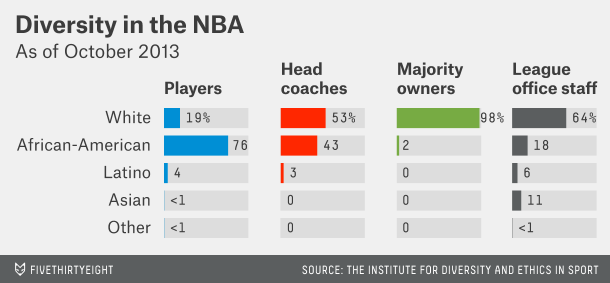
chalabi-sports-diversity-nba1

Mike Pesca thinks it was a bad call for NBA Commissioner Adam Silver to impose a lifetime ban on Sterling and encourage the board of governors to force a sale of the Clippers:

A swift beheading by the commissioner robs players and fans of a chance to foment justice on their own. Silver did a favor to the Clippers players who didn’t want to be put in the uncomfortable position of having to actually do anything beyond the symbolic in opposition to Sterling’s racism. …

In accepting plaudits for serving as an exacting executioner, Silver also sidesteps the fact that his office—led by David Stern with Silver as his longtime No. 2—was for years an institutional enabler. The lesson of Donald Sterling seems to extend no further than Donald Sterling, and stretches no earlier than the revelations of the past week. In fact, injustice existed longitudinally and latitudinally, with the damage done by the NBA’s inaction reaching beyond that league’s offices. If the NBA had punished Sterling a long time ago, would Major League Baseball have approved Astros owner Jim Crane, despite his company having paid a multimillion-dollar settlement for allegedly having engaged in discriminatory behavior?

Along those lines, Kareem Abdul-Jabbar criticizes the media and the public for focusing their outrage on Sterling’s racist remarks after ignoring years of much worse behavior:

He was discriminating against black and Hispanic families for years, preventing them from getting housing. It was public record. We did nothing.

Suddenly he says he doesn’t want his girlfriend posing with Magic Johnson on Instagram and we bring out the torches and rope. Shouldn’t we have all called for his resignation back then? … So, if we’re all going to be outraged, let’s be outraged that we weren’t more outraged when his racism was first evident. Let’s be outraged that private conversations between people in an intimate relationship are recorded and publicly played. Let’s be outraged that whoever did the betraying will probably get a book deal, a sitcom, trade recipes with Hoda and Kathie Lee, and soon appear on Celebrity Apprentice and Dancing with the Stars.

Many readers are flagging a similar argument on YouTube from Bomani Jones, an ESPN radio host who wrote a column eight years ago called “Sterling’s racism should be news.” One reader adds:

Think about this. Al Sharpton was prepared to mount a boycott of the NBA’s major advertisers if the league didn’t suspend Sterling as a result of the phone call. BUT, before the phone call was revealed, Sharpton was willing to stand beside Sterling while the two were honored by the NAACP. This, in spite of the fact that Sharpton knew (or certainly should have known) Sterling’s record. Does this mean that Sharpton thinks this phone call was worse that housing and employment discrimination?

Bouie elaborates on that disconnect:

When it comes to open bigotry, everyone is an anti-racist. The same Republicans who question the Civil Rights Act and oppose race conscious policy are on the front lines when it’s time to denounce the outlandish racism of the day. …

At the same time, we all but ignore the other dimension of racism—the policies and procedures that sustain our system of racial inequality. The outrage that comes when a state representative says something stupid about professional basketball players is absent when we learn that black children are punished at dramatically higher rates than their white peers, even as preschoolers. Likewise, it’s absent when we learn that banks targeted minorities—regardless of income—for the worst possible mortgage loans, destroying their wealth in the process. In turn, this blinds us to the racial implications of actions that seem colorblind. In a world where racism looks like cartoonish bigotry, it’s hard to build broad outrage for unfair voter identification laws or huge disparities in health care access.

Meanwhile, according to Adam Serwer, “There’s a more disturbing element to the controversy that has largely escaped notice”:

Sterling’s remarks show how deep, interpersonal racism can persist despite longstanding, even intimate relationships with people of color. Stiviano, Sterling’s girlfriend, is black and Hispanic. Through his charitable foundation, Sterling has given money to organizations like the NAACP,  the United Negro College Fund, and the Black Business Association. He is the owner of a basketball team made up largely of black athletes.

Yet none of these things appear to have moderated Sterling’s feelings towards black people. This is nothing new of course – even during slavery, white plantation owners sired entire families with people they owned as chattel without ever questioning the legitimacy of a system that treated blacks as property. The “black friends” defense has become a running joke precisely because it’s equally popular and unpersuasive. Sterling’s remarks are a reminder that having black associations, friends, or even lovers, doesn’t mean you can’t still hold racist views.

A reader chimes in:

So they’re banning Sterling for life and fining him $2.5 million. Listen, I think the guy is racist as hell. But are we really convicting people without a hearing, taking away their property and fining them $2.5 million for not liking black people? Isn’t that his right? It’s odious to be a jerk, and I’m appalled, but I think people have a right to hate other people. There isn’t much record of him breaking the law in his specific duties as owner of the ball team, is there?

Again, I’m troubled by this stuff. This guy makes my skin crawl. And the Mozilla guy who wants to ban my own marriage, yuck, but doesn’t he have the right to be biased too, as long as they don’t break the law? I hate that bias, and think they’re losers, but I’m uncomfortable with this witch hunt – even if they happen to be real witches.

Another

I want to disagree with the reader who questioned “convicting people without a hearing” and talks about people’s right to be biased “as long as they don’t break the law.” That’s not what is at issue here. The NBA as an association has its own rules and regulations, which Sterling’s remarks fall afoul of, and the fine and ban are entirely an internal matter to the league. Sterling has been an NBA owner for decades; the rules are written and voted on by his peers, and enforced by an employee of the league (the commissioner) who is therefore an employee of his and of his peers’; and players and coaches are routinely held to these standards of public conduct (albeit for lesser offenses). This isn’t a matter of legal or governmental punishment. It’s not even the same as the Eich case, precisely because there were actual pre-existing standards Sterling violated. The issue that Sterling was known to hold these views already is a valid one (the man discriminated in housing, after all), but the idea that this is somehow a violation of his rights is ridiculous.

And another:

As the news about Sterling’s comments unfolded, I too was initially uncomfortable with the “witch hunt.” But then I realized this has nothing to do with the NBA passing judgment on Sterling’s racism – and everything to do with the NBA protecting its own brand.

As the past thirty years have shown, the NBA doesn’t care about Sterling’s racism. What it does care about is the money his racism was potentially going to cost the league. The NBA very quickly realized that if they left Sterling in place – say, if they suspended him for a year, or even “indefinitely” – this issue was going to fester, advertisers were going to continue to abandon ship, and the team’s revenues (if not the league’s) would be in jeopardy.

So the NBA kicked Donald Sterling out of the club. In effect, through their behavior over the last thirty years, the other NBA owners essentially told Sterling, “Everything would have been fine if you would have just kept your mouth shut. But now you’re messing with our money, and if there’s one thing rich, white guys don’t like, it’s other people messing with their money.”

Another adds along those lines:

If the league didn’t act quickly, decisively, and harshly, this would have derailed a highly enjoyable playoffs but also led to more advertisers re-evaluating their relationship with the league in general. It also would have caused a players’ revolt. There were rumors that Golden State and the Clippers’ players were going to boycott the game in protest if the league didn’t handle it.

Basketball is a stars league (more so than any other team sport) and the stars were going to act (see LeBron and the Heat engaging in a solidarity protest before their game over the weekend). And if the players acted, the league was going to be in trouble. It could result in fewer sponsors and lower attendance/viewers. Energizing the players to act collectively is not something the owners want. If the star players were going to boycott games, it would be incredibly damaging (and all signs were pointing that way).

And don’t feel bad about Sterling – he is going to get paid north of $1 billion dollars when the team is sold (I’ve seen basketball guys like Bill Simmons estimate north of 1.5 billion). He’s being kicked out of a private, high-profile, exclusive club because he was going to hurt the overall brand of the NBA irreparably if he wasn’t.

(Chart via Mona Chalabi)

Quote For The Day

“My girls and I make a lot of dark jokes together. In the upcoming season [of Louie], there’s a line from a conversation I had with my older girl. She was saying how whenever she sees a three-legged dog, it lifts her spirits, because three-legged dogs are wonderfully unaware that they have a malady. They just walk around, and they don’t give a shit. And I said, ‘You know, honey, they are lucky. But do you know the only thing luckier than a three-legged dog? A four-legged dog.’ And she really laughed. Whenever she laughs that hard at something dark? I know it’s good,” – Louis CK.

Previous Dish on some very lucky tripods here, here, and here.