Meep Meep Watch

Yesterday, an ABC/WaPo poll registered a “new high” for Obamacare support:

ACA Support

The Fix summarizes the poll numbers:

Overall, 49 percent support and 48 percent oppose the health-care law in the new poll, hardly changed from January (46-49 support-oppose) but clearly better than November, when 40 percent expressed support and 57 percent were opposed.  The growth in support has been concentrated among those who “somewhat” support the law, with strong opponents still outnumbering strong supporters by a 36 to 25 percent margin.

Democratic support has surged to a record-tying 76 percent, jumping 11 percentage points since January to the highest level since March 2010, immediately after the law was passed. Currently at 78 percent , Republican opposition has outpaced Democratic support by double digits in nearly every poll over the past two years, but in the latest survey they are within three percentage points.

Other polls are not-so-encouraging, which is why the poll of polls shows little movement. But Allahpundit wonders whether this is the start of a trend:

Specifically, what if it’s true that the law has become a bit more popular with Democrats now that it’s kinda sorta in range of its original goal of seven million enrollments if you squint real hard and ignore things like nonpayment of premiums and the age mix of America’s many new O-Care risk pools? The better the polling gets, especially among independents, the more reluctant some Republicans in Congress will be to support full repeal later.

Last fall, I argued that Obama’s presidency, already historic in significant ways, would become as influential as Reagan’s if two things happened: if the ACA stuck and American entered an era of near-universal healthcare; and if the negotiations with Iran led to an end of sanctions and a controlled Iranian nuclear capability. Both would be generational game-changers – one in domestic policy, the other in foreign affairs. I’ve also long argued that Obama’s entire presidency makes no sense if you try and judge it by its ability to spike the polls in any given news cycle.

So where are we? Too soon to tell on Iran. But after a clear, self-inflicted disaster – the website’s debut – we’ve seen a classic Obama pattern. The fail is replaced by a dogged, persistent, relentless attempt at repair. I’d argue that the competence behind the repair of the site and the revival of the ACA’s fortunes has been as striking as the original incompetence. And we do not and should not judge a president by his mistakes; the critical judgment is in how he responds to those mistakes. As Dick Cheney might put it, the results speak for themselves:

In 2017 there will be, according to the CBO, 36 million Americans newly covered by ACA through exchange policies or Medicaid. That’s a huge number of voters. You have to live in Foxland to think that any great number of these will see themselves as victims of coercion rather than beneficiaries of a terrific entitlement. The second reason comes from the ramshackle, Heath Robinson (Am.E: Rube Goldberg) nature of the Act. This makes it so hard to understand what is going on. More important, it means that any remotely feasible replacement will also be hugely complicated. Simple repeal and reversion to the status quo ante will be as as unacceptable to the electorate as single-payer.

Worse, the Republicans are now in the position of nit-picking, cold-water dousing and general negativity that tends not to wear well over time. Once again, it seems to me, they have misjudged this president’s long game.

All they have now are scare stories and a narrative that simply cannot include the fact that millions more people have irrevocable health insurance than did before Obamacare. They do not have an alternative to offer the 36 million people whose health insurance would be disrupted or ended if repeal took place. Their current strategy – backed by endless propaganda – might yet work this fall. But the more it works this fall, the less it is likely to work thereafter. If the GOP regains the Senate, it seems to me that the case for a Democrat in the White House in 2018 will be much stronger, if only to protect the country from far right over-reach.

Now look at the economic forecast: the IMF is predicting growth of 2.8 percent this year and 3 percent in 2015, easily the best performance among Western economies. We may see further declines in unemployment. This does not seem to me to be compatible with declining support for Obama and his record. In fact, I’d be surprised – barring, of course, any number of game-changing events – if Obama’s approval ratings were not ticking up by the summer.

We’ve been here so many times before with this president – when he seems temporarily becalmed, inert, unable or unwilling to seize every moment. But over the long run, you see the virtues of persistence, relentlessness and pragmatic advance. The opes he once inspired may be dimmed or dashed right now; but in the cold light of day, they shouldn’t be. Like the slow, excruciating accumulation of delegates in the epic 2008 primary campaign, Obama never puts it away until he puts it away. But it’s coming. And more and more people are beginning to see it.

Email Of The Day

Screen Shot 2014-03-31 at 1.18.45 AM

There’s a real joy and incredible reward in shepherding this little blog. For me, it’s about that direct communication with readers, what I’d call a strange new phenomenon: mass intimacy. To wit:

I’m a long-time reader, ever since you had the white font and blue background – loved that aesthetic. But tonight, I’m finally a subscriber as well. Awkward situation: I’m three beers along on a day when I got to see, on an ultrasound, my first child – stretching, flipping, and, hopefully, searching for truth … and for the first time in my life, I found myself asking how can I convey my commitment to that search. Well, I thought, let me put some money where my mouth is …

It really doesn’t get much better than that. And since we’re at the end of March, here’s an update on our progress:

Screen Shot 2014-04-01 at 1.04.08 PM

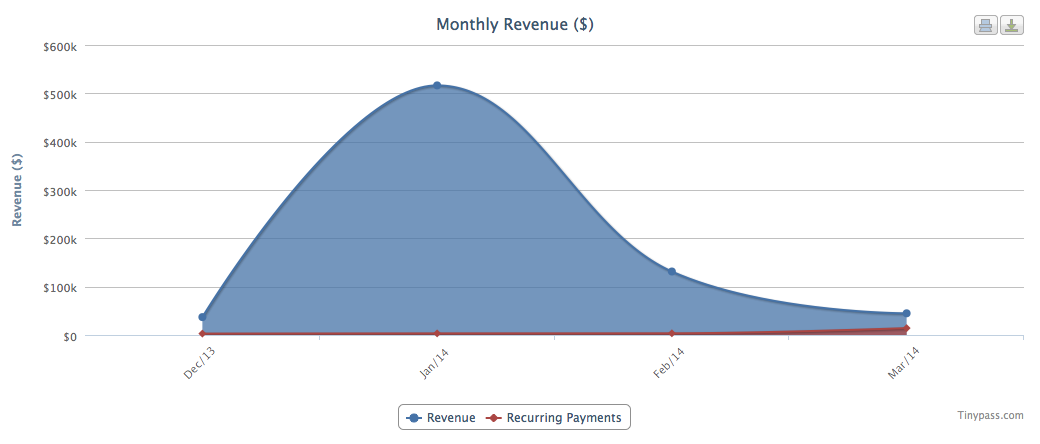
Today, we have 28,100 subscribers, and have had revenue of $694K since January 1. Traffic was down from a record February, at 826,000 unique visitors, but higher than six previous months this past year. Revenue this March was $45K, compared with March 2013 which brought us $38K. Revenue for the first quarter of 2014 was 105 percent of last year. We’re growing, but slowly and surely. And with your help, we’ve been able to avoid the ethically perilous world of sponsored content, and do all of this even without ads for subscribers.

You did this and make this possible every day. Thank you.

And if you’re still procrastinating, subscribe!

How Do We Survive A Warming World?

Elizabeth Kolbert reads through the new Intergovernmental Panel on Climate Change (IPCC) report:

The I.P.C.C. doesn’t conduct any research of its own—its conclusions are based entirely on already-published scientific papers—so it could be argued that there was no real news in the latest document. The force of the report comes simply from assembling all the data in one place; the summary reads like a laundry list of the apocalypse—flood, drought, disease, starvation. Climate change, the group noted, will reduce yields of major crops by up to two per cent each decade for the remainder of this century. (One of the reasons for this is that heat waves, which will become more common as the world warms, depress the yields of staple crops like corn.)

Since the global population is projected to grow throughout the century—to eight billion by 2025, nine billion by 2050, and almost eleven billion by 2100—this is obviously rather bad news.

John Upton explains what the IPCC report means for the US:

For North America, the report states there is “high confidence” of links between climate change and rising temperatures, ravaging downpours, and declining water supplies. Even if temperatures are allowed to rise by just 3.6 degrees Fahrenheit (2 C), which is the goal of current international climate negotiations (a goal that won’t be met unless everybody gets a lot more serious about curbing greenhouse gas pollution), such severe weather is going to get a lot worse. North America’s coastal regions will continue to face a particularly long list of hazards, with climate change bringing growing risks of “sea-level rise, warming, ocean acidification, extratropical cyclones, altered upwelling, and hurricanes and other storms.”

Brian Merchant notes the technological solutions the IPCC report endorses:

Judging by the choices listed, the scientists believe we’re primarily going to need technologies to make our resource use more efficient; to squeeze every drop out of our dwindling water supplies and increasingly stressed crops. About half of the recommended technologies fall into that category, which makes sense: drought and heat waves are on the rise, as are global population trends. Nourishing 10 billion people with rampant dry spells and desertification will be no easy task. So, better water reclamation technology will likely prove important; reverse osmosis processes, for instance, have improved to the point where it can transform wastewater into clean drinking water. It’s the stigma of drinking sewage water that needs be removed, mostly, and to scale up adoption.

Food and water will have to be stored longer, too, and science is tackling some interesting new preservation methods that may come in handy—using pressurization to kill harmful bacteria, for one.

Uri Friedman and Svati Kirsten Narula want to stop waiting for an international response:

[P]reparing for the worst actually presents major opportunities for the private sector and local governments. In its report this week, the IPCC is indeed calling for action—but not in the form of grand international declarations or promises. “Among the many actors and roles associated with successful adaptation, the evidence increasingly suggests two to be critical to progress; namely those associated with local government and those with the private sector,” the report states. The implicit message: Citizens should stop waiting for world leaders to legislate climate change away—because that can’t be done. Instead, individuals and communities need to show entrepreneurial initiative and figure out how best to survive in an increasingly volatile climate.

But what exactly does “adaptation” look like in practice? Americans have long practiced climate-change adaptation—by, for instance, commissioning public art to make hurricane-evacuation routes more visible, systematically planting trees to combat urban heat, and genetically engineering drought-tolerant crops. In many of these cases, people aren’t even aware that they’re “adapting” to climate change; they’re just doing what needs to be done to keep the water flowing or the business growing.

Additionally, Climate Central collects harrowing charts from the report, while Climate Progress shames conservative news outlets for downplaying the IPCC’s findings.

Israel Would Like Its Spy Back, Please

There are reports that the US is considering releasing Israeli spy Jonathan Pollard. This extraordinary concession is being made … merely to keep the Israelis from ending the current “peace process”. That’s how comprehensively the Israeli government has the United States in its pocket. Crowley brings us up to speed:

He currently resides in a federal prison in Butner, N.C. Pollard is a Jewish-American who, while serving as a U.S. Navy intelligence analyst, passed American secrets to the Israelis. In 1985, he was sentenced to life in prison—a sentence that many Israelis and some American Jews consider excessive, cruel and potentially tainted by anti-Semitism. Now the Obama administration is considering releasing Pollard from prison as an incentive to keep the Israelis at the peace table, according to reports from multiple U.S. and Israeli news outlets

Shane Harris provides more background on Pollard:

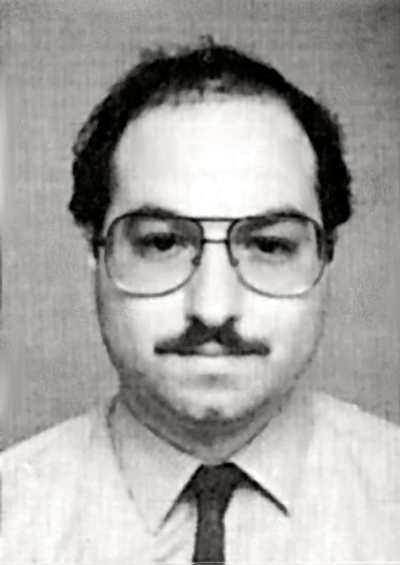
Jonathan_PollardThis isn’t the first time that Pollard’s release has been floated in the midst of U.S.-brokered Middle East peace talks. In 1998, President Bill Clinton was prepared to release Pollard during the summit at Wye River, Md., but the effort was scuttled when intelligence officials protested and then-Director of Central Intelligence George Tenet threatened to resign. That reveals the depths of U.S. spies’ animosity toward Pollard, whom many regard as one of the most harmful spies in recent history. Three decades after Pollard confessed to giving Israel a stack of documents that, by his own estimation, would have measured six-by-six feet and stood 10-feet high, intelligence veterans insist that Pollard did far more damage to U.S. national security than is generally known.

Pollard is a traitor. Releasing him as part of a deal to find some way forward in Israel-Palestine would be a low-point in America’s dealings with the Jewish state, and another sign of just how much contempt the Israeli government has for the United States. Koplow fumes:

[R]eleasing Pollard in the context of current negotiations is a terrible mistake. Pollard himself has nothing to do with an Israeli-Palestinian peace deal. He is not being held by the Palestinian Authority or Hamas, his actions were in no way related to the conflict, and his status should be completely unrelated to the talks. That the Israeli government would link his release to its own willingness to resolving a wholly separate issue is shameful.

If Israel does not think that it is in its own best interests to continue negotiating or if it genuinely believes that it has no reliable partner across the table, then it should end the negotiations irrespective of what the U.S. offers since to do otherwise would be to take a concession in bad faith. Conversely, if the Israeli government believes that negotiations stand a good chance of success and that a deal with the Palestinians would be in Israel’s best interests, then it is monstrously dumb to link the willingness to keep on talking to Pollard’s release. Pollard is a factor that has no impact at all on the substance of a deal. His remaining in prison or his walking out a free man will not make Israel any safer or any more trustful of the Palestinians, and so using him as a reason to either keep negotiating or cease negotiating makes absolutely no sense at all from a substantive perspective. Were I the U.S., I would call this bluff without blinking.

Furthermore, if the negotiations are going so poorly that Israel will only agree to keep them going if Pollard is let out, then the two sides stand very little chance of coming to an agreement. That being the case, why release Pollard for such an ephemeral concession?

Amen. The US should never be that weak – even when dealing with Israel. Goldblog also doubts that releasing Pollard would advance the peace process:

Pollard’s release would constitute a political triumph for Israeli Prime Minister Benjamin Netanyahu, and it would create feelings of gratitude for Netanyahu among the right-wing ministers in his ruling coalition. But these feelings would dissipate entirely at the exact moment when Netanyahu returns to the business at hand: trading land to the Palestinians in exchange for peace. These feelings would also dissipate, though not quite to the same degree, the moment Netanyahu once again began releasing Palestinian prisoners to the custody of the Palestinian Authority.

The right-wing of the Netanyahu coalition, and the right-most members of the prime minister’s own Likud Party, would like very much to welcome Pollard at Ben-Gurion International Airport, but they will not trade land for him, not one inch. To think otherwise is foolish. The cause of Middle East peace will not be advanced by the release of a hapless spy.

Larison weighs in:

Letting Pollard go early (he’s up for parole late next year) might please some hawks, but it would be a bad decision and one that ought to invite scorn regardless of one’s foreign policy views. Pollard’s release shouldn’t be part of these negotiations, but if it is the U.S. ought to get much more in exchange for giving up something that Israeli governments have sought for decades. Unless the administration wants nothing more than to convey just how desperate it is to get even the smallest concession from Israel on settlements, the deal as reported seems to be a very bad one.

Josh Marshall also wants more for Pollard’s release:

Pollard should be a chit. As I said, he’s served almost all of his minimum sentence. And it’s entirely reasonable to free even the worst of spies to secure critical US interests. This is certainly one. But here we seem even to be considering offering this prize in exchange for inconsequential concessions which can easily be taken back once Pollard is in Israel.

Aaron David Miller gets the final word:

If Barack Obama wants to release Jonathan Pollard because he’s paid his dues, then let him do so on humanitarian grounds. But don’t introduce other matters into an already dysfunctional negotiation, try to justify the release in the name of a peace process that isn’t going anywhere, undermine the intelligence community in the process, and pretend to be pro-Israel by doing something that even the most pro-Israeli president in U.S. history, Bill Clinton, wouldn’t do. Releasing Pollard won’t save the peace process. But not releasing him will spare us all a boneheaded move and yet another tactic in search of a strategy.

The View From Your Window Contest: Winner #198

vfyw_3-29

A reader throws up her hands:

A tennis court, a small island, an airplane, and a palm tree. Is that all there is to go on, or an I missing something obvious?? If I check in on Tuesday morning and I read, “500 people correctly guessed this weeks window,” I swear I will hang up my hat! (Just kidding… I enjoy this too much).

I will take a wild guess and say some small place in the Indian Ocean. Room 813.

Another reader:

That looks very much like one of the many lagoons that dot the sea shore along San Diego County, CA. I’m going to say this is looking across the Laguna Hedionda from the Snug Harbor Marina in Carlsbad.

Another uses the process of elimination:

Sure as hell not Albany, NY … but I wish it were!

Another gets much closer:

The geography doesn’t ring a bell, but I’m sure I’ve seen those clouds before – somewhere in Hawaii?

Elsewhere in the Pacific:

This week is a real tough one. For some reason the fauna and the architecture has me betting on a small city in Muslim SE Asia. After accounting for the presence of the river, the mountains, and the medium level of development, I’m going to guess Bandar Seri Begawan.  I know I’m not right (I can’t find any tennis courts anywhere near downtown) but I really want it to be because Brunei is just crazy enough for this contest. This one stumped me. Congrats.

One of the handful of correct guesses this week:

The U.S. hint you provided was very helpful.

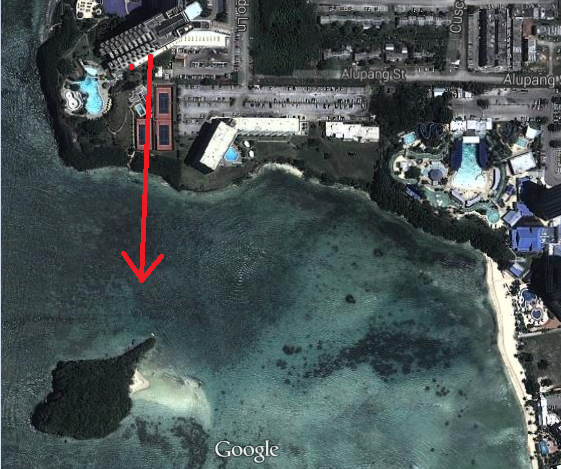
Not so much for telling me that it was the U.S. – which was my immediate guess from looking at the photo – but for suggesting that it was probably a place that doesn’t immediately spring to mind as being part of the U.S. After searching the coastlines of Puerto Rico and St. Thomas, and ruling out St. John for not having an airport, I went to look for an inlet with a green-covered rock island and a tennis court that abuts the water. Thanks to Google Maps, I found both of those things at the Alupang Cove Condominium on the cliff of Satpon Point in Hagatna Bay, Tamunging, Guam and the neighboring Sheraton Laguna Guam Resort.

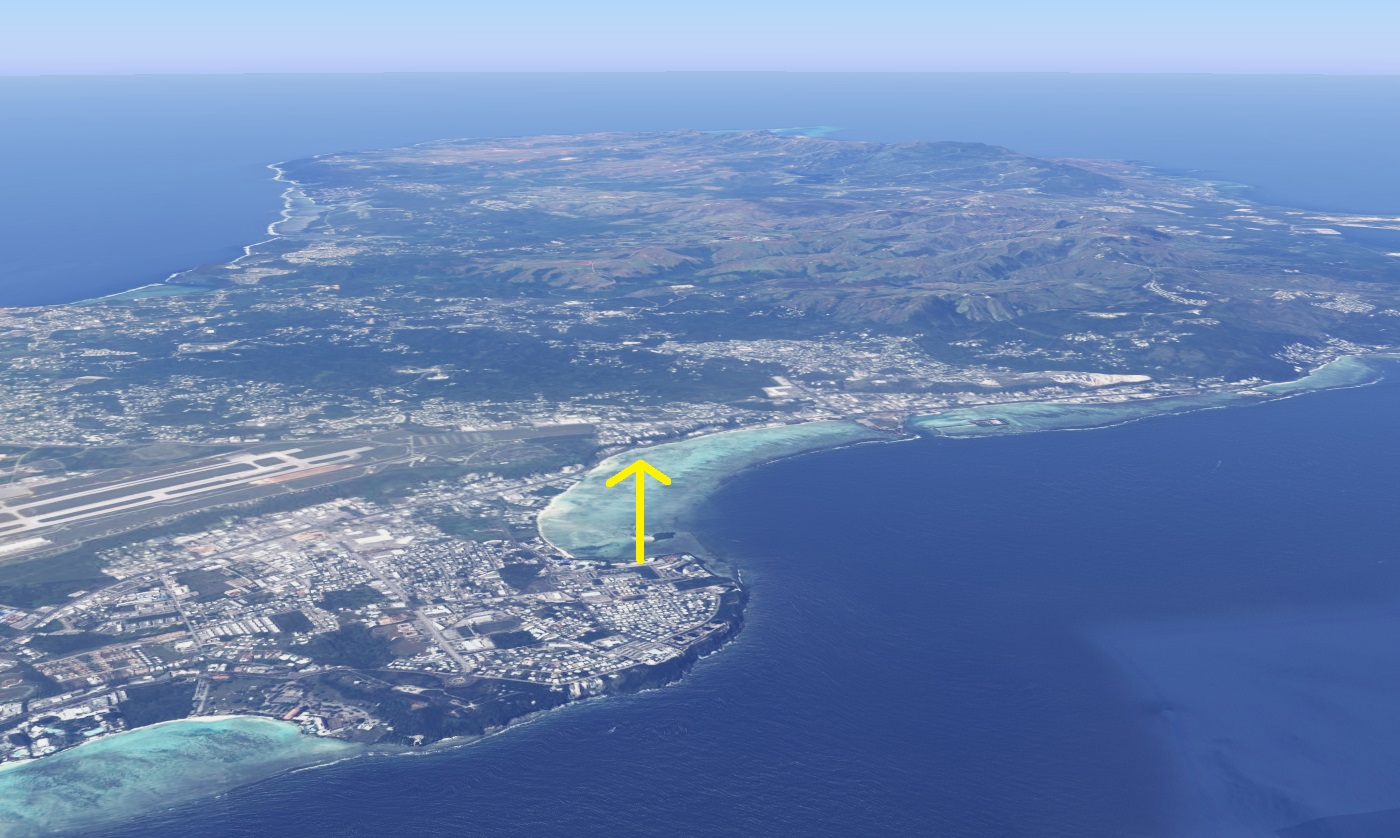
It looks to me like the photo was actually taken from the Sheraton, from one of the lower level rooms. The area in question can be seen in the upper right of this photo, where the Sheraton is the terraced-shaped building in that corner. I’d guess the photo was taken from one of the lowest-level of guest room, just above the cement roof pictured in the photo. For the sake of the ridiculous precision that’s usually needed, let’s say the third room from the end.

Guam

Excited to get one that isn’t from my home town and in a place I’ve never visited!

Another Guam guesser:

Thanks for the hint, otherwise not sure I would have been able to figure this one out. Clearly it was a tropical location, and with the clue that it was in the US, that immediately made me think of Guam. What looks like an airport tower in the picture and plane quickly oriented me to look for water side locations that would have a view of an airport (in this case I believe the Antonio Won Pat Int’l Airport). Also, it was clearly in a developed area of Guam.

The picture was taken from the Sheraton Laguna Resort in Tamuning, Guam with a view across the Agana Bay. I have limited time and have not been able to find any good pictures showing this exact view, but am pretty sure about my guess. I will guess the photo was taken from the sixth floor.

A local chimes in:

Nice touch with the “In the United States” quote, as not many Americans actually realize that.  I know this place well because I kinda live down the beach from it.  The building seen on the right is Alupang Beach Condos.  This picture must have been taken from the Guam Sheraton Hotel. This is my first time even trying for one of these, but this week I’ve never been so sure of an answer. Thanks for featuring my beautiful island.

Another local describes the scene in detail:

I used to live up on the bluff on the far side of the picture, in Maite, right behind what’s known as the Calvo compound, where the current governor and members of his extended family live. That’s Alupang Island in the foreground, in Hagatna Bay. The taller white building across the bay is Alupang Tower, and the 10-story building looking tiny off to the right, in downtown Hagatna, is the DNA Building, where I used to work. The medium-sized building in the middle background with the green roof is First Hawaiian Bank’s Maite branch. The plane is landing at Won Pat Airport, probably from Japan.

I hope all this detail gets me somewhere, because I can’t do all that expert triangulating to tell you exactly what window this was taken from. Presumably a window at the Sheraton, since those look like the Sheraton tennis courts. If only you hadn’t dropped the “It’s in the U.S.” hint, I might have had a chance. At any rate, thanks for the trip down memory lane.

Another almost gets the window:

The hint made this too easy.  Palm trees, clearly volcanic mountains, buildings that look in need of refurbishment, but it is “in the United States”. I first thought of Puerto Rico, then maybe Hawaii.  Third guess was Guam.  A quick Google Earth lap around Guam, and the distinctive island in the photo popped up, with clearly visible tennis courts. The fact that there is a visible airplane on final to runway 6 at Antonio B. Won Pat International Airport is even better!

The photo is taken from one of the lower floors of a south facing room in the Sheraton Laguna Guam Resort Hotel:

image002-2

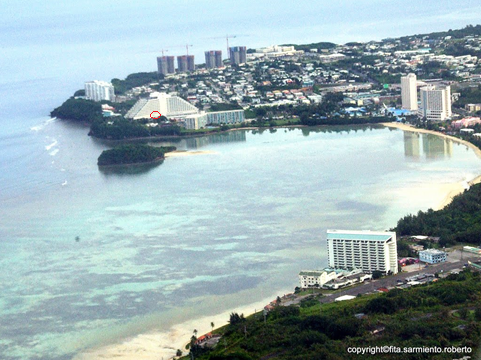
Here is a shot of the hotel from a distance, looking almost exactly in the opposite direction, with the approximate location of the room circled:

image003-1

Here is another photo showing the roofline, with my guess at the room circled:

image005

Guess which reader didn’t need a hint?

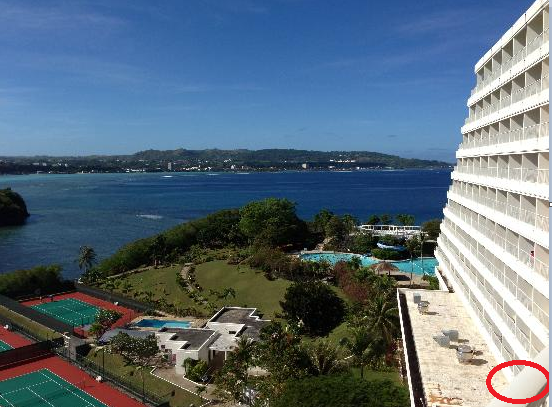
Clues? Humbug! Happily, I didn’t see the extra help until after I’d located the view and was back reading the regular Dish posts. This week’s view comes from the Sheraton Laguna Hotel in Tamuning, Guam. The picture was taken from the 1st guest floor of the hotel and looks south by southwest along a heading of 197.45 degrees. (A truly rough guess for time and date would be around 8:26 on the morning of March 26th.)

VFYW Tamuning Bird's Eye Marked - Copy

VFYW Tamuning Actual Window Marked - Copy

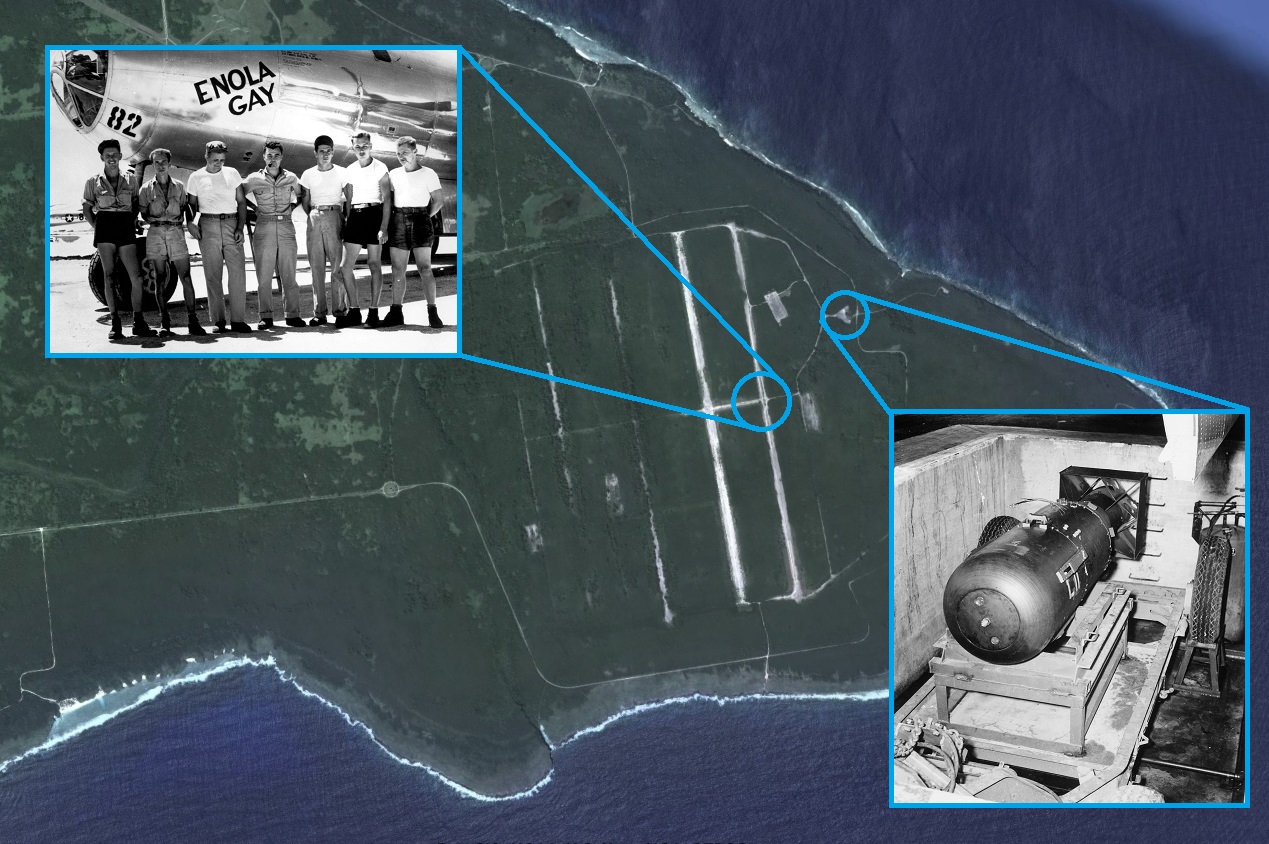
Two weeks ago for VFYW #196, Bonn, I wrote about how the capture of the nearby Remagen bridge portended the end of the war in Europe. Curiously, this week we’re near a site that holds similar significance in the Pacific theater. Just north of Guam lies another island in the Marianas, the island of Tinian. Today it’s sparsely populated, but in 1945 Tinian was home to a massive air field from which the US launched B-29 raids on Japan. And it was from that same field that Paul Tibbets and his crew flew the Enola Gay to attack Hiroshima on the morning of August 6, 1945. Japan, of course, surrendered nine days later. Here’s a satellite shot of Tinian’s overgrown North Field, with insets showing the Enola Gay on the runway and “Little Boy” in its loading pit:

unnamed

But only one reader got the correct room:

Two clues pointed to Guam or similar islands in this part of the Pacific. The landscaping and layout of the grounds are very reminiscent of Hawaii resort designs and plantings from the 1980s and 1990s. The raised limestone islet eliminated Hawaii and other volcanic islands. Guam was the next choice, as it is partially formed of limestone and has resorts influenced by Hawaii developments if not planned by the same firms. Multiple triangulations from the islet and buildings across the bay all pointed to the area near or at the bend along the building’s southern side.

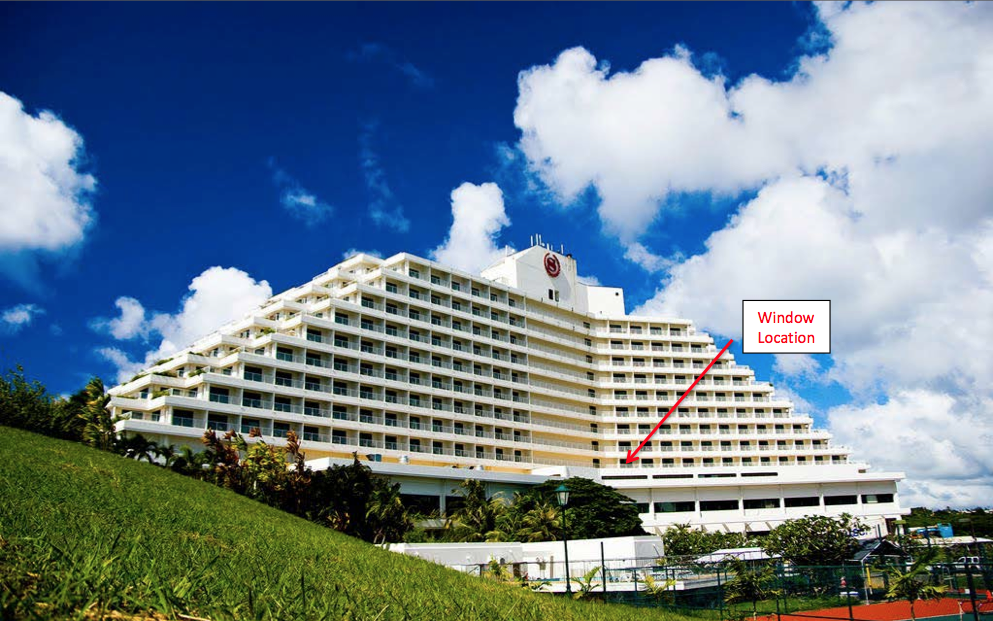
The window location guess relies on a change in the angle of exposed concrete beams on the lower roof which is visible in the aerial image of the building and immediately below the lanai railing in the photograph. Not a clue on room number, but I think it’s this room:

CONTEST-IMAGE-1

As you can see from the image provided by the submitter below, that reader nailed it:

image002-1I’m delighted to see that you used my picture for this week’s VFYW contest! I said Hagatna, Guam in my submission email because that’s what the view is looking at. But now that it “matters,” here’s a bit more information. I took the photograph from room 302 of the Sheraton Laguna Guam Resort in Tamuning, Guam. (Third floor – there’s an elevation drop from the front of the hotel to the back, which is why it looks higher than that in the picture.) That little island in the middle of the picture is one of many popular snorkeling spots, and the hotel gives you a kayak to get over there.

My grandfather piloted a B-29 in WWII from Guam’s North Field (now Andersen AFB), and I’d always wanted to see this sliver of my family history. He’s second from the right in this picture:

Crew 911

After driving around the island for a couple of days, one thing I left with was an appreciation for how beautiful and varied Guam is. This isn’t exactly an original opinion – Tumon, the island’s center of tourism, is a popular destination for Asian beachgoers. And apparently, one Cartier boutique isn’t enough to satisfy the demand – in a one-mile stretch there are two of them, along with two Louis Vuittons …

I’m guessing that this will be a tough contest!

So tough there were only 18 entries. We’ll try to make next week’s view a little easier …

(Archive)

Hard Times For French Socialists

They managed to elect the first female mayor of Paris … and that’s about it. Consider:

At a second round of voting on March 30th, Mr. [Francois] Hollande’s Socialist Party lost over 150 towns, most of them to the opposition centre-right. … Among the more dramatic losses were Toulouse, a city in the southwest that it had thought was safe, Roubaix  and Tourcoing, two industrial cities in the north with a deep left-wing heritage, and a string of other cities, including Amiens, Caen, Tours, Reims and Limoges, held by the left since 1912. Even some towns in the Paris region, which had been governed by Communist Party since the second world war, such as Villejuif, swung to the right.

The centre-right UMP was the primary beneficiary of this disillusion, and of a high abstention rate. Overall, the second-round result gave the combined mainstream right 46 percent of the vote, compared with 40 percent for the Socialists, Greens and other left-wing parties. This translates into 572 mayors for the right in towns of a population over 10,000, to 349 for the left, reversing the outcome in 2008.

Robert Zaretsky calls the far-right Front National “the real winner” of the elections:

The party captured only around 5 percent of the popular vote, but presented candidates in only 600 of the 32,000 towns and cities that held elections over the weekend. This indisputable victory not only could lead to the capture of several city halls, but perhaps more importantly, has already redefined France’s political landscape.

He elaborates:

While no one has suggested shooting illegal immigrants from Romania or North Africa, the FN long ago called for the expulsion of three million “illegals” from France. More recently, FN leader Marine Le Pen has spoken about an “Arab occupation” of many French cities, while Florian Philippot, the FN candidate who is poised to win the mayor’s race in the Alsatian city of Forbach, insists on the term “invasion.” In response, the mainstream French right has adopted the same language, sometimes with even greater ferocity. … becoming the leader of the UMP, Jean-François Copé has upped the ideological ante, asserting that the children of illegal immigrants born on French soil should not automatically become French citizens. The so-called droitisation, or pushing to the right, of the UMP’s discourse, is clearing the ground for tacit alliances with the FN.

Dan Bilefsky also examines the National Front’s sudden emergence as a major third party:

“The French Far-Right Isn’t Scary Anymore and That’s the Problem,” declared an English-language blog in the French daily Liberation.

Renée Kaplan, the blog’s writer, noted that many were mortified by the realization that the tendency by the French intelligentsia to dismiss the National Front as marginalized pariahs no longer corresponded to reality. She wondered ruefully: “Maybe this France — a real voting part of which supports a far-right, anti-immigrant, anti-European, nationalist party — actually is France today.”

The telegenic Ms. Le Pen has sought to rebrand the National Front as mainstream by distancing herself from her father, the founder of the party, and a man widely viewed as anti-Semitic. She has even vowed to take legal action against anyone who characterized the party as “extreme right.” Yet the National Front has cleaved to its mantra of France for the French. Last summer, Mr. Le Pen called the Roma community in Nice, in the south of France, “smelly” and “rash-inducing.”

Meanwhile, Gregory Viscusi and Helene Fouquet view the election as “a referendum on Hollande’s almost two years in power,” noting that the current president is the least popular one to hold office in more than half a century. Alexander Stille blames Hollande’s mismanagement of the economy for his party’s poor showing:

The reasons for voter dissatisfaction with the Hollande government are not hard to find. … When he came into office, in May of 2012, he listed unemployment, economic stagnation, and declining economic competitiveness as his highest priorities. France’s economy actually shrunk slightly in both 2012 and 2013, still mired in the recession from which most other industrialized nations have begun to emerge. France’s unemployment rate is now at about eleven per cent, even higher than the approximately 9.5 per cent rate when Hollande came into office. Hollande seems to have tinkered around the edges—fulfilling some of his campaign promises, such as hiring more teachers and increasing scholarships and jobs programs for younger people—but he has lost sight of the bigger picture. He ended up taxing far more than the richest strata of French society to pay for policies that failed to deliver significant results. Hollande seems incapable of articulating a vision of what he wants for France and how he intends to achieve it.

Veronique de Rugy zooms in on how grand gouvernement contributes to France’s economic problems:

France’s tax haul stands at more than 45 percent of GDP-one of the highest in the Eurozone. Sarkozy did implement some small but beneficial pension reforms, which Hollande promptly overturned and replaced with a measly and insufficient increase in the pension contribution period. Not only is the new president unconcerned with the sustainability of the French pension system, but he refuses to follow the example of Europe’s periphery by liberalizing French labor and product markets.

Hollande’s commitment to big government hasn’t won him any friends. The French rank him as the least popular president of the Fifth Republic, and young people are voting with their feet. According to the data from French consulates in London and Edinburgh, the number of French people living in London is probably somewhere between 300,000 and 400,000. That’s more than the number of French people living in Bordeaux, Nantes, or Strasbourg.

She has little faith, however, that any party will attempt to shrink the state:

[W]hile François Hollande and his irresponsible and backward socialist policies and rhetoric have accelerated France’s economic demise, in addition to several waves of brain drain, right-wing presidents Sarkozy and Chirac pursued many of the same policies when they were in power. Under Sarkozy, spending on everything from special interests to social welfare went up, while French people were subjected to over 200 new tax increases. While he made some gestures toward increasing the retirement age, he didn’t do much to free the labor market from regulatory asphyxiation.

John Lloyd sheds more light on the domestic scene:

At a time when many other European economies are showing some growth, output in France’s manufacturing and service sectors is contracting. Unemployment is rising, with a quarter of those under age 25 jobless. A recent report showed an uptick in manufacturing, but the country has a long way to go to make up for the declines of the recent past. …   Disenchantment with the EU is now sweeping France. The mainstream parties, where the official position has long been supportive of the EU, are challenged to be more skeptical. The liberal political philosopher Pierre Manent writes that “life for European citizens is determined more and more not by the familiar national debate … but by the outcome of a European process that is much less comprehensible.” This simple truth – that most people are unfamiliar with and thus cannot relate to the forces that govern their lives – has been the theme that Le Pen and her comrades have hammered at mercilessly, finally catching the popular mood.

Andrew Stuttaford looks ahead:

The next thing to watch will be the elections to the EU parliament scheduled for late May. On some projections, the National Front (which is, not so incidentally, committed to taking France out of the euro) will come top in the French vote , which would be another sign that economic incompetence and the stifling Europhile consensus of the EU’s establishment  is not only radicalizing increasing numbers of voters, but leaving them with few places to turn other than to parties that were pariahs just a few years ago.

Toward A Reckoning On Torture

abugrahib4_gallery__470x3750.jpg

So we are approaching the moment when we will have some measure of understanding of the scale and breadth and severity of the war crimes authorized by the last administration. We don’t – infuriatingly – have the full Senate Intelligence Committee report on the Bush-Cheney torture program, but we are beginning to get clues and assessments from people who have actually read the report. That means we should be careful in jumping to conclusions. But, so far, we’re seeing why the CIA has done all it possibly can to keep their war crimes hidden from public accountability.

That avoidance of accountability was not just to the American people, but also to their representatives. The report, we’re told, shows how the CIA deliberately conflated intelligence breakthroughs secured by ethical intelligence work and by torture. Here’s one example:

One official said that almost all of the critical threat-related information from Abu Zubaida was obtained during the period when he abuse184_3.jpgwas questioned by Soufan at a hospital in Pakistan, well before he was interrogated by the CIA and waterboarded 83 times. Information obtained by Soufan, however, was passed up through the ranks of the U.S. intelligence community, the Justice Department and Congress as though it were part of what CIA interrogators had obtained, according to the committee report.

“The CIA conflated what was gotten when, which led them to misrepresent the effectiveness of the program,” said a second U.S. official who has reviewed the report. The official described the persistence of such misstatements as among “the most damaging” of the committee’s conclusions.

This is not terribly surprising. Once a constitutional republic has decided to adopt torture, the gravity of the decision makes it a necessity for those inflicting it to prove it worked. But of course, it doesn’t work – which leads to lies and misrepresentations to insist that it did. In turn those lies help perpetuate the torture. In almost all torture regimes, this tight epistemic closure is routine.

There are also hints and guesses of further barbarism. We find, for example, that torture methods well-documented in the Bush-Cheney war on terror can be combined for particular sadism. And so freezing prisoners to near-hypothermia is documented elsewhere in the war, as is waterboarding. But these can be put together! Hence:

At the secret prison, Baluchi endured a regime that included being dunked in a tub filled with ice water. CIA interrogators forcibly kept his head under the water while he struggled to breathe and beat him repeatedly, hitting him with a truncheon-like object and smashing his head against a wall, officials said. As with Abu Zubaida and even Nashiri, officials said, CIA interrogators continued the harsh treatment even after it appeared that Baluchi was cooperating.

The perpetuation of the torture beyond any intelligence needs is also a feature of torture regimes. Once prisoners have been completely dehumanized – blindfolded, stripped, frozen or beaten, strung from shackles that force them into excruciating crucifixion-style stress positions – they become easy prey for pure sadism. This is human nature. When CIA officials have been given the green light to do as they want with prisoners, to experiment with various torture techniques with a guarantee of being beyond the reach of the law, the worst will always happen.

What’s truly encouraging about the report is that it apparently has exhaustive records on every single tortured prisoner, and the intelligence they did or did not provide. It could offer some real finality. And then it will offer this democracy a choice. When war crimes have been committed so brutal and foul, so horrifying and sadistic, so useless and immoral, are we simply going to say: no one will ever be held accountable? No one who ordered this will ever face sanction?

That is the second reckoning that this country will have to make. I wish I had confidence that we will not again simply decide to look away. What I do know is that a democracy that does look the other way is no longer a democracy.