by Dish Staff
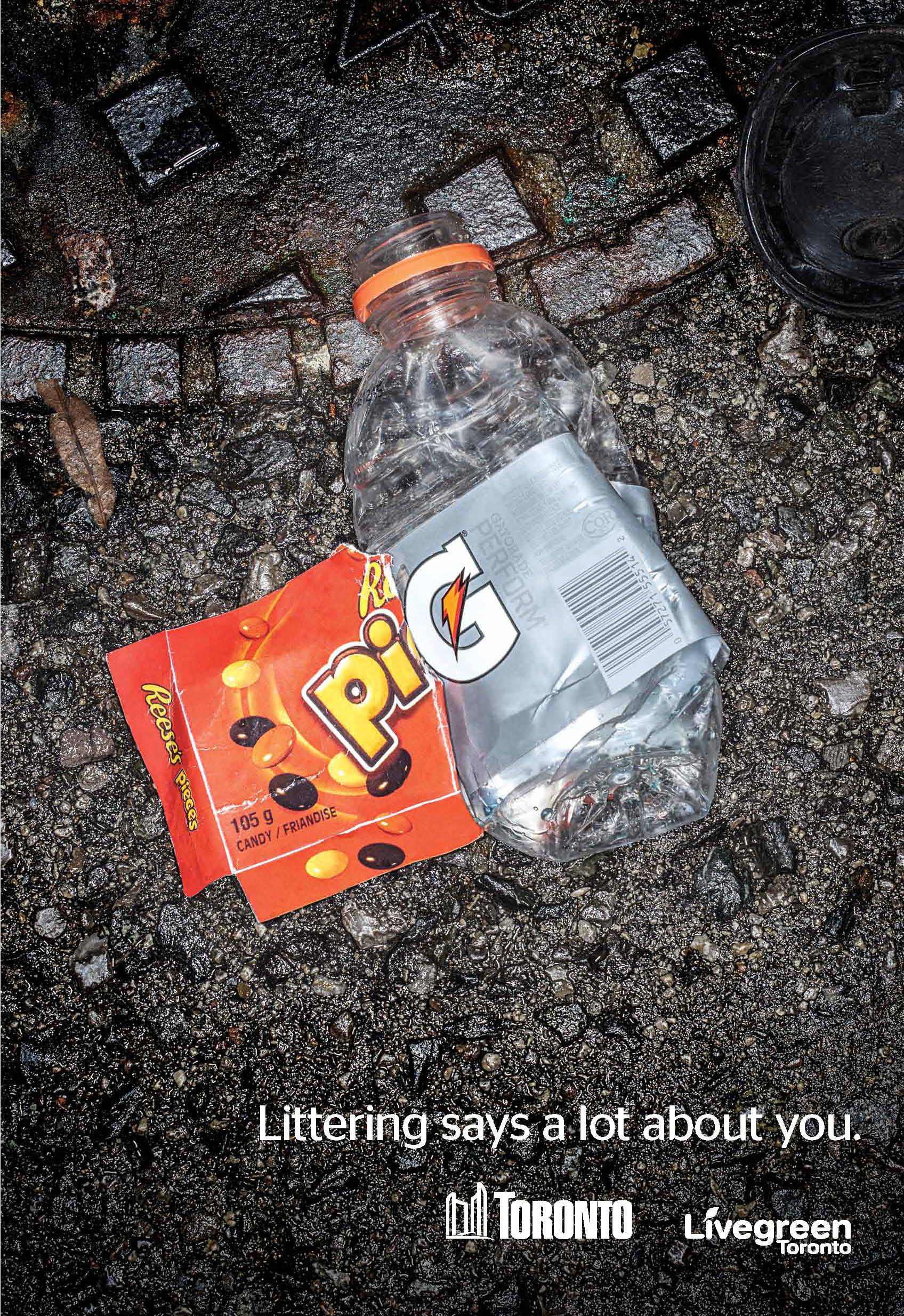
The city of Toronto lets the litter do the talking:

One more:
(Hat tip: Reddit user j0be)
The city of Toronto lets the litter do the talking:
One more:
(Hat tip: Reddit user j0be)
Alex Goldman rounds up some responses to the latest parental overshare debacle, and provides a note of clarification:
The original article was written mistakenly as though the [author] had written about his son using his son’s real name. He was, in fact, using a pseudonym for his son, though critics note that his son’s real name can easily be found online with the information given in the article.
Slightly less nausea-inducing, then, but not much. Goldman sort of defends sharing of this nature, because stigma:
I’m of two minds on this one. It certainly wouldn’t have marginalized the impact of the story had [the author] pseudonymized his son. At the same time, I feel like this conversation has some implicit porn shaming in it that doesn’t acknowledge pornography as something that should be destigmatized (which is, to be clear, hardly a settled matter, rather a personal opinion). I think that Eagle handled the subject as delicately as he could in his article, but I wonder if that’s enough for a kid who is about to enter adolescence and will always deliver search results that include an article called “I didn’t expect to find pornography in my 9-year-old’s web history.” Placing myself in the shoes of this kid, I think I would be annoyed about this article when I turned 15, and find it funny by the time I turn 18. And no sane employer would fault someone for finding an article his dad wrote about him when he was nine in his search results. It’s kind of a matter of perspective.
I was, I should say, good and ready to be done with this topic. But I feel compelled to return, because Goldman’s point is the now-standard defense of these pieces. Sure, the thing revealed about is embarrassing (Goldman hedges on this, but kind of admits it), but it shouldn’t be. That goes for any number of topics broached in such essays – mental or physical illness, body-image neurosis, awkward early-dating woes, why-do-all-my-friends-hate-me middle-school tantrums, and so on. The defense, then, hinges on the notion that, by writing about these sensitive issues, parents shed the relevant stigma, thereby helping both their child and others with the same concern.
The most obvious problem here is that if there is a stigma on whatever it is, even if there shouldn’t be, you’re humiliating your kid. If dude wants to reduce the stigma on porn consumption, by all means, let him tell the Atlantic about his own preferred websites. But how much is stigma, and how much is a matter of privacy? It’s one thing to say that many, many people look at porn, and another entirely to say that the specific porn they look at, or looked at at age nine, is a public matter. It’s hard for me to picture just what this stigma-free utopia would look like where all information about every moment of every person’s life is happily shared at all contexts.
Juan Cole casts doubt on how much of a victory the Gaza ceasefire really is for Israel:
[W]hat the Israeli military was going for was a result similar to its 2006 war on Hizbullah in Lebanon; since that conflict Hizbullah has not fired any rockets into Israel or Israeli-occupied territories like the Shebaa Farms (which belong to Lebanese farmers). It is not at all clear that the war produced any such similar cessation of hostilities between Gaza and Israel. In part, there are undisciplined small groups in Gaza perfectly able and willing to construct some flying pipe bombs and send them over to Beersheva and Sderot (former Palestinian cities from which Gaza refugees hail that are now Israeli cities). One drawback of Israel reducing Hamas’s capabilities is that it also reduced its ability to police the Strip. Hamas itself has in the past honored cease-fires as long as Israel has observed their terms. In part, that 70% of Palestinians in Gaza are refugee families from what is now Israel and that 40% still live in squalid refugee camps means that they are very unlike the Shiites of southern Lebanon, who are farmers with their own land.
The Dish looked at the hazy definition of “victory” in Gaza during the previous ceasefire earlier this month. Mitchell Plitnick observes how Netanyahu failed to achieve his strategic goals:
Netanyahu is now going to face international pressure to seriously engage in peace talks through Egyptian mediation. His preference, and that of his right flank in Israel, will be to stall on such talks, but with the United States and Europe increasing their support for a resolution to the issue of Gaza, Netanyahu will find himself in the middle of a tug o’ war battle. With that same right flank becoming increasingly alienated from and hostile to him, he may be forced to the table. That table will house yet another massive failure on Bibi’s part. … Bibi’s purpose in all of this was to rend asunder the Palestinian unity government. Now the United Nations, the European Union, Egypt, Saudi Arabia, and crucially, the United States, are pushing for that same unity government—currently composed of technocrats led by Mahmoud Abbas—to take over in Gaza.
But Hamas didn’t exactly “win” either, Adam Chandler remarks:
Hamas made many promises that they did not deliver. The group said they would fight until the blockade of Gaza ended. Despite some cosmetic shifts, the blockade is still in effect. They demanded that Israel release the prisoners it rearrested, pay its salaries, and establish a seaport. None of those things have happened, although some discussions are set to take place next month. As many have pointed out, after 50 days, Hamas ultimately accepted a ceasefire proposal that is almost identical to one proffered by Egypt on the war’s eighth day. Hamas rejected that proposal. And the wages for all this bluster was death. A lot of Palestinian death and misery, including 100,000 homeless.
Ed Krayweski suggests that the ceasefire might have come thanks to America’s stepping back from the negotiations, demonstrating that we’re not as indispensable in the Middle East as we think we are:
Reserving judgment on Kerry’s skills as a negotiator, his attempt to negotiate a truce was doomed from the start. The U.S. plays too active a role, yet is not vested enough in the situation in Israel, to have acted as an effective negotiator. Egypt, with which the Gaza strip also shares a tightly controlled border, which sends aid to Gaza, and which has a 35 year old peace deal with Israel, was far better positioned to negotiate a truce than the U.S. America’s participation in negotiations may have also made them harder to succeed by drawing so much public and press attention to the process. In those conditions, Israeli and Hamas negotiators might have been more interested in not appearing weak in the court of public opinion.
Keating looks ahead:
I don’t think a brief return to fighting is out of the question, but a return to the level of carnage we saw in July seems improbable. It’s likely that Israel will agree to ease but not entirely lift the travel and trade blockade on the territory. This could involve some opening of the checkpoints on the territory’s borders, the construction of a port and expanding of fishing rights, the expansion of humanitarian aid, and talks on prisoner releases. It’s been obvious for weeks that this is what a final settlement would look like, which raises the question of why it couldn’t be reached earlier. … The talks will continue and will get messy, and they may be punctuated by renewed bursts of violence, but things are slowly returning to normal. Which is to say that things are returning to an intolerable situation that is unsustainable in the long run for both parties.
But Noah Efron thinks the aftermath of the war offers some opportunities to both Israel and the Palestinians:
Likely, the Palestinian Authority will have renewed influence in Gaza. Possibly, the reach and power of Hamas is diminished. The project of rebuilding all that was destroyed in Gaza may offer opportunities for world leaders who have little sympathy for Hamas to develop alternative civic leadership in the region. The greater involvement of Egyptian leaders, also untrusting of Hamas, suggests as well that a future can be hewn for Gaza that is different from its recent past. All of these things, taken together, are not enough to make one optimistic about future relations between Gaza and Israel. But they do show that, rather than disengage, Israel needs to engage with Gaza. If we are smart, energetic, creative and, above all, lucky (all things at which Israelis, at our best, excel), this war may prove to be a turning point toward a Gaza that we can live with and, perhaps, towards a Palestine that we can live beside.
I guess my beat here is known, because everyone is passing along the following:
Where European anti-Semitism meets offensive fashion, indeed. As Elena Cresci’s piece (like so many of the many, many others discussing this) mentions, this is only Zara’s latest oops-my-bad:
It seems there were also some keffiyeh-print shorts…
…but I’m not sure whether those are a problem because a) they seem to some to be too supportive of the Palestinian cause, or b) it’s cultural appropriation to turn a keffiyeh into haute jogging shorts. As in, basically everyone can be offended by those shorts. Well done, Zara! With one pair of probably not all that flattering shorts, you’ve created the common enemy that will bring peace to the Middle East once and for all!
But back to their latest blooper. Is the “sheriff” tee the ultimate in Zoolander? That it had been available in Israel definitely adds to the cluelessness. Seems the shirt itself was relatively affordable – I mean, it’s a kid’s shirt from Zara – so there isn’t that added Zoolander level of something being in poor taste as well as comically expensive. But something resembling a concentration-camp uniform for a child scores fairly high on the tone-deafness scale, I should think. I’d say it’s a serious contender.
Kilgore remarks upon Rubio’s immigration “course correction“:
It really is amazing the extent to which partisan and ideological predispositions can affect how one interprets the same data. I look at Marco Rubio’s behavior on the immigration issue over the last sixteen months and see an unusually shameless flip-flop by a man willing to do almost anything to become president. Byron York looks at the same behavior, and even acknowledges the remarkable extent of self-contradiction going on; yet he purports to see Rubio as a brave and realistic pro-immigration-reform leader who is executing a “course correction” because he understands “the people” need some good vicious border enforcement before they’ll calm down enough to accept the mass legalization, a.k.a. “amnesty,” that conservative activists are sworn to oppose to the very last ditch.
Allahpundit yawns:
The fact that Rubio’s now endorsing a piecemeal, sequential “security first” option is getting media attention today but it’s really nothing new. His retreat from comprehensive reform has been a long one. He was talking up a sequential approach last October, with the ink on the Gang of Eight bill newly dry, after he temporarily became border hawks’ public enemy number one.
But Chait posits that the “newest iteration of Rubio is the opposite of the figure he and party leaders envisioned last year” and that the “transformation ought to terrify them”:
The trouble for Republicans is that the political theater created by the Dreamers is not going to stop. They can try their best to control officially sanctioned media debates, but the Dreamers are staging debates without permission, endlessly highlighting the cruelty of the Republican stance. It is a strategy for which the Republicans so far have no answer. The symbolic denouement of Rubio’s immigration debacle may well be an angry old man brandishing his cane at young Dreamers.
Rubio is also getting a lot of press for allegedly threatening to shutdown the government. Vinik thinks this is a media fabrication:
On Tuesday night, the Huffington Post published an article with the headline: “Marco Rubio Hints At A Government Shutdown Fight Over Immigration.” The problem is that Rubio, who was quoted from an interview with Breitbart, doesn’t come close to threatening a government shutdown. Here’s what he said: “There will have to be some sort of a budget vote or a continuing resolution vote, so I assume there will be some sort of a vote on this. I’m interested to see what kinds of ideas my colleagues have about using funding mechanisms to address this issue.” That’s not hinting at a government shutdown. It’s Rubio saying he wants to use the budget process to put pressure on the Democrats to vote on Obama’s controversial immigration policies.
But Molly Ball sees a shutdown as a real possibility. She hears from a “well-placed House Republican source” that the “GOP leadership is increasingly nervous about the potential for a rebellion on the funding bill”:
[N]ot all Republicans are convinced the shutdown was such a disaster for them. A few weeks ago in Texas, I watched Cruz tell a roomful of conservative activists that the fight to defund Obamacare was actually a partial victory. “If you listen to Democrats, if you listen to the media—although I repeat myself—they will tell you that fight last summer and fall didn’t succeed,” he said. But, he asked, “Where are we now today?” The president’s approval ratings are lower than ever, voters overwhelmingly dislike Obamacare, and Republicans have a chance at winning a dozen or more Senate seats. Rather than suffer a setback in the shutdown (which he did not mention), Cruz said, “I believe we have laid the foundation for winning the war to repeal Obamacare.”
If conservatives buy Cruz’s logic, which they tend to do, the prospect of another shutdown might not scare them much. And that could mean Congress is headed for trouble.
Just one day after Vladimir Putin and Petro Poroshenko met in Belarus to discuss a resolution to the Ukrainian conflict, the NYT is reporting that Russian forces have invaded southeast Ukraine near the city of Novoazovsk:
The attacks outside this city and in an area to the north essentially have opened a new, third front in the war in eastern Ukraine between government forces and pro-Russian separatists, along with the fighting outside the cities of Donetsk and Luhansk. Exhausted, filthy and dismayed, Ukrainian soldiers staggering out of Novoazovsk for safer territory said Tuesday they were cannon fodder for the forces coming from Russia. As they spoke, tank shells whistled in from the east and exploded nearby. … A Ukrainian military spokesman said Wednesday the army still controlled Novoazvosk but that 13 soldiers had died in the fighting. The behavior of the Ukrainian forces corroborated assertions by Western and Ukrainian officials that Russia, despite its strenuous denials, is orchestrating a new counteroffensive to help the besieged separatists of the Donetsk People’s Republic, who have been reeling from aggressive Ukrainian military advances in recent weeks.
The Interpreter’s live blog rounds up reports of other incursions:
The ATO press centre has announced that reports have been received of a column of up to 100 Russian military vehicles, including tanks, armoured personnel carriers, infantry fighting vehicles and Grad rocket launchers, on the move towards Telmanovo along the road from Starobeshevo, which reportedly fell to Russian or Russian-backed forces earlier. According to Ukrainska Pravda, the ATO press centre noted that the vehicles were marked with white circles or triangles. A battalion task force of the Russian Armed Forces has reportedly set up headquarters in the village of Pobeda, just to the south of Snezhnoye. Russian or separatist reinforcements have been sent to Amvrosievka, where they are fighting Ukrainian forces, claims the ATO press centre.
In Max Fisher’s interpretation, Putin’s stealth war strategy is now paying off:
That lesson is this: the Western world can set all the red lines it wants — don’t use chemical weapons, don’t invade sovereign countries — but if you cross that red line just a little bit at a time, inching across over weeks and months, rather than crossing it all at once, then Western publics and politicians will get red-line fatigue and lose interest by the time you’re across. … Russia’s meddling in eastern Ukraine became a stealth invasion, which has become an overt invasion. But it was all done just gradually enough, and with just enough uncertainty around each incremental escalation, that Russia has managed to invade a sovereign European country, in the year 2014, without sparking any larger war or the credible threat of any substantial response beyond sanctions.
That’s because, as Thomas Graham underscores, Russia cares a lot more about Ukraine than we do:
Tellingly, throughout this crisis, no prominent Western leader has seen it fit to make a major address to explain what is at stake in Ukraine and to request significant sacrifices to advance Western goals. Indeed, it was the upsurge of public outrage over the downing of Flight MH17 and the desecration of the crash site that compelled reluctant European governments to accede to the more stringent sectoral sanctions against Russia. But with that outrage subsiding, the preference remains to focus on what both governments and publics see as their more salient domestic political and economic challenges rather than divert resources to either punish Russia or help Ukraine. Putin knows all this, even if many armchair generals in Washington do not. This balance of interests, resources, and sacrifice means that the West and Kyiv will have to accommodate Russia to some extent, especially on the question of Ukraine’s geopolitical orientation and Russian influence in Eastern Ukraine, to resolve the crisis.
Jelani Cobb brings a personal perspective:
I spent eight days in Ferguson, and in that time I developed a kind of between-the-world-and-Ferguson view of the events surrounding Brown’s death. I was once a linebacker-sized eighteen-year-old, too. What I knew then, what black people have been required to know, is that there are few things more dangerous than the perception that one is a danger. I’m embarrassed to recall that my adolescent love of words doubled as a strategy to assuage those fears; it was both a pitiable desire for acceptance and a practical necessity for survival. I know, to this day, the element of inadvertent intimidation that colors the most innocuous interactions, particularly with white people. There are protocols for this. I sometimes let slip that I’m a professor or that I’m scarcely even familiar with the rules of football, minor biographical facts that stand in for a broader, unspoken statement of reassurance: there is no danger here. And the result is civil small talk and feeble smiles and a sense of having compromised. Other times, in an elevator or crossing a darkened parking lot, when I am six feet away but the world remains between us, I remain silent and simply let whatever miasma of stereotype or fear might be there fill the void.
Fuck you, I think. If I don’t get to feel safe here, why should you?
Earthquakes are much more deadly in developing countries:
Charles Kenny brings to light some startling statistics:
Fatalities after the Haiti quake were 20 times the Japanese fatalities from Kobe. The CATDAT database suggests that all of the top 10 most deadly earthquake-related events in the last 100 years, which killed between 52,000 and 283,000 each, happened in developing countries. Four of those top 10 have happened since 2000: the Indian Ocean tsunami, plus the earthquakes in Haiti; Sichuan, China; and Kashmir, Pakistan. The creators of the database estimate that the average number of deaths per earthquake in the most developed countries in their sample is less than 50—compared with more than 450 in the countries with the lowest income, education, and life expectancy.
Inspired by Bill McKibben’s musings on his beloved solo canoe, readers share stories of their prized possessions:
I’ll pony up one: my Dad’s old 6″ Criterion Dynascope telescope. He bought it shortly after I was born and took it out all through my childhood. About the time he moved out of the old house, he gave it to me. It’s had 46 years of use – I’ve had to replace the focuser, rebuild the secondary mirror mount, and try to repair the clutch on the tracking drive. At the same time I also built a solar filter for it, as well as modified an old webcam to do low-level astrophotography (see right).
Technology has long since passed it by; these days you can get far lighter, easier-to-use scopes with computerized tracking, error-correcting drives and everything else. But the Dynascope is still optically sound, and if the astrophotos I’ve taken with it won’t compare to what you see in the back of Sky & Telescope, they’re mine. I’m hoping one of my kids will want it.
Another:
I’m sure I’ll not be the only one to say this, but the only truly prized possession I own (aside from my dog, which I don’t think counts) are my guitars. I’m a professional musician, but even if I weren’t, they’d be the only things that I own that I’d never want to part with.
The irony is that I’m quite sure someone else will e-mail about how he or she is finally cleaning out their storage unit and getting rid of the guitar they always thought they’d learn how to play. Your post immediately brought me back to this Onion classic: Local Self-Storage Facility A Museum Of Personal Failure. One of my all-time faves.
Another:
Mine is easy. It’s my sailboat. It’s not big, new, or fancy; it’s a 1981 Hunter 27-footer that cost as much, when I bought her 14 years ago, as a used Toyota. And yet, how she restores my soul; she’s perfect for sailing my home waters of the Chesapeake Bay and for cruising to the many towns and gunkholes (sheltered anchorages) that make it such a fascinating place. And she’s been capable of much longer voyages. She’s built like a tank, can sleep two very comfortably (and up to five much less so).
I think that for most of we sailors, sailing fills an aesthetic need. It’s not the fastest or even the most practical way of getting from Point A to B (particularly if the wind is blowing from B). But with the gentle heel of the boat, the sound of wind and water (no engine noise when sailing), stimulating conversation or none at all as my companions nap in the gentle rhythm of the waves or when I sail alone; everything about sailing seems to make life feel a little deeper, vibrant, and more colorful.
Another:
At one time, while living in downtown DC, I owned six motorcycles. I regularly spent more on tools than suits and food (though my day job required ties and not oily jeans). While most thought my interest in motorcycles was absurd, I found it oddly liberating. Furiously bucking the “de-clutter” or “downsizing” trends, I loved every broken part, stripped bolt, and odd Craigslist purchase. I once defiantly started all six motorcycles at the same time, because I was proud I could make them all work.
Over the years I’ve learned that it’s not the stuff that burdens people, but our modern inability to take apart, understand, rewire, hack, solder, work on, fix, and ultimately enjoy the things we own. If I had to call an electrician for every switch or socket that didn’t work in our house or schedule auto repairs and have some teenager try and talk me into $80 windshield wipers, I’d be stressed about the stuff I own, too.
Another:
When I graduated high school, my parents let me choose my gift: a suit for interviewing, or a fly rod. I opted for the fly rod. Since then, that rod has gone with me from coast to coast, from salt flats in Florida to high mountain streams to my favorite place of all time, the Lamar Valley in Yellowstone National Park. Every time I pick up that rod, I feel the magic in it. It’s now imbued with the memories of all of the places I’ve been, the experiences I’ve had, and – especially – the friends I’ve fished with for the past 26 years.

 The Dish