Starving For Help

by Dish Staff

Sudan

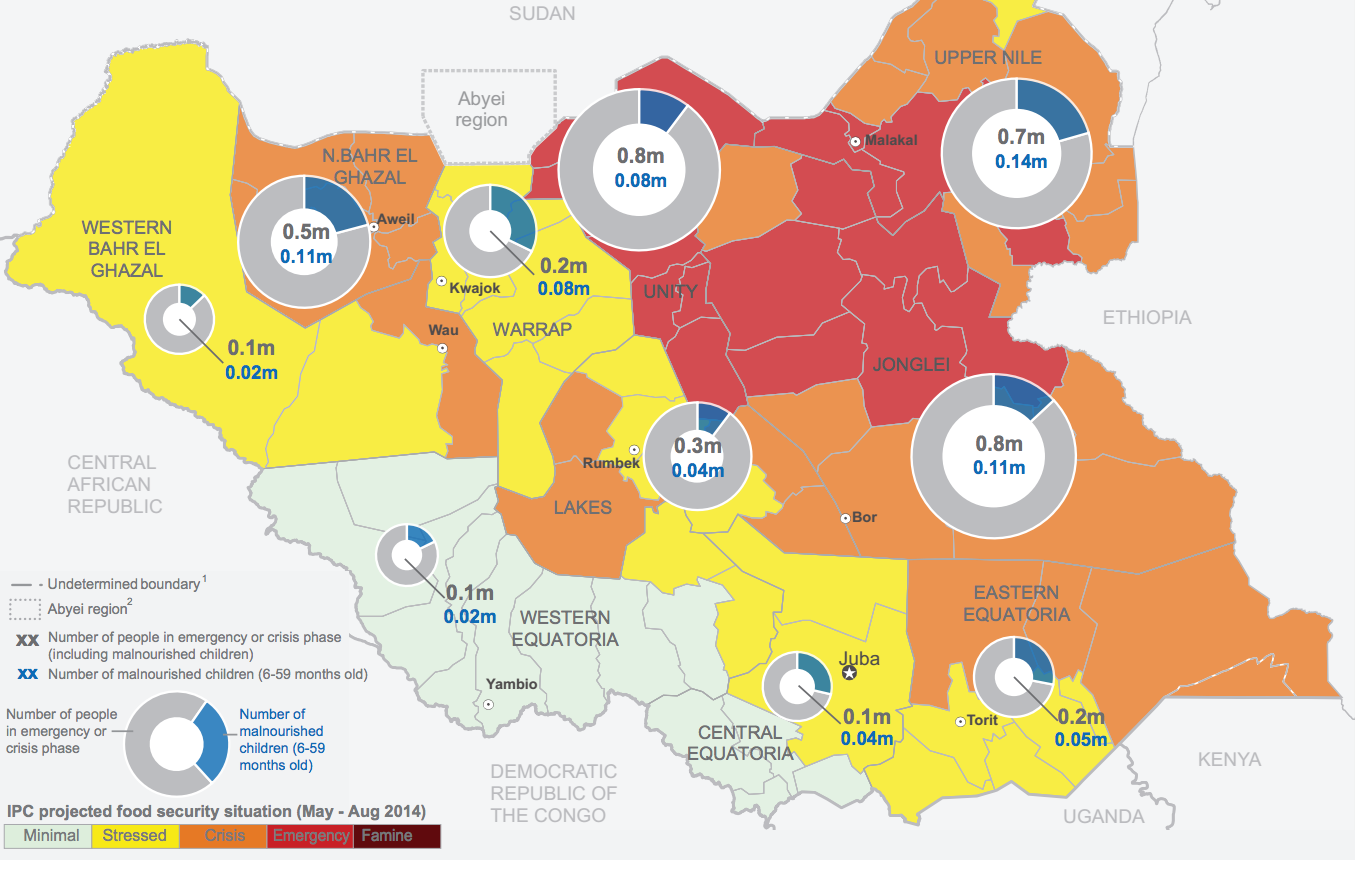
Ty McCormick warns of an impending famine in South Sudan, where over 1 million people are already in dire need of food aid:

The origins of the food-security crisis are layered. War disrupted the planting season, not just where there was active fighting, but across the northern half of the country as farmers fled their fields in anticipation of violence. But systematic underinvestment by the South Sudanese government, which has battled numerous corruption scandals since it became independent in 2011, is also part of the equation: Roughly 90 percent of South Sudanese territory is suitable for agriculture, but only about four percent of it was being cultivated, even before the current crisis. This combination of greed, violence, and lack of capacity has proven deadly. …

Experts have yet to formally declare a famine — a step that requires rigorous analysis of food supply, malnutrition, and mortality rates and can take months to complete — but the United Nations has classified South Sudan a “level-3 emergency,” a designation it shares with only three other countries: Syria, Iraq, and the Central African Republic. But aid agencies, like UNICEF, caution against relying too heavily on formal declarations or quantitative analysis. Waiting for a famine declaration before taking action, they warn, could be catastrophic. “By the time the famine was declared in Somalia in 2011,” said Veitch, “Half of the people that would die in the famine were already dead.”

Unfortunately, Rick Noack indicates, the fact that we can see it coming doesn’t necessarily mean that donor countries will step up to prevent it:

The author of [a Chatham House report on early warnings and responses to famine], Rob Bailey, told The Post that “decision-makers perceive significant downside risks from funding early action,” such as the possibility of money being diverted to hostile groups. Hence, foreign governments often wait until the last moment to provide funding – making it likely to come too late. In the early phases of a crisis, the pressure on decision-makers is low because public awareness is similarly low. Conversely, risks are high: Who wants to spend taxpayer’s money on a foreign, predicted crisis of uncertain scale?

Noack also reports that the US Government is the leading donor of aid to South Sudan, having sent another $180 million last week (out of a total $636 million this year.) But will any other countries follow suit?

(Chart: A UN map showing “South Sudan’s counties by level of food insecurity, and also indicates the number of malnourished children.”)

Is Edward Snowden the World’s Dumbest Spy?, Ctd

by Freddie deBoer

Lots of reader objections on this one:

On Snowden’s motives and capabilities:

“I do know that he’s in Russia because he’s been trapped there by our government, and that if he’s a spy, he’s gotta be the world’s worst.”

Well, you’re half right. Snowden is in Russia because that’s where he chose to go, one day after his passport was revoked. I respect the whistle-blower argument, but Snowden did much more than leak evidence of crimes and overreach by the NSA. He took those documents and fled. Unlike Chelsea Manning, who seems to have far more personal integrity than Snowden, he did not remain here to face the consequences of his actions. If he truly believed he was doing a service for the country, or the world, and was not in flagrant violation of oaths he took, he should have stood his ground here in the US, or at the very least on neutral soil, NOT left to be succored by avowed international enemies of the US.

And his actions have shown that at the very least, he is extremely naive about international relations.

Any information that was on any digital device he took with him on his route to Sheremetyevo via Hong Kong was almost certainly compromised. If they were not (doubtful),  just how secure and careful have Greenwald and others who have access to those documents been in the intervening year? Surely you don’t think it is a coincidence that Aeroflot just happened to be willing to convey him to Moscow on a cancelled passport, do you? Putin loves having Snowden there to irritate the US, and has been playing him like a violin for over a year. Did you watch that pandering April  interview that Snowden claimed later was an attempt to catch Putin in a lie? If that was his aim, he has totally misunderstood both Putin and the nature of the personality cult he has been assiduously building in Russia. As events in Ukraine have shown, Putin *doesn’t care* if the West thinks (or knows) that he’s lying, and most Russians won’t believe the biased Western media even if presented with clear evidence. The West already suspected (and now knows) that Putin is an opportunist with no respect for international law or sanctions if they get in the way of what he wants. Snowden is just one more convenient tool in his arsenal of catspaws to use against what he considers to be a hostile coalition of Western powers.

I am not yet willing to brand Snowden an out-and-out traitor, but his actions are not nearly as blameless as you seem to think. He has repeatedly tried to trade off of information he stole from the NSA to secure asylum with several different governments. If he really wanted to expose US malfeasance while still protected US security interests, he should have left for neutral territory well before leaking any documents, established himself and submitted an asylum claim, THEN started leaking. Instead, his clumsy attempts at whistleblowing and evading responsibility for the same have resulted in him being in the power of an enemy state with no regard for world stability if it stands in the way of their interests.

Snowden’s own words: “I blew the whistle on the NSA’s surveillance practices not because I believed that the United States was uniquely at fault, but because I believe that mass surveillance of innocents – the construction of enormous, state-run surveillance time machines that can turn back the clock on the most intimate details of our lives – is a threat to all people, everywhere, no matter who runs them.” Snowden doesn’t just think the NSA overstepped its legal bounds in surveilling US citizens; he doesn’t think the NSA should be spying on *anyone at all*, and neither should anybody else. Well, that’s fucking great, but that’s just. not. reality. It is this kind of attitude that lead to Sec of State Henry Stimson shutting down the American Black Chamber and dismissing much of its staff without a pension or NDA after World War I. The key figure behind the chamber, Herbert Yardley, went on to write his own expose of their activities, mostly out of financial need, but likely also out of pique. I still have more respect for Yardley and his motivations than I do for Snowden.

The NSA’s own commentary on Yardley’s memoir: “Yardley, with no civil service status or retirement benefits, found himself unemployed just as the stock market was collapsing and the Great Depression beginning. He left Queens and returned to his hometown of Worthington, Indiana, where he began writing what was to become the most famous book in the history of cryptology. There had never been anything like it. In today’s terms, it was as if an NSA employee had publicly revealed the complete communications intelligence operations of the Agency for the past twelve years-all its techniques and major successes, its organizational structure and budget-and had, for good measure, included actual intercepts, decrypts, and translations of the communications not only of our adversaries but of our allies as well.”

I’ll just say, briefly: I wish Chelsea Manning had escaped the way Snowden has. I see nothing noble about her being stuck in a cage for the next several decades.

Email O’Clock

by Dish Staff

workweek

Derek Thompson stayed up late to write an article about working late:

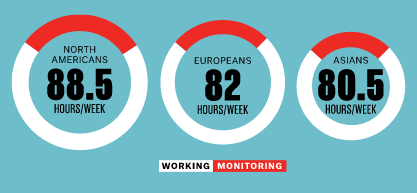
“It really is a global economy,” says David Mars, a New York venture capitalist. But if the pressures of globalization and a flimsy economy have endangered the set-hour workweek, mobile technology has obliterated it. In an unpublished Harvard Business School survey that I reviewed last year, American managers and workers reported that they were “on”—either working or “monitoring” work while being accessible—almost 90 hours a week. With this new denominator, email isn’t 28 percent of a 45-hour workweek. It’s 14 percent of a workweek that begins when our heads lift off the pillow and ends when we fall, face-first and exhausted, back into it. Wake-up-to-power-down is the new 9-to-5.

Getting Out The Vote In Ferguson

by Dish Staff

Ferguson’s government is much whiter than its population. But Yglesias doubts that will be true for long:

Nobody who lives in the area could possibly think that local government doesn’t matter any more, and a community capable of organizing nightly protest marches should have relatively little trouble getting people to come out and vote. And if Ferguson’s African-American residents do vote, they should have relatively little trouble installing a government that hears their concerns and leans against the systemic inequities in the American criminal justice system.

In other words, the town at the center of this drama may well see a real improvement in political representation. The deeper problem is going to lie elsewhere — in the many towns large and small where people of color are a minority of eligible voters and the basis of white political power is firmer.

Friedersdorf wants recall elections:

A successful recall of Ferguson’s mayor and city council is the best outcome I can imagine from a protest movement that is justifiably angry, but uncertain about how to achieve its goals and at risk of losing public support if the streets turn more violent. Protesters want transparency in the investigation into Brown’s death, accountability for the police department, and an end to leadership that demonstrates such disregard and seeming contempt for the city’s black people. Perhaps existing pressure on city leaders, or appeals already made to the Department of Justice, will help advance those goals—but while more night protests would seem to offer scant hope for additional gains, replacing the city’s elected leadership would advance the protesters’ goals directly and dramatically. The effort would be nonviolent, it might well increase civic participation for years or even generations to come, and if successful, it would send an inspiring message to those who feel powerless: that a system very much stacked against them is still a far more powerful weapon than a molotov cocktail.

Jonathan Rodden points out that, “while St. Louis is indeed among the most segregated metropolitan regions in the United States, Ferguson and some of its North County neighbors are among the most racially integrated municipalities in Missouri and well beyond”:

Let us not learn the wrong lessons from recent events in Missouri. By no means does Ferguson prove the defeatist claim that blacks and whites cannot live together in peace as the inner suburbs transform. Those of us who grew up in the integrated Ferguson-Florissant area in recent decades know otherwise. It is not a post-racial paradise, but it is a functioning multiracial community. What we are seeing in Ferguson is not merely the latest manifestation of the age-old problem of segregation and housing discrimination. Rather, it is evidence that the best hope for a solution – -the creation of integrated middle-class neighborhoods such as Ferguson — cannot work without political inclusion and accountability.

Fred Siegel is much more pessimistic about Ferguson’s future:

Riots bring but one certainty—enormous economic and social costs. Businesses flee, taking jobs and tax revenues with them. Home values decline for all races, but particularly for blacks. Insurance costs rise and civic morale collapses. The black and white middle classes move out. Despite its busy port and enormous geographic assets, Newark, New Jersey has never fully recovered from its 1967 riot. This year, Newark elected as its mayor Ras Baraka, the son and political heir of Amiri Baraka—the intellectual inspiration for the 1967 unrest.

The story is similar in Detroit, which lost half its residents between 1967 and 2000. Civic authority was never restored after the late 1960s riots, which never really ended; they just continued in slow motion. “It got decided a long time ago in Detroit,” explained Adolph Mongo, advisor to the jailed former “hip-hop mayor,” Kwame Kilpatrick, that “the city belongs to the black man. The white man was a convenient target until there were no white men left in Detroit.” The upshot, explained Sam Riddle, an advisor to current congressman John Conyers, first elected in 1965, is that “the only difference between Detroit and the Third World in terms of corruption is that Detroit don’t have no goats in the streets.”

Digital Breaks, or “Breaks”

by Freddie deBoer

3078674842_63807d53cd_b

Exactly a year ago, David Roberts of Grist announced that he was taking an internet break, and would return on Labor Day of 2014. Roberts wrote at the time

I am burnt the fuck out.

I spend each day responding to an incoming torrent of tweets and emails. I file, I bookmark, I link, I forward, I snark and snark and snark. All day long. Then, at night, after my family’s gone to bed and the torrent has finally slowed to a trickle and I can think for more than 30 seconds at a stretch, I try to write longer, more considered pieces.

I enjoy every part of this: I enjoy sharing zingers with Twitter all day; I enjoy writing long, wonky posts at night. But the lifestyle has its drawbacks. I don’t get enough sleep, ever. I don’t have any hobbies. I’m always at work. Other than hanging out with my family, it’s pretty much all I do — stand at a computer, immersing myself in the news cycle, taking the occasional hour out to read long PDFs. I’m never disconnected.

It’s doing things to my brain.

So he elected to take a break from internet life. He’s not the first. Disconnecting from the internet has become a little genre onto its own. The most well-known of these disconnections, and the most emblematic, is that of The Verge‘s Paul Miller. And it’s emblematic precisely because of what Miller says didn’t happen– he didn’t get wiser, he didn’t get healthier. He writes,

One year ago I left the internet. I thought it was making me unproductive. I thought it lacked meaning. I thought it was “corrupting my soul.”

It’s a been a year now since I “surfed the web” or “checked my email” or “liked” anything with a figurative rather than literal thumbs up. I’ve managed to stay disconnected, just like I planned. I’m internet free.

And now I’m supposed to tell you how it solved all my problems. I’m supposed to be enlightened. I’m supposed to be more “real,” now. More perfect.

But instead it’s 8PM and I just woke up. I slept all day, woke with eight voicemails on my phone from friends and coworkers. I went to my coffee shop to consume dinner, the Knicks game, my two newspapers, and a copy of The New Yorker. And now I’m watching Toy Story while I glance occasionally at the blinking cursor in this text document, willing it to write itself, willing it to generate the epiphanies my life has failed to produce.

I didn’t want to meet this Paul at the tail end of my yearlong journey.

This, in my experience, is typical of people who have disconnected: they come back to report that in fact their online selves are more real and more fulfilling, and that really it was their doubts and dissatisfaction with the internet that had been misguided. Some go so far as to say that disconnecting is not actually possible. Miller cites Nathan Jurgensen, who has built a theory of pathology for those who advocate disconnecting. The message is clear: you can take your break, but there is no escape.

Miller is part of what I’ve called, in the past, the internet’s immune system. It’s a facet of online culture whereby even the mildest criticism of digital life attracts reflexive, defensive argument, even though the entire weight of capitalism pushes us to spend more and more time in that digital space. Alan Jacobs recently wrote about this weird fantasy world where Luddites are more  powerful than enthusiastic technologists, saying “Where you and I live, of course, technology companies are among the largest and most powerful in the world, our media are utterly saturated with the prophetic utterances of their high priests, and people continually seek high-tech solutions to every imaginable problem, from obesity to road rage to poor reading scores in our schools.” One of my favorite bloggers, Michael Sacasas, has written at length about the odd way in which one of the most powerful economic and cultural forces in the world has come to be defended as if  were a powerless underdog. Jurgensen acquits his arguments well, but I always am left wondering: where, exactly, is this perception of threat coming from? From a small handful of people who have disconnected from the internet, in comparison to the millions who spend most of their waking lives online?  It’s strange.

I will 100% cop to the fact that I am one of those IRL fetishists that Jurgensen derides. Because for me– for me– the internet is fun and useful but not nearly as moving or important as real life. And I think that, for most people, meeting someone face to face, enjoying their physical presence, is not replicable digitally. But that’s just my perception, and I have no interest in spreading that Gospel. Like Alan, I would like it if online triumphalism was not rendered compulsory by its avatars. What I want to say to others is that if you want to disconnect, you need to really disconnect– you can’t spend your offline time thinking about your old online self. When I read Miller’s piece, it’s unclear to me whether he ever went all the way in his disconnection. Of course the experience will disappoint you if you go offline but keep your online state of mind.

So that’s the real question for Roberts. Were I a betting man, I’d say he comes back and says something similar to Miller– it was cool, I lost some weight, played with my kids, but it wasn’t really a big deal and I better appreciate how the internet makes us “social” now. But the deeper issue is whether he’ll come back having spent that year thinking of all the funny stuff he’d be saying or cool stuff he’d be learning if he were online. If that’s the case, I’m afraid there’s no way disconnecting could ever have satisfied him.

(Photo by Michael Herfort)
A Better Set Of Lies

by Jonah Shepp

Rosie Gray flags Russia Today’s new ad campaign:

“The campaign will be comprised of several different posters, and we kicked it off with wild postings in the New York City,” RT spokespersongrid-cell-30824-1408370582-5 Anna Belkina said in an email. “Soon it will be extended to Washington, DC, and London.” … The ads feature a picture of Colin Powell with the tagline: “This is what happens when there is no second opinion. Iraq War: No WMDs, 141,802 civilian deaths. Go to RT.com for the second opinion.” Another poster says, “In case they shut us down on TV, go to RT.com for the second opinion.”

Asked whether RT believes it is in danger of being shut down on American television, Belkina provided a statement from RT editor-in-chief Margarita Simonyan: “Alternative voices, however rare, are often met with fear, hostility and bureaucratic obstructionism in the attempt to stifle them — because they are inconvenient to the establishment. We want the viewers to know that no matter what, RT will remain THE place to go to for that second opinion.”

That’s a well-crafted message, and it illustrates one of the many ways in which the massive missteps of the Bush era are coming back to bite us.

Lies empower lies, and the lies that underpinned the neoconservative project, helped along by a cowed press that parroted them, were inevitably going to create an opening for foreign propaganda outlets and homegrown conspiracy theorists to tell a skeptical public what was “really” going on. When the establishment’s narrative is revealed to be false, that lends credibility to “alternative” narratives, whether they are true or not, and creates a market for anything that contradicts the official line. A deceitful government and a wimpy media make us vulnerable to propaganda. The Obama administration shares some blame for this, but, well, there’s a reason it’s Colin Powell on that poster and not Hillary Clinton.

The most disquieting feature of the poster is that its headline is correct. The foreign propaganda outlets masquerading before American liberals as objective news sources (RT and al-Jazeera in particular, but Iran’s Press TV also comes to mind) are enabled by the fact that when they tell us that our government has lied to us about matters of great magnitude, that thousands have died because of those lies, and that even well-respected mainstream media outlets failed to uncover those lies until it was far too late, whatever else they may be, they’re right about that.

How Do You Fix A Police Department?

by Dish Staff

Josh Voorhees has suggestions. The feds could step in:

If Holder concludes that there has been a pattern of misconduct by the police—either in the lead-up to Brown’s death or in its aftermath—the president has the ability to force widespread reforms within the department with the help of a law passed in the wake of the Rodney King beating. The provision in question, part of what was officially known as the Violent Crime Control and Law Enforcement Act of 1994, is “one of the most significant” pieces of civil rights legislation passed in the latter part of 20th century, and also one of the most “overlooked,” according to Joe Domanick, the associate director of the John Jay College of Criminal Justice’s Center on Media, Crime, and Justice. The law gives the federal government two options: It can either formally pursue a federal civil rights lawsuit against the Ferguson Police Department by alleging a “pattern and practice” of misconduct or the administration and city officials can enter into what is known as a “consent decree” that would mandate a specific set of reforms that would then be overseen by an independent court-appointed monitor. Faced with the possibility of a costly court battle, most cities have historically taken the path of least resistance and signed on the decree’s dotted lines. Ferguson officials probably wouldn’t buck that trend.

According to Samuel Walker, the emeritus professor of criminal justice at the University of Nebraska at Omaha, such an outcome is “the best hope we have” for turning around the troubled department. The reforms that normally accompany a consent decree “really get at the critical issue here, which is the culture of the department,” Walker says. “Day in and day out, what do officers know they have to do and what do they know that they can get away with?”

He notes that this worked for the LAPD after the Rodney King beating. Cincinnati also successfully changed:

Officers are now trained in low-light situations, like confronting a suspect at night in an alley, as was the case in [Timothy] Thomas’s death. The agreement also created the Citizens Complaint Authority to investigate incidents when officers used serious force. Most importantly, it instructed officers to build relationships with the community by soliciting feedback with residents and using all available information to find solutions to problems before necessarily resorting to a law enforcement response. The ACLU of Ohio, which was one of the signatories of the agreement, hails it as “one of the most innovative plans ever devised to improve police-community relations.”

These new policies have not fixed all of the racial injustices in Cincinnati, but they have improved them.

Jonah Goldberg recommends hiring minority cops:

I am as against racial quotas as anyone, but the idea that police forces shouldn’t take into account the racial or ethnic make-up of their communities when it comes to hiring has always struck me as bizarre. A Chinese-American cop will probably have an easier time in Chinatown than a Norwegian-American cop. A bilingual Hispanic cop will have similar advantages in a mostly Spanish-speaking neighborhood. When my dad was a kid in the Bronx, it was not uncommon for a cop to give a teenager a well-intentioned smack as a warning and leave it at that. But forget the smack. Today, in many neighborhoods, if a white cop even talks harshly to a black kid, it might immediately be seen as a racial thing. If a black cop said the exact same things, it might be received differently.

But historian Heather Ann Thompson notes that integrated police forces don’t always solve the problem of racist policing:

Even if police departments are integrated — certainly this has been proven in Detroit, and in other cities where you have many, many more black police officers — the problem is that police are charged with policing the community and particularly policing the poor black community. The act of policing places the police in opposition to this community. Even if the officers are black, that does not guarantee that there’s going to be smooth police-community relations. Fundamentally, the problem is that there is so much targeted policing in these neighborhoods.

Israel Has Been Singled Out By Israel’s Defenders, Ctd

by Freddie deBoer

Tensions Remain High At Israeli Gaza Border

Continuing the conversation about our culpability in Israel’s actions, this email sums up a lot of reader sentiment:

Your explanation is valid as far as Americans go, since they provide so much financial and more importantly, diplomatic, support to Israel.  That’s not true for people in other countries.  As just one example, let’s look at the civilian casualties and other atrocities in Syria, which are orders of magnitude greater than those caused by Israel.  Did the Latin American countries who recalled their ambassadors from Israel to protest civilian casualties in Gaza similarly recall their ambassadors from Syria?  Have there been any mass protest demonstrations at Syrian embassies in Europe? We can look at other recent atrocities and find similar absences of outrage around the world, yet consciences everywhere seem to miraculously awaken when Israel is involved.

I am a supporter of Israel as a country, but not of many of the policies of its government.  Many of Israel’s actions in the West Bank are not only immoral and illegal (and illegal under Israeli law, yet they go unpunished), they are also stupid and self-defeating. Far from asking to end to criticisms of Israel, I join in many of them, provided they are based on an informed understanding of the situation. Too often they are not – people see some footage of civilian casualties, read some blog posts, and are suddenly instant experts on the Middle East.  I expect people who offer an opinion to know what they are talking about.  When I hear mischaracterizations (or disregard) of Hamas’ ultimate aims, ignorance of the chronology and reasons for Israel’s blockade of Gaza, wholesale swallowing of Hamas’ propaganda re civilian vs. military casualty figures, and most infuriating of all, minimization of the threat of invasion/terror tunnels and the effect of thousands of rockets used exclusively against civilian targets in Israel, I don’t see much reason to value their opinions.

Here is the fundamental question we’re considering: is Israel the same as other countries? Or is it different from other countries? The answer from my critics seems to switch depending on which would be more useful for defending Israel at that moment.

Though many have complained that I use terms like “killing children,” no credible source doubts that Israel has killed hundreds of civilians in Gaza in this most recent campaign, or that many of them have been children. Instead, we are still to defend Israel despite that fact because Israel is different, because it is the only democracy in the region and a more moral nation than the ones we identify as bad actors. And yet here we have this emailer defending Israel because it is better than Syria. That hardly seems like living up to the standard of the region’s only democracy. “Better than the Assad regime” does not strike me as a particularly enthusiastic endorsement.

So which is it? Are we required to support Israel because it is a more advanced, democratic, moral nation? Or are we expected to hold it to an identical standard as Assad’s Syria? You can’t have it both ways. If you think Israel exists on a higher moral plane than its neighbors, then you have to insist that it act morally. For all of the many ways in which Israel’s democracy has been undermined by the rise of ultra-nationalists and ethnic supremacists in the past decades, it remains subject to democratic review in a way that Syria’s regime simply doesn’t. Israel could become a freer and more just nation through loud and committed democratic engagement, but that can’t happen if we excuse all of its bad deeds in the name of defending it.

(Photo by Lior Mizrahi/Getty Images)

Forced To Bear Her Rapist’s Child

by Dish Staff

Kitty Holland and Ruadhán Mac Cormaic report on the latest abortion controversy in Ireland:

The young woman who was refused an abortion and later had her pregnancy delivered by Caesarean section, has spoken of her attempt to take her own life when she was 16 weeks pregnant. She says she was a victim of rape before she came to Ireland earlier this year and she found out she was pregnant during a medical check soon after. In an interview with The Irish Times she says she immediately expressed her desire to die rather than bear her rapist’s child, when she was eight weeks and four days pregnant. … The section was performed on her earlier this month. She was discharged a week later and is receiving psychiatric care in the community. The baby, whom she has not had contact with, remains in hospital.

Amanda Marcotte blames anti-abortion legislation:

The situation perfectly encapsulates how abortion bans work in the real world: The most vulnerable women are harmed, while more privileged women find ways to get abortions. In Ireland, women who can afford to travel simply go to England to get abortions, meaning that poor and immigrant women under travel restrictions are out of luck. A young immigrant rape victim has now been put through an entirely unnecessary horror show, but hey, at least Irish politicians can preen about how “pro-life” they are.

Sarah Ditum voices her outrage:

As an onlooker to this case, what strikes me is the constant traffic of foreign objects through this woman’s body, imposing foreign wills. The penis of the rapist who forced himself into her. The nasogastric tube stuck into her nostril and down against her resisting throat. The scalpel of the doctors who cut her open, their hands in her belly, the moving horror of another body within your restrained flesh. The unbelievable awfulness of being compelled to provide life to the child of the man who raped you.

Face Of The Day

Liberia Battles Spreading Ebola Epidemic

Local residents dress a sick Saah Exco, 10, after bathing him in a back alley of the West Point slum on August 19, 2014 in Monrovia, Liberia. According to a community organizer, Saah’s mother died of suspected but untested Ebola in West Point before he was brought to the isolation center on the evening of August 13th with his brother Tamba, 6, aunt Ma Hawa, and cousins. His brother died on August 15th. Saah fled the center that same day with several other patients before it was overrun by a mob of slum residents on August 16th. Once out in the neighborhood, Saah was not sheltered, as he was suspected of having Ebola, so he’s been sleeping outside. Residents reportedly began giving him medication, a drip, and oral rehydration liquids today. The whereabouts and condition of his aunt and cousins, who left the facility when it was overrun by the mob, is still unknown at this time. The Ebola virus has killed more than 1,000 people in four African nations, more in Liberia than any other country. Photo by John Moore/Getty Images.

View Alan Taylor’s heartbreaking gallery of images from the Liberian Ebola crisis here.