Getting Medieval On Ebola?

by Dish Staff

With regards to containing the outbreak, Stephen Mihm describes a medieval approach called “cordon sanitaire” that’s currently being used in Liberia, Guinea, and Sierra Leone:

The problem, then as now, is the logistical challenge of completely eliminating any movement in or out of a large territory. One critic, writing in the 1880s about cholera outbreaks in Europe, observed that officials could “close every railroad line and every Alpine wheel route,” but refugees “would improvise a hundred footpaths through the mountains to find a way home.”

Moreover, the use of a cordon sanitaire in the past, while ostensibly aimed at restricting the movement of people, often had the opposite effect. In the Egyptian cholera epidemics of the late 19th century, imperial administrators used the cordon sanitaire, only to find that it panicked the populace. Many people fled the area out of fear that they would perish if left behind.

The practice can, notes Mihm, even cause further deaths: “It is perhaps not surprising that by the late 19th century many people came to denounce the practice as a relic of the Dark Ages.” Meanwhile, Dr. Philip Rosoff questions the use of experimental drugs:

If you read the WHO release on the ethics of using these drugs, they emphasize a couple of points: it should be okay to use them, but informed consent should be gotten. That seems to be self-evident but I’m not sure what informed consent means under situations of such desperation when a drug that’s never been used in people is held out as a life saver.

And he adds that this type of scenario makes good science unlikely:

[T]he WHO talks about collecting data but that’s going to be almost impossible to do. It’ll be impossible to decide whether it’s effective or not because it’s not going to be used under controlled circumstances. When people get better, we’ll have no idea whether it was because people are using the drug, or if somebody dies after getting the drug you don’t know whether it’s the disease or the drug. Because these patients are so sick, it may not be possible to detect side effects that you could under more controlled circumstances.

And then there are the entirely fake treatments, like Garcinia Cambogia powder, being marketed to the paranoid. Michael Byrne notes a silver-based dietary supplement which may have already scammed its way into Nigeria:

Of particular concern is a product called NanoSilver, sold by the Natural Solutions Foundation. The product is basically a solution of tiny silver particles, and purports to be something of a cure-all for infections of any stripe. Silver has demonstrated antimicrobal properties and, in the hands of the supplement industry, this can only mean that it treats whatever disease is handy. And while indeed silver is effective in surface antibiotic applications—as a disinfectant coating for medical devices, or a antimicrobal protectant utilized around public spaces—it is also fairly toxic to humans. And despite the howling chorus of natural heath boosters (just Google “silver particles cure”) the concept hasn’t really been shown to cure or treat anything once it’s inside the human body.

Previous Dish coverage of the Ebola outbreak here.

To Bind Up The Nation’s Wounds

by Matthew Sitman

US-CRIME-RACE-POLICE-SHOOTING

I noted in my introduction earlier today that I don’t usually write about politics, that I prefer, especially when things get bad, to retreat into literature and poetry. This was my impulse when news of what happened in Ferguson first flickered across my screen – to my shame, I just wanted to avert my gaze. And I managed to do just that for a day or two, until it couldn’t be ignored, and it shifted from a “local story” to the topic that completely dominated my Twitter feed and Facebook page, almost to the exclusion of everything else. Ferguson, Missouri, was “just a place,” as the New York Times put it, until, suddenly, it wasn’t. That phrase gets more chilling every time I read it.

In what I’ve read about the killing of Michael Brown and its aftermath, certain issues have been front-and-center, with the widespread evils of entrenched racism and the militarization of the police being the most prominent. But I’ve also noticed something else going on, which is that more and more people seem to believe that Ferguson reveals something quite damning about America itself, that it points to deeper, systemic issues that go far beyond one killing in one town – that the disregard for black lives in America is a sin that undermines so much about what we like to believe about our country, and our hopes for its future. James Poulos gets at this well:

Americans—in and out of my Twitter feed—have begun to grasp that hideous possibility: that America has manufactured a violent and predominantly black permanent underclass, subjected to our malignant paranoia about crime, living slow-motion death sentences in ghettos from which no amount of presidential hope, change, or lecturing can release them.

Even more important, Americans have begun to understand that the scourge-ification of this underclass is inseparable from the realization of our worst collective nightmare—the scourging of America itself, the ruin of the promise of America that still strikes us in our gut as providential. The widespread belief, still largely subconscious or at least unspoken, that America is breaking, and that we deserve the suffering ahead.

He then turns to Lincoln to further develop this thought:

“Fondly do we hope,” Lincoln said in his Second Inaugural, “fervently do we pray, that this mighty scourge of war may speedily pass away. Yet, if God wills that it continue until all the wealth piled by the bondsman’s two hundred and fifty years of unrequited toil shall be sunk, and until every drop of blood drawn with the lash shall be paid by another drawn with the sword, as was said three thousand years ago, so still it must be said ‘the judgments of the Lord are true and righteous altogether.’”

We do not want this to be true. This is what we fear: that America, despite its brilliance and its progress, is inescapably complicit in the sin of slavery and racism, bearing a moral debt that cannot be repaid but in suffering and blood—as such debts are paid so routinely around the world which we pride ourselves, however rationally, on standing so far above.

I think it has to be clear by now that we do bear that moral debt and are complicit in the ongoing sin of racism and white supremacy, even if too few of us are willing to admit it, and what I found compelling about Poulos’ essay is that he points beyond policy questions to the deeper moral issues involved. I certainly hope the killing in Ferguson leads to policy changes, especially when it comes to the militarization of our police forces. With Freddie, I also hope that the protests in Ferguson are the first stirrings of “dragging the police back under community control.” But these reforms won’t really be enough, even if they do help. Ferguson is about more than a few police officers with big guns behaving badly.

What we need, in other words, is what Ta-Nehisi Coates described in his recent essay on reparations:

What I’m talking about is more than recompense for past injustices—more than a handout, a payoff, hush money, or a reluctant bribe. What I’m talking about is a national reckoning that would lead to spiritual renewal. Reparations would mean the end of scarfing hot dogs on the Fourth of July while denying the facts of our heritage. Reparations would mean the end of yelling “patriotism” while waving a Confederate flag. Reparations would mean a revolution of the American consciousness, a reconciling of our self-image as the great democratizer with the facts of our history.

Beyond policy fixes is the necessity of a “national reckoning” with the reality of racial injustice in this country. More white people like myself should care about the criminalization of black men apart from when it’s trendy to mention it on Twitter. What I am concerned about is what happens after the situation in Ferguson is “resolved.” And I don’t see how we can really have that national reckoning apart from the ways Coates lays out in his essay, addressing the full breadth of the way blacks have been marginalized, punished, and plundered throughout our history. We can take away the police’s military equipment, but we also need “a revolution of the American consciousness.” The question we face is not just “Why do the police in Ferguson have that equipment?” but “Why did they turn those arms against black people?” Beneath policy debates lurks the problems of the human heart, and the hate and indifference residing there.

All this is another way of saying we need repentance, real repentance. I do not accept that the only way forward is through “suffering and blood.” To invoke the prophetic tradition both Lincoln and Poulos are leaning on, repentance can forestall the anger of the Lord. As the writer of the book of Jonah proclaimed, “When God saw what they did and how they turned from their evil ways, he relented and did not bring on them the destruction he had threatened.” And so if we’re going to revisit Lincoln, it’s worth mentioning the call that closed his second Inaugural address:

With malice toward none, with charity for all, with firmness in the right as God gives us to see the right, let us strive on to finish the work we are in, to bind up the nation’s wounds, to care for him who shall have borne the battle and for his widow and his orphan, to do all which may achieve and cherish a just and lasting peace among ourselves and with all nations.

Let us turn from our evil ways and repent, and bind up the nation’s wounds as best we can. Read Ta-Nehisi Coates’ essay, if you haven’t already, and consider, as TNC suggests, supporting John Conyer’s congressional bill, H.R. 40. Keep tweeting about Ferguson, sure, but when your social media feed reverts to pictures of cats and snarky one-liners, remember what we saw and felt this last week. And one other thing: I want to hear from Dish readers about concrete ways they hope to “finish the work we are in” in the weeks, months, and years ahead. Write to me at dish@andrewsullivan.com with ideas and suggestions about how to do this, how you plan on being more than a spectator who simply waits to tweet about the next killing and the next protest.

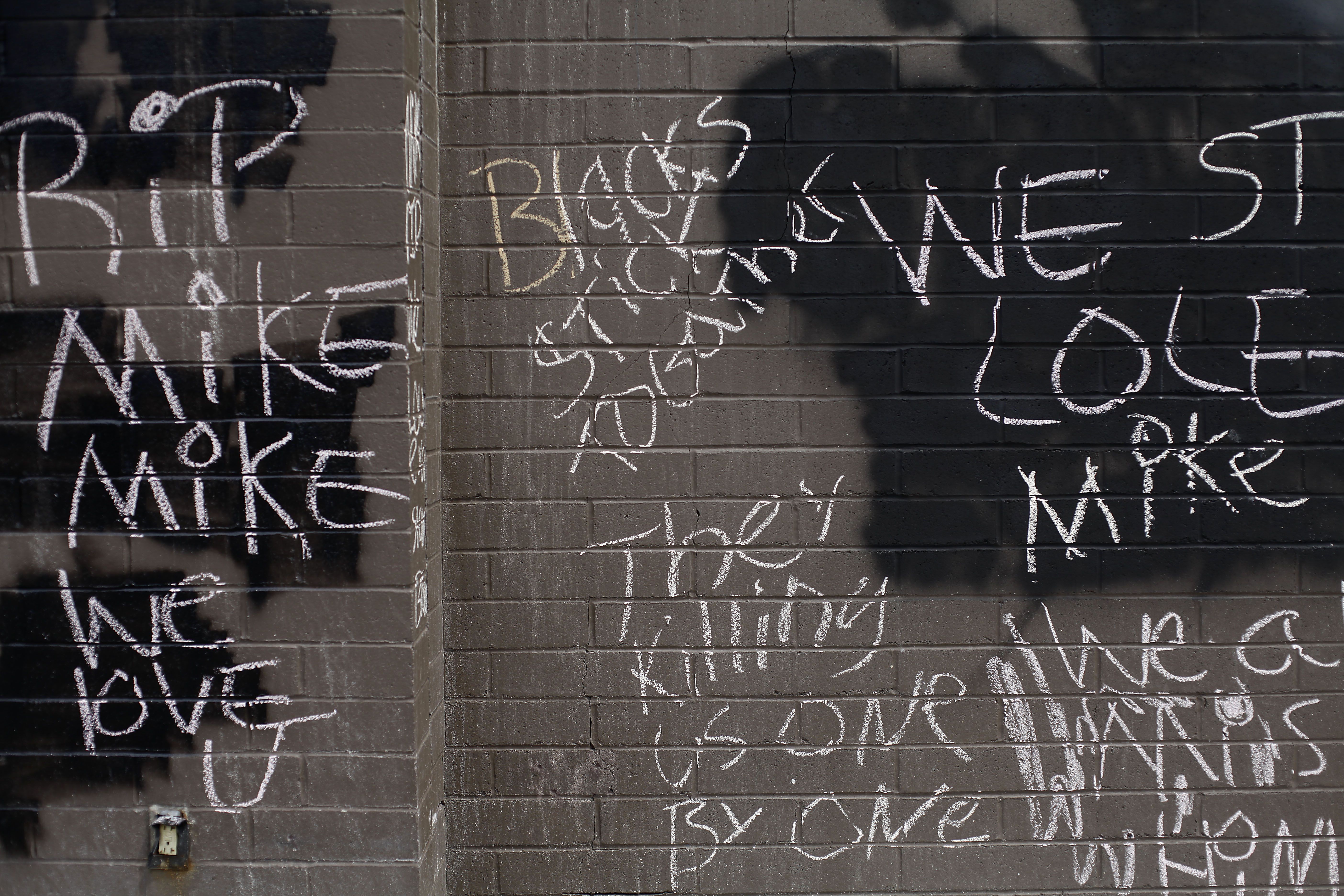
(Photo: Demonstrators wrote messages while protesting on August 15, 2014, the shooting death of 18-year-old Michael Brown in Ferguson, Missouri. By Joshua Lott/AFP/Getty Images)

Perry Gets His “Gate”

by Dish Staff

On Friday, a grand jury in Travis County, Texas indicted governor Rick Perry on charges of abuse of official capacity and coercion of a public servant after he threatened to veto funding for a government oversight program, allegedly to pressure the Democratic DA who ran it into resigning, and subsequently made good on the threat:

A special prosecutor spent months calling witnesses and presenting evidence that Perry broke the law when he promised publicly to nix $7.5 million over two years for the public integrity unit run by the office of Travis County Democratic District Attorney Rosemary Lehmberg. Lehmberg was convicted of drunken driving, but refused Perry’s calls to resign. … The unit Lehmberg oversees is the same that led the investigation against former U.S. House Majority Leader Tom DeLay, a Texas Republican who in 2010 was convicted of money laundering and conspiracy to commit money laundering for taking part in a scheme to influence elections in his home state.

The emerging consensus among legal and political commentators is that the indictment is entirely specious. Eugene Volokh lays out the many reasons why:

[T]he Texas Constitution expressly reserves the veto power to the governor. The governor is entitled to decide which laws he “approv[es]” and which he disapproves — without constraint from the legislature, or from county-level district attorneys. The legislature certainly can’t make it a crime for the governor to veto its appropriation bills; that would deny the governor the power that the Texas Constitution gives him.

Nor can the legislature make it a crime, I think, for the governor to veto its appropriation bills as an attempt to influence some government official’s behavior — behavior that is commonplace in the political process, and that is likewise within the governor’s exclusive power to decide which bills to give his “approval.” To be sure, the legislature can make it a crime for the governor to accept bribes in exchange for a veto; but there the crime is the acceptance of the bribe, not the veto itself.

Chait calls it “unbelievably ridiculous”:

The prosecutors claim that, while vetoing the bill may be an official action, threatening a veto is not. Of course the threat of the veto is an integral part of its function. The legislature can hardly negotiate with the governor if he won’t tell them in advance what he plans to veto. This is why, when you say the word “veto,” the next word that springs to mind is “threat.” That’s how vetoes work. The theory behind the indictment is flexible enough that almost any kind of political conflict could be defined as a “misuse” of power or “coercion” of one’s opponents. To describe the indictment as “frivolous” gives it far more credence than it deserves. Perry may not be much smarter than a ham sandwich, but he is exactly as guilty as one.

But Alec MacGillis argues that the charges, though unlikely to hold water, are illustrative of how Perry operates:

[R]egardless of how strong the charges against Perry are, it is worth noting how fitting they are. Put simply, the case against Perry points to an aspect of his political persona that is well known in Texas but has too often been overlooked in the national portrayal of Perry. On the national stage, Perry is alternately depicted as a hardened ideologuethe states’ rights gunslinger who openly flirted with secessionand as a bumbling buffoon who watched his high-octane 2012 presidential campaign flame out in a moment of debate-stage befuddlement. Both of these caricatures miss Perry’s essence. As I argued in a 2011 profile of him for this magazine, Perry is both more conniving and less ideologically-motivated than the national perception of him would have one believe. He is, at heart, a political operator and a striver who has wielded the many levers of power available to him as governor of the second largest state less to advance a coherent conservative agenda than for his own aggrandizement and that of his cronies.

But then, he’s not the only one. The indictment itself is a crystal-clear case of politics in the courtroom, as the Bloomberg View editors lament:

This would be ordinary partisan tit for tat, except that a law enforcement office is involved. Political disputes should be resolved in political venues — legislative bodies and public debates — not in criminal courts. If Perry’s veto is an abuse of power, then the state legislature could impeach him, as it did Texas Governor James “Pa” Ferguson nearly 100 years ago. Impeachment, however, is entirely unnecessary: The legislature could simply vote to override Perry’s line-item veto. For failing to do so, should the entire legislature be indicted? Of course not. Perry is guilty of partisan behavior, not felonious conduct.

Ross Ramsey raises the question of how the indictment might affect Perry’s ambitions in 2016:

This job is ending, but the governor is at the beginning of his next run for office, and the indictment is national news, like Chris Christie’s bridge. The governor’s supporters blame Democratic politics — Travis County is liberal, and the prosecutors are hard on Republicans, they say — but this is catnip for other Republicans. Perry isn’t competing with Democrats, but with other Republicans for the chance to compete with the Democrats.

Maybe his lawyers can get the indictment snuffed before there is a trial. Maybe there will be a trial, and a jury will find nothing criminal has taken place. Meanwhile, the governor and others are already haunting Iowa, the home of the first presidential primaries almost two years from now. This indictment could be to the Perry presidential campaign what a sewer leak is to the opening of a new restaurant: The food might not be the diners’ strongest memory of the meal.

But Harry Enten and Walt Hickey cast some doubt on that suggestion:

A lot of reporters and pundits will spend the next several weeks trying to answer that question, but the truth is we won’t know for quite some time. It looked like Perry would have had a difficult time capturing the nomination even before Friday’s indictment. According to recent polls by NBC/Marist, Perry was at 7 percent in Iowa and 5 percent in New Hampshire. His Iowa numbers are especially depressed from where he was polling when he first declared his candidacy in 2012.

Perhaps more importantly, Perry’s repeated gaffes in 2012 would have made it difficult for the GOP establishment to support him again in 2016. As we’ve noted in the past, establishment support (or at least a lack of opposition) is key to winning a Republican primary. It’s one of the reasons Newt Gingrich lost in 2012. The establishment wants to nominate electable candidates. Perry’s past missteps and misstatements may have rendered him unacceptable to Republican power brokers.

Dish Shirts: 100% Cotton Tees Are Here!

by Chris Bodenner

Howler-9color

We are sold out of the screen-printed tri-blend t-shirts we launched last month, but Dish polos are still available – in navy blue and white. When we released our premium tri-blends, a reader wrote:

Shirts do look beautiful, congratulations and hope you sell a lot because I am a big fan of your blog.  I will unfortunately be abstaining because I am allergic to polyester and can only buy all natural fibers – cotton, all linen or rayon mix, etc.

Another had a similar concern:

Please consider finding a really soft 100% cotton shirt (for purists as well as those of us with sensory issues).

We took those considerations to heart and are now offering a 100% cotton version of both t-shirt designs – the Howler (seen above) and the Logo, seen below next to the navy Polo:

shirt-combo

Both the Logo and Howler versions of our 100% cotton t-shirts come in nine different colors: White, Navy Blue, Light Blue, Royal Blue, Red, Kelly Green, Asphalt, Teal, and Brown. So go here if you’d like to purchase a Howler shirt in one of those colors or go here for a Logo version. And both designs still come in men’s sizes and women’s sizes – no unisex.

Another big thanks to Jerzy Shustin and everyone else at BustedTees for hosting our shirts. As always, we welcome your feedback in the inbox: dish@andrewsullivan.com.

Suicide Leaves Behind Nothing, Ctd

by Dish Staff

A few more readers share their stories:

A close friend – also a funny, intelligent, well-liked guy – killed himself four years ago. One of his (and my) best friends said at his memorial:

Bob was one of the smartest people I ever met. He never did anything without thinking all the way through. I hate his last decision and I don’t agree with it, but I have to believe that he did the right thing – for Bob.

This was a revelation for me. I think when we speak about suicide as a failure of ego, or the end of a losing battle, or a selfish choice, etc. we do a dishonor to the dead. Bob did a thing he chose to do: suicide is a conscious act. In denying the logic of that act we deny the dead the very last agency they had.

I know there are biochemical reasons for depression and in that sense we can say a suicidal person lacks volition, but this seems even harsher to me:

not only can a depressive not control their emotions or thoughts, they can’t control their behavior. Perhaps they can’t, but how does it help them to remind them of the fact? Are they zombies? If they were “fighting” depression, is this how they’d want to be remembered: the depression “won?” A suicidal person is making a choice, and it’s usually not a choice about us, the survivors.

In circumstances where someone seizes the reins of their own death deliberately, publicly, and without the stain of depression – living wills, advance directives, hospice care, denying care, assisted suicide – we don’t beat our chests about their selfishness. Indeed we rarely use the word “suicide,” and often speak about their “brave choices.” People usually disagree about these choices as well, but they seldom deny that the person making them has the appropriate agency to do so. The difference is striking.

Another reader quotes John Tabin:

Those who’ve never been suicidal may not realize how hollow the insistence that “there’s always hope” can sound.  The very essence of depression is the absence of hope.

In my own experience, it’s worse than that.  It’s the conviction that hope itself is poisonous.  That it’s a lie you have to burn your insides to tell yourself.  That it’s every bit as big a lie as hopelessness.

On a different note, another thing people don’t understand about severe depression is that it’s a physical experience.  Aside from the lack of energy, which seems to be universal, the physical aspect is different for different people.  For some people I’ve known, depression physically hurts.  For me, it takes the form of a hollowness in the stomach.  At my worst, in the bout that eventually led to my diagnosis, I could not eat at all.  The very idea of food made me sick.  I ended up in the hospital with an IV, having all sorts of tests done, and losing 20% of my body weight.  It was months before I could eat any but the blandest of foods.

Severe depression is both mentally and physically exhausting.  You just have nothing left for anybody.  No intelligence, no humor, no counsel, no sympathy, no love, no hate, no words, no nothing.  Those things belong to persons, and you have no personhood left.  You are an empty sieve.

Whenever I hear people say suicide is the most selfish act a person can take, I just shake my head.  By the time a “person” has reached the point of realizing — not “thinking,” because that’s not how they experience it —realizing existence is meaningless hurt for which the only solution is nonexistence and they can no longer stand the pain, they have no personhood left.  There’s only the most tiny and shriveled remnants of a self in there: a desiccated pea in an empty cavern.

It’s not selfish at all.  Not in any sense in which we use the word, anyway.

Read the whole thread on depression and suicide here.

Holding Cops Accountable

by Dish Staff

Michael Bell’s powerful article on the shooting of his son demonstrates just how hard it is:

I have known the name of the policeman who killed my son, Michael, for ten years. And he is still working on the force in Kenosha.

Yes, there is good reason to think that many of these unjustifiable homicides by police across the country are racially motivated. But there is a lot more than that going on here. Our country is simply not paying enough attention to the terrible lack of accountability of police departments and the way it affects all of us—regardless of race or ethnicity. Because if a blond-haired, blue-eyed boy — that was my son, Michael — can be shot in the head under a street light with his hands cuffed behind his back, in front of five eyewitnesses (including his mother and sister), and his father was a retired Air Force lieutenant colonel who flew in three wars for his country — that’s me — and I still couldn’t get anything done about it, then Joe the plumber and Javier the roofer aren’t going to be able to do anything about it either.

Ed Krayewski criticizes how “none of the establishment activists who have attached themselves to the situation in Ferguson seem to be doing anything to focus people’s attentions on the systemic problems behind police brutality, starting with the propensity of most fatal police shootings to be ruled justified in a process shrouded in government secrecy and privilege”:

We shouldn’t have to read these kinds of stories and speculate about what happened, there ought to be a transparent process trusted by the public that can come to an understandable conclusion, whether you end up agreeing or not.

 Instead, cops and prosecutors act almost like a team during investigations of police shootings—it shouldn’t be surprising given that they do operate as a team in pretty much every other part of their jobs. And police generally control the narrative of a shooting, painting themselves in the most positive light possible and victims in the most negative light possible. Without an engaged national media they often get away with it.

Suderman examines Missouri’s standard for deadly force:

So, the suspect doesn’t have to be armed, and doesn’t even have to present an immediate threat. Instead, if an officer believes that there’s no other way to make the arrest happen, and also believes that the suspect has attempted to commit a felony, the officer is justified in using deadly force. If a cop wants to arrest someone, and has a “reasonable” belief that the person has even tried to commit a felony, he or she is allowed to kill.

That seems like a rather lax standard, and one that would give a pass to practically any arresting officer who could plausibly claim to have believed that the suspect had attempted or committed a felony offense.

LaDoris Hazzard Cordell wants more restrictions on the use of force:

First, police departments must broaden the definition of reasonable use of force. In 1989 the U.S. Supreme Court in Graham v. Connor defined the reasonable use of force as force “judged from the perspective of a reasonable officer on the scene, and its calculus must embody an allowance for the fact that police officers are often forced to make split-second decisions about the amount of force necessary in a particular situation.” That definition has been interpreted narrowly by law enforcement agencies across the country to mean that the reasonableness of the force is limited to an examination of only the amount of force used in the moment. The conduct of officers right before the use of force is never examined. Under this definition, officers who provoke individuals and officers who escalate situations get a pass.

The definition of what constitutes the reasonable use of force must be expanded to include the circumstances leading up to the use of force, so that the inquiry into the misconduct sweeps in whatever the officer did prior to the decision to  use force, along with the conduct of the victim.

Max Ehrenfreund considers what Obama should do:

Thursday, Rep. Hank Johnson (D-Ga.) proposed a bill that would prohibit the Pentagon from transferring some military-grade equipment under this program. Obama doesn’t have to wait for Congress, though. In the meantime, he has at least two options: instruct the Pentagon to to keep more of its armored vehicles and automatic weapons to itself, and require applicants for Homeland Security grant money to report more precisely how they use the funds.

But Waldman expects such steps to have a relatively minor impact:

The militarization of the country’s police forces is something that has been growing for a couple of decades, fueled first by the War on Drugs and then by the insane idea that the police in every hamlet in every corner of the country needed to be able to wage battles against Al Qaeda strike teams. Congress could turn off the spigot that pours this equipment into these communities, but unless the federal government starts repossessing the equipment it already distributed (highly unlikely, to say the least), police departments all over the country will still be awash in military gear.

And that’s the biggest challenge: the problems the Ferguson case highlights are widely distributed, through thousands of police departments and millions of interaction between cops and citizens. The federal government can respond in a limited way to what we’ve all seen, but its actions will go only so far.

The Tyranny Of The Anonymous

by Jonah Shepp

Jack Shafer rails on news outlets for being way too generous with anonymity for their sources:

An Aug 13 Times piece noted that U.S. administration officials “spoke on condition of anonymity because they were not authorized to speak publicly.” This justification has become so popular in modern journalism that when you drop it into Nexis, the database burps and informs you that the query will return more than 3,000 stories containing the passage or something very close to it. If a lower anonymity bar than “was not authorized to speak publicly” exists, I cannot imagine it. Very few people are authorized to speak publicly in government, corporations, and institutions. Does that mean that anybody who has accepted a muzzle can expect anonymity from the press? The huge numbers coughed up by Nexis support that notion.

Another anonymity justification that rattles Nexis’ foundations is the source who “spoke on the condition of anonymity because of the sensitivity of the topic.” On Aug. 12, the sensitive-topic source was an Iraqi official speaking the Washington Post. And what sort irreplaceable information did the official impart? “We are entering a potential clash. … On the ground, [there are] tanks and armored vehicles. It’s a very complicated situation with the army.” Yes, yes, tanks, armored vehicles, and a complication situation! Very sensitive information. For giving the paper these gems, the source deserves placement in the Post‘s witness protection program.

I learned a lot about the perniciousness of anonymous sources while working as a newspaper editor in Jordan, a country whose press isn’t censored or brutalized as it is in, say, China or Iran, but isn’t exactly “free” either. I can’t tell you how many times I had some variant of the following conversation:

Me: Who’s this “source in the ministry who declined to be named”?

Reporter: Well, actually, it’s the minister himself. But he doesn’t want to announce this officially yet, so he asked me not to use his name.

Me: That’s dishonest.

Reporter: I know, but if I quote him by name he’ll get mad at me and stop answering my phone calls.

Me: …

…and so of course we’d quote the minister anonymously. The lame explanations Shafer cites (“not authorized to speak to the press” and “because of the sensitivity of the topic”) appeared in the paper daily, and still do. But that’s not because The Jordan Times is specifically lacking in journalistic integrity: rather, journalistic integrity is simply not an option in a country where the anonymous government source is often the only source available, and where looking for other, better sources can get a journalist in all sorts of legal or extralegal trouble.

Of course, hardly anybody in the government is “authorized to speak to the press”, but leaking information – or misinformation – through anonymous sources is a great way to establish a veneer of transparency without any real accountability. It’s also a great way to mislead the public that a source is speaking against the government’s wishes, when in fact he is revealing exactly what he’s been instructed to reveal. One of the most important lessons I took away from that experience is that crafty, illiberal governments can still exercise significant control over an ostensibly “independent” press, through vague laws, self-censorship, “soft containment”, and anonymity as the rule rather than the exception. The payoff comes in the form of praise and aid from Western governments for whom press freedom in name alone is too often good enough.

In light of that lesson, the scourge of government anonymity in the American press is even more unsettling. While Shafer’s right to criticize the NYT and the WaPo for lowering the bar here, what worries me most is that the leak-by-anonymous-source method of engagement with the media has become standard operating procedure in Washington. A government that can’t tell the public what it’s up to without hiding behind vague statements from nameless officials is simply not to be trusted, and a press that goes along with it is not quite as “free” as we’d like to think.

Ferguson From Abroad

by Dish Staff

National news in the US is world news everywhere else, and the continued chaos in Ferguson, MO, is drawing some international attention, including a brief Twitter lecture from the Iranian Supreme Leader on America’s moral bankruptcy. Zack Beauchamp finds that more than a little ironic:

The Iranian government itself does not treat minorities particularly well. Take Iran’s Kurds, for example. About 6.5 million Kurds live in western Iran, but not in peace. A 2009 Human Rights Watch report documents widespread restrictions on Kurdish free speech (like banning books), denial of due process rights to Kurds suspected of political dissidence, and torture of Kurdish detainees. Dozens of Kurds are on death row, often convicted of political offenses.

But here’s the catch: Khamenei, awful as he may be, still has a point about Ferguson. Despite the staggering hypocrisy of his tweet, he’s correct that the police conduct in Ferguson is unconscionable and racist. The United States doesn’t, or shouldn’t, want human rights-abusing enemies to be able to point to things like this to whitewash their own abuses.

It’s not just Iran, either. Josh Kovensky takes note of how Ferguson is being covered in the Russian media:

An RT article, “Protests Against Police Tyranny have Spread Across the Main Cities of the USA,” suggested that the nation is on the brink of chaos as the “rage of Americans … spreads across the entire country.” Sputink i Pogrom, a nationalist newsmagazine, tweeted out, “What do you think? Should Russia grant Obama asylum in Rostov after the Ferguson Maidanites occupy Washington?” And Svobodnaya Pressa, a popular Russian news website, ran an article calling the Ferguson protests “AfroMaidan,” in reference to Euromaidan protests in Kiev, Ukraine, earlier this year. 

In that Svobodnaya Pressa article, Sergei Bespalov, the docent of the humanities division of the Russian Academy of Agriculture and State Service, attributes the events in Ferguson in part to the “fact” that white Americans have “prejudice towards African-Americans … in their blood.” Bespalov predicts further unrest, adding that “if [Obamacare] is cancelled, this could … provoke racial conflicts,” and that “a significant part of African-Americans and Latinos could perceive [Obamacare’s cancellation] as a challenge from the white majority.”

This coverage harkens back to the way Ameircan racism was portrayed in Soviet propaganda during the Cold War, Karoun Demirjian adds:

The United States’ problems with racism have long been a favored topic for Russians, dating back to the heyday of the Soviet Union. During the 1920s and 1930s, Soviet leaders pointed to the existence of Jim Crow laws in the United States as a way of asserting the moral superiority of the Soviet Union. Racism, which was illegal in the Soviet Union, was deemed a systematic byproduct of capitalism. In the civil rights era, especially, the Soviet Union used American anti-black racism as fodder to challenge the United States’ claims to leadership of the “free world.”

Soviet and modern-day Russia alike have had their own problems with racism as well, of course – to the point where Russia was recently rated by one publication as one of the worst countries for people of color to travel in. But that stigma doesn’t cause the Russian government to pull any punches with the United States over the situation in Ferguson – or to refrain from using it as an opportunity to highlight America’s race problems to their fullest extent.

In light of this international scrutiny, Max Fisher’s tongue-in-cheek “if it happened there” version of the Ferguson story is particularly relevant:

Missouri, far-removed from the glistening capital city of Washington, is ostensibly ruled by a charismatic but troubled official named Jay Nixon, who has appeared unable to successfully intervene and has resisted efforts at mediation from central government officials. Complicating matters, President Obama is himself a member of the minority sect protesting in Ferguson, which is ruled overwhelmingly by members of America’s majority “white people” sect.

Analysts who study the opaque American political system, in which all provinces are granted semi-autonomous self-rule, warned that Nixon may seize the opportunity to move against weakened municipal rulers in Ferguson. Missouri’s provincial legislature, a traditional “shura council,” is dominated by the opposition faction. Though fears of a military coup remain low, it is still unknown how Nixon’s allies within the capital will respond should the crisis continue. Now, international leaders say they fear the crisis could spread.

How We Turned Our Cops Into Soldiers

by Dish Staff

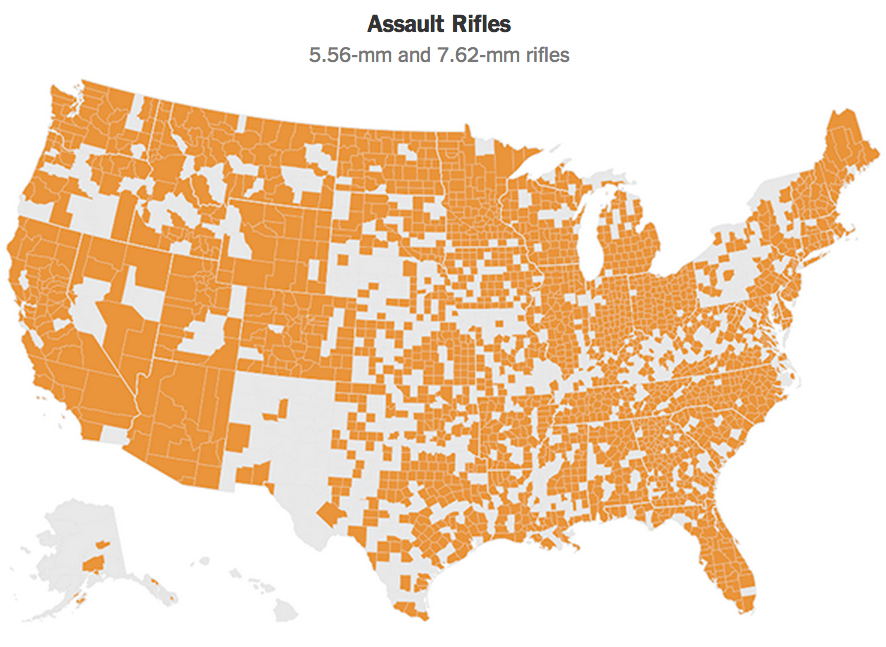
The NYT has a great visualization on the surplus military gear being funneled to police departments. Here is one map, of several:

Assault Rifles


Shirley Li provides background on the 1033 program, the “Department of Defense initiative that channels surplus military equipment to state and local police departments.”:

The 1033 program reached as far as it did because of its attractive promise of sophisticated military-grade equipment and easy access, Cato Institute Project on Criminal Justice Director Tim Lynch told The Wire. “Police in these small police departments, they go to their chief and say, ‘Look, the Pentagon’s going to give away this equipment. If we don’t grab it now, the next county will. We need it just in case,'” Lynch said. “No police chief will say no, so they acquire it and put it in a warehouse so most people, even people in the city council, aren’t aware of it.” …

“I think the 1033 program should be shut down,” he told The Wire. “I think that will restore some common sense to these agencies around the country because when they have to spend their own money, it changes the dynamic. They have to decide whether they need a new police car or a new officer or an armored vehicle from the Pentagon.”

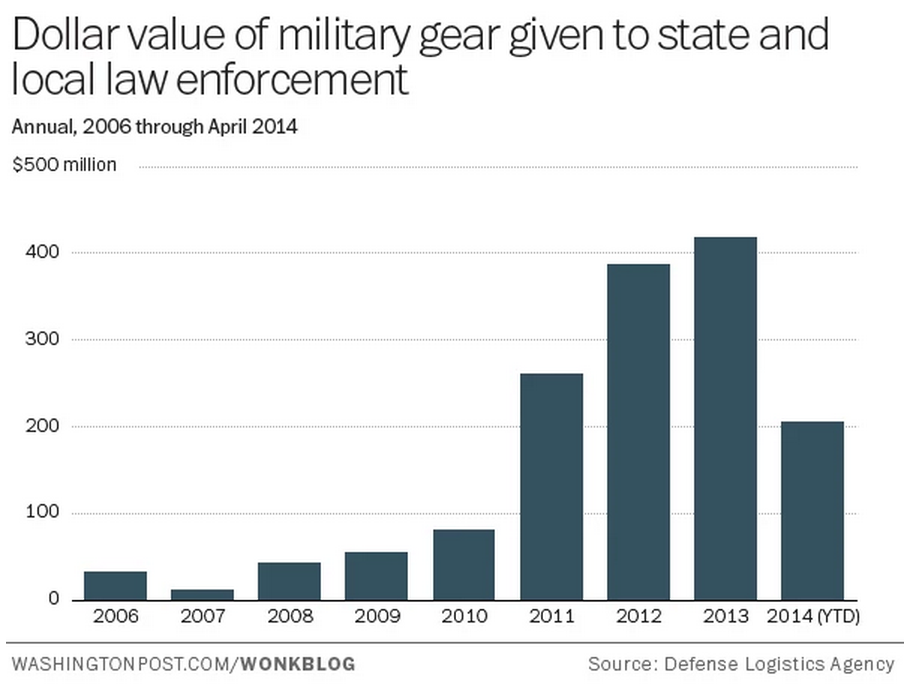
Ingraham looks at how the wars have put the program on steroids:

In 2006, the Pentagon transferred roughly $33 million worth of goods to local agencies. By 2013 that number had risen more than tenfold, to at least $420 million. Much of this can be explained by the winding down of wars in Iraq and Afghanistan. As those missions ended, more surplus goods became available for domestic use.

Military Gear

In 2012 the Pentagon transferred 27 mine-resistant vehicles and other armored combat vehicles to local law enforcement agencies. That number jumped more than sevenfold the following year. In 2014 so far, heavy armored combat vehicles account for nearly half of the total dollar value of gear transferred to local agencies.

Annie Lowrey explains why the police were militarized:

It all starts back in 1990, a time when the country found itself with less demand for military equipment abroad and new use for it back home. Within our shores, the drug wars were escalating; gang violence was surging; and sociologists were warning of sociopathic child “superpredators.” At the same time, the military was starting to shrink as the Cold War ended. Put two and two together and you get the 1033 program, which transferred assets from the military to the police. (Here’s a capsule history.) … But here’s the thing. Since 1990, according to Department of Justice statistics, the United States has become a vastly safer place, at least in terms of violent crime.

Drum adds:

We’ve spent the past two decades militarizing our police forces to respond to problems that never materialized, and now we’re stuck with them. We don’t need commando teams and SWAT units in every town in America to deal with either terrorism or an epidemic of crime, so they get used for other things instead. And that’s how we end up with debacles like Ferguson.

Police militarization was a mistake. You can argue that perhaps we didn’t know that at the time. No one knew in 1990 that crime was about to begin a dramatic long-term decline, and no one knew in 2001 that domestic terrorism would never become a serious threat. But we know now. There’s no longer even a thin excuse for arming our police forces this way.

Ezra joins the conversation:

Police get all this equipment and, as a condition of the program, need to use it within a year. What they don’t get is training. The ACLU’s Kara Dansky, who authored an important report on police militarization, told Vox she was “not aware of any training that the government provides in terms of use of the equipment,” or of “any oversight in terms of safeguards regarding the use of the equipment by the Defense Department.”

So police have all this military equipment, very little training on how to use it, and a requirement that they deploy it within a year. But the problems they were supposed to use the equipment against have either eased or vanished.

Ken Snyder, a reader over at Rod Dreher’s place, spotlights the role that the public has played:

[T]he important point is that I think this is what we citizens wanted. We want the police to be ready and able to deal with terrorists and active shooters. So these are the police that we want, but only in very specific situations. So citizens are shocked to see that equipment and, if not tactics, that same mindset applied in situations like Ferguson, and the many examples that are shared across web sites and local media. But once the police have this equipment, training, and mindset, as a practical matter, the citizens of a particular community don’t get to decide when they utilize it. We leave that up to the ‘experts’ who have ‘all of the information’. I think in some ways this is just another facet of the ongoing discussion in our country about NSA spying, etc: we want security, but at what price?


Israel Is Singled Out By Israel’s Defenders

by Freddie deBoer

One of the strangest and most fundamentally disingenuous lines of criticism used to attack critics of Israel’s brutal occupation of Palestine is that we are “singling Israel out,” that we pay special attention to Israel in a world of bad actors, and that this is indicative of obsession and, of course, anti-Semitism. The accusation is illegitimate on its face; America’s relationship to Israel, in terms of monetary aid, military aid, cooperation between intelligence services, and diplomatic protection at the UN and elsewhere, is unlike any other in the world. Read The Intercept’s exhaustive reporting on the incredible degree to which the United States supports Israel’s government and military. There is no relationship in American diplomacy –none– that is comparable to that between the United States and Israel. It is a wholly unique connection, unique in the depth of our support and in how unconditional that support is. The incredibly powerful Israeli lobby in American politics, which has earned very close to unanimous support for the Israeli government in Congress, has singled out Israel through those efforts. That’s just reality.

Our moral responsibility to Israel is different from that of antagonist nations because we have a hand in Israel’s actions. George Scialabba summarized this case recently:

The anti-imperialist/anti-totalitarian distinction is misleading because, broadly speaking, one side (Cockburn’s) is protesting crimes that their readers can readily, as citizens, do something about, and in fact are ultimately responsible for, while the other side (Berman’s) is not. Abuses by Castro and Chavez, and crimes by Saddam and Iran’s ayatollahs, are undoubtedly real. But the U.S. government did/does not support those regimes and was/is not responsible for their crimes.

I would argue that this is both basic political theory and basic morality. We bear moral responsibility for those things that we can control. I am a citizen of the United States, and the United States makes Israeli apartheid possible. I am therefore responsible for it in a way that I am not responsible for the theocratic thugs in Tehran or Saudi Arabia. It’s just a fundamental failure to understand the meaning of responsibility to suggest that we are too focused on Israel in comparison to other bad actors. And it’s the self-same lobby that accuses us of singling Israel out that has done everything to make this relationship unique.

So too with our media. It’s bizarre to read pieces like, for example, this insufferable piece of ethnic discourse policing by Shmuel Rosner, arguing that American Jews have a responsibility to censor themselves when it comes to Israel, and maintain the view that it is Israel’s critics who are singling Israel out. Rosner asks American Jews to treat Israel differently than any other issue in the broad sweep of our democratic conversation. He is charging them with prioritizing the ethnic and religious priorities he has invented for them over their democratic responsibilities. Shmuel Rosner has singled Israel out. Is Rosner guilty of anti-Semitism? Or consider this piece by Tim Murphy of New York Magazine. Murphy’s piece asserts that, in New York politics, Israel is the third rail, and he quotes many New Yorkers who feel that way. Is he making it up? Are they? Is he anti-Semitic to acknowledge this dynamic? If this is an accurate depiction of a fundamental difference in how Israel is discussed, how are critics of Israel the ones doing the singling out?

I know many fearless and combative political people who simply never speak or write about Israel. They have weighed the risks, they tell me, and find them too dangerous to make speaking out worth it. That is a kind of singling out, and one which comes not from critics but from the toxic rhetorical environment that Israel’s most aggressive defenders have created, through the constant conflation of criticism of Israel with anti-Semitism. I have often asked professors and mentors about how to engage politically while building an academic career. I have been counseled in many different ways on this question. But what is striking is the number of professors and mentors, Jewish and not alike, who have said to me “just not Israel.” Engage, debate, invite controversy– but not about Israel. Yes, I suppose they are singling Israel out. But they are not doing so to cast aspersions on the country. Rather they are trying to counsel me in a way that they think is a matter of simple professional self-defense.

Maybe all of these people who say that criticizing Israel represents a particularly dangerous form of controversy are anti-Semitic, I don’t know. I think, instead, that Israel is “singled out” because Israel’s many powerful defenders have made the topic of Israel singular, singular in the broad sweep of American politics– singularly ugly, singularly toxic, singularly dysfunctional, singular risky.  And I also believe that Israel is singled out because of the singular hopelessness of its brutal, racist occupation, and the vast architecture of political and rhetorical defense that has been erected to justify it. It’s the bleak reality of the ritualistic punishment and oppression of a living people, in the name of defending “the region’s only democracy.” That’s singular.